Determine the necessary mass, volume, or concentration for preparing a solution.
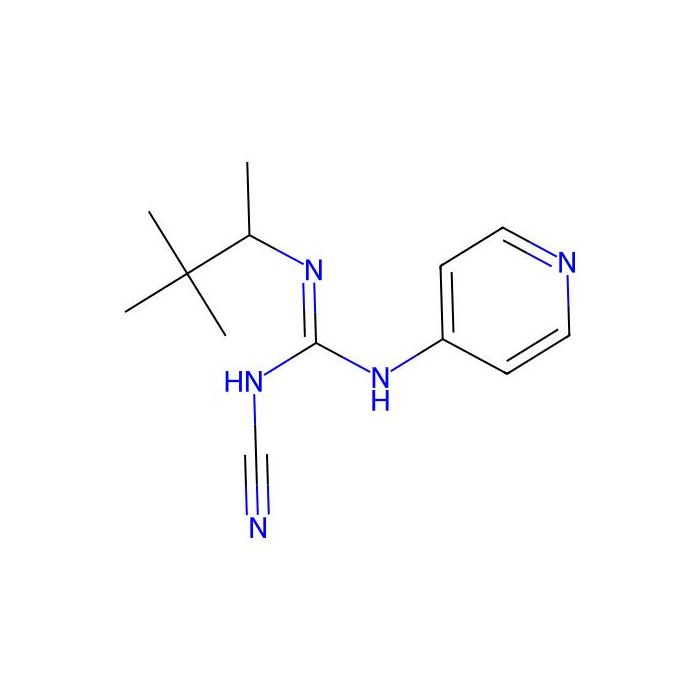
Pinacidil is a potent activator of potassium channel . Pinacidil is an antihypertensive agent which hyperpolarises vascular smooth muscle by opening K + -channels. Pinacidil significantly improves the reperfusion function and cardiac compliance. Pinacidil has direct cardioprotective efficacy.
H315:Causes skin irritation
H319:Causes serious eye irritation
H335:May cause respiratory irritation
H302:Harmful if swallowed
P261:Avoid breathing dust/fume/gas/mist/vapors/spray.
P305+P351+P338:IF IN EYES: Rinse cautiously with water for several minutes. Remove contact lenses if present and easy to do - continue rinsing.
P280:Wear protective gloves/protective clothing/eye protection/face protection.
P302+P352:IF ON SKIN: wash with plenty of water.
P321:Specific treatment (see ... on this label).
P405:Store locked up.
P501:Dispose of contents/container to an approved waste disposal plant.
P264:Wash hands [and …] thoroughly after handling.
P271:Use only outdoors or in a well-ventilated area.
P270:Do not eat, drink or smoke when using this product.
P304+P340:IF INHALED: Remove person to fresh air and keep comfortable for breathing.
P403+P233:Store in a well-ventilated place. Keep container tightly closed.
P362+P364:Take off contaminated clothing and wash it before reuse.
P330:Rinse mouth.
P264+P265:Wash hands [and …] thoroughly after handling. Do not touch eyes.
P301+P317:IF SWALLOWED: Get medical help.
P337+P317:If eye irritation persists: Get medical help.
P332+P317:If skin irritation occurs: Get medical help.
P319:Get medical help if you feel unwell.
The following are general, literature-based protocols for using small-molecule ion-channel modulators like Pinacidil in common assay formats. Optimize for your system.
DMSO stock preparation:
Plate-based membrane potential assay (fluorescent dye):
Electrophysiology (whole-cell patch clamp):
86Rb+ efflux assay:
Note: No tested application data are provided for this specific item; parameters above are starting points only.
Research role (general, literature): Pinacidil is widely used as a tool compound to activate ATP-sensitive potassium (KATP) channels in vitro. KATP channels are hetero-octamers formed by Kir6.x pore subunits (Kir6.1/KCNJ8 or Kir6.2/KCNJ11) and sulfonylurea receptor subunits (SUR1/ABCC8, SUR2A/ABCC9, SUR2B/ABCC9 splice variants).
Notes and limitations:
Pinacidil is not a buffering agent and does not define a specific pH range. It is typically dosed into pre-made assay buffers as a bioactive ligand.
Practical notes:
Item-specific buffer guidance and pKa are not provided; consult CoA/Spec Sheet and validate empirically for your assay.
This product is a discrete bioactive small molecule rather than a process solvent or reagent consumed in bulk. As such, the concept of a "green alternative" is not typically applicable.
Practical green-chemistry considerations for handling bioactive ligands:
If your workflow focuses on membrane potential or ion-channel assays, consider running orthogonal readouts (e.g., impedance vs. fluorescence) to reduce repeat experiments and overall chemical use.
No direct greener substitute for Pinacidil is proposed, as substitution would change the biological probe identity and data comparability.
This product is supplied strictly for research use (per Product Data) and is not intended for formulation, therapeutic, or diagnostic use.
Relevant research-related pharmaceutical contexts (non-clinical):
No pharmacopeial monograph or excipient role is claimed. Any cGMP suitability, impurity limits, or residual solvent specifications are not provided with this listing; refer to the CoA/Spec Sheet if required for your internal QA review.
Item-specific specifications are not provided with this listing. Consult the CoA/Spec Sheet for authoritative values.
Practical notes (general):
What Moligand™ implies (general description):
Item-specific acceptance criteria:
Best practices for screening-grade small molecules:
Regulatory note:
As a finished small-molecule ligand, Pinacidil is not typically used as a synthetic reagent. Its primary research applications are as a reference modulator in ion-channel and membrane-potential studies.
Assay and research applications (general, literature):
Practical tips:
Note: No item-specific activity specifications are provided. Potency and efficacy depend on expression system, subunit composition, temperature, and recording conditions.
Not a synthetic reagent; therefore classical reaction condition guidance (catalysts/stoichiometry/yields) does not apply to this product.
Assay preparation conditions (general, literature):
Item-specific stability data, solubility limits, and potency values are not provided here; verify empirically and refer to the CoA/Spec Sheet.
Safety information specific to this item is not provided here. Always consult the Safety Data Sheet (SDS) for authoritative guidance.
General laboratory precautions for small, bioactive heteroaromatic guanidines:
Storage and shipping (item-specific):
Pinacidil is a neutral-to-basic, heteroaromatic cyanoguanidine. Selection of solvent depends on the intended operation (stock solution for screening vs. preparative handling).
Selection guidance:
Note: Item-specific solubility values are not provided; confirm experimentally for your lot.
Item-specific storage and shipping:
Reconstitution (general guidance for screening compounds):
Handling and stability:
Research use note: For research use only (per Product Data). Not for human or veterinary use.
Pinacidil is a small-molecule research ligand widely used as a reference opener of ATP-sensitive potassium (KATP) channels.
Structural features (general, literature):
Pinacidil itself is a terminal, bioactive small molecule and is not commonly used as a building block in synthesis. Nevertheless, understanding its functional groups can aid in analog design and in assessing stability during handling.
Functional-group considerations (general):
Analogue-oriented retrosynthetic notes (literature/general):
Because this listing is not a reagent, use it as a reference ligand rather than a synthon. If derivatization is desired, start from known intermediates used in cyanoguanidine synthesis rather than from the final compound.
No item-specific biological specifications are provided with this listing.
Literature-based target profile (for research context only):
Caveats:
For definitive, lot-specific bioactivity data, users should generate their own in-house reference curves under the intended assay conditions.
La nostra guida alla selezione delle qualità copre purezza, stato dello stabilizzatore e idoneità all'applicazione per tutte le varianti del nostro catalogo.
Visualizza la guida alle qualità Moligand™ →