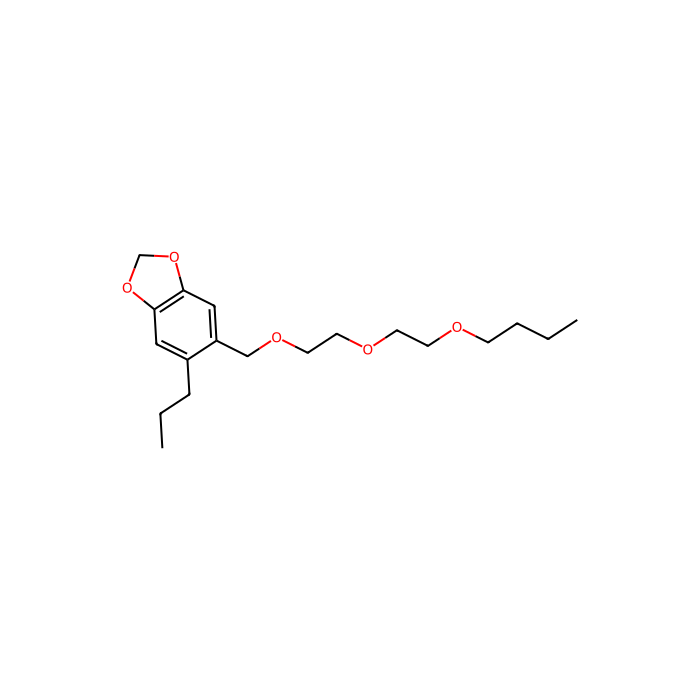
This compound belongs to the class of organic compounds known as benzodioxoles. These are organic compounds containing a benzene ring fused to either isomers of dioxole. Dioxole is a five-membered unsaturated ring of two oxygen atoms and three carbon atoms.
External Descriptors
Synergist
1. Djoumbou Feunang Y, Eisner R, Knox C, Chepelev L, Hastings J, Owen G, Fahy E, Steinbeck C, Subramanian S, Bolton E, Greiner R, and Wishart DS. ClassyFire: Automated Chemical Classification With A Comprehensive, Computable Taxonomy. Journal of Cheminformatics, 2016, 8:61.
Determine the necessary mass, volume, or concentration for preparing a solution.
Dilution Calculator
Determine the dilution needed to prepare a stock solution.
Reconstitution Calculator
Recensioni
Recensioni dei clienti
Application Protocols
No standardized immunoassay or cell-based application protocols are specified for this item.
General guidance for research use:
Prepare a concentrated stock solution in a suitable organic solvent (e.g., ethanol, isopropanol, acetone, or DMSO). Typical lab stocks are in the 10–100 mg/mL range, adjusted to your assay’s solvent tolerance.
For biological assays, keep final organic solvent content low (commonly ≤0.5–1% v/v) and include solvent controls.
For formulation studies, design emulsifiable concentrates using nonionic surfactants if aqueous dispersion is required; characterize droplet size and stability.
Item-specific, validated protocols and recommended dilutions: Not specified for this item; refer to CoA/Spec Sheet and adapt from relevant peer-reviewed methods.
Biological Roles
Mechanistic role (literature/general): Piperonylbutoxide is widely used in entomological and toxicological research as a mechanism-based inhibitor of cytochrome P450 monooxygenases. By attenuating oxidative metabolism in insects, it reveals the contribution of P450-mediated detoxification to resistance phenotypes and alters the disposition of co-administered xenobiotics.
Research contexts:
Resistance diagnostics: Co-application with an insecticidal active in bioassays to test for metabolic resistance; improved efficacy in the presence of PBO suggests a P450-driven resistance component.
Metabolism studies: Tool compound to suppress microsomal oxidation in homogenates, S9 fractions, or in vivo insect models; helps parse phase I vs. phase II metabolic steps.
Environmental fate: Used as a model hydrophobic ether for studies of photolysis, oxidative degradation, and sorption in soils and sediments.
Biochemical interactions (general):
Inhibits certain CYP isoforms (organism-dependent); acts through reversible binding and, in some cases, mechanism-based (quasi-irreversible) inactivation.
Limited aqueous solubility necessitates the use of co-solvents or emulsifiers for biological experiments; solvent controls are essential to avoid confounding effects.
Cautions:
Off-target effects are possible at higher concentrations, including general membrane perturbation due to surfactant-like character; titrate minimally effective concentrations.
Do not extrapolate research findings to clinical contexts; this product is for laboratory research use only.
Buffer Applications
Piperonylbutoxide is not a buffering agent and is essentially insoluble in water; it is not used to prepare pH buffer systems.
Practical note: For aqueous biological assays requiring PBO, prepare an organic stock (e.g., in ethanol, isopropanol, DMSO) and dilute into the buffered medium with vigorous mixing or with the aid of surfactants; include solvent-only controls.
Buffer selection should be based on the biological system (e.g., phosphate, HEPES, Tris). PBO does not contribute to buffering capacity.
Green Alternatives
Piperonylbutoxide is an auxiliary component rather than a reaction solvent; “green alternatives” relate to selecting more sustainable co-solvents/adjuvants or reducing loading levels while achieving the same experimental end points.
Strategies (general):
Optimize formulation with bio-based solvents (e.g., ethyl lactate, 2-methyltetrahydrofuran) or vegetable-oil-derived carriers to decrease petroleum content while maintaining solubility of the active ingredient; retain PBO at the minimum effective concentration for mechanistic studies.
Consider alternative synergists from renewable feedstocks if mechanistically appropriate; assess environmental fate and aquatic toxicity in your system.
Comparison highlights (general; illustrative):
Piperonylbutoxide vs. terpene-based adjuvants:
PBO: strong P450-inhibitory synergist; high lipophilicity; persistent in nonpolar matrices; aquatic toxicity considerations.
Terpene adjuvants (e.g., d-limonene): renewable, biodegradable, strong solvency; limited P450 inhibition, may increase volatility and odor.
Solvent carriers:
Aromatic hydrocarbons (toluene/xylene): good solvency, established methods; higher VOC concerns.
Ethyl lactate/propylene carbonate: better EHS profile; verify chemical compatibility and stability of actives and PBO.
Practical guidance:
Conduct small-scale DoE to balance efficacy, environmental footprint, and analytical performance. Capture mass balance data (e.g., VOC emissions, biodegradability metrics) to quantify improvements.
Pharmaceutical Uses
This product is supplied for research use only. Piperonylbutoxide is not typically employed as a pharmaceutical excipient in human drug products.
Formulation R&D context (general):
In laboratory settings, PBO may be explored as a lipophilic co-solvent/adjuvant in non-aqueous formulations for mechanistic toxicology or delivery studies involving xenobiotics. Such investigations are non-clinical and exploratory.
Regulatory note:
No pharmacopeial monograph information is provided for this item. Any compatibility or impurity-profile assessments must be established de novo for the intended research use.
Item-specific status: Not specified for this item; refer to CoA/Spec Sheet for any available quality or impurity information relevant to formulation research.
Physical Properties
Item-specific specifications: Not specified for this item; refer to CoA/Spec Sheet.
Typical literature values (for reference only; not item specifications):
Physical state: Colorless to pale yellow oily liquid (literature/general).
Boiling behavior: High-boiling; distills under reduced pressure (literature/general). Reported atmospheric bp is very high; practical handling typically avoids atmospheric distillation.
Melting point: Liquid at ambient temperature; pour point below room temperature (literature/general).
Density: Approximately near 1 g/mL at 20–25 °C (literature/general; varies with lot and temperature).
Solubility: Practically insoluble in water; miscible with many organic solvents (e.g., aromatics, chlorinated solvents, alcohols, esters) (literature/general).
LogP (octanol/water): High (strongly lipophilic) (literature/general).
Refractive index: High relative to typical hydrocarbons due to aromatic/ether content (literature/general).
Practical handling notes (general):
Viscosity: Moderately viscous at room temperature; gentle warming (30–40 °C) can aid pipetting or weighing.
Volatility: Low; minimal evaporative loss under ambient conditions compared to common solvents.
Always verify critical parameters for your application from the item’s CoA/Spec Sheet or SDS.
Quality and Grades
Item-specific grade/purity: Not specified for this item; refer to CoA/Spec Sheet.
How to interpret common grades (general guidance):
Analytical/AR grade indicates tight control of organic impurities and moisture; suitable for quantitative analytical work and method development.
Technical/formulation grade materials may prioritize performance characteristics (e.g., viscosity, solvency, low odor) over ultra-low trace impurities; often used for screening or formulation R&D.
Pesticide/formulation research grade may emphasize compatibility with active ingredients (e.g., pyrethrins/pyrethroids) and low UV-absorbing impurities for stability testing.
Stabilizers and inhibitors:
Piperonylbutoxide is typically supplied without added stabilizers. If a stabilizer or antioxidant is used in a particular lot, consult the CoA to understand impacts on spectral background, GC purity, or downstream assays.
Verification recommendations:
For quantitative or regulatory-relevant studies, confirm identity/purity by GC-FID/GC–MS and 1H/13C NMR. Check water content (by KF) if moisture-sensitive matrices are involved.
If low-UV background is critical (e.g., stability-indicating HPLC), review UV cutoff or baseline behavior of the supplied lot (item-specific: Not specified for this item; refer to CoA/Spec Sheet.).
Reaction and Applications
Primary research application (general):
Piperonylbutoxide is a well-known synergist for pyrethrins and pyrethroid insecticides. In research, it is used to potentiate insecticidal activity by inhibiting oxidative detoxification enzymes (notably cytochrome P450 monooxygenases) in insects, thus increasing the apparent potency and persistence of the active ingredient.
Formulation and assay uses:
As a co-formulant/adjuvant in laboratory formulations to evaluate the contribution of metabolic inhibition to efficacy.
In biochemical and toxicological studies, PBO is included to probe P450-mediated metabolism of xenobiotics (e.g., to differentiate metabolic vs. target-site resistance in insect models).
Analytical method development:
Serves as an internal or external standard for method validation in multi-residue or formulation analyses (GC or LC), given its distinctive chromatographic behavior and UV response.
Synthetic chemistry context (less common):
The benzylic ether and benzodioxole moieties are reactive under strong acidic or oxidative conditions; researchers sometimes use PBO as a model substrate in studies of benzylic oxidation, ether cleavage, or environmental degradation pathways.
Practical tips:
Prepare concentrated stocks in a fully miscible organic solvent (e.g., ethanol, acetone, DMSO) and dilute into test systems immediately before use to minimize precipitation.
When evaluating synergism, include appropriate solvent controls and assess potential independent effects of PBO on organisms or enzyme preparations.
Research use only; not for use in humans or clinical applications.
Reaction Conditions
Piperonylbutoxide is not commonly used as a reagent in synthetic transformations. When it is subjected to chemical reactions for degradation or derivatization studies, the following general observations apply (literature/general guidance):
Acidic cleavage of benzylic ether:
Conditions: Strong Brønsted acids (e.g., H2SO4) or Lewis acids at elevated temperature can cleave the benzylic C–O bond.
Solvents: Non-nucleophilic (e.g., toluene, chlorinated solvents) to minimize side reactions.
Oxidation of benzylic position:
Reagents: KMnO4, Cr(VI) reagents, or catalytic oxidations (e.g., DDQ, photoredox) can convert the benzylic methylene to aldehyde/acid.
Considerations: The benzodioxole can be sensitive to over-oxidation; control stoichiometry and temperature.
Photolysis or UV/H2O2 can degrade PBO in laboratory studies; product distribution depends on matrix and light wavelength.
Formulation stability testing:
Thermal aging (40–54 °C), photostability (UV/visible), and oxidative stress (air bubbling) are standard stress conditions to map degradation pathways for analytical method development.
These are general literature-based guidelines and not recommended synthetic procedures. Adapt conditions to your research objective and verify by small-scale testing.
Safety and Handling
Item-specific hazard classification: Not specified for this item; refer to SDS for authoritative GHS, pictograms, and H/P statements.
General safety profile (literature/general):
Piperonylbutoxide is a high-boiling, lipophilic organic liquid. It may cause eye/skin irritation on contact and is harmful if ingested in quantity. Avoid inhalation of aerosols/mists.
Environmental note: Often classified as hazardous to aquatic life; prevent release to the environment. Follow institutional waste and spill procedures.
PPE and engineering controls (good laboratory practice):
Wear lab coat, safety glasses/goggles, and appropriate chemically resistant gloves (e.g., nitrile). Use in a fume hood when handling open quantities, heating, or preparing formulations/aerosols.
Avoid skin contact; wash thoroughly after handling.
Incompatibilities and stability (general):
Generally stable under normal laboratory conditions. Avoid strong oxidizing agents and strong acids for prolonged periods. The benzylic ether and dioxole ring can be cleaved under vigorous acidic conditions.
Not prone to peroxide formation (not an aliphatic ether solvent); nonetheless, store away from peroxidizing agents and heat sources.
First-aid overview (general guidance; defer to SDS):
Skin/eye contact: Rinse with plenty of water for ≥15 minutes; remove contaminated clothing. Seek medical attention if irritation persists.
Inhalation: Move to fresh air; seek medical attention if symptoms occur.
Ingestion: Rinse mouth; do not induce vomiting unless directed by medical personnel; seek medical advice.
Consult the product-specific SDS for complete and binding safety information.
Solvent Selection
This product is a high-boiling organic liquid used primarily as a synergist/adjuvant rather than as a chromatography or reaction solvent.
Applicability:
Not typically selected as a reaction or extraction solvent. Instead, choose a suitable solvent to dissolve piperonylbutoxide for formulations or assays.
Water: Practically insoluble; requires surfactants/emulsifiers for aqueous dispersions.
Organic solvents: Readily soluble in hydrocarbons (toluene, hexanes), oxygenates (alcohols, ethers, esters), and chlorinated solvents (DCM, chloroform). Selection depends on the active ingredient and application (e.g., formulation concentrate vs. bioassay stock).
Practical choices:
For analytical standards and bioassay stocks: ethanol, isopropanol, acetone, DMSO, or acetonitrile are commonly used; confirm compatibility with the biological system and active ingredient.
For formulation research: aromatic hydrocarbons (e.g., xylene) or ester solvents may be used; for water-based prototypes, prepare emulsifiable concentrates using nonionic surfactants.
Comparison (general):
Versus low-boiling solvents (e.g., DCM): PBO has negligible volatility and serves as a persistent co-solvent/adjuvant in matrices.
Versus triglyceride oils: PBO provides higher solvency for many actives while maintaining lipophilicity; however, it offers less biodegradability than some bio-based oils.
Storage and Reconstitution
Storage conditions (from Product Data): Room temperature. Protect from direct sunlight. Keep container tightly closed to minimize oxidative/photo degradation.
Shipping (from Product Data): Normal ambient shipping.
Stability notes (general):
Stable under normal laboratory conditions. Avoid prolonged exposure to strong acids, oxidizers, or high-intensity UV light.
If crystallization or increased viscosity is observed at low ambient temperatures, warm gently (e.g., 30–40 °C water bath) and mix to homogeneity before use.
For analytical or bioassay use, prepare stocks in ethanol, isopropanol, acetone, acetonitrile, or DMSO. Verify clarity after dilution into aqueous media; add surfactant if needed.
Store prepared stocks in amber vials at room temperature or 2–8 °C depending on solvent and experimental timeline. Minimize headspace and repeated freeze–thaw.
Item-specific stabilizers, purity, water/peroxide/metal limits: Not specified for this item; refer to CoA/Spec Sheet.
For long-term projects, document lot number and storage history to ensure reproducibility.
Structure and Identity
Piperonylbutoxide (PBO) is a lipophilic benzodioxole-derived aromatic ether widely used as a synergist in agrochemical research formulations.
Item-specific identifiers (from Product Data):
CAS: 51-03-6
SKU: P113864
InChIKey: Not specified for this item; refer to CoA/Spec Sheet.
SMILES: Not specified for this item; refer to CoA/Spec Sheet.
Composition (literature/general):
Molecular formula (literature): C19H30O5
Molecular weight (literature): ~338.44 g/mol
Structural features (general description):
Core ring system: A 1,3-benzodioxole (“piperonyl”) ring fused to a benzene with a methylenedioxy bridge (–O–CH2–O–) across adjacent ring oxygens.
Benzylic ether linkage: The aromatic ring bears a benzylic –CH2–O– tether to a flexible poly(ethylene glycol)-like chain terminating in a butoxy group (“butoxide” segment). Overall, this gives a tri-ether architecture: aryl–CH2–O–CH2–CH2–O–CH2–CH2–O–(CH2)3–CH3.
Functional groups: Acetal-like benzodioxole, multiple ether linkages, benzylic methylene, and a terminal aliphatic butyl group.
Stereochemistry: Achiral as typically supplied (no stereocenters in the parent structure).
2D structure in words (general): An electron-rich benzodioxole ring substituted at the benzylic position by a tri-ether chain that ends in a n-butyl ether, imparting high hydrophobicity with limited polarity localized on ether oxygens.
Synthetic Utility
Piperonylbutoxide is not typically used as a synthetic reagent or building block; its principal role is as a synergist/adjuvant. Nevertheless, understanding its functional group chemistry is useful for degradation, stability, or transformation studies.
Functional group reactivity (general):
Benzylic ether (Ar–CH2–O–): Susceptible to acid-catalyzed cleavage; benzylic oxidation (e.g., with strong oxidants) can yield corresponding benzaldehyde/benzoic-acid derivatives.
Benzodioxole ring: Can undergo oxidative ring opening under vigorous conditions (e.g., peracids, photolysis with sensitizers).
Polyether chain: Stable to mild base and nucleophiles; can be cleaved under strong acidic conditions or high-temperature transetherification.
Uses in method development:
Model substrate for investigating oxidative stability of benzylic ethers and for validating GC/LC methods (due to its moderate volatility and strong UV chromophore from the aromatic ring).
Retrosynthetic note:
Conceptually arises from coupling a piperonyl (benzodioxolylmethyl) electrophile with a butoxyethoxyethoxy alcohol via etherification. This informs potential impurity profiles (unreacted alcohols, over-alkylated byproducts) to target in QC.
Target Specificity
No target specificity data (e.g., antigen/epitope, clone, isotype, species reactivity) apply to this chemical product.
This item is a small-molecule adjuvant/synergist, not an antibody or biological probe with defined binding specificity.
Item-specific bioactivity metrics are not provided; consult the primary literature for organism- or enzyme-specific inhibition profiles relevant to your study.
Utilizziamo i cookie per garantire il corretto funzionamento del sito web e, ove consentito, per migliorare la tua esperienza. Puoi gestire le tue preferenze in qualsiasi momento nelle Impostazioni. Per saperne di più, consulta la nostra Cookie Policy.
Desidera che le inviamo un messaggio quando avremo sconti disponibili?
Ricordamelo più tardi
Grazie! Controlli la sua casella di posta per confermare.
Products are supplied to verified businesses, institutions, and qualified professionals for research and development use only. Not for use in humans, animals, diagnosis, or therapy.

 J2626127