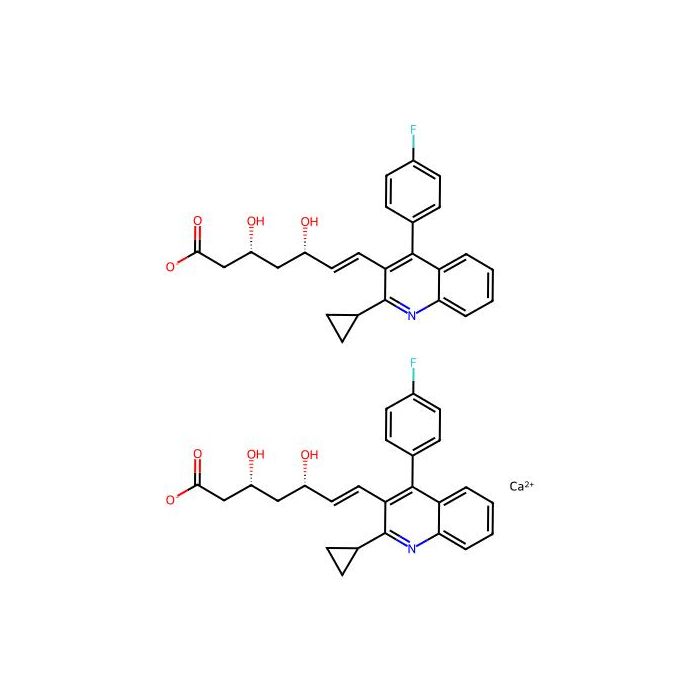
Pitavastatin - Moligand™,≥98% , Inhibitor of hydroxymethylglutaryl-CoA reductase, CAS No.147511-69-1, Inhibitor of hydroxymethylglutaryl-CoA reductase

CAS: 147511-69-1 Cat. No.: P302925 Formula: C25H24FNO4 Peso molecolare: 421.46 Numero EC: 643-092-3 PubChem CID: 5282452
Disponibile su ordine
QUALITÀ & PUREZZA Moligand™ ? Moligand™ — Aladdin's line of ligands and bioactive small molecules. Use for receptor, pathway, and binding studies needing defined small-molecule tools. ≥98%
Synonyms
(3R,5S,6E)-7-(2-Cyclopropyl-4-(p-fluorophenyl)-3-quinolyl)-3,5-dihydroxy-6-heptenoic acid|NK 104|P 872441|pitavastatia|(3R,5S,6E)-7-[2-cyclopropyl-4-(4-fluorophenyl)quinolin-3-yl]-3,5-dihydroxy hept-6-enoic acid|(3R,5S,6E)-7-(2-Cyclopropyl-4-(4-fluorophenyl)quinolin-3-yl)-3,5-dihydroxyhept-6-enoic acid|Itavastatin|(+)-(3R,5S,6E)-7-(2-Cyclopropyl-4-(4-fluorophenyl)-3-quinolyl)-3,5-dihydroxy-6-heptenoic acid|(3R,5S,6E)-7-[2-cyclopropyl-4-(4-fluorophenyl)quinolin-3-yl]-3,5-dihydroxyhept-6-enoic acid|(E,3R,5S)-7-[2-cyclopropyl-4-(4-fluorophenyl)quinolin-3-yl]-3,5-dihydroxyhept-6-enoic acid|Pitavastatin|P-872441|PITAVASTATIN [MART.]|PITAVASTATIN (MART.)|(e)-(3r,5s)-7-[2-cyclopropyl-4-(4-fluoro-phenyl)-quinolin-3-yl]-3,5-dihydroxy-hept-6enoic acid|(E)-(3R,5S)-7-[2-Cyclopropyl-4-(4-fluoro-phenyl)-quinolin-3-yl]-3,5-dihydroxy-hept-6-enoic acid|Pitavastatin [INN]|Pitavastatina|E-(3R,5S)-7-[2-Cyclopropyl-4-(4fluoro-phenyl)quinolin-3-yl]-3,5-dihydroxy-hept-6-enoic acid|Livalo|PITAVASTATIN [VANDF]|PITAVASTATIN [MI]|(3r,5s,6e)-7-[2-cyclopropyl-4-(p-fluorophenyl)-3-quinolyl]-3,5-dihydroxy-6-heptenoic acid|(3R,5S,E)-7-(2-cyclopropyl-4-(4-fluorophenyl)quinolin-3-yl)-3,5-dihydroxyhept-6-enoic acid|(E,3R,5S)-7-(2-cyclopropyl-4-(4-fluorophenyl)quinolin-3-yl)-3,5-dihydroxyhept-6-enoic acid|pitavastatinum|NK-104|6-Heptenoic acid, 7-(2-cyclopropyl-4-(4-fluorophenyl)-3-quinolinyl)-3,5-dihydroxy-, (3R,5S,6E)-|6-Heptenoic acid, 7-(2-cyclopropyl-4-(4-fluorophenyl)-3-quinolinyl)-3,5-dihydroxy-, (S-(R*,S*-(E)))-|PITAVASTATIN [WHO-DD]|6-Heptenoic acid, 7-[2-cyclopropyl-4-(4-fluorophenyl)-3-quinolinyl]-3,5-dihydroxy-, (3R,5S,6E)-|NK104
Storage
Store at -20°C
Shipped In
Ice chest + Ice pads
★
Dimensione
Germania (EU)
USA*
Prezzo
Qtà
5mg
P302925-5mg
Su ordinazione · 8–12 settimane
28,55€
Enter a quantity for the sizes you want to add.

Panoramica

Pitavastatin (NK-104) is a potent hydroxymethylglutaryl-CoA (HMG-CoA) reductase inhibitor. Pitavastatin inhibits cholesterol synthesis from acetic acid with an IC50 of 5.8 nM in HepG2 cells. Pitavastatin is an efficient hepatocyte low-density lipoprotein-cholesterol (LDL-C) receptor inducer.

Specifiche

Sinonimi
(3R,5S,6E)-7-(2-Cyclopropyl-4-(p-fluorophenyl)-3-quinolyl)-3,5-dihydroxy-6-heptenoic acid | NK 104 | P 872441 | pitavastatia | (3R,5S,6E)-7-[2-cyclopropyl-4-(4-fluorophenyl)quinolin-3-yl]-3,5-dihydroxy hept-6-enoic acid | (3R,5S,6E)-7-(2-Cyclopropyl-4-(4-fluorophenyl)quinolin-3-yl)-3,5-dihydroxyhept-6-enoic acid | Itavastatin | (+)-(3R,5S Mostra altro
Specifiche e purezza
Moligand™,≥98%
Condizioni di conservazione di stoccaggio
Store at -20°C
Spedito in
Ice chest + Ice pads
Questo prodotto richiede spedizione a catena fredda. I servizi di terra e altri servizi economici non sono disponibili.
Grado
Moligand™
Tipo di azione
INHIBITOR
Meccanismo d'azione
Inhibitor of hydroxymethylglutaryl-CoA reductase
Purezza
≥98%
Nomi e identificatori
SMILES
C1CC1C2=NC3=CC=CC=C3C(=C2C=CC(CC(CC(=O)O)O)O)C4=CC=C(C=C4)F
IUPAC Name
(E,3R,5S)-7-[2-cyclopropyl-4-(4-fluorophenyl)quinolin-3-yl]-3,5-dihydroxyhept-6-enoic acid
InChIKey
VGYFMXBACGZSIL-MCBHFWOFSA-N
InChI
1S/C25H24FNO4/c26-17-9-7-15(8-10-17)24-20-3-1-2-4-22(20)27-25(16-5-6-16)21(24)12-11-18(28)13-19(29)14-23(30)31/h1-4,7-12,16,18-19,28-29H,5-6,13-14H2,(H,30,31)/b12-11+/t18-,19-/m1/s1
Isomeri SMILES
C1CC1C2=NC3=CC=CC=C3C(=C2/C=C/[C@H](C[C@H](CC(=O)O)O)O)C4=CC=C(C=C4)F
PubChem CID
5282452
Peso molecolare
421.46

Dati avanzati

Taxonomic Classification

Taxonomy Tree

KingdomOrganic compounds
SuperclassOrganoheterocyclic compounds
ClasseQuinolines and derivatives
SubclassPhenylquinolines
Intermediate Tree Nodes Not available
Direct ParentPhenylquinolines
Alternative Parents Phenylpyridines  Medium-chain hydroxy acids and derivatives  Medium-chain fatty acids  Beta hydroxy acids and derivatives  Fluorobenzenes  Halogenated fatty acids  Heterocyclic fatty acids  Hydroxy fatty acids  Unsaturated fatty acids  Aryl fluorides  Heteroaromatic compounds  Secondary alcohols  Carboxylic acids  Azacyclic compounds  Monocarboxylic acids and derivatives  Hydrocarbon derivatives  Carbonyl compounds  Organic oxides  Organofluorides  Organonitrogen compounds  Organopnictogen compounds  
Molecular FrameworkAromatic heteropolycyclic compounds
Substituents Phenylquinoline - 4-phenylpyridine - Medium-chain hydroxy acid - Medium-chain fatty acid - Beta-hydroxy acid - Fluorobenzene - Halobenzene - Halogenated fatty acid - Heterocyclic fatty acid - Hydroxy fatty acid - Aryl fluoride - Aryl halide - Monocyclic benzene moiety - Hydroxy acid - Fatty acyl - Fatty acid - Pyridine - Unsaturated fatty acid - Benzenoid - Heteroaromatic compound - Secondary alcohol - Carboxylic acid - Monocarboxylic acid or derivatives - Azacycle - Carboxylic acid derivative - Organohalogen compound - Organic oxide - Organopnictogen compound - Organic oxygen compound - Organofluoride - Organonitrogen compound - Organooxygen compound - Alcohol - Organic nitrogen compound - Carbonyl group - Hydrocarbon derivative - Aromatic heteropolycyclic compound
DescrizioneThis compound belongs to the class of organic compounds known as phenylquinolines. These are heterocyclic compounds containing a quinoline moiety substituted with a phenyl group.
External Descriptors quinolines - statin (synthetic) - cyclopropanes - dihydroxy monocarboxylic acid - monofluorobenzenes
Struttura 3D
Modello di struttura chimica interattiva


Obiettivi associati (umani)
HMGCR Tclin 3-hydroxy-3-methylglutaryl-coenzyme A reductase (1 Activities)
Activity TypeActivity Value -log(M)Mechanism of ActionActivity ReferencePublications (PubMed IDs)
ESR1 Tclin Estrogen receptor alpha (17718 Activities)
Activity TypeRelationActivity valueUnitsAction TypeJournalPubMed IddoiAssay Aladdin ID
HMGCR Tclin HMG-CoA reductase (2475 Activities)
Activity TypeRelationActivity valueUnitsAction TypeJournalPubMed IddoiAssay Aladdin ID
NR3C1 Tclin Glucocorticoid receptor (14987 Activities)
Activity TypeRelationActivity valueUnitsAction TypeJournalPubMed IddoiAssay Aladdin ID
PGR Tclin Progesterone receptor (8562 Activities)
Activity TypeRelationActivity valueUnitsAction TypeJournalPubMed IddoiAssay Aladdin ID
ADRB2 Tclin Beta-2 adrenergic receptor (11824 Activities)
Activity TypeRelationActivity valueUnitsAction TypeJournalPubMed IddoiAssay Aladdin ID
CHRM2 Tclin Muscarinic acetylcholine receptor M2 (10671 Activities)
Activity TypeRelationActivity valueUnitsAction TypeJournalPubMed IddoiAssay Aladdin ID
ADRB1 Tclin Beta-1 adrenergic receptor (6630 Activities)
Activity TypeRelationActivity valueUnitsAction TypeJournalPubMed IddoiAssay Aladdin ID
HTR1A Tclin Serotonin 1a (5-HT1a) receptor (14969 Activities)
Activity TypeRelationActivity valueUnitsAction TypeJournalPubMed IddoiAssay Aladdin ID
ADRA2A Tclin Alpha-2a adrenergic receptor (9450 Activities)
Activity TypeRelationActivity valueUnitsAction TypeJournalPubMed IddoiAssay Aladdin ID
AR Tclin Androgen Receptor (11781 Activities)
Activity TypeRelationActivity valueUnitsAction TypeJournalPubMed IddoiAssay Aladdin ID
CHRM1 Tclin Muscarinic acetylcholine receptor M1 (12690 Activities)
Activity TypeRelationActivity valueUnitsAction TypeJournalPubMed IddoiAssay Aladdin ID
DRD2 Tclin Dopamine D2 receptor (23596 Activities)
Activity TypeRelationActivity valueUnitsAction TypeJournalPubMed IddoiAssay Aladdin ID
GABRA1 Tclin GABA receptor alpha-1 subunit (399 Activities)
Activity TypeRelationActivity valueUnitsAction TypeJournalPubMed IddoiAssay Aladdin ID
MAOA Tclin Monoamine oxidase A (11911 Activities)
Activity TypeRelationActivity valueUnitsAction TypeJournalPubMed IddoiAssay Aladdin ID
CNR1 Tclin Cannabinoid CB1 receptor (20913 Activities)
Activity TypeRelationActivity valueUnitsAction TypeJournalPubMed IddoiAssay Aladdin ID
DRD1 Tclin Dopamine D1 receptor (9720 Activities)
Activity TypeRelationActivity valueUnitsAction TypeJournalPubMed IddoiAssay Aladdin ID
PTGS1 Tclin Cyclooxygenase-1 (9233 Activities)
Activity TypeRelationActivity valueUnitsAction TypeJournalPubMed IddoiAssay Aladdin ID
SLC6A2 Tclin Norepinephrine transporter (10102 Activities)
Activity TypeRelationActivity valueUnitsAction TypeJournalPubMed IddoiAssay Aladdin ID
HRH2 Tclin Histamine H2 receptor (5428 Activities)
Activity TypeRelationActivity valueUnitsAction TypeJournalPubMed IddoiAssay Aladdin ID
HTR2A Tclin Serotonin 2a (5-HT2a) receptor (14758 Activities)
Activity TypeRelationActivity valueUnitsAction TypeJournalPubMed IddoiAssay Aladdin ID
HTR2C Tclin Serotonin 2c (5-HT2c) receptor (11471 Activities)
Activity TypeRelationActivity valueUnitsAction TypeJournalPubMed IddoiAssay Aladdin ID
AVPR2 Tclin Vasopressin V2 receptor (2912 Activities)
Activity TypeRelationActivity valueUnitsAction TypeJournalPubMed IddoiAssay Aladdin ID
ADORA1 Tclin Adenosine A1 receptor (17603 Activities)
Activity TypeRelationActivity valueUnitsAction TypeJournalPubMed IddoiAssay Aladdin ID
AGTR1 Tclin Type-1 angiotensin II receptor (5176 Activities)
Activity TypeRelationActivity valueUnitsAction TypeJournalPubMed IddoiAssay Aladdin ID
SLC6A4 Tclin Serotonin transporter (12625 Activities)
Activity TypeRelationActivity valueUnitsAction TypeJournalPubMed IddoiAssay Aladdin ID
ADRA1A Tclin Alpha-1a adrenergic receptor (8359 Activities)
Activity TypeRelationActivity valueUnitsAction TypeJournalPubMed IddoiAssay Aladdin ID
PTGS2 Tclin Cyclooxygenase-2 (13999 Activities)
Activity TypeRelationActivity valueUnitsAction TypeJournalPubMed IddoiAssay Aladdin ID
HRH1 Tclin Histamine H1 receptor (7573 Activities)
Activity TypeRelationActivity valueUnitsAction TypeJournalPubMed IddoiAssay Aladdin ID
OPRM1 Tclin Mu opioid receptor (19785 Activities)
Activity TypeRelationActivity valueUnitsAction TypeJournalPubMed IddoiAssay Aladdin ID
DRD3 Tclin Dopamine D3 receptor (14368 Activities)
Activity TypeRelationActivity valueUnitsAction TypeJournalPubMed IddoiAssay Aladdin ID
AVPR1A Tclin Vasopressin V1a receptor (5412 Activities)
Activity TypeRelationActivity valueUnitsAction TypeJournalPubMed IddoiAssay Aladdin ID
OPRD1 Tclin Delta opioid receptor (15096 Activities)
Activity TypeRelationActivity valueUnitsAction TypeJournalPubMed IddoiAssay Aladdin ID
OPRK1 Tclin Kappa opioid receptor (16155 Activities)
Activity TypeRelationActivity valueUnitsAction TypeJournalPubMed IddoiAssay Aladdin ID
HTR3A Tclin Serotonin 3a (5-HT3a) receptor (3366 Activities)
Activity TypeRelationActivity valueUnitsAction TypeJournalPubMed IddoiAssay Aladdin ID
SLC6A3 Tclin Dopamine transporter (10535 Activities)
Activity TypeRelationActivity valueUnitsAction TypeJournalPubMed IddoiAssay Aladdin ID
GRIN1 Tclin Glutamate (NMDA) receptor subunit zeta 1 (122 Activities)
Activity TypeRelationActivity valueUnitsAction TypeJournalPubMed IddoiAssay Aladdin ID
KCNH2 Tclin HERG (29587 Activities)
Activity TypeRelationActivity valueUnitsAction TypeJournalPubMed IddoiAssay Aladdin ID
CACNA1C Tclin Voltage-gated L-type calcium channel alpha-1C subunit (766 Activities)
Activity TypeRelationActivity valueUnitsAction TypeJournalPubMed IddoiAssay Aladdin ID
PDE3A Tclin Phosphodiesterase 3A (3309 Activities)
Activity TypeRelationActivity valueUnitsAction TypeJournalPubMed IddoiAssay Aladdin ID
SLC29A1 Tclin Equilibrative nucleoside transporter 1 (1711 Activities)
Activity TypeRelationActivity valueUnitsAction TypeJournalPubMed IddoiAssay Aladdin ID
ADRA2C Tclin Alpha-2c adrenergic receptor (4876 Activities)
Activity TypeRelationActivity valueUnitsAction TypeJournalPubMed IddoiAssay Aladdin ID
CHRM3 Tclin Muscarinic acetylcholine receptor M3 (7750 Activities)
Activity TypeRelationActivity valueUnitsAction TypeJournalPubMed IddoiAssay Aladdin ID
HTR2B Tclin Serotonin 2b (5-HT2b) receptor (10323 Activities)
Activity TypeRelationActivity valueUnitsAction TypeJournalPubMed IddoiAssay Aladdin ID
TBXA2R Tclin Thromboxane A2 receptor (5717 Activities)
Activity TypeRelationActivity valueUnitsAction TypeJournalPubMed IddoiAssay Aladdin ID
ADORA2A Tclin Adenosine A2a receptor (16305 Activities)
Activity TypeRelationActivity valueUnitsAction TypeJournalPubMed IddoiAssay Aladdin ID
ADORA3 Tchem Adenosine A3 receptor (15931 Activities)
Activity TypeRelationActivity valueUnitsAction TypeJournalPubMed IddoiAssay Aladdin ID
BDKRB2 Tclin Bradykinin B2 receptor (3970 Activities)
Activity TypeRelationActivity valueUnitsAction TypeJournalPubMed IddoiAssay Aladdin ID
CHRNA4 Tclin Neuronal acetylcholine receptor protein alpha-4 subunit (1265 Activities)
Activity TypeRelationActivity valueUnitsAction TypeJournalPubMed IddoiAssay Aladdin ID
MC3R Tchem Melanocortin receptor 3 (5659 Activities)
Activity TypeRelationActivity valueUnitsAction TypeJournalPubMed IddoiAssay Aladdin ID
MLNR Tchem Motilin receptor (1724 Activities)
Activity TypeRelationActivity valueUnitsAction TypeJournalPubMed IddoiAssay Aladdin ID
Obiettivi associati (non umani)
Mc4r Melanocortin receptor 4 (1205 Activities)
Activity TypeRelationActivity valueUnitsAction TypeJournalPubMed IddoiAssay Aladdin ID
Npy1r Neuropeptide Y receptor type 1 (8 Activities)
Activity TypeRelationActivity valueUnitsAction TypeJournalPubMed IddoiAssay Aladdin ID
Cckar Cholecystokinin A receptor (90 Activities)
Activity TypeRelationActivity valueUnitsAction TypeJournalPubMed IddoiAssay Aladdin ID
Pde4d Phosphodiesterase 4D (4 Activities)
Activity TypeRelationActivity valueUnitsAction TypeJournalPubMed IddoiAssay Aladdin ID
Ebp 3-beta-hydroxysteroid-Delta(8),Delta(7)-isomerase (31 Activities)
Activity TypeRelationActivity valueUnitsAction TypeJournalPubMed IddoiAssay Aladdin ID
Meccanismi d'azione
Certificati (CoA, COO, BSE/TSE e tabella di analisi)
C of A & Other Certificates(BSE/TSE, COO):
Analytical Chart:

Find and download the COA for your product by matching the lot number on the packaging.

1 results found

Lot NumberCertificate TypeDataOggetto
G2616252G2616252Certificate of AnalysisFeb 04, 2026 P302925
Proprietà chimiche e fisiche
Punto di infiammabilità (°C)372.3±31.5 ℃
Punto di ebollizione (°C)692.0±55.0℃ at 760 mmHg
Peso molecolare421.500 g/mol
XLogP33.500
Hydrogen Bond Donor Count3
Hydrogen Bond Acceptor Count6
Rotatable Bond Count8
Exact Mass421.169 Da
Monoisotopic Mass421.169 Da
Topological Polar Surface Area90.700 Ų
Heavy Atom Count31
Formal Charge0
Complexity631.000
Isotope Atom Count0
Defined Atom Stereocenter Count2
Undefined Atom Stereocenter Count0
Defined Bond Stereocenter Count1
Undefined Bond Stereocenter Count0
The total count of all stereochemical bonds1
Covalently-Bonded Unit Count1
Citations of This Product
Calcolatori di soluzioni
Recensioni

Recensioni dei clienti

Application Protocols

Item-specific, validated protocols are not provided for this product. Refer to laboratory SOPs, peer-reviewed literature, and the product’s CoA/SDS for guidance.

General research practices (non-binding examples)

  • Stock preparation: Dissolve in DMSO to a convenient concentration; vortex and, if necessary, sonicate briefly. Aliquot and store to minimize freeze–thaw.
  • Enzyme assay setup: Include matched vehicle controls (same DMSO %), a positive control if available, and a titration series spanning expected IC50 values (literature). Confirm absence of precipitation after dilution into buffer.
  • Analytical QC: Verify identity/purity by LC–MS/UPLC under your lab’s conditions prior to critical experiments.

Note: The above are general suggestions for small-molecule ligands and are not validated protocols for this specific item.

Biological Roles

Scope: Research/biochemistry context only; no clinical/medical claims.

Literature summary

  • Primary biochemical target: HMG-CoA reductase (HMGCR), the rate-limiting enzyme of the mevalonate pathway. Pitavastatin acts as a competitive inhibitor by mimicking the tetrahedral intermediate through its dihydroxyheptenoic acid motif.
  • Pathway impact: Inhibition of HMGCR reduces flux through the mevalonate pathway, affecting biosynthesis of cholesterol and isoprenoids (e.g., farnesyl/geranylgeranyl pyrophosphate). These effects are frequently interrogated in cell-free and cellular models to study lipid homeostasis and protein prenylation.
  • Physicochemical pharmacology: The lipophilic, weak-acid character facilitates membrane partitioning and influences uptake in cell systems (literature). Transporter interactions (e.g., OATP family) are often evaluated in mechanistic studies.
  • Research utilities: Used as a positive control to benchmark HMGCR activity assays, as a probe in target engagement/occupancy experiments, and in transcriptomic/proteomic studies of sterol-regulatory element binding protein (SREBP)-linked responses (literature).

Note: Experimental outcomes depend strongly on assay format, concentration, exposure time, and solvent percentage. Always include appropriate controls and refer to primary literature for context-specific findings.

Buffer Applications

Not typically applicable. Pitavastatin is not a buffering agent and does not define a useful conjugate acid/base pair for routine buffer systems. For experimental work, select buffers appropriate to your biological assay (e.g., HEPES, PBS, Tris) and assess Pitavastatin solubility and stability after dilution from organic stock solutions.

Green Alternatives

Context: The primary environmental consideration with Pitavastatin in research is solvent use for dissolution rather than the molecule itself.

Greener solvent strategies (general/literature)

  • Prefer DMSO over DMF/NMP where compatible; DMSO has a better environmental, health, and safety (EHS) profile.
  • Use ethanol or water–ethanol mixtures when feasible for short-term assays; confirm solubility and assay tolerance.
  • Solubilization aids such as hydroxypropyl-β-cyclodextrin can reduce the required DMSO percentage in aqueous systems.

Comparison (general)

  • DMSO: Good EHS balance; high solvency for lipophilic acids; widely accepted in bioassays.
  • DMF/NMP: Strong solvency but higher reproductive and chronic toxicity concerns; avoid when possible.
  • PEG 400/propylene glycol: Useful for in vivo formulation research (not for clinical use); higher viscosity and potential assay interference must be tested.

Operational greens

  • Minimize solvent volumes via high-concentration stocks and microplate-based assays.
  • Standardize solvent percentage across all wells to avoid repeats and reduce waste.
  • Collect organic waste separately for proper disposal to improve downstream solvent recovery.
Pharmaceutical Uses

For research use only — no medical or clinical claims.

Research/manufacturing context (general)

  • Reference standard: Commonly used as a reference material in analytical method development and validation (e.g., LC–UV/LC–MS) for small-molecule assays.
  • Impurity profiling: Serves as a comparison compound in impurity/related-substances studies and stability-indicating methods (literature generality for statins).
  • Formulation research: Utilized to investigate solubilization strategies (cyclodextrins, co-solvents) and solid-state behaviors (polymorphism, amorphous dispersions) in preformulation studies.
  • Metabolism studies: Applied as a probe substrate/inhibitor in microsomal or hepatocyte systems to evaluate metabolic pathways and transporter interactions (research only).

Compliance note

  • Pharmacopoeial status for this specific item: Not specified for this item; refer to CoA/Spec Sheet.
  • Any GMP or clinical use is outside the scope of this product (research-grade Moligand™).
Physical Properties

Item-specific specifications

  • Appearance: Not specified for this item; refer to CoA/Spec Sheet.
  • Any numeric specs (mp/bp, density, UV cutoff, water/peroxide/metal, RI): Not specified for this item; refer to CoA/Spec Sheet.

Literature/typical properties for reference (free acid; not item specifications)

  • Physical state: crystalline solid (literature)
  • Melting point: reports vary; commonly cited ~182–186 °C (literature)
  • Solubility: sparingly soluble in water/buffer; soluble in polar aprotic organics (DMSO, DMF) and in alcohols (MeOH, EtOH) (literature)
  • pKa: carboxylic acid pKa typically ~4–5; secondary alcohols much less acidic (literature)
  • LogP: statins of this scaffold are lipophilic; reported clogP typically >2 (literature)

Notes for use

  • For biological assays, prepare concentrated DMSO stocks and dilute into aqueous media with vigorous mixing; consider co-solvents or cyclodextrins to enhance apparent solubility (literature). Always verify actual solubility/compatibility under your conditions.
Quality and Grades

Item-specific

  • Grade/Purity: Moligand™ (Aladdin). This designation indicates suitability for small-molecule screening, ligand discovery, and biochemical assay applications in research.

What Moligand™ implies (general guidance)

  • Focus on identity and assay utility: Emphasis is typically placed on structural identity and suitability as a reference ligand for target engagement studies, rather than on low-UV or ultra-trace inorganic specifications (which are critical for some analytical grades).
  • Documentation: For batch-specific assay suitability, impurity profile, and residual solvents, consult the CoA/Spec Sheet.

Other grades (context; not for this item)

  • Analytical Reagent/HPLC grades prioritize chromatographic background and UV transparency.
  • Pharmacopoeial/API grades address GMP and compendial compliance; not applicable here (research use only).

Stabilizers/antioxidants

  • Stabilizer content: Not specified for this item; refer to CoA/Spec Sheet.
  • Implication: Absence/presence of stabilizer can affect bioassay baselines; verify if your application requires additive-free material.
Reaction and Applications

Applicability to this compound type

  • As a finished small-molecule ligand/inhibitor, Pitavastatin is not typically used as a synthetic reagent or solvent. Its principal research applications are biochemical and biophysical.

Research applications (literature; research use only)

  • Enzyme studies: Widely used as a competitive inhibitor reference for 3-hydroxy-3-methylglutaryl-CoA reductase (HMGCR) in kinetic assays, binding studies, and mechanism evaluation.
  • Structural biology: Serves as a co-crystallization ligand for HMGCR and related targets to map binding interactions and conformational changes.
  • Biophysics: Applied in isothermal titration calorimetry (ITC), differential scanning fluorimetry (DSF), and surface plasmon resonance (SPR) to quantify binding affinity and thermodynamics.
  • Chemical biology: Used in target engagement assays (e.g., CETSA, DARTS) to validate on-target binding in lysates or cells when compatible with assay conditions.

Practical tips (general)

  • Stock solutions: Prepare concentrated DMSO stocks under dry, inert conditions if long-term storage is expected; aliquot to minimize freeze–thaw.
  • Light/oxidation: Protect from light and avoid prolonged exposure to strong base or oxidants to reduce degradation of the allylic/diol/carboxylate motif.
Reaction Conditions

Not typically applicable. Pitavastatin is supplied as a finished small molecule for biochemical/analytical research rather than as a reagent in synthetic transformations.

Assay preparation context (literature; general guidance only)

  • Stock solvent: DMSO preferred for concentrated stocks; ensure complete dissolution before dilution.
  • Working solutions: Dilute into assay buffer while maintaining a consistent final DMSO content across samples (commonly ≤0.1–1% v/v depending on assay tolerance).
  • Temperature: Prepare and store stocks at ambient to low temperature; avoid prolonged heating which may promote degradation.
  • Filtration: 0.22 μm PTFE/nylon filters can be used to clarify solutions if particulate persists after dissolution.

Note: Specific reaction/catalysis conditions do not apply to this product; consult primary literature for any specialized derivatization workflows.

Safety and Handling

Item-specific hazard details

  • Signal Word: Not specified for this item; refer to SDS.
  • H-Statements: Not specified for this item; refer to SDS.
  • GHS Classification/Pictograms: Not specified for this item; refer to SDS.

General laboratory safety (advice; defer to SDS)

  • PPE: Use appropriate lab coat, safety glasses, and nitrile gloves. Handle powders in a fume hood to minimize dust inhalation.
  • Avoid exposure: Prevent inhalation, ingestion, and skin/eye contact. Wash thoroughly after handling.
  • Incompatibilities: Strong oxidizers and strong bases may induce degradation of the carboxylic-acid/allylic alcohol motif (general chemistry guidance).
  • First aid (overview): If inhaled, move to fresh air; if on skin/eyes, rinse with water for 15 minutes; if ingested, seek medical attention. Provide SDS to responders.
  • Environmental: Avoid release to the environment; collect waste in appropriate organic solid/halogenated solvent containers per institutional policy.
  • Thermal sensitivity: No known explosive/peroxide-forming functional groups; nevertheless, avoid overheating and open flames.

Authoritative information is found in the product’s SDS; always consult the SDS before use.

Solvent Selection

Use-case focus: Pitavastatin is a lipophilic, weakly acidic small molecule. Solvent choice is primarily driven by dissolution for stock solutions and compatibility with bioassays.

Literature guidance (not item specifications)

  • Polarity/miscibility: Readily soluble in polar aprotic solvents (DMSO, DMF); soluble in lower alcohols (MeOH, EtOH); sparingly soluble in water and most nonpolar hydrocarbons.
  • pH effect: Aqueous solubility increases under basic conditions via carboxylate formation, but elevated pH can compromise stability or biological assay relevance; prefer organic stock in DMSO followed by dilution into buffered media.
  • Typical practice: Prepare 10–50 mM DMSO stock solutions (literature); filter if needed using low-protein-binding membranes before assay dilution.

Practical comparison (literature)

  • DMSO: Excellent solubilizer; widely tolerated up to 0.1–1% v/v in cell-free assays; watch cellular tolerability.
  • DMF/NMP: Strong solvents but less favored in biological systems due to cytotoxicity.
  • Ethanol/MeOH: Useful co-solvents; typically keep final content ≤1–2% v/v in bioassays.
  • Aqueous buffers: Poor solvent alone; consider cyclodextrin inclusion complexes or surfactants for kinetic solubilization if DMSO must be minimized.

Tip: Verify precipitation after dilution into buffers (visual check or light scattering). Maintain a constant final solvent percentage across control and test wells.

Storage and Reconstitution

Item-specific

  • Storage Conditions: Store at -20°C
  • Shipped In: Ice chest + Ice pads

General guidance

  • Container: Keep tightly closed in the original container with desiccant if available. Protect from light.
  • Aliquoting: Upon first opening, consider subdividing into small aliquots in inert, moisture-resistant vials to reduce headspace and freeze–thaw cycles.
  • Reconstitution: For stock solutions, use anhydrous DMSO or another suitable solvent. Mix thoroughly (vortex) and, if needed, gentle sonication to aid dissolution. Record solvent, concentration, and date on the vial.
  • Freeze–thaw: Avoid repeated cycles. Store solutions at ≤-20°C; bring to room temperature before opening to minimize moisture ingress; refreeze promptly after use.
  • Stability: Solution/shelf stability is method- and matrix-dependent and is not specified for this item; refer to CoA/Spec Sheet and verify experimentally by LC/MS or HPLC.

Research use note

  • For research use only. Not for human or veterinary use.
Structure and Identity

Overview: Pitavastatin is a small-molecule statin scaffold widely used as a reference ligand/inhibitor in lipid-metabolism and enzymology research (research use only).

Item-specific (from Product Data)

  • SKU: P302925
  • Product Name: Pitavastatin
  • CAS: 147511-69-1
  • PubChem CID: 5282452
  • InChIKey: Not specified for this item; refer to CoA/Spec Sheet.
  • SMILES: Not specified for this item; refer to CoA/Spec Sheet.

Literature identity (for reference; not item specifications)

  • Common chemotype: dihydroxyheptenoic acid statin with a quinolinyl/fluorophenyl moiety
  • Functional groups: secondary alcohols (vicinal diol), carboxylic acid, alkene, quinoline heteroaromatic, aryl fluoride, cyclopropyl substituent
  • Stereochemistry: typically reported as (3R,5S) at the diol-bearing centers (literature)
  • Molecular formula (free acid): C25H24FNO4 (literature)
  • Molecular weight (free acid): ~421.46 g/mol (literature)

2D structural description (literature)

  • A hept-6-enoic acid side chain bearing a 3,5-dihydroxy motif is tethered at C-3 of a quinoline ring substituted at C-4 with a para-fluorophenyl and at C-2 with a cyclopropyl group. The terminal of the side chain ends with a carboxylic acid; the internal alkene aligns E to the backbone in most depictions.
Synthetic Utility

Not a general-purpose reagent. As an end-stage, chiral, functionally dense small molecule, Pitavastatin is seldom employed as a building block in routine synthesis.

Chemistry perspective (literature context)

  • Functional groups: A dihydroxy acid with an internal alkene and heteroaromatic substituent. The carboxylic acid can form salts/esters; the vicinal diol can form cyclic acetals/boronates for analytical derivatization.
  • Derivatization: Prodrug strategies (e.g., esterification) and isotopic labeling at selected positions have been reported for ADME research tools (literature). Such transformations require careful protection of the diol and control of E/Z geometry.
  • Analytical derivatization: Silylation or esterification may be used for GC/MS or improved chromatographic behavior in specialized workflows.

Retrosynthetic note

  • The scaffold is typically assembled via quinoline functionalization followed by side-chain installation with control of the (3R,5S) stereochemistry (literature). These insights are mainly of academic interest rather than practical utility for this catalog item.
Target Specificity

Item-specific target details are not provided for this product; refer to the catalog or CoA/Spec Sheet for any validated targets or assay data.

Literature context (for orientation only; not a specification)

  • Frequently studied against: HMG-CoA reductase (HMGCR) as a benchmark inhibitor in enzymology and structural studies.

Researchers should generate target-specific data under their own assay conditions to confirm suitability.

Desidera che le inviamo un messaggio quando avremo sconti disponibili?

Ricordamelo più tardi

Grazie! Controlli la sua casella di posta per confermare.

Ops! Le notifiche sono disabilitate.