Determine the necessary mass, volume, or concentration for preparing a solution.
Molecular weight: 150000-300000,0.1 % (w/v) in H2O per flussi di lavoro cromatografici e analitici sensibili che richiedono un'interferenza minima della linea di base.
Store at 2-8°C Spedizione Wet ice. Consultare il COA specifico del lotto per le specifiche esatte.
SDS, COA, scheda tecnica e scheda delle specifiche disponibili per il download. COA specifico del lotto accessibile tramite ricerca per numero di lotto.
Citato in 62 pubblicazioni peer-reviewed su cromatografia, sintesi organica e reazioni di accoppiamento incrociato.
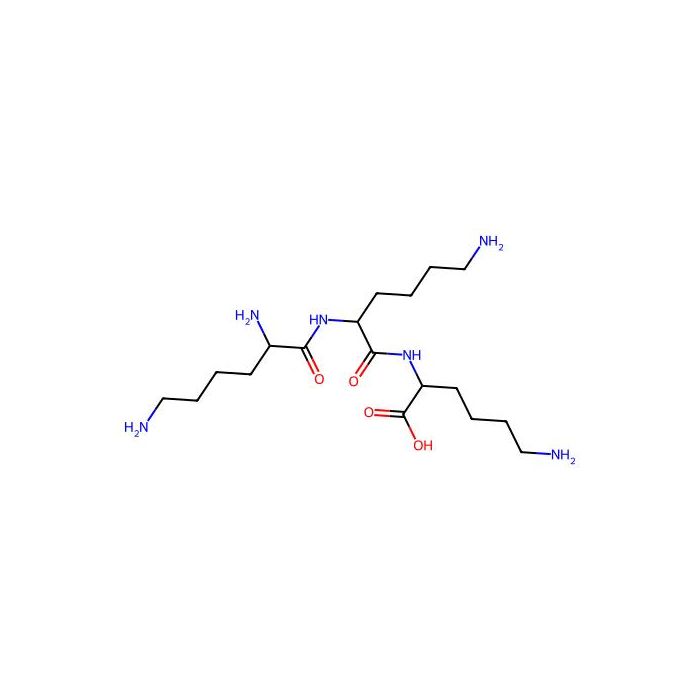
Poly-L-lysine is a positively charged amino acid polymer with approximately one HBr per lysine residue. The hydrobromide allows the poly-L-lysine to be in a crystalline form soluble in water. A small amount of product may be found in the beta structure because the HBr interferes with hydrogen bonding between amino and either the carboxyl groups or N or O containing moieties.
Documento completo su pericoli, manipolazione, stoccaggio e conformità normativa.
<<<<<<< HEAD Scarica SDS → ======= Scarica SDS → >>>>>>> release248-p3Dati di qualità specifici del lotto. Inserisci il numero di lotto per recuperare il COA esatto.
Cerca COA →Riepilogo di riferimento rapido delle specifiche e applicazioni del prodotto.
Visualizza scheda tecnica →Attributi di qualità completi e criteri di accettazione per questa qualità.
Visualizza scheda delle specifiche →Taxonomy Tree
| Kingdom | Organic compounds |
|---|---|
| Superclass | Organic acids and derivatives |
| Classe | Carboxylic acids and derivatives |
| Subclass | Amino acids, peptides, and analogues |
| Intermediate Tree Nodes | Peptides |
| Direct Parent | Oligopeptides |
| Alternative Parents | N-acyl-L-alpha-amino acids Alpha amino acid amides Medium-chain fatty acids Amino fatty acids N-acyl amines Secondary carboxylic acid amides Amino acids Monocarboxylic acids and derivatives Carboxylic acids Organopnictogen compounds Organic oxides Monoalkylamines Hydrocarbon derivatives Carbonyl compounds |
| Molecular Framework | Aliphatic acyclic compounds |
| Substituents | Alpha-oligopeptide - N-acyl-alpha-amino acid - N-acyl-alpha amino acid or derivatives - N-acyl-l-alpha-amino acid - Alpha-amino acid amide - N-substituted-alpha-amino acid - Alpha-amino acid or derivatives - Medium-chain fatty acid - Amino fatty acid - Fatty amide - N-acyl-amine - Fatty acyl - Fatty acid - Secondary carboxylic acid amide - Amino acid or derivatives - Carboxamide group - Amino acid - Carboxylic acid - Monocarboxylic acid or derivatives - Organopnictogen compound - Primary aliphatic amine - Organic nitrogen compound - Hydrocarbon derivative - Carbonyl group - Organic oxide - Organonitrogen compound - Amine - Primary amine - Organooxygen compound - Organic oxygen compound - Aliphatic acyclic compound |
| Descrizione | This compound belongs to the class of organic compounds known as oligopeptides. These are organic compounds containing a sequence of between three and ten alpha-amino acids joined by peptide bonds. |
| External Descriptors | Not available |
Find and download the COA for your product by matching the lot number on the packaging.
| Lot Number | Certificate Type | Data | Oggetto |
|---|---|---|---|
| Certificate of Analysis | Mar 12, 2026 | P303253 | |
| Certificate of Analysis | Mar 12, 2026 | P303253 | |
| Certificate of Analysis | Feb 26, 2026 | P303253 | |
| Certificate of Analysis | Feb 26, 2026 | P303253 | |
| Certificate of Analysis | Feb 05, 2026 | P303253 | |
| Certificate of Analysis | Feb 05, 2026 | P303253 | |
| Certificate of Analysis | Sep 18, 2025 | P303253 | |
| Certificate of Analysis | Sep 18, 2025 | P303253 | |
| Certificate of Analysis | Jul 15, 2025 | P303253 | |
| Certificate of Analysis | Jul 15, 2025 | P303253 | |
| Certificate of Analysis | Dec 13, 2024 | P303253 | |
| Certificate of Analysis | Dec 13, 2024 | P303253 | |
| Certificate of Analysis | Jun 04, 2024 | P303253 | |
| Certificate of Analysis | Jun 04, 2024 | P303253 | |
| Certificate of Analysis | Jan 31, 2024 | P303253 | |
| Certificate of Analysis | Jan 31, 2024 | P303253 | |
| Certificate of Analysis | Jan 31, 2024 | P303253 | |
| Certificate of Analysis | Jan 31, 2024 | P303253 | |
| Certificate of Analysis | Aug 02, 2023 | P303253 | |
| Certificate of Analysis | Aug 02, 2023 | P303253 | |
| Certificate of Analysis | Apr 03, 2023 | P303253 | |
| Certificate of Analysis | Apr 03, 2023 | P303253 |
| Peso molecolare | 402.500 g/mol |
|---|---|
| XLogP3 | -5.600 |
| Hydrogen Bond Donor Count | 7 |
| Hydrogen Bond Acceptor Count | 8 |
| Rotatable Bond Count | 17 |
| Exact Mass | 402.295 Da |
| Monoisotopic Mass | 402.295 Da |
| Topological Polar Surface Area | 200.000 Ų |
| Heavy Atom Count | 28 |
| Formal Charge | 0 |
| Complexity | 463.000 |
| Isotope Atom Count | 0 |
| Defined Atom Stereocenter Count | 3 |
| Undefined Atom Stereocenter Count | 0 |
| Defined Bond Stereocenter Count | 0 |
| Undefined Bond Stereocenter Count | 0 |
| The total count of all stereochemical bonds | 0 |
| Covalently-Bonded Unit Count | 1 |
The following protocols provide general, literature-based guidance for using poly-L-lysine solutions in research. They are not validated for this specific item; adjust based on the CoA (concentration, MW) and your experimental needs.
A. Coating tissue-culture-treated plastic or glass
B. Preparing polyplexes with plasmid DNA (research)
C. Layer-by-layer film assembly
Sterility note: For cell culture, use sterile technique and sterile-filter working solutions when possible.
These are general protocols; consult the SDS/CoA for any item-specific constraints.
Poly-L-lysine is not a native biological polymer (the natural counterpart is polypeptides with varied sequences), but its structure comprises repeats of the amino acid L-lysine, a canonical proteinogenic amino acid.
General/literature context (not product-specific):
Note: These are generalized roles reported in the biomaterials and cell culture literature and are not specific performance claims for this catalog item.
Not typically applicable. Poly-L-lysine is a cationic polymer used for surface coating and polyelectrolyte complexation rather than as a buffering agent.
Practical notes (literature; not product-specific):
For buffer recipes, consult your specific downstream application; this product does not define a buffering system.
Context: Poly-L-lysine solutions are water-based and used at low concentrations, aligning well with green chemistry principles of safer solvents and benign auxiliaries. Environmental considerations focus on resource origin, biodegradability, and cytotoxicity.
Greener or alternative choices (literature; trade-offs noted):
Small comparison (general; not product-specific):
Recommendation: For labs emphasizing green practices, start with aqueous PLL/PDL at the lowest effective concentration and consider recombinant peptide coatings when cell-type-specific cues are required without animal sourcing.
No therapeutic claims are made. The following reflects general formulation and manufacturing research uses reported in the literature and does not pertain to clinical application.
Literature/formulation context (not product-specific):
Regulatory/status notes:
This catalog item is for research use only and not for use in humans or diagnostic procedures.
Item-specific specifications
General/literature characteristics for poly-L-lysine solutions (for context; not product specs):
Note: Exact values depend on degree of polymerization, counterion, and concentration; consult the CoA for item-specific metrics.
Item-specific quality details
Context and typical grade definitions (general; not product-specific):
Implications for selection:
For this specific catalog item, consult the CoA/Spec Sheet for exact grade, concentration, MW distribution, and sterility testing results.
This material is primarily a biological/materiomics tool rather than a small-molecule reagent. Its “applications” are rooted in electrostatic interactions and interfacial assembly, not classical organic reactions.
Key application areas (literature; not product-specific):
Practical tips (literature):
Note: No classical reaction conditions apply; focus on interfacial assembly and electrostatics.
Classical reaction conditions are not directly applicable; however, common operational conditions for surface coating and conjugation with poly-L-lysine are well established in the literature (general guidance; not product-specific):
Surface coating (cell culture):
Layer-by-layer (LbL) assembly:
Bioconjugation via NHS-esters:
DNA/RNA polyplex formation (research):
Note: Optimize conditions empirically based on MW/concentration of the specific PLL solution. These are general literature values and not specifications for this item.
Item-specific hazard information
General safety considerations (literature/practice; not product-specific):
Always consult the product-specific SDS for authoritative safety and regulatory guidance.
Applicability: This product is supplied as a solution and is typically used as received or diluted in aqueous media. Organic solvent selection is generally not applicable.
General/literature guidance (not product-specific):
When to choose PLL vs alternatives (literature):
Comparison (general):
Note: For this item, consult the CoA for buffer composition and permissible diluents. If unspecified, perform small-scale compatibility tests before large-scale coating.
Item-specific instructions
General guidance for aqueous PLL solutions (not product-specific):
Reconstitution: Not applicable (supplied as a solution). For preparing working solutions, dilute with sterile water or compatible buffer as required by the application, verifying pH and ionic strength to maintain adsorption/performance.
Always refer to the product’s CoA and SDS for definitive, item-specific storage and handling directions.
Poly-L-lysine (PLL) solution is a water-based preparation of a polycationic homopolymer composed of L-lysine residues joined by peptide (amide) bonds.
Structural features (general/literature):
2D description in words:
As a functional macromolecule, poly-L-lysine serves as a versatile scaffold rather than a classical reagent.
Utility in synthesis and materials (literature; not product-specific):
Considerations:
These utilities describe general strategies; consult the CoA for this item’s concentration and MW to plan stoichiometry.
Not applicable. This product is a polymer solution, not an affinity reagent or antibody. It does not possess antigen/epitope specificity, clone, isotype, or species reactivity.
For application-relevant specificity, see sections on Reaction & Applications and Application Protocols describing electrostatic interactions with negatively charged surfaces and biomolecules.