Determine the necessary mass, volume, or concentration for preparing a solution.
| Activity Type | Relation | Activity value | Units | Action Type | Journal | PubMed Id | doi | Assay Aladdin ID |
|---|

Mw(Viscosity-average) 300000 for sensitive chromatographic and analytical workflows requiring minimal baseline interference.
Store at 2-8°C Ships Wet ice Check lot-specific COA for exact specifications.
SDS, COA, datasheet, and spec sheet available for download. Lot-specific COA accessible via lot number lookup.
Cited in 20 peer-reviewed publications across chromatography, organic synthesis, and cross-coupling reactions.
General Description
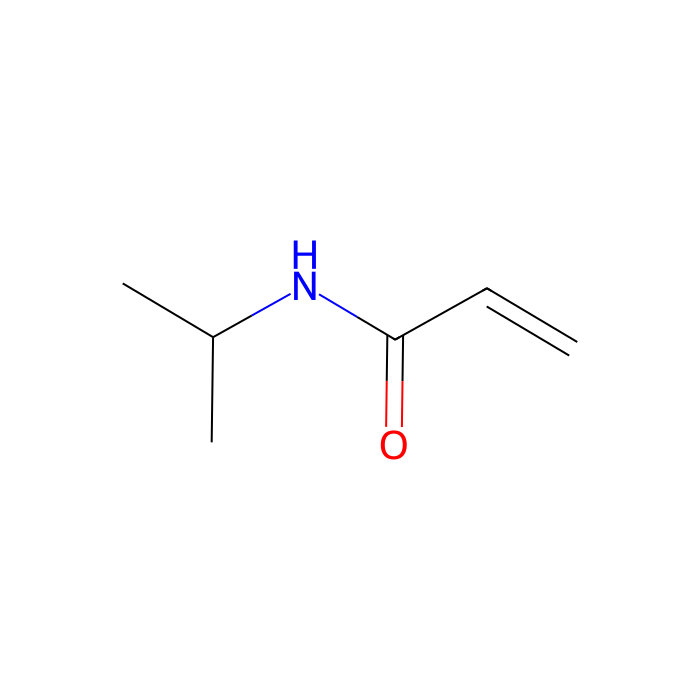
Poly( N -isopropylacrylamide) (PNIPAM) is a temperature-responsive polymer used in biomedical research applications. PNIPAM undergoes a reversible, lower critical solution temperature (LCST) phase transition when heated above 32 °C, transitioning from a soluble to an insoluble material. PNIPAM is also frequently crosslinked to yield hydrogels with reversible, thermal shrinking and swelling. Poly( N -isopropylacrylamide) is also readily functionalized and has been used as the hydrophilic block in the synthesis of thermoresponsive, amphiphilic block copolymers. Due to the similarity in temperature between the LCST of PNIPAM and the temperature of the human body, PNIPAM materials have been frequently utilized in tissue engineering and controlled drug delivery research applications. Poly( N -isopropylacrylamide) (PNIPAM) is a thermo-sensitive polymer with a low critical solution temperature (LCST). It exhibits both hydrophobic and hydrophilic characteristics below and above the LCST. It forms microgels, typically by free-radical precipitation polymerization.
Application
PNIPAM can be used in the formation of a smart hydrogel, which finds potential usage in sensors, fuel cells, supercapacitors, and lithium-ion batteries. It can also be used in the fabrication of molecular nanothermometer. PNIPAM is coated with gold nanoparticles (AuNPs) to form microgels that facilitate highly reproducible signals for surface-enhanced Raman scattering (SERS). Thermosensitive polymer, can be used to form a hydrogel. Aqueous polymer solution undergoes a phase transition from a soluble to an insoluble state when the temperature is raised to ca. 32 °C.
Comprehensive hazard, handling, storage, and regulatory compliance document.
Download SDS →Lot-specific quality data. Enter your lot number to retrieve the exact COA.
Look up COA →Full quality attributes and acceptance criteria for this grade.
View spec sheet →Taxonomy Tree
| Kingdom | Organic compounds |
|---|---|
| Superclass | Organic acids and derivatives |
| Classe | Carboxylic acids and derivatives |
| Subclass | Acrylic acids and derivatives |
| Intermediate Tree Nodes | Not available |
| Direct Parent | Acrylic acids and derivatives |
| Alternative Parents | Secondary carboxylic acid amides Organopnictogen compounds Organonitrogen compounds Organic oxides Hydrocarbon derivatives Carbonyl compounds |
| Molecular Framework | Aliphatic acyclic compounds |
| Substituents | Acrylic acid or derivatives - Secondary carboxylic acid amide - Carboxamide group - Organic nitrogen compound - Organic oxygen compound - Organopnictogen compound - Organic oxide - Hydrocarbon derivative - Organooxygen compound - Organonitrogen compound - Carbonyl group - Aliphatic acyclic compound |
| Descrizione | This compound belongs to the class of organic compounds known as acrylic acids and derivatives. These are organic compounds containing acrylic acid CH2=CHCO2H or a derivative thereof. |
| External Descriptors | Not available |
| Activity Type | Relation | Activity value | Units | Action Type | Journal | PubMed Id | doi | Assay Aladdin ID |
|---|
Find and download the COA for your product by matching the lot number on the packaging.
| Lot Number | Certificate Type | Data | Oggetto |
|---|---|---|---|
 G2616172 | Certificate of Analysis | Jun 12, 2026 | P432408 |
| G2616173 | Certificate of Analysis | Jun 12, 2026 | P432408 |
| G2616174 | Certificate of Analysis | Jun 12, 2026 | P432408 |
| H2321148 | Certificate of Analysis | Jun 08, 2026 | P432408 |
| H2321183 | Certificate of Analysis | Jun 08, 2026 | P432408 |
| H2321185 | Certificate of Analysis | Jun 08, 2026 | P432408 |
| H2321422 | Certificate of Analysis | Jun 08, 2026 | P432408 |
| E2515583 | Certificate of Analysis | May 08, 2025 | P432408 |
| E2515608 | Certificate of Analysis | May 08, 2025 | P432408 |
| E2520701 | Certificate of Analysis | May 08, 2025 | P432408 |
| H2321146 | Certificate of Analysis | Jul 28, 2023 | P432408 |
| H2321147 | Certificate of Analysis | Jul 28, 2023 | P432408 |
| H2321184 | Certificate of Analysis | Jul 28, 2023 | P432408 |
| H2321423 | Certificate of Analysis | Jul 28, 2023 | P432408 |
| Solubilità | Soluble in Acetone, THF, water (cold) |
|---|---|
| Peso molecolare | 113.160 g/mol |
| XLogP3 | 0.900 |
| Hydrogen Bond Donor Count | 1 |
| Hydrogen Bond Acceptor Count | 1 |
| Rotatable Bond Count | 2 |
| Exact Mass | 113.084 Da |
| Monoisotopic Mass | 113.084 Da |
| Topological Polar Surface Area | 29.100 Ų |
| Heavy Atom Count | 8 |
| Formal Charge | 0 |
| Complexity | 96.700 |
| Isotope Atom Count | 0 |
| Defined Atom Stereocenter Count | 0 |
| Undefined Atom Stereocenter Count | 0 |
| Defined Bond Stereocenter Count | 0 |
| Undefined Bond Stereocenter Count | 0 |
| The total count of all stereochemical bonds | 0 |
| Covalently-Bonded Unit Count | 1 |