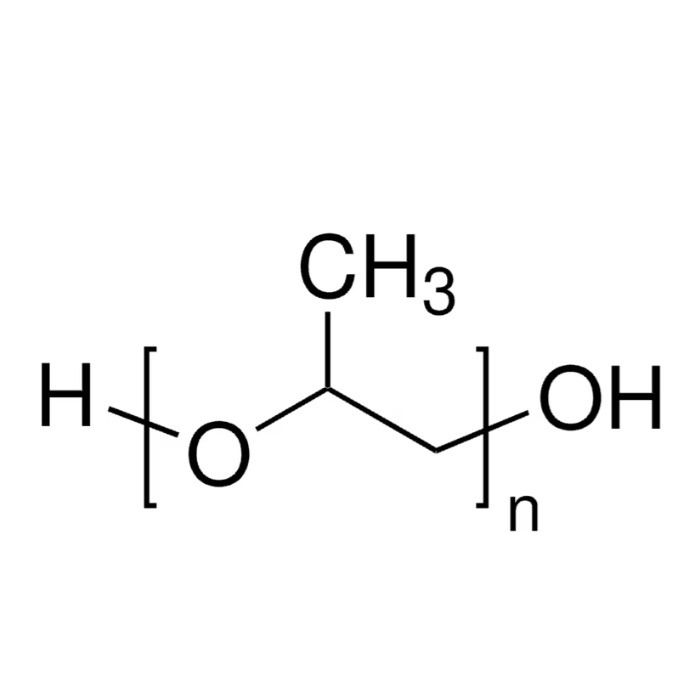
Poly(propylene glycol)(PPG) - average Mw 1000 , CAS No.25322-69-4

CAS: 25322-69-4 Cat. No.: P103210 Formula: C3nH6n+2On+1 Numero EC: 500-039-8
Disponibile su ordine
QUALITÀ & PUREZZA average Mw 1000
Synonyms
Lineartop E|2-(2-HYDROXYPROPOXY)-1-PROPANOL|2-(2-Hydroxypropoxy)propanol|Niax ppg|2-(2-hydroxypropoxy)propan-1-ol|Desmophen 360C|PPG|Emkapyl
Storage
Room temperature
Shipped In
Normal
★
Dimensione
Germania (EU)
USA*
Prezzo
Qtà
25g
P103210-25g
—
5 Disponibile
8,59€
250g
P103210-250g
8 Disponibile
3 Disponibile

12,06€

14,66€
Salva 2,60 € (17.75%)
500g
P103210-500g
—
3 Disponibile
17,27€
Enter a quantity for the sizes you want to add.

Panoramica

Poly(propylene glycol) (PPG) is a biocompatible polymer widely used as a precursor to fabricate biomedical materials. It is soluble in water at low temperatures and becomes insoluble at high temperatures.

Specifiche

Sinonimi
Lineartop E | 2-(2-HYDROXYPROPOXY)-1-PROPANOL | 2-(2-Hydroxypropoxy)propanol | Niax ppg | 2-(2-hydroxypropoxy)propan-1-ol | Desmophen 360C | PPG | Emkapyl
Specifiche e purezza
average Mw 1000
Condizioni di conservazione di stoccaggio
Room temperature
Spedito in
Normal
Nomi e identificatori
Pubchem Sid
SMILES
CC(CO)OCC(C)O
IUPAC Name
2-(2-hydroxypropoxy)propan-1-ol
InChIKey
DUFKCOQISQKSAV-UHFFFAOYSA-N
InChI
1S/C6H14O3/c1-5(8)4-9-6(2)3-7/h5-8H,3-4H2,1-2H3
Isomeri SMILES
CC(CO)OCC(C)O
WGK Germania
1
RTECS
TR5250000
Reaxys
1736302
Reaxys-RN_link_address
https://www.reaxys.com/reaxys/secured/hopinto.do?context=S&query=IDE.XRN=1736302&ln=

Dati avanzati

Taxonomic Classification

Taxonomy Tree

KingdomOrganic compounds
SuperclassOrganic oxygen compounds
ClasseOrganooxygen compounds
SubclassAlcohols and polyols
Intermediate Tree Nodes Not available
Direct ParentSecondary alcohols
Alternative Parents Dialkyl ethers  Primary alcohols  Hydrocarbon derivatives  
Molecular FrameworkAliphatic acyclic compounds
Substituents Secondary alcohol - Ether - Dialkyl ether - Hydrocarbon derivative - Primary alcohol - Aliphatic acyclic compound
DescrizioneThis compound belongs to the class of organic compounds known as secondary alcohols. These are compounds containing a secondary alcohol functional group, with the general structure HOC(R)(R') (R,R'=alkyl, aryl).
External Descriptors Not available
Struttura 3D
Modello di struttura chimica interattiva


Certificati (CoA, COO, BSE/TSE e tabella di analisi)
C of A & Other Certificates(BSE/TSE, COO):
Analytical Chart:

Find and download the COA for your product by matching the lot number on the packaging.

47 results found

Lot NumberCertificate TypeDataOggetto
F2624188F2624188Certificate of AnalysisMay 20, 2026 P103210
F2624186F2624186Certificate of AnalysisMay 20, 2026 P103210
F2624185F2624185Certificate of AnalysisMay 20, 2026 P103210
F2624184F2624184Certificate of AnalysisMay 20, 2026 P103210
F2624183F2624183Certificate of AnalysisMay 20, 2026 P103210
F2624182F2624182Certificate of AnalysisMay 20, 2026 P103210
J2516335J2516335Certificate of AnalysisSep 25, 2025 P103210
J2516334J2516334Certificate of AnalysisSep 25, 2025 P103210
J2516333J2516333Certificate of AnalysisSep 25, 2025 P103210
J2516332J2516332Certificate of AnalysisSep 25, 2025 P103210
J2516331J2516331Certificate of AnalysisSep 25, 2025 P103210
E2620118E2620118Certificate of AnalysisSep 25, 2025 P103210
J2516336J2516336Certificate of AnalysisSep 25, 2025 P103210
A2614169A2614169Certificate of AnalysisSep 25, 2025 P103210
B2520062B2520062Certificate of AnalysisSep 12, 2024 P103210
I2525058I2525058Certificate of AnalysisSep 12, 2024 P103210
J2408009J2408009Certificate of AnalysisSep 12, 2024 P103210
J2408010J2408010Certificate of AnalysisSep 12, 2024 P103210
D2510040D2510040Certificate of AnalysisSep 12, 2024 P103210
E2513029E2513029Certificate of AnalysisSep 12, 2024 P103210
E2522010E2522010Certificate of AnalysisSep 12, 2024 P103210
J2408011J2408011Certificate of AnalysisSep 12, 2024 P103210
J2408012J2408012Certificate of AnalysisSep 12, 2024 P103210
J2408013J2408013Certificate of AnalysisSep 12, 2024 P103210
J2310417J2310417Certificate of AnalysisJun 19, 2023 P103210
J2310418J2310418Certificate of AnalysisJun 19, 2023 P103210
J2310419J2310419Certificate of AnalysisJun 19, 2023 P103210
J2310445J2310445Certificate of AnalysisJun 19, 2023 P103210
J2310443J2310443Certificate of AnalysisJun 07, 2023 P103210
J2310444J2310444Certificate of AnalysisJun 01, 2023 P103210
F2317377F2317377Certificate of AnalysisApr 27, 2023 P103210
F2327494F2327494Certificate of AnalysisApr 27, 2023 P103210
F2317503F2317503Certificate of AnalysisApr 27, 2023 P103210
F2317495F2317495Certificate of AnalysisApr 27, 2023 P103210
F2317493F2317493Certificate of AnalysisApr 27, 2023 P103210
F2317392F2317392Certificate of AnalysisApr 27, 2023 P103210
K2228652K2228652Certificate of AnalysisAug 13, 2022 P103210
K2228625K2228625Certificate of AnalysisAug 13, 2022 P103210
K2228660K2228660Certificate of AnalysisAug 13, 2022 P103210
K2228696K2228696Certificate of AnalysisAug 13, 2022 P103210
K2228697K2228697Certificate of AnalysisAug 13, 2022 P103210
C2212299C2212299Certificate of AnalysisFeb 22, 2022 P103210
C2212258C2212258Certificate of AnalysisFeb 22, 2022 P103210
C2212253C2212253Certificate of AnalysisFeb 22, 2022 P103210
C2212252C2212252Certificate of AnalysisFeb 22, 2022 P103210
C2212245C2212245Certificate of AnalysisFeb 22, 2022 P103210
B2303801B2303801Certificate of AnalysisFeb 22, 2022 P103210
Proprietà chimiche e fisiche
SolubilitàMiscible with water, ethanol, diethyl ether and chloroform.
Indice di rifrazione1.447
Punto di infiammabilità (°F)445.0 °F
Punto di infiammabilità (°C)229.44℃
Peso molecolare134.17
XLogP3-0.700
Hydrogen Bond Donor Count2
Hydrogen Bond Acceptor Count3
Rotatable Bond Count4
Exact Mass134.094 Da
Monoisotopic Mass134.094 Da
Topological Polar Surface Area49.700 Ų
Heavy Atom Count9
Formal Charge0
Complexity65.300
Isotope Atom Count0
Defined Atom Stereocenter Count0
Undefined Atom Stereocenter Count2
Defined Bond Stereocenter Count0
Undefined Bond Stereocenter Count0
The total count of all stereochemical bonds0
Covalently-Bonded Unit Count1
Sicurezza e pericoli (GHS)
Pictogrammi
GHS06,   GHS07
Segnale
Danger
Indicazioni di pericolo

H301:Toxic if swallowed

Precauzioni

P264:Wash hands [and …] thoroughly after handling.

P270:Do not eat, drink or smoke when using this product.

P280:Wear protective gloves/protective clothing/eye protection/face protection.

P321:Specific treatment (see ... on this label).

P330:Rinse mouth.

P305+P351+P338:IF IN EYES: Rinse cautiously with water for several minutes. Remove contact lenses if present and easy to do - continue rinsing.

P405:Store locked up.

P501:Dispose of contents/container to an approved waste disposal plant.

P264+P265:Wash hands [and …] thoroughly after handling. Do not touch eyes.

P301+P316:IF SWALLOWED: Get emergency medical help immediately.

P301+P317:IF SWALLOWED: Get medical help.

P337+P317:If eye irritation persists: Get medical help.

WGK Germania
1
RTECS
TR5250000
Reaxys
1736302
Reaxys-RN_link_address
https://www.reaxys.com/reaxys/secured/hopinto.do?context=S&query=IDE.XRN=1736302&ln=
Domande frequenti e articoli
Adding a Temperature-Triggered Switch to NCO: How Blocked Isocyanates Affect the Storage, Curing, and Film Performance of 1K Baking Coatings
Guide to Selecting Polyurethane Coating Systems: Application Analysis for Wood, Flooring, Plastics, Automotive, and Industrial Protection
How Do Isocyanates and Polyols Affect the Performance of Polyurethane Coating Films: Structure, Raw Material Selection, and Performance Design Essentials
Comprehensive Performance Analysis of Polyurethane Coating Films: Soft/Hard Segment Structure, Microphase Separation, Crosslinking and Curing, and Selection of Representative Chemicals
When Should You Choose Silicone Resin? Selection Comparison with Epoxy, Acrylic, Polyurethane, Fluororesin, and Other Coating Resins
Potassium Fatty Acid Soaps: Structure and Formulation Applications—Production Processes, Alkalinity, Foam Control, and Low-Foam Cleaning
Polyurethane Coating Resins: Not a Single Resin, but a Designable High-Performance System
Cashew Nut Shell Liquid (CNSL): From Cashew Processing By-Product to Reactive Bio-Based Raw Material for Coating Resins
The Role of Polyether-Modified Polysiloxanes in Controlling Coating Leveling and Smooth Tactile Feel: Molecular Structure, Surface Migration, and Interfacial Control Mechanisms
Resin Polarity in Coating Formulations: From Molecular Structure to Dissolution, Compatibility, Interfacial Interactions, and Formulation Design
From Structure to Selection: Mechanisms and Application Assessment of Low-Foam Oil and Wax Removal with Fatty Acid Methyl Ester Ethoxylates (FMEE)
Mechanism of Action and Selection Logic of Defoamers for Daily Chemical Products: Foam Stability, Foam-Breaking Mechanisms, and Representative Raw Material Analysis
Mechanisms and Troubleshooting of Foam Reduction in Personal and Household Care Formulations: Film Rupture, Weak Interfacial Films, Insufficient Surfactant Supply, and Phase-State Disturbance
Key Variable in the Long-Term Stability of Waterborne Pigment Concentrates: How Dispersant Molecular Weight Distribution (MWD) Affects Pigment Dispersion, Surface Adsorption-Layer Formation, and Storage Stability
Influencing Factors and Control Strategies for Blistering in Neutral Wall Putty: An Experimental Analysis Based on HPMC Dosage, Viscosity, and Ground Calcium Carbonate Fineness
Application of Aldimine Latent Curing Agents in One-Component Moisture-Curing Polyurethane Systems —— Mechanism of CO₂ Bubble Control and Key Formulation Design Points
Bis-Oxazolidine Latent Curing Agents: Turning Moisture from a Foaming Risk into a Trigger for Moisture Curing
Differences Between Cast CPU and Thermoplastic TPU in Structure, Processing, Performance, and Applications
Citations of This Product
Calcolatori di soluzioni
Recensioni

Recensioni dei clienti

Desidera che le inviamo un messaggio quando avremo sconti disponibili?

Ricordamelo più tardi

Grazie! Controlli la sua casella di posta per confermare.

Ops! Le notifiche sono disabilitate.