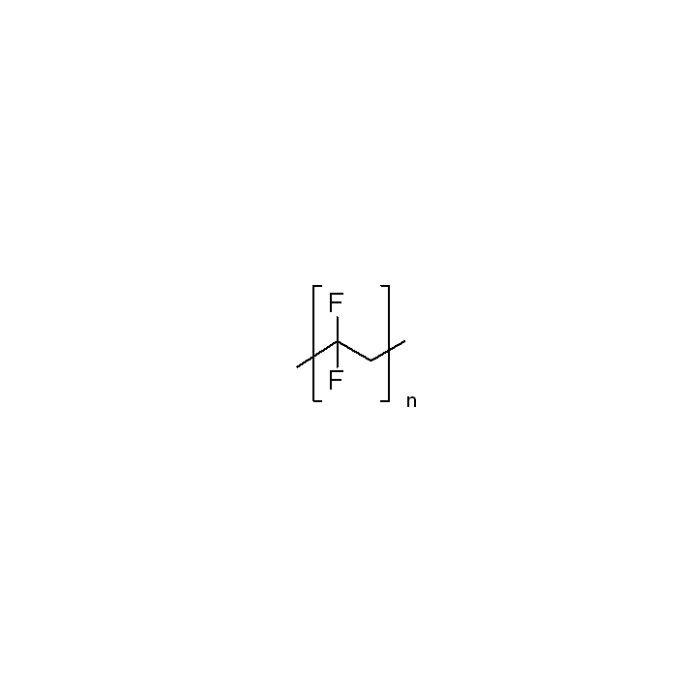
Poly(vinylidene fluoride)(PVDF) - average Mw ~534,000 by GPC, powder , CAS No.24937-79-9

CAS: 24937-79-9 Cat. No.: P432380 Formula: (CH2CF2)n Numero EC: 607-458-6
Disponibile su ordine
GRADE & PURITY average Mw ~534,000 by GPC, powder
Synonyms
fluorovinylidene | HSDB 5206 | CCRIS 6744 | Halocarbon 1132A | Kynar | 1,1-Difluoroethylene | Vinylidene fluoride | NCI-C60208 | Genetron 1132a | Vinylidene difluoride | UN1959 | NCI-C60204 | PVDF
Storage
Room temperature
★
Size
Germania (EU)
USA*
Price
Qty
5g
P432380-5g
—
2 Disponibile
68,46€
Enter a quantity for the sizes you want to add.
🧪
Why this grade

average Mw ~534,000 by GPC, powder for sensitive chromatographic and analytical workflows requiring minimal baseline interference.

🌡

Storage & shipping

Room temperature Ships Check lot-specific COA for exact specifications.

📋

Quality documents

SDS, COA, datasheet, and spec sheet available for download. Lot-specific COA accessible via lot number lookup.

📚

Literature proof

Cited in 1114 peer-reviewed publications across chromatography, organic synthesis, and cross-coupling reactions.

Panoramica

Poly(vinylidene fluoride) PVDF is a semi crystalline non-centrosymmetric polymer which exhibits piezo-, pyro- and ferroelectric properties. It is a linear polymer that shows permanent electric dipoles perpendicular to the direction of the molecular chain. These dipoles result from the difference in electronegativity between the atoms of hydrogen and fluorine with respect to carbon. Depending on the processing conditions, PVDF exhibits several different crystalline phases (α,β,γ,δ). The β phase of PVDF is the phase that exhibits the best ferroelectric and piezoelectric properties.


Application

Poly(vinylidene fluoride) (PVDF) is used in nanoporous electrodes. It is used to synthesize composites comprising of ultrafine fibers of PVDF embedded with carbon nanotubes. It can be used in sensors, actuators, for energy storage, sphygmomanometers, pressure sensors and nanogenerators, lithium ion batteries. Additionally, it may find application as matrix for PVDF-nanoclay nanocomposites and PVDF acrylic rubber/clay nanocomposite hybrid.

Specifications

Sinonimi
fluorovinylidene | HSDB 5206 | CCRIS 6744 | Halocarbon 1132A | Kynar | 1,1-Difluoroethylene | Vinylidene fluoride | NCI-C60208 | Genetron 1132a | Vinylidene difluoride | UN1959 | NCI-C60204 | PVDF
Specifiche e purezza
average Mw ~534,000 by GPC, powder
Condizioni di conservazione di stoccaggio
Room temperature
Nomi e identificatori
Sorrisi canonici
FC(F)=C
IUPAC Name
1,1-difluoroethene
InChIKey
BQCIDUSAKPWEOX-UHFFFAOYSA-N
INCHI
1S/C2H2F2/c1-2(3)4/h1H2
Isomeri SMILES
C=C(F)F

Documentazione

📋 Safety Data Sheet (SDS)

Comprehensive hazard, handling, storage, and regulatory compliance document.

Download SDS →

✅ Certificate of Analysis (COA)

Lot-specific quality data. Enter your lot number to retrieve the exact COA.

Look up COA →

📊 Datasheet

Quick-reference summary of product specifications and applications.

View datasheet →

🔬 Specification Sheet

Full quality attributes and acceptance criteria for this grade.

View spec sheet →

Advanced Data

Taxonomic Classification

Taxonomy Tree

KingdomOrganic compounds
SuperclassOrganic oxygen compounds
ClasseOrganooxygen compounds
SubclassKetene acetals
Intermediate Tree Nodes Not available
Direct ParentKetene acetals
Alternative Parents Vinyl fluorides  Fluoroalkenes  Organofluorides  Hydrofluorocarbons  Hydrocarbon derivatives  
Molecular FrameworkAliphatic acyclic compounds
Substituents Ketene acetal or derivatives - Fluoroalkene - Haloalkene - Vinyl halide - Vinyl fluoride - Hydrofluorocarbon - Hydrocarbon derivative - Organofluoride - Organohalogen compound - Aliphatic acyclic compound
DescrizioneThis compound belongs to the class of organic compounds known as ketene acetals. These are organic compounds comprising the ketene acetal functional group, with the general structure XC(Y)=C(R3)R4 (R1,R2=H, alkyl, aryl; X,Y=any hetero atom).
External Descriptors acetal
Struttura 3D
Modello di struttura chimica interattiva


Meccanismi d'azione
Certificati (CoA, COO, BSE/TSE e tabella di analisi)
C of A & Other Certificates(BSE/TSE, COO):
Analytical Chart:

Find and download the COA for your product by matching the lot number on the packaging.

21 results found

Lot NumberCertificate TypeDataOggetto
I2526099Certificate of AnalysisJun 27, 2025 P432380
G2508557Certificate of AnalysisJun 27, 2025 P432380
G2508556Certificate of AnalysisJun 27, 2025 P432380
G2508555Certificate of AnalysisJun 27, 2025 P432380
C2513866Certificate of AnalysisMar 07, 2025 P432380
C2513694Certificate of AnalysisMar 07, 2025 P432380
C2513593Certificate of AnalysisMar 07, 2025 P432380
C2513612Certificate of AnalysisMar 07, 2025 P432380
A2515499Certificate of AnalysisJan 08, 2025 P432380
A2515503Certificate of AnalysisJan 08, 2025 P432380
A2515502Certificate of AnalysisJan 08, 2025 P432380
A2515497Certificate of AnalysisJan 08, 2025 P432380
I2402304Certificate of AnalysisAug 20, 2024 P432380
I2402305Certificate of AnalysisAug 20, 2024 P432380
C2407396Certificate of AnalysisMar 01, 2024 P432380
C2407395Certificate of AnalysisMar 01, 2024 P432380
E2420030Certificate of AnalysisMar 01, 2024 P432380
C2407394Certificate of AnalysisMar 01, 2024 P432380
H2423008Certificate of AnalysisMar 01, 2024 P432380
K2317343Certificate of AnalysisNov 10, 2023 P432380
K2317344Certificate of AnalysisNov 10, 2023 P432380
Proprietà chimiche e fisiche
Punto di fusione (°C)155-165°C
Peso molecolare64.030 g/mol
XLogP31.300
Hydrogen Bond Donor Count0
Hydrogen Bond Acceptor Count2
Rotatable Bond Count0
Exact Mass64.0125 Da
Monoisotopic Mass64.0125 Da
Topological Polar Surface Area0.000 Ų
Heavy Atom Count4
Formal Charge0
Complexity27.000
Isotope Atom Count0
Defined Atom Stereocenter Count0
Undefined Atom Stereocenter Count0
Defined Bond Stereocenter Count0
Undefined Bond Stereocenter Count0
The total count of all stereochemical bonds0
Covalently-Bonded Unit Count1
Domande frequenti e articoli
How to Choose a Hydrogen Evolution (HER) Catalyst: Kinetic Barriers in Water Electrolysis, AWE/PEM/AEM Pathways, and a Materials-Family Roadmap (with a Product Map)
Panorama Guide to Lithium-Ion Battery Electrode Materials: Working Principles, Materials Map, and Selection Navigation (incl. Tables 1–4)
A Panorama Guide to Synthetic Resins: Definitions & Polymerization Mechanisms, Classification Frameworks, Common Resins and Applications, Packaging Codes, and a Selection Roadmap (Tables 1–3)
Optical & Optoelectronic Materials Selection Guide:Positioning materials, key metrics, and validation paths along “Generation → Guiding → Control → Readout” (with product navigation and Tables 1–4)
uide to Hydrophobic Polymers and Hydrophobic Surfaces: Wetting Models, Evaluation Metrics, and Task-Oriented Material Selection (including Tables 1–3)
Research Value of Polyelectrolyte Multilayers: Layer-by-Layer Design of Interfacial Composition, Mass Transport, and Function
Citations of This Product
Calcolatori di soluzioni
Recensioni

Recensioni dei clienti

Shall we send you a message when we have discounts available?

Remind me later

Thank you! Please check your email inbox to confirm.

Oops! Notifications are disabled.