GRADE & PURITYACS?ACS grade — meets American Chemical Society specifications, the analytical benchmark in the US. Use for analytical and QC work needing ACS-defined purity.≥99.95%
Benzoic acid - Benzoyl - Dicarboxylic acid or derivatives - Carboxylic acid salt - Organic alkali metal salt - Carboxylic acid - Carboxylic acid derivative - Organic oxygen compound - Organic oxide - Hydrocarbon derivative - Organic potassium salt - Organic salt - Organooxygen compound - Aromatic homomonocyclic compound
Descrizione
This compound belongs to the class of organic compounds known as benzoic acids. These are organic Compounds containing a benzene ring which bears at least one carboxyl group.
External Descriptors
Not available
1. Djoumbou Feunang Y, Eisner R, Knox C, Chepelev L, Hastings J, Owen G, Fahy E, Steinbeck C, Subramanian S, Bolton E, Greiner R, and Wishart DS. ClassyFire: Automated Chemical Classification With A Comprehensive, Computable Taxonomy. Journal of Cheminformatics, 2016, 8:61.
Determine the necessary mass, volume, or concentration for preparing a solution.
Dilution Calculator
Determine the dilution needed to prepare a stock solution.
Reconstitution Calculator
Recensioni
Recensioni dei clienti
Application Protocols
No antibody- or assay-based application protocols are applicable to this chemical reagent. For relevant laboratory uses, see the Reaction & Applications, Buffer Applications, and Reaction Conditions sections for detailed, practical guidance on standardization, buffer preparation, and TOC standard preparation.
Biological Roles
This compound is an inorganic–organic salt used as a laboratory reagent; it does not have a canonical biological role.
Literature/general context
Phthalate species in biology: Phthalate esters are environmental contaminants with biological interactions, but potassium hydrogen phthalate (the acid salt of phthalic acid) is distinct and primarily an analytical reagent.
Metabolism: In biological systems, phthalic acid can arise from hydrolysis of phthalate esters and may be further metabolized to benzoate and then to hippurate; however, KHP itself is not typically encountered in vivo.
Biochemical use: Its main interface with biology is indirect—preparing buffers near pH 5 or calibrating instruments (TOC analyzers) for samples of biological origin.
No clinical or therapeutic claims are associated with this product; it is intended strictly for research and analytical laboratory use.
Buffer Applications
KHP is widely used to prepare phthalate buffers effective in the mildly acidic range.
Effective pH range (literature)
pKa2 (H2Ph ⇌ HPh− + H+): ~5.41 at 25 °C; useful buffer range approximately pH 4.4–6.4.
0.05 M phthalate buffer stock: Dissolve 10.21 g of KHP (MW ~204.22 g/mol, literature) in water and dilute to 1.000 L. Adjust pH with ~0.1 M NaOH to the desired set point using a calibrated pH meter.
For pH 4.0–6.0: Use the Henderson–Hasselbalch relation pH = pKa + log([HPh−]/[H2Ph]) to calculate the ratio of KHP (acid form) to its fully neutralized salt (phthalate) required.
Practical tips
Temperature dependence: Verify pH at the working temperature; pKa shifts slightly with temperature.
Ionic strength: For reproducibility, maintain constant ionic strength or report it.
Conductivity/purity: Use high-purity water. For spectroscopic assays, consider filtering and degassing to remove particulates and dissolved gases.
Note: Exact buffer recipes for this specific item are not certified specifications; adjust empirically to your experimental needs.
Green Alternatives
KHP is already a relatively safe, non-volatile solid with excellent shelf stability. For certain analytical roles, alternatives may be considered based on solubility, toxicity, or waste minimization.
Comparison (literature/general)
KHP vs oxalic acid dihydrate: Oxalic acid is more hazardous (toxic, potential for dermal absorption) and can introduce water-of-crystallization variability; KHP is safer and anhydrous-equivalent, improving accuracy.
KHP vs benzoic acid: Benzoic acid has low water solubility, complicating aqueous standard preparation; KHP is readily water-soluble.
KHP vs potassium hydrogen tartrate (KHT): KHT is food-grade but sparingly water-soluble; KHP offers better solubility and more consistent equivalence for titrations.
| Primary standard | Relative hazard | Water solubility | Handling/stability | Notes |
|---|---|---|---|---|
| KHP | Low (irritant) | High | Non-hygroscopic, stable | Common choice for base standardization |
| Oxalic acid·2H2O | Higher (toxic) | High | Hydrate variability | Less preferred for routine standardization |
| Benzoic acid | Low–moderate | Low | Stable | Better for nonaqueous titrations |
| Potassium hydrogen tartrate | Low | Low–moderate | Food-grade | Limited use due to solubility |
Waste considerations: Aqueous KHP solutions are mildly acidic; neutralize before disposal per local regulations.
Pharmaceutical Uses
Item-specific status
No pharmacopeial grade or excipient designation is provided for this item; ACS grade is intended for analytical and laboratory use. Any pharmacopeial compliance is Not specified for this item; refer to CoA/Spec Sheet.
Literature/general context
Role in pharmaceutical QC: Commonly used in quality control laboratories as a primary standard to standardize volumetric bases and to prepare calibration buffers in the acidic range.
Formulation use: Not typically used as an excipient in finished dosage forms due to its analytical, not functional, role.
Instrument calibration: Used to prepare TOC standards for validation of water systems and cleaning validation programs.
No therapeutic or clinical claims are made; for research and analytical use only.
Physical Properties
Item-specific values (specs)
Appearance: Not specified for this item; refer to CoA/Spec Sheet.
Molecular formula: Not specified for this item; refer to CoA/Spec Sheet.
Molecular weight: Not specified for this item; refer to CoA/Spec Sheet.
Physical state: Crystalline solid; typically colorless to white (literature)
Melting behavior: ~296 °C with decomposition (literature)
Density: ~1.64 g/cm³ at 20–25 °C (literature)
Solubility: Readily soluble in water; sparingly soluble in lower alcohols; essentially insoluble in nonpolar solvents (literature)
Acid–base: Conjugate acid of hydrogen phthalate has pKa2 ~5.41 at 25 °C; first dissociation of phthalic acid pKa1 ~2.95 (literature)
Partitioning: LogP not applicable (ionic salt; literature qualitative)
Hygroscopicity: Low; suitable as a primary standard due to stability and non-volatility (literature)
Odor: Odorless (literature)
Note: Numerical values above are provided for general reference; consult the CoA/SDS for item-specific specifications.
Quality and Grades
Item-specific grade
ACS grade: Conforms to ACS Reagent specifications suitable for general analytical use. For this item, exact impurity limits are Not specified for this item; refer to CoA/Spec Sheet.
Practical implications for KHP (literature/general)
Primary-standard behavior: Potassium hydrogen phthalate is widely used to standardize aqueous bases (e.g., NaOH, KOH) because it can be obtained at high purity, is non-hygroscopic, thermally stable below its decomposition point, and has a well-defined equivalent weight (~204.22 g per equivalent of H+; literature).
UV/Chromatographic background: KHP has strong UV absorbance in the aromatic region; if buffer transparency is critical (e.g., low-UV mobile phases), evaluate UV cutoffs empirically. Exact UV data Not specified for this item; refer to CoA/Spec Sheet.
Trace metals/ionic contaminants: For acid–base standardization or TOC standards, low levels of inorganic contaminants are beneficial; specific limits for this item are Not specified for this item; refer to CoA/Spec Sheet.
Stabilizers/additives: None typically required; for this item the presence of stabilizers is Not specified for this item; refer to CoA/Spec Sheet.
Reaction and Applications
Analytical applications (literature/general)
Primary standard for base standardization: Accurately weighed, oven-dried KHP is dissolved in CO2-free water and titrated with NaOH or other bases using phenolphthalein or potentiometric detection. One mole of KHP neutralizes one mole of monovalent base.
TOC/TC standards: KHP is commonly used as a Total Organic Carbon standard due to known carbon content and stability.
pH buffer component: Together with NaOH or KOH, forms phthalate buffers effective around pH 4–6 (pKa2 ~5.41).
Laboratory processes
Calibration and validation: Used to validate titrators, pH meters (through buffer prep), and TOC analyzers.
Acidimetric assays: Serves as a reference substrate in method development for acid–base titrimetry and coulometric titrations.
Practical handling notes (literature)
Drying: For highest accuracy, dry at 120 °C for 1–2 h to constant mass in a vacuum or drying oven and cool in a desiccator before weighing.
Weighing: Use an analytical balance (±0.1 mg) and closed weighing vessels to avoid moisture/CO2 uptake during transfer.
Indicators: Phenolphthalein (endpoint near pH ~8.2–10) is commonly used for NaOH standardization; potentiometric titration eliminates indicator bias.
Reaction Conditions
The most common “reaction” usages are analytical titrations and buffer preparations (literature/general guidance):
Standardization of NaOH
Dry KHP at 120 °C for 1–2 h; cool in a desiccator.
Weigh ~0.4–0.7 g to ±0.1 mg, dissolve in ~75–100 mL CO2-free water.
Titrate with ~0.1 M NaOH to a phenolphthalein endpoint or potentiometric equivalence point. Perform a blank with CO2-free water.
Prepare KHP stock solution; adjust with NaOH/KOH to target pH 4.4–6.0. Verify pH at working temperature.
TOC standard solution
Prepare gravimetrically with high-purity water; filter if needed; store in clean, inert containers to prevent contamination. Concentration traced to KHP carbon content (literature practice).
Typical conditions
Solvent: Water (degassed/CO2-free for titration).
Temperature: Ambient (20–25 °C) for volumetric work; avoid heating in solution to minimize CO2 exchange.
These are general literature practices; adapt to your SOPs and instrumentation.
Safety and Handling
Item-specific hazard information
GHS classification, signal word, pictograms, H-statements: Not specified for this item; refer to SDS.
General safety guidance (literature; not a substitute for SDS)
Expected hazards: Low acute toxicity; may cause irritation to eyes, skin, and respiratory tract as dust.
PPE: Use lab coat, safety glasses or face shield, and appropriate gloves (e.g., nitrile). Handle solids in a fume hood or well-ventilated area to minimize dust inhalation.
Incompatibilities: Strong bases will neutralize; strong acids will fully protonate to phthalic acid; avoid contact with strong oxidizers as with most organic salts. Avoid generating dust; prevent contamination with alkali carbonates if preparing primary-standard solutions.
First-aid overview: If inhaled, move to fresh air; if on skin, wash with soap and water; if in eyes, rinse cautiously with water for several minutes; if ingested, rinse mouth and seek medical advice. Always follow institutional SOPs.
Fire response: Material is organic; may combust at elevated temperatures. Use water spray, CO2, dry chemical, or foam. Combustion can produce irritant fumes (CO/CO2).
Environmental precautions: Prevent large releases to waterways; collect spills by sweeping with minimal dust and dispose according to local regulations.
Defer to the product SDS for authoritative hazard classifications and emergency measures.
Solvent Selection
This product is a solid reagent rather than a solvent. Solvent selection is typically about choosing a dissolution medium for your application.
Aqueous dissolution (typical)
Water: Primary solvent; KHP dissolves readily to form acidic solutions suitable for titration standards and buffer preparation.
Ionic strength/purity: Use freshly boiled, CO2-free, deionized water for preparing primary-standard solutions to minimize carbonate uptake by standardized bases.
Mixed solvents
Aqueous alcohols: Limited solubility in ethanol/methanol; water is strongly preferred for analytical preparations.
When to choose KHP vs alternatives
For base standardization in water, KHP is preferred over weakly soluble or hygroscopic acids (e.g., benzoic acid, oxalic acid dihydrate) due to stability and handling advantages (literature).
Practical tips
Filter if necessary through ashless paper to remove particulates when high-purity solutions are required (e.g., TOC standards), avoiding adsorption losses by pre-rinsing the filter.
Storage and Reconstitution
Item-specific storage
Storage conditions: Room temperature (per Product Data).
Shipping: Normal conditions (per Product Data).
General handling and solution stability (literature/general)
Solid stability: Store tightly closed in a clean, dry container. Protect from prolonged moisture exposure to preserve mass accuracy for primary-standard use. Desiccation after drying is recommended.
Reconstitution/preparation: Dissolve the required mass in high-purity, CO2-free water for titration standards or in reagent-grade water for buffers/TOC standards. Mix until fully dissolved; gentle warming may be used if necessary, then cool to room temperature before use.
Solution storage: For highest accuracy, prepare standardization solutions fresh on the day of use. If storage is necessary, keep in airtight glass or fluoropolymer bottles to minimize CO2 absorption and microbial contamination; verify concentration/pH before critical measurements.
Freeze–thaw: Not applicable to the solid; avoid freezing aqueous buffer solutions unless validated for your application.
Research use note
For research use only (per Product Data).
Structure and Identity
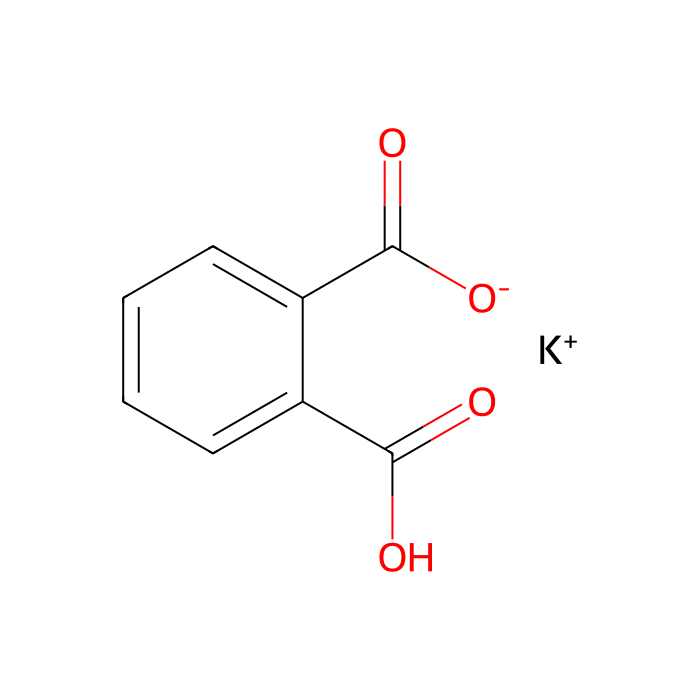
Brief overview: Potassium biphthalate (commonly abbreviated KHP; also called potassium hydrogen phthalate) is the monopotassium salt of phthalic acid used widely as an acidimetric primary standard.
Item-specific (Product Data)
SKU: P112246
Product name: Potassium biphthalate (KHP)
CAS: 877-24-7
CID: 23676735
InChIKey: 152690
SMILES: Not specified for this item; refer to CoA/Spec Sheet.
Grade/Purity: ACS
Storage: Room temperature; shipped under normal conditions
Molecular formula (literature): C8H5KO4 (often written as KHC8H4O4)
Molecular weight (literature): ~204.22 g/mol
2D structural description: A benzene ring bearing two adjacent (ortho) carboxylate groups; one is present as a carboxylic acid (–CO2H), the other is deprotonated (–CO2−) and ion-paired with K+. The resulting species is the hydrogen phthalate monoanion with K+ as counterion. No stereocenters are present.
Functional groups: Aromatic ring; one carboxylic acid; one carboxylate (potassium salt).
Synthetic Utility
While primarily an analytical standard, KHP can have niche synthetic and preparative roles (literature/general):
Acid source and counterion
Provides a controlled single equivalent of acidity (one acidic proton), useful when a non-volatile, solid acid is advantageous in aqueous media.
Potassium counterion can facilitate precipitation or ion-exchange where sodium or ammonium are undesirable.
Salt formation and separations
Hydrogen phthalate forms crystalline salts with certain organic cations; can be useful in resolution or purification studies where crystallinity and thermal stability are desired.
Precursor transformations
Acidification yields phthalic acid; neutralization with base gives phthalate salts (Ph2−), enabling access to phthalate buffers and salts with alternative cations via metathesis.
Ion chromatography and standards
Serves as a reference anion (hydrogen phthalate) for method development and system suitability tests.
Note: It is not typically a building block for complex organic synthesis or a participant in named carbon–carbon bond-forming reactions.
Target Specificity
Not applicable. This product is a chemical reagent (not a biological affinity reagent), and no target specificity, epitope, clone, isotype, or species reactivity applies.
We use cookies to ensure the website functions properly and, where permitted, to improve your experience. You can manage your preferences at any time in Settings. Learn more in our Cookie Policy.
Shall we send you a message when we have discounts available?
Remind me later
Thank you! Please check your email inbox to confirm.
Products are supplied to verified businesses, institutions, and qualified professionals for research and development use only. Not for use in humans, animals, diagnosis, or therapy.

 E2414119