QUALITÀ & PUREZZAMoligand™?Moligand™ — Aladdin's line of ligands and bioactive small molecules. Use for receptor, pathway, and binding studies needing defined small-molecule tools.≥99%
Moligand™,≥99% Moligand™ per flussi di lavoro cromatografici e analitici sensibili che richiedono un'interferenza minima della linea di base.
🌡
Stoccaggio e spedizione
Store at -20°C,Desiccated Spedizione Ice chest + Ice pads. Consultare il COA specifico del lotto per le specifiche esatte.
📋
Documenti di qualità
SDS, COA, scheda tecnica e scheda delle specifiche disponibili per il download. COA specifico del lotto accessibile tramite ricerca per numero di lotto.
📚
Prova documentale
Citato in 0 pubblicazioni peer-reviewed su cromatografia, sintesi organica e reazioni di accoppiamento incrociato.
Panoramica
Propofol β-D-glucuronide is a metabolite of propofol sulfate,mediated by UDP-glucuronosyltransferase (UGT), and can be used to study sleep deprivation (SD).
This compound belongs to the class of organic compounds known as phenolic glycosides. These are organic compounds containing a phenolic structure attached to a glycosyl moiety. Some examples of phenolic structures include lignans, and flavonoids. Among the sugar units found in natural glycosides are D-glucose, L-Fructose, and L rhamnose.
External Descriptors
Not available
1. Djoumbou Feunang Y, Eisner R, Knox C, Chepelev L, Hastings J, Owen G, Fahy E, Steinbeck C, Subramanian S, Bolton E, Greiner R, and Wishart DS. ClassyFire: Automated Chemical Classification With A Comprehensive, Computable Taxonomy. Journal of Cheminformatics, 2016, 8:61.
Determine the necessary mass, volume, or concentration for preparing a solution.
Dilution Calculator
Determine the dilution needed to prepare a stock solution.
Reconstitution Calculator
Recensioni
Recensioni dei clienti
Application Protocols
Tested applications and recommended dilutions are not provided for this item. Refer to the product CoA/Spec Sheet or SDS for any available handling notes.
No assay protocols are validated or supplied by the manufacturer for SKU P1440773. Users typically develop in-house procedures (e.g., LC–MS calibration standards, β-glucuronidase assays) tailored to their instruments and matrices.
Biological Roles
Propofol β-D-glucuronide is a primary phase II metabolite of propofol, produced by UDP-glucuronosyltransferases (UGTs) that conjugate glucuronic acid to the phenolic hydroxyl of the parent compound (literature, notably UGT1A9 in human liver).
Formation (literature): In hepatocytes and liver microsomes, propofol undergoes rapid O-glucuronidation using UDP-glucuronic acid (UDPGA) as cofactor, yielding the β-D-glucuronide. This increases polarity, facilitating biliary and renal excretion.
Physicochemical consequences: Conversion to the glucuronide dramatically increases aqueous solubility and reduces membrane permeability versus propofol, shifting disposition toward urine and bile.
Enzymatic fate (literature):
Susceptible to hydrolysis by β-glucuronidase, an enzyme present in lysosomes, some microbiota, and certain tissues, regenerating aglycone propofol under specific conditions.
May interact with transporters that recognize organic anions (e.g., MRP2/ABCC2, OATs), influencing tissue distribution and excretion.
Research utility:
Serves as a definitive analytical marker of propofol glucuronidation capacity in in vitro systems (recombinant UGT isoforms, microsomes, S9 fractions) and for in vivo metabolic profiling.
Useful in evaluating drug–drug interaction risks at the level of UGT-mediated conjugation and transporter-mediated clearance in preclinical studies.
Note: These roles are presented for biochemical context. This product is for research use only and is not intended for clinical or diagnostic applications.
Buffer Applications
While propofol β-D-glucuronide is not itself a buffering agent, it is commonly prepared and handled in buffered aqueous media for enzymology and analytical workflows.
pH considerations (literature/general):
The glucuronic acid moiety typically has a carboxyl pKa near 3–3.5 in related compounds; the conjugate is largely deprotonated (anionic) at neutral pH. Maintain pH 5–8 for good stability and solubility unless a specific protocol dictates otherwise.
Common buffers for handling and assays (general):
Enzyme assays: 50–100 mM phosphate (pH 6.5–7.4) or Tris (pH 7.4–8) for UGT reaction mixtures or β-glucuronidase hydrolysis controls.
LC–MS sample diluents: 5–20 mM ammonium formate or acetate (pH 3.5–6.5) in water–acetonitrile or water–methanol for volatility and ionization efficiency.
Practical guidance:
Avoid strong acidic buffers if preserving the O-glycosidic bond is critical; acid catalysis can promote cleavage over time.
Use low ionic strength and volatile buffers for mass spectrometry; filter through 0.2 µm to remove particulates before injection.
For quantitative work, prepare fresh buffered working solutions from frozen aliquots to limit hydrolysis or microbial growth.
Item-specific buffer preferences or validated recipes are not provided for this SKU; consult your method requirements and the literature for detailed formulations.
Green Alternatives
This product is not an organic solvent or bulk reagent where traditional green substitution frameworks directly apply. Nonetheless, for analytical and biochemical workflows involving propofol β-D-glucuronide, consider greener operational choices (general guidance):
Prefer aqueous buffers over chlorinated or highly toxic organic solvents during sample preparation and chromatography whenever compatible with method performance.
Use volatile, low-toxicity mobile phase additives (ammonium acetate/formate) in place of nonvolatile salts to reduce waste handling burdens.
Minimize DMSO concentration in working solutions (<1–2%) and replace with water or biocompatible cosolvents where feasible.
Adopt micro-scale assays and microflow LC to reduce solvent consumption.
Illustrative comparison (general):
Aqueous buffers vs. strong acids/bases: improved safety, lower corrosion, less hazardous waste; tradeoff is potential need for refrigerated storage to maintain conjugate stability.
MeOH vs. MeCN: methanol has a better environmental profile but may provide different chromatographic selectivity; choose based on performance and EHS balance.
These are general sustainability considerations; no item-specific environmental metrics are provided for this SKU.
Pharmaceutical Uses
This product is supplied strictly for research use only and is not intended for human or veterinary applications.
Role in pharmaceutical R&D (general/literature):
Analytical reference standard in bioanalytical method development and validation (e.g., LC–MS/MS) to quantify propofol metabolism in preclinical studies.
Tool compound for evaluating UGT-mediated conjugation pathways, metabolite identification, and transporter interactions during discovery/development.
Formulation/excipient status: Not used as an excipient; no pharmacopeial monograph is indicated for this metabolite. Any compendial status is Not specified for this item; refer to CoA/Spec Sheet if needed.
Manufacturing context:
Can be incorporated into internal controls, system suitability samples, and stability-indicating methods for metabolite tracking.
No clinical claims are made or implied. For regulated studies, ensure traceability and documentation (CoA, purity, salt/hydrate state) meet your quality system requirements.
Physical Properties
Item-specific measured physical constants are not provided for this catalog entry. The following points summarize expectations based on literature and general chemical reasoning for aryl β-D-glucuronides; do not treat as product specifications.
Appearance: Not specified for this item; refer to CoA/Spec Sheet. (Literature: glucuronides are typically off-white to white hygroscopic solids.)
State and polarity (literature/general): Highly polar organic acid; typically isolated as the free acid or an alkali metal salt; solid at ambient conditions.
Solubility (literature/general):
Freely soluble in water and aqueous buffers (especially above the pKa of the uronic acid carboxyl group).
Soluble in polar aprotic solvents such as DMSO; sparingly soluble in alcohols; poorly soluble in nonpolar organic solvents (e.g., hexanes, toluene).
Acid–base behavior (literature): The glucuronic acid carboxyl group has a typical pKa around 3–3.5 in related compounds, implying predominant anionic form at physiological pH; exact pKa for propofol β-D-glucuronide not established here.
Partitioning (literature/general): Expected very low logP and high logD(pH 7.4) hydrophilicity due to the carboxylate and multiple hydroxyls.
Hygroscopicity (literature/general): Carbohydrate conjugates can be hygroscopic; handle rapidly in dry atmosphere for accurate weighing.
Specifications such as melting point, density, refractive index, UV cutoff, or elemental limits are Not specified for this item; refer to CoA/Spec Sheet.
Quality and Grades
Supplied grade: Moligand™ (product data).
What Moligand™ implies (general description):
Intended for medicinal chemistry screening, biochemical assay development, and chemical biology workflows where well-defined identity and consistent performance are required.
While high purity is typically associated with screening libraries, exact purity percentage, residual solvents, water content, inorganic/organic impurities, or salt form are Not specified for this item; refer to CoA/Spec Sheet.
Identity and documentation:
CAS: 114991-26-3; PubChem CID: 71751823 listed for cross-reference.
InChIKey as provided: 174440. If a structure-confirmation package (NMR, MS, HPLC) is needed for your compliance workflow, request the current batch CoA/Spec.
Stabilizers/additives: Not specified for this item; refer to CoA/Spec Sheet. No stabilizer is assumed; if present, it will be disclosed on CoA.
Release testing (general expectations for this category): Identity by NMR/HRMS, purity by HPLC/UPLC, appearance, and water/volatile content by KF/GC as applicable; specific acceptance criteria are batch-dependent and provided on CoA.
Fit-for-purpose guidance:
For LC–MS bioanalytical standards, confirm salt form and hydration state to ensure accurate gravimetric/volumetric preparations.
For biochemical assays (e.g., β-glucuronidase studies), verify that residual solvents or buffers (if any) are compatible with your system.
Reaction and Applications
As the conjugated metabolite of propofol, propofol β-D-glucuronide is most valuable as a reference standard and tool compound rather than as a synthetic reagent.
Representative research uses (general/literature):
Bioanalytical standard for quantifying propofol glucuronidation in in vitro (liver microsomes, recombinant UGTs) and in vivo metabolism studies by LC–MS/MS.
Positive control substrate/product in β-glucuronidase assays and inhibitor screening; enables benchmarking of enzymatic hydrolysis rates to liberate propofol.
Transport studies: probe of anionic efflux transporters (e.g., MRP/ABCC family) and renal/hepatic handling of glucuronides.
Method development: optimization of solid-phase extraction (SPE) or protein precipitation protocols for polar metabolites.
Chemical behavior (general):
Acid-labile O-glycosidic bond; hydrolysis accelerated under strong acid and by β-glucuronidase; comparatively stable in neutral aqueous media at low temperature.
Anionic at neutral pH due to the carboxylate, enhancing aqueous solubility and affecting retention on reversed-phase LC (often requires ion-pairing or high aqueous content).
Practical notes:
For calibration curves, gravimetric primary stocks in water or DMSO can be serially diluted into 50:50 MeOH:water with 0.1% formic acid or 5 mM ammonium acetate (literature practice) to stabilize and standardize ionization.
When comparing UGT activities (e.g., UGT1A9), ensure cofactor UDPGA is not limiting and include saccharolactone only when preventing deconjugation is necessary.
No manufacturer-specific application notes are provided for this SKU; tailor use to your assay/system.
Reaction Conditions
No item-specific reaction testing data are provided. The following conditions are general literature guidance for workflows involving propofol β-D-glucuronide.
Enzymatic hydrolysis (β-glucuronidase, general):
Buffer: 50–100 mM sodium acetate or phosphate, pH 5.0–6.8.
Temperature: 37°C.
Time: 0.5–16 h depending on enzyme source and loading.
Monitoring: LC–MS/MS or HPLC-UV for decrease of glucuronide and appearance of propofol.
Chemical stability studies (general):
Neutral pH (6–8) at 0–4°C: relatively stable over days to weeks in the absence of enzymes.
Acidic conditions (pH <3) and elevated temperature: accelerated cleavage of O-glycosidic bond; avoid prolonged exposure.
LC–MS method development (general):
Mobile phase A: water with 5–10 mM ammonium acetate/formate; Mobile phase B: acetonitrile or methanol.
Gradient: high aqueous start (90–98% A) to retain the polar glucuronide on C18; alternative HILIC can be used for enhanced retention.
Ionization: negative ESI often preferred for carboxylate-containing glucuronides; positive ESI may be viable with ammonium adducts; optimize source parameters empirically.
Solubility handling (general):
Stock: 1–100 mM in water or DMSO; aliquot and freeze to avoid repeated thawing.
All parameters above are literature/general guidance and should be optimized for your specific matrix, instrument, and assay goals.
Safety and Handling
Regulatory/GHS
GHS classification, signal word, pictograms, and H-statements: Not specified for this item; refer to the product SDS for authoritative safety information.
Research use: For research use only (product data). Not for human or veterinary use.
General hazards (general chemistry): Carbohydrate conjugates are typically of low volatility; dust may cause mechanical irritation. Avoid inhalation of powders and contact with eyes/skin.
PPE and engineering controls (best practice):
Wear lab coat, safety glasses, and appropriate chemical-resistant gloves (e.g., nitrile). Handle powders in a fume hood or on a balance enclosure to minimize dust exposure.
Use local exhaust when weighing or transferring.
Incompatibilities (general): Strong oxidizing agents; strong bases/acids may promote hydrolysis or degradation of the glycosidic linkage; avoid prolonged exposure to elevated temperature and moisture.
First aid (overview; defer to SDS):
Inhalation: Move to fresh air; seek medical attention if symptoms persist.
Skin/eye contact: Rinse with water for several minutes; remove contaminated clothing; seek medical attention for persistent irritation.
Ingestion: Rinse mouth; do not induce vomiting; seek medical advice.
Thermal/chemical stability (general): O-glycosidic bonds can be susceptible to acid-catalyzed hydrolysis; β-glucuronides are enzymatically cleavable by β-glucuronidase. Protect from moisture and heat to minimize degradation.
Waste: Collect aqueous/organic waste according to institutional and local regulations; do not discharge to drains without authorization.
Solvent Selection
Propofol β-D-glucuronide is a highly polar, ionic analyte above pH ~3 due to the glucuronic acid carboxylate. Solvent choice should prioritize solubility, chemical stability, and analytical compatibility.
Primary solvents (general/literature guidance):
Water and aqueous buffers (pH 4–8) for most biochemical and analytical applications.
DMSO for high-concentration stock solutions (e.g., 10–100 mM), then dilute into buffer immediately before use.
Methanol or acetonitrile-water mixtures for LC sample prep; include modest buffer or volatile acid/base for pH control.
Miscibility and polarity (general): Insoluble or very sparingly soluble in nonpolar solvents (hexane, toluene, MTBE). Limited solubility in neat acetonitrile; markedly improved with water content.
Stability considerations:
Avoid strong acid (risk of glycosidic hydrolysis) and strong base (risk of β-elimination/sugar degradation) during long storage.
For LC–MS, use volatile buffers (ammonium formate/acetate, pH 3.5–6.5) to balance ionization efficiency and stability.
Practical tips:
If weighing hygroscopic solid, rapidly transfer into a premeasured volume of solvent to minimize moisture uptake.
For quantitative work, prepare fresh aqueous stocks and store aliquots at ≤−20°C to limit hydrolysis.
Comparison (general):
Water/buffer: best biocompatibility and ionization control; shortest stability at extremes of pH.
DMSO: highest solubilizing power; may suppress certain enzyme activities upon dilution if residual DMSO >1–2%.
MeOH/MeCN: excellent for LC sample cleanup; may require pH adjustment to maintain analyte integrity.
Storage and Reconstitution
Item-specific storage and shipping (product data):
Storage conditions: Store at −20°C, desiccated.
Shipping: Ice chest + ice pads.
Container and handling (best practice):
Keep tightly closed in original container with desiccant. Warm to room temperature in a desiccator before opening to prevent condensation.
Minimize exposure to ambient humidity; promptly reseal after use.
Stability notes (general):
β-D-Glucuronides are generally stable at neutral pH when kept cold and dry; avoid strong acids/bases and elevated temperatures that can promote hydrolysis.
Reconstitution (item-specific): Not specified for this item; refer to CoA/Spec Sheet.
Prepare primary stocks in water, buffer (pH 6–7.4), or DMSO depending on the intended use. Typical working stocks: 1–10 mM.
Filter (0.2 µm) or centrifuge if particulate matter is present before analytical injections.
For long-term storage of solutions, aliquot and freeze at ≤−20°C; avoid repeated freeze–thaw cycles by using single-use aliquots.
Assign in-house retest dates and monitor by LC/HPLC to confirm integrity over time, especially after multiple thaws.
Always consult the current batch CoA for any additional, lot-specific storage or handling instructions.
Structure and Identity
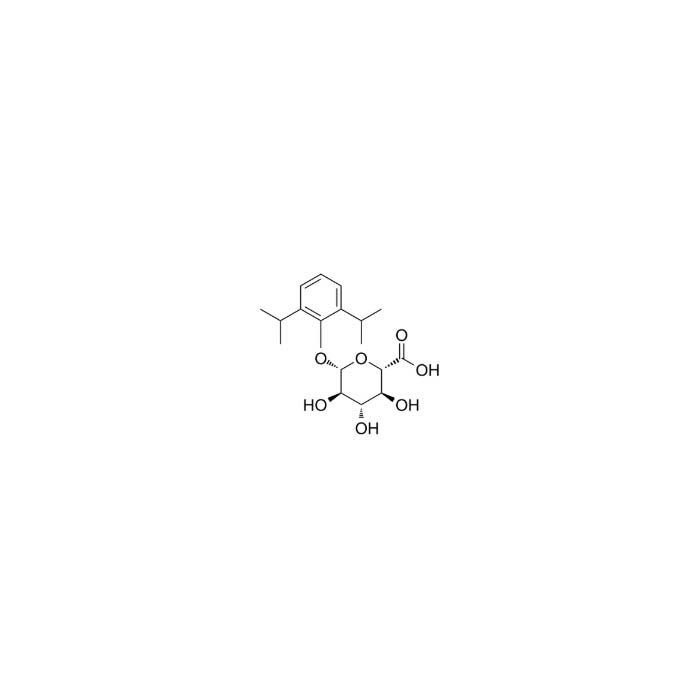
Propofol β-D-glucuronide is the phase II O-glucuronide conjugate of the phenolic anesthetic propofol (2,6-diisopropylphenol), in which the phenolic oxygen is glycosidically linked to the anomeric carbon (C1) of β-D-glucuronic acid.
Item identifiers (product data)
SKU: P1440773
Product name: Propofol β-D-glucuronide
CAS: 114991-26-3
PubChem CID: 71751823
InChIKey: 174440 (as supplied)
SMILES: Not specified for this item; refer to CoA/Spec Sheet.
Structure description (general chemistry)
Functional groups: aryl ether (phenolic O–glycosidic bond), β-D-glucuronide (pyranose), terminal carboxylic acid (often present as salt in practice), multiple secondary alcohols on the sugar ring, two isopropyl substituents on the aromatic ring.
Stereochemistry: β-configuration at the anomeric center; D-series configuration across the glucuronic acid stereocenters (literature).
Ring systems: one benzene ring; one glucopyranose (pyran) ring oxidized at C6 to carboxyl.
Composition
Molecular formula: Not specified for this item; refer to CoA/Spec Sheet.
Molecular weight: Not specified for this item; refer to CoA/Spec Sheet.
Notes: The structure can be visualized as propofol–O–(β-D-glucuronide), i.e., the phenolic hydrogen of propofol is replaced by the β-D-glucuronosyl residue via an O-glycosidic bond.
Synthetic Utility
Propofol β-D-glucuronide is primarily a tool and reference compound rather than a building block; however, its chemistry informs several useful transformations and assays.
Functional group behavior (general):
O-β-D-glucuronide linkage: susceptible to acid-catalyzed hydrolysis and enzymatic cleavage by β-glucuronidase; relatively stable in neutral aqueous media at low temperature.
Carboxylic acid (glucuronic acid C6): enables salt formation (e.g., sodium, ammonium) to tune solubility; can participate in ion-pairing during separations.
Multiple hydroxyls: provide handles for derivatization (e.g., peracetylation for GC analysis after suitable protection/deprotection, literature practices).
Applications in synthetic/analytical workflows:
Reference for validating chemical or enzymatic glucuronidation procedures of phenolic substrates (e.g., benchmarking UGT-mediated reactions or chemical Koenigs–Knorr-type glycosylations in method development).
Positive control substrate for β-glucuronidase inhibition assays; quantification of released propofol gauges hydrolytic performance.
Calibration of SPE methods targeting polar anionic metabolites; optimization of wash/elution strength.
Retrosynthetic note (general):
Constructed by glycosylation of propofol (aglycone) with a protected glucuronic acid donor (e.g., trichloroacetimidate, halide, or thioglycoside donors) under conditions favoring β-selectivity, followed by global deprotection and, if desired, salt formation. This is literature context and not a manufacturing description of this SKU.
Because this item is supplied as a finished metabolite standard, further synthetic manipulation is typically unnecessary.
Target Specificity
Not applicable. This product is a small-molecule metabolite standard, not a biological affinity reagent. No antigen/epitope, species reactivity, clone, or isotype information applies. Item-specific target specificity data are not provided for this SKU.
Domande frequenti
What is the purity of this product?
This product is supplied at ≥99% purity (chemical assay). Lot-specific values are stated on the Certificate of Analysis.
What is Moligand??
Moligand? is one of Aladdin Scientific's premium product lines, formulated for high-purity applications across multiple workflows. Compared to standard grades in the same workflow, Moligand? products typically offer tighter specifications, more rigorous QC, and stronger lot-to-lot consistency.
How should this product be stored?
Store at ?20 °C, desiccated. Keep the container tightly closed with desiccant — the material is moisture-sensitive.
How is this product shipped?
This product ships in an insulated container with ice pads. Unpack on arrival and transfer it to the storage condition stated above.
What are the CAS number, molecular formula and molecular weight?
The CAS Number is 114991-26-3, the molecular formula is C18H26O7, and the molecular weight is 354.39 g/mol. InChIKey JZSJIASBMOIIKI-RUKPJNHUSA-N.
What documentation is provided?
Available product documentation, including Certificates of Analysis (COA), Safety Data Sheets (SDS), and specification sheets, is shown in the product document area. Document availability and access follow the current site policy.
Hai bisogno di aiuto per scegliere la qualità?
La nostra guida alla selezione delle qualità copre purezza, stato dello stabilizzatore e idoneità all'applicazione per tutte le varianti del nostro catalogo.
Utilizziamo i cookie per garantire il corretto funzionamento del sito web e, ove consentito, per migliorare la tua esperienza. Puoi gestire le tue preferenze in qualsiasi momento nelle Impostazioni. Per saperne di più, consulta la nostra Cookie Policy.
Desidera che le inviamo un messaggio quando avremo sconti disponibili?
Ricordamelo più tardi
Grazie! Controlli la sua casella di posta per confermare.
Products are supplied to verified businesses, institutions, and qualified professionals for research and development use only. Not for use in humans, animals, diagnosis, or therapy.

 K2514643