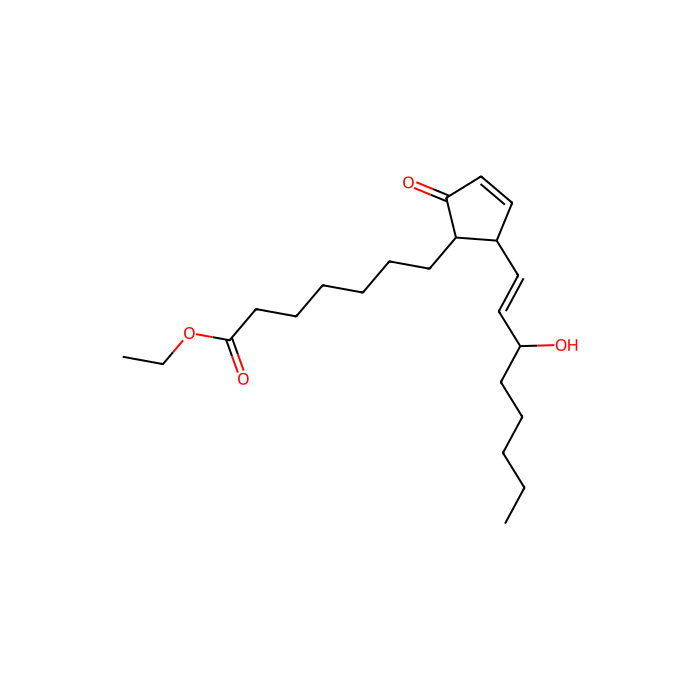
This compound belongs to the class of organic compounds known as prostaglandins and related compounds. These are unsaturated carboxylic acids consisting of a 20 carbon skeleton that also contains a five member ring, and are based upon the fatty acid arachidonic acid.
External Descriptors
Not available
1. Djoumbou Feunang Y, Eisner R, Knox C, Chepelev L, Hastings J, Owen G, Fahy E, Steinbeck C, Subramanian S, Bolton E, Greiner R, and Wishart DS. ClassyFire: Automated Chemical Classification With A Comprehensive, Computable Taxonomy. Journal of Cheminformatics, 2016, 8:61.
Certificati (CoA, COO, BSE/TSE e tabella di analisi)
C of A & Other Certificates(BSE/TSE, COO):
Analytical Chart:
Calcolatori di soluzioni
Molarity Calculator
Determine the necessary mass, volume, or concentration for preparing a solution.
Dilution Calculator
Determine the dilution needed to prepare a stock solution.
Reconstitution Calculator
Recensioni
Recensioni dei clienti
Application Protocols
Item-specific, validated application protocols: Not specified for this item; refer to CoA/Spec Sheet and SDS.
General handling protocols (literature/general)
Stock preparation: Dissolve in anhydrous DMSO or ethanol to 10–50 mM under inert gas; vortex to mix. Filter through a PTFE syringe filter (0.2 µm) if particulate is present.
Aliquoting: Dispense single-use aliquots in amber vials or low-bind tubes. Flush with nitrogen/argon before sealing.
Working solutions: Dilute into assay buffer with vigorous mixing to final solvent ≤0.1–1% v/v (as assay allows). Confirm solubility visually; avoid precipitation.
Analytical check: Verify concentration by UV or LC–MS if quantitative dosing is required.
Notes
Include vehicle controls matching solvent type and percentage.
Minimize freeze–thaw by using small aliquots.
Biological Roles
Scope note: The following are general, literature-based roles of the prostaglandin A₁ (PGA₁) chemotype; they are provided for biochemical context only. This product is for research use only and not for human or veterinary use.
Literature/general overview
PGA₁ is a cyclopentenone prostaglandin derived biosynthetically from dihomo-γ-linolenic acid pathways. The α,β-unsaturated ketone (enone) confers electrophilicity, enabling covalent Michael addition to protein cysteines and other nucleophiles.
Such covalent interactions can modulate protein function in cell signaling pathways in vitro (e.g., redox-sensitive transcription factors, thiol enzymes; literature/general). The ethyl ester form enhances membrane permeability and stability relative to the free acid but typically requires in situ or metabolic hydrolysis to yield PGA₁ acid for receptor-level interactions.
In cell-free systems, PGA-type prostaglandins can serve as electrophilic lipid standards to study adduct formation kinetics, glutathione conjugation, and phase II metabolic processing (literature/general).
Handling implications
Due to potential bioactivity at low concentrations, rigorously control exposure and include appropriate vehicle controls in experiments.
Verify absence/presence of stabilizers if studying covalent protein modification, as radical scavengers can affect redox signaling readouts.
Buffer Applications
Not typically applicable.
Prostaglandin A₁ ethyl ester is a hydrophobic small molecule, not a buffering agent. It does not form defined buffer systems. For experimental use, it is typically dissolved in an organic cosolvent (e.g., DMSO or ethanol) and then diluted into a biological buffer as a vehicle. Optimize vehicle percentage to maintain solubility and avoid precipitation.
Green Alternatives
Context (general)
The primary environmental considerations for this compound arise from the choice of solvents and stabilizers during handling and synthesis rather than from the molecule itself.
Greener solvent choices (literature/general)
Prefer ethyl acetate, ethanol, or 2-methyltetrahydrofuran (2-MeTHF) over chlorinated solvents where feasible.
For extractions and workups, replace dichloromethane with ethyl acetate/heptane systems when selectivity allows.
Use supercritical CO₂ for preparative separations where infrastructure exists.
Stabilization without heavy additives
Minimize oxygen exposure by working under nitrogen/argon and using small aliquots; this can reduce the need for antioxidant stabilizers.
Comparison (general)
Dichloromethane/chloroform: excellent solubility but high environmental/health impact.
Ethyl acetate/ethanol: good solvency for esters and improved environmental profile; may require temperature control to match solubility.
2-MeTHF/CPME: water-tolerant ethers with better safety/green scores than THF/diethyl ether; confirm compatibility with enone stability.
Waste minimization
Concentrate and recycle solvent streams when possible; segregate halogenated from non-halogenated waste to facilitate disposal.
Pharmaceutical Uses
No therapeutic or clinical claims are made. For research and development context only.
General formulation roles (literature/general)
Prostaglandin esters are often explored as prodrug-like forms in preclinical research, leveraging increased lipophilicity and improved chemical stability relative to the free acid.
In formulation studies, the ethyl ester may be incorporated into lipid-based delivery systems (e.g., micelles, liposomes, emulsions) to examine release and hydrolysis behavior in model systems.
Standards and monographs
No pharmacopeial monograph information is provided for this specific ethyl ester. Confirm any regulatory specifications independently if developing analytical methods.
Physical Properties
Item-specific specifications
Appearance: Not specified for this item; refer to CoA/Spec Sheet.
Molecular Weight: Not specified for this item; refer to CoA/Spec Sheet.
Any numeric physicochemical specs (bp, mp, density, UV cutoff, water/peroxide/metal content): Not specified for this item; refer to CoA/Spec Sheet.
Literature/general expectations for PGA₁ ethyl ester (non-spec, for planning only)
Physical state: typically a colorless to pale oil or low-melting waxy solid for long-chain prostaglandin esters.
Solubility: poor in water; good in organic solvents (e.g., ethanol, methanol, isopropanol, ethyl acetate, dichloromethane, chloroform, acetone); highly soluble in DMSO (literature/general).
Partitioning: expected to be highly lipophilic due to long hydrocarbon chain and esterification (high logP; literature/general, not item-specific).
Spectroscopy: UV absorption increases in 200–230 nm region and in the near-270–280 nm region for cyclopentenone conjugation (literature/general); use for qualitative tracking by HPLC-UV.
Practical notes (general)
Sensitive to light, air, and heat; may isomerize or oxidize at the polyunsaturated chain. Handle under low light and inert gas when feasible.
The ethyl ester can slowly hydrolyze in basic aqueous media; minimize exposure to strong base at elevated temperatures.
Quality and Grades
Item-specific grade/purity
Grade/Purity: Not specified for this item; refer to CoA/Spec Sheet.
Context and implications (general)
For bioactive lipids and their esters, key quality attributes typically include isomeric purity (E/Z ratio of double bonds), stereochemical integrity at ring stereocenters, and low oxidation byproducts (peroxides/epoxides). In the absence of a stated grade, verify via CoA and, if critical, confirm by in-house HPLC and MS.
UV background: HPLC- or LC-MS–oriented grades often feature low non-volatile residue and low UV background; if your application is trace analysis, consider pre-testing solvent blanks and stabilizers.
Stabilizers: Some suppliers add a trace antioxidant (e.g., BHT) to limit autoxidation of polyunsaturated chains. Presence/absence and level of stabilizer should be confirmed on the CoA; stabilizers can affect certain assays.
Purity: analytical HPLC with UV at 205–215 nm and 270–280 nm; LC-MS to detect oxidized/isomerized impurities.
Peroxide value: optional screening for autoxidation (if relevant to your work).
Reaction and Applications
Item-specific manufacturer applications
Manufacturer Applications: Not specified for this item; refer to CoA/Spec Sheet.
Research and synthetic uses (literature/general)
Prodrug/handling form: The ethyl ester serves as a protected, more lipophilic form of PGA₁ for ease of handling, purification, and incorporation into hydrophobic matrices; it can be hydrolyzed to the free acid under controlled conditions.
Electrophilic probe chemistry: The cyclopentenone enone can undergo Michael addition with nucleophiles (thiols, amines), enabling covalent modification studies of peptide/protein thiols or small-molecule adduct formation (literature/general).
Derivatization: Selective reductions (e.g., 1,2- vs 1,4-addition regimes), epoxidation of double bonds, hydrogenation/isomerization studies along the polyunsaturated chain.
Lipidomics reference: Can serve as a reference material for method development in LC–MS-based lipidomics when analyzing prostaglandin A-type species (use appropriate internal standards; literature/general).
Practical tips
Protect from light and oxygen (amber vials, inert gas headspace). Consider adding a trace antioxidant when compatible with downstream use.
Avoid strong base or prolonged basic aqueous conditions to prevent unwanted saponification.
For covalent adduct studies, control pH (7–8) and thiol availability; monitor by LC–MS.
For hydrolysis to the acid, prefer anhydrous transesterification or mild saponification, then immediate acidification and extraction to minimize isomerization/oxidation.
Reaction Conditions
General conditions (literature/general; optimize experimentally)
Hydrolysis to PGA₁ acid: mild saponification (e.g., 0.05–0.2 M NaOH or K₂CO₃ in MeOH/H₂O, 0–25 °C) with careful monitoring; immediate acidification (e.g., dilute HCl to pH ~2) and extraction at low temperature to minimize isomerization/oxidation.
Transesterification: catalytic acid (p-TsOH) or base (NaOMe) in corresponding alcohol (ROH) at 0–25 °C; short reaction times favored to preserve double-bond geometry.
Michael additions to enone: soft nucleophiles (e.g., thiols) in buffered aqueous-organic media (pH 7–8) or in aprotic solvents with base (e.g., Et₃N); monitor by LC–MS.
Epoxidation of double bonds: peracids (e.g., mCPBA, 0 °C to rt) with antioxidant precautions; quench and work up promptly.
Hydrogenation: H₂ (1–3 atm) over Pd/C in EtOAc/EtOH at 0–25 °C to reduce select double bonds; the enone can also be reduced depending on catalyst and conditions.
Practical controls
Inert atmosphere (N₂/Ar) and subdued light throughout to prevent autoxidation/isomerization.
Use acid-washed glassware and peroxide-free solvents. Include a small amount of antioxidant (e.g., BHT) if compatible with downstream use.
Yields and times
Not specified for this item; consult primary literature for specific transformations of PGA-type esters.
Safety and Handling
Item-specific hazard data
GHS Classification: Not specified for this item; refer to SDS.
Signal Word: Not specified for this item; refer to SDS.
H-Statements/Pictograms: Not specified for this item; refer to SDS.
General safety considerations for prostaglandin esters (literature/general)
Potential hazards: may cause skin/eye irritation and respiratory irritation. Lipid mediators can exhibit potent biological activity at very low concentrations; avoid exposure and ingestion.
PPE: lab coat, safety glasses, and appropriate chemical-resistant gloves (e.g., nitrile). Work in a fume hood to avoid inhalation of solvent vapors and aerosols.
Incompatibilities: strong oxidizers; strong bases/acids (ester hydrolysis/side reactions); light and oxygen (autoxidation of unsaturated bonds). Avoid prolonged exposure to elevated temperature.
Special risks: cyclopentenone prostaglandins contain electrophilic enone functionality capable of Michael addition to thiols; avoid skin contact.
First-aid overview (general; always follow SDS)
Skin: wash with soap and water; remove contaminated clothing.
Eyes: rinse cautiously with water for several minutes; seek medical attention if irritation persists.
Inhalation: move to fresh air; seek medical attention if symptoms occur.
Ingestion: rinse mouth; seek medical attention. Do not induce vomiting unless directed.
Waste
Collect organic solvent waste per institutional and local regulations. Quench reactive residues cautiously; avoid strong base that may hydrolyze product unless intended for disposal.
Reference
For authoritative and item-specific guidance, consult the SDS.
Solvent Selection
Polarity and miscibility (literature/general)
Prostaglandin A₁ ethyl ester is highly lipophilic and essentially insoluble in water; it dissolves readily in polar aprotic (DMSO, DMF, acetonitrile to a degree) and polar protic organic solvents (ethanol, methanol, isopropanol), as well as in moderately nonpolar solvents (ethyl acetate, dichloromethane, chloroform, toluene).
Working stock recommendations (general)
Prepare concentrated stocks (e.g., 10–50 mM) in dry, oxygen-reduced DMSO or ethanol. Aliquot and store at −20 °C, protected from light.
For aqueous systems, pre-dissolve in a minimal volume of solvent, then dilute into buffered media with vigorous mixing; final cosolvent content often kept ≤0.1–1% v/v (optimize per assay).
Selection guidance
DMSO: best for long-term frozen stocks; minimal volatility; strong solvating power.
Ethanol: suitable for biological additions; volatile; ensure compatibility with assay.
Ethyl acetate or CH2Cl2: convenient for extractions and preparative workflows.
Comparison (general)
If minimal biological interference is critical, ethanol may be preferable to DMSO. For synthetic transformations, choose solvent based on reaction (e.g., MeOH/EtOH for transesterification; THF/DMF for coupling chemistries).
Storage and Reconstitution
Item-specific instructions (from Product Data)
Storage Conditions: Store at -20°C.
Shipped In: Ice chest + Ice pads.
Additional best practices (general)
Protect from light (amber containers) and from air (nitrogen/argon headspace). Store desiccated.
Avoid repeated freeze–thaw cycles; keep as single-use aliquots.
If long-term storage is required (>6 months), evaluate stability under −80 °C.
Reconstitution (general guidance)
Solvents: Use anhydrous DMSO or ethanol for stock solutions. Water solubility is poor; pre-dissolve in organic solvent before any aqueous dilution.
Concentration: Not specified for this item; refer to CoA/Spec Sheet. Common working stocks are 10–50 mM (literature/general) tailored to assay needs.
Thawing: Warm briefly to room temperature to fully dissolve, then immediately return unused material to −20 °C.
Stability notes
The polyunsaturated chain and enone are susceptible to oxidation and isomerization. Use peroxide-free solvents and consider adding trace antioxidant if compatible with your application.
For authoritative stability data (shelf life, impurity limits), consult the CoA/Spec Sheet.
Structure and Identity
Brief overview: Prostaglandin A₁ ethyl ester is an ethyl-esterified derivative of the cyclopentenone prostaglandin A₁ (PGA₁), typically used as a lipophilic, storage-stable form for research in prostanoid chemistry and biochemistry.
Item-specific (from Product Data)
SKU: P350962
Product Name: Prostaglandin A₁ ethyl ester
CAS: 93464-24-5
PubChem CID: 12149511
InChIKey: 345083 (note: this is not in standard InChIKey format; refer to CoA/Spec Sheet for confirmation)
Molecular Formula: Not specified for this item; refer to CoA/Spec Sheet.
Molecular Weight: Not specified for this item; refer to CoA/Spec Sheet.
SMILES: Not specified for this item; refer to CoA/Spec Sheet.
Structural features (general/literature description of the PGA₁ ethyl ester scaffold)
Contains a 5-membered cyclopentenone ring with an α,β-unsaturated carbonyl (electrophilic Michael acceptor).
Polyunsaturated aliphatic side chains (cis-alkenes) typical of prostaglandins.
Terminal carboxylate of PGA₁ masked as an ethyl ester, increasing lipophilicity and hydrolytic stability.
No defined stereochemistry is provided in Product Data; prostaglandins typically contain multiple stereocenters established by natural biosynthesis (literature).
Core cyclopentane ring bearing one enone (C=O conjugated to C=C), a hydroxyl or carbonyl substitution pattern characteristic of A-series prostaglandins, and two side chains: an ω-chain with multiple double bonds and a shorter substituent; the terminal acid is ethyl-esterified.
Synthetic Utility
Functional groups and reactivity (literature/general)
Cyclopentenone enone: undergoes conjugate (1,4-) addition with soft nucleophiles (thiols, amines), and can participate in selective reductions and Michael-type functionalizations.
Polyunsaturated side chain: amenable to epoxidation (e.g., mCPBA), dihydroxylation (OsO₄/NMO), hydrogenation (H₂/Pd), or E/Z isomerization under light/acid; careful control is required to preserve native geometry.
Ethyl ester: allows standard ester chemistry—hydrolysis (acidic/basic), transesterification, activation to mixed anhydrides or acid chlorides (after deprotection) for amide coupling.
Retrosynthetic value
The ester can serve as a masked acid handle for convergent coupling strategies, enabling late-stage diversification without acid-sensitive side reactions.
Electrophilic tagging: the enone can be derivatized with labeled thiols/amines to generate affinity probes or reporter conjugates for analytical studies.
Analytical handles
Distinct IR bands for ester and enone carbonyls facilitate monitoring. HPLC-UV at 205–215 nm and ~275 nm (enone) is useful for purity tracking; MS readily detects the sodium adduct in ESI+ (literature/general).
Target Specificity
Item-specific target details are not provided for this product.
No antigen, epitope, clone, isotype, or species reactivity information applies; this product is a small-molecule lipid ester, not an antibody or biologic. Any interactions discussed elsewhere (e.g., covalent adduct formation with thiols) are general, literature-based biochemical observations and not product-specific validations.
We use cookies to ensure the website functions properly and, where permitted, to improve your experience. You can manage your preferences at any time in Settings. Learn more in our Cookie Policy.
Shall we send you a message when we have discounts available?
Remind me later
Thank you! Please check your email inbox to confirm.
Products are supplied to verified businesses, institutions, and qualified professionals for research and development use only. Not for use in humans, animals, diagnosis, or therapy.