Determine the necessary mass, volume, or concentration for preparing a solution.
≥95% for sensitive chromatographic and analytical workflows requiring minimal baseline interference.
Room temperature Ships Normal Check lot-specific COA for exact specifications.
SDS, COA, datasheet, and spec sheet available for download. Lot-specific COA accessible via lot number lookup.
Cited in 1 peer-reviewed publications across chromatography, organic synthesis, and cross-coupling reactions.
Comprehensive hazard, handling, storage, and regulatory compliance document.
Download SDS →Lot-specific quality data. Enter your lot number to retrieve the exact COA.
Look up COA →Full quality attributes and acceptance criteria for this grade.
View spec sheet →Taxonomy Tree
| Kingdom | Organic compounds |
|---|---|
| Superclass | Benzenoids |
| Classe | Benzene and substituted derivatives |
| Subclass | Benzenesulfonic acids and derivatives |
| Intermediate Tree Nodes | Not available |
| Direct Parent | Benzenesulfonic acids and derivatives |
| Alternative Parents | 1-sulfo,2-unsubstituted aromatic compounds Benzenesulfonyl compounds Nicotinamides Aniline and substituted anilines Pyridinones Pyridinolates Aminotriazines Chloro-s-triazines Dihydropyridines Methylpyridines Aryl chlorides Sulfonyls Organosulfonic acids Heteroaromatic compounds Azo compounds Lactams Organic metal halides Carboximidic acids Propargyl-type 1,3-dipolar organic compounds Azacyclic compounds Organic oxides Organic sodium salts Organochlorides Organooxygen compounds Amines Hydrocarbon derivatives Organic cations |
| Molecular Framework | Aromatic heteromonocyclic compounds |
| Substituents | Benzenesulfonate - 1-sulfo,2-unsubstituted aromatic compound - Nicotinamide - Arylsulfonic acid or derivatives - Benzenesulfonyl group - Aniline or substituted anilines - Pyridinolate - Amino-1,3,5-triazine - Pyridinone - Chloro-s-triazine - Halo-s-triazine - Dihydropyridine - Methylpyridine - Aminotriazine - Hydropyridine - Pyridine - Triazine - 1,3,5-triazine - Aryl chloride - Aryl halide - Heteroaromatic compound - Organic sulfonic acid or derivatives - Organosulfonic acid or derivatives - Organosulfonic acid - Sulfonyl - Azo compound - Lactam - Propargyl-type 1,3-dipolar organic compound - Organic 1,3-dipolar compound - Organic metal halide - Organoheterocyclic compound - Carboximidic acid - Carboximidic acid derivative - Azacycle - Organic alkali metal salt - Organic oxygen compound - Organic salt - Organohalogen compound - Organochloride - Organonitrogen compound - Amine - Organooxygen compound - Organosulfur compound - Organic sodium salt - Hydrocarbon derivative - Organic oxide - Organic nitrogen compound - Organic cation - Aromatic heteromonocyclic compound |
| Descrizione | This compound belongs to the class of organic compounds known as benzenesulfonic acids and derivatives. These are organic compounds containing a sulfonic acid or a derivative thereof that is linked to a benzene ring. |
| External Descriptors | Not available |
No manufacturer-validated protocols are provided for this item. The following procedure outlines a general lab-scale cellulose dyeing test for reactive dyes (literature/general). Optimize for your substrate and this SKU.
Lab-scale exhaust dyeing (cotton):
Notes:
This guidance is non-specific; confirm parameters with small trials and consult the item’s CoA.
This product is a synthetic reactive dye supplied for research use and does not have an inherent biological role.
Literature/general context:
Caution:
For research use only: As specified in the Product Data, this material is not intended for clinical or in vivo applications.
This product is a colorant and is not a buffering agent. Therefore, it is not typically used to establish or maintain solution pH.
Practical notes for related workflows (literature/general):
If your application requires a specific buffer recipe or pH profile, design it around the kinetics of the reactive moiety you are employing and verify performance experimentally with this SKU.
Considerations for greener practice with reactive azo dyes (literature/general):
Strategies and alternatives:
Tradeoffs (general):
Recommendation: Conduct a small design-of-experiments (DOE) varying pH, temperature, and electrolyte to map fixation vs. hydrolysis for your substrate, then scale under the most resource-efficient conditions.
No pharmacopeial grade or excipient role is specified for this item.
Context (literature/general):
Compliance reminder:
Recommendation:
Item-specific physical property specifications are not provided in the Product Data for SKU R331861.
Literature/general notes for reactive azo dyes (context, not product specifications):
Practical guidance:
Interpretation and guidance (general):
Research use only: As stated in the Product Data, this material is for research use only. It is not intended for food, drug, cosmetic, household, or clinical applications.
Recommendation: Prior to critical experiments, document the following from the CoA for this SKU: dye content (%), moisture (%), inorganic salt (%), λmax and ε (if given), and any stated impurity limits. Where not provided, establish internal QC (UV–Vis fingerprint, HPLC profile) for your application.
Manufacturer applications are not provided. The following summarizes literature/general uses of reactive yellow dyes (including C.I. Reactive Yellow 86 as a class designation) in research and processing; verify suitability for your workflow.
Practical tips (general):
Note: Exact reactivity and shade depth depend on the specific structure and dye content for the supplied lot; consult the CoA and perform small-scale trials.
Item-specific reaction conditions are not provided. The following are literature/general conditions commonly employed for reactive dyes and should be adapted/validated for this SKU and substrate.
For cellulose (exhaust dyeing):
For protein/amine labeling (analytical scale):
Surface functionalization:
Monitoring and QA:
Caution: Hydrolysis of the reactive group competes under alkaline conditions; prepare alkaline baths immediately before use.
Safety data specific to this item (GHS classification, H-statements, pictograms, signal word) are not provided in the Product Data. Always consult the product SDS for authoritative hazard classification and emergency measures.
General laboratory safety guidance for reactive azo dyes (literature/general):
Storage conditions: Room temperature (per Product Data). Keep container tightly closed, dry, and protected from light and sources of contamination. Refer to SDS for detailed stability and incompatibility information.
Item-specific solubility data are not provided. The following guidance reflects literature/general properties of anionic reactive azo dyes and should be verified experimentally for this SKU.
Comparison (general):
Tip: Pre-wet powders and add incrementally under vigorous stirring to prevent agglomeration and to achieve homogeneous solutions.
Reconstitution (general guidance; not item-specific):
Documentation: For any item-specific constraints (e.g., moisture limits, dye content, λmax), consult the CoA/Spec Sheet. Always label solutions with preparation date, concentration, and pH.
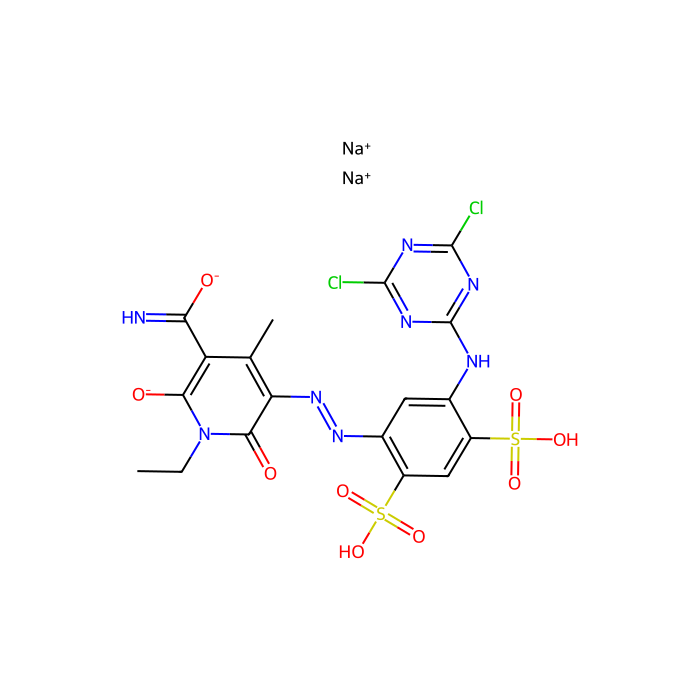
Reactive Yellow 86 is a member of the reactive dye class (Color Index: Reactive Yellow 86), commonly used to covalently color hydroxyl-containing substrates (e.g., cellulose) under alkaline conditions.
Item-specific identifiers (from Product Data):
Structural features (literature/general, not item-specific):
2D structural description (literature/general):
Note: Exact atom-level structure for this catalog item is not specified here; consult the supplied Certificate of Analysis (CoA) for definitive identity parameters.
While primarily a colorant, reactive dyes can serve as useful electrophilic tagging reagents in materials and polymer chemistry (literature/general):
Practical considerations:
Note: Exact reactivity parameters for this SKU should be verified experimentally; no item-specific reactive group is specified in the Product Data.
Not applicable. This product is a small-molecule dye, not a biological targeting reagent or antibody.
General note (literature): Reactive dyes exhibit chemical, not biological, specificity—they react with nucleophilic functional groups (e.g., –OH on cellulose; –NH2 on proteins/polymers) under alkaline conditions. Any selectivity arises from reaction conditions and substrate accessibility, not molecular recognition of a biological target.