GRADE & PURITYAnimal Free?Animal-free — produced without animal-derived components to reduce contamination risk. Use in biomanufacturing and culture avoiding animal-origin material.Carrier Free?Carrier-free — supplied without added carrier protein/stabilizer. Use when carriers (e.g. BSA) would interfere with conjugation or sensitive assays.Bioactive?Bioactive grade — verified to retain biological activity in functional assays. Use when the molecule must be functionally active, not just pure.ActiBioPure™?ActiBioPure™ — Aladdin's premier line for bioactive and recombinant products. Use when both high purity and preserved biological activity are required.His Tag?His tag grade — recombinant protein bearing a His tag for affinity purification/detection. Use to purify, immobilize, or detect the tagged protein.≥95%(SDS-PAGE)
Accession #
Q9HBG7
Protein Tag
C-10His
Expression system
HEK293
Endotoxin Concentration
<0.1 EU/μg
Bioactivity
Measured by its ability to bind biotinylated Recombinant Human CD229/SLAMF3 in a functional ELISA.
Animal Free,Carrier Free,Bioactive,ActiBioPure™,His-Tag,≥95%(SDS-PAGE) ActiBioPure™,Animal Free,Bioactive,Carrier Free,His Tag for sensitive chromatographic and analytical workflows requiring minimal baseline interference.
🌡
Storage & shipping
Store at -20°C,Avoid repeated freezing and thawing Ships Ice chest + Ice pads Check lot-specific COA for exact specifications.
📋
Quality documents
SDS, COA, datasheet, and spec sheet available for download. Lot-specific COA accessible via lot number lookup.
📚
Literature proof
Cited in 0 peer-reviewed publications across chromatography, organic synthesis, and cross-coupling reactions.
Panoramica
Function Self-ligand receptor of the signaling lymphocytic activation molecule (SLAM) family. SLAM receptors triggered by homo- or heterotypic cell-cell interactions are modulating the activation and differentiation of a wide variety of immune cells and thus are involved in the regulation and interconnection of both innate and adaptive immune response. Activities are controlled by presence or absence of small cytoplasmic adapter proteins, SH2D1A/SAP and/or SH2D1B/EAT-2. May participate in adhesion reactions between T lymphocytes and accessory cells by homophilic interaction. Promotes T-cell differentiation into a helper T-cell Th17 phenotype leading to increased IL-17 secretion; the costimulatory activity requires SH2D1A. Promotes recruitment of RORC to the IL-17 promoter. May be involved in the maintenance of peripheral cell tolerance by serving as a negative regulator of the immune response. May disable autoantibody responses and inhibit IFN-gamma secretion by CD4+ T-cells. May negatively regulate the size of thymic innate CD8+ T-cells and the development of invariant natural killer T (iNKT) cells.
Specifications
Product Name
Recombinant Human CD229/SLAMF3 Protein
Sinonimi
Cell surface molecule Ly-9 | Lymphocyte antigen 9 | Signaling lymphocytic activation molecule 3 | SLAM family member 3 | SLAMF3 | SLAM Family Member 3 | CD229 antigen | CD229 | cell-surface molecule Ly-9 | hly9 | Ly9 | lymphocyte antigen 9 | Cell surface
Grado
ActiBioPure™, Animal Free, Bioactive, Carrier Free, His Tag
Reconstitute in sterile water to a concentration of 0.1-0.5 mg/ml.
Condizioni di conservazione di stoccaggio
Store at -20°C,Avoid repeated freezing and thawing
Spedito in
Ice chest + Ice pads
Stabilità e conservazione
Store at -20~-80℃ for more than 1 year. Upon receipt, it is recommended to aliquot. Avoid freeze/thaw cycle.
Immagini
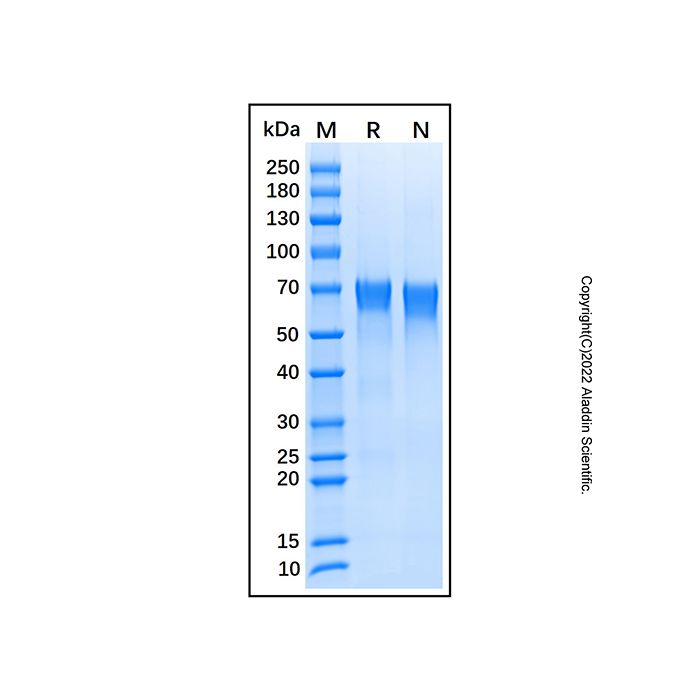
Recombinant Human CD229/SLAMF3 Protein (rp143892) - SDS-PAGE 2 μg/lane of Recombinant Human CD229/SLAMF3 Protein was resolved with SDS-PAGE under reducing (R) and non-reducing (N) conditions and visualized by Coomassie® Blue staining, showing the band at 60 - 70 kDa.
Documentazione
📋 Safety Data Sheet (SDS)
Comprehensive hazard, handling, storage, and regulatory compliance document.
Determine the necessary mass, volume, or concentration for preparing a solution.
Dilution Calculator
Determine the dilution needed to prepare a stock solution.
Reconstitution Calculator
Recensioni
Recensioni dei clienti
Application Protocols
No manufacturer-verified application protocols or tested use-cases are provided for this SKU; Not specified for this item. The following are general, non-item-specific guidelines:
ELISA (general): Coat plates with 1–5 µg/mL of recombinant SLAMF3 in carbonate buffer (pH 9.6) overnight at 4°C. Block with 1–5% BSA. Detect binding of analytes (e.g., anti-SLAMF3 antibodies) with appropriate labeled secondary. Optimize coating concentration to balance signal and orientation.
SPR/BLI (general): Capture His-tagged SLAMF3 on Ni-NTA or anti-His sensors to ~100–1000 RU (SPR) and inject analyte over multiple concentrations with 1:3 serial dilutions. Use HEPES-buffered saline + 0.005–0.05% surfactant; include reference surface controls.
Cell-based binding (general): Incubate fluorescently labeled recombinant protein with SLAMF3-positive cells at 4°C to assess binding; include competition with unlabeled protein or blocking antibodies to confirm specificity.
Immobilization (general): For affinity columns, couple via Ni2+-chelate matrices for oriented presentation; validate retention of activity post-coupling.
These parameters are starting points only. Validate and optimize for your specific instruments, matrices, and analytes. For any lot-specific instructions or activity qualifications, refer to the CoA/Spec Sheet.
Biological Roles
General literature overview (no clinical claims):
Identity: CD229 (SLAMF3, also known as Ly9 in mouse) is a member of the Signaling Lymphocytic Activation Molecule (SLAM/CD150) family of immunoglobulin superfamily receptors.
Expression: Predominantly on hematopoietic cells, including B cells, T cells, and NK-lineage subsets. Expression levels can vary by activation state and developmental stage (literature generality).
Ligand/interaction: SLAMF3 engages in homophilic binding (SLAMF3–SLAMF3 interactions) via its extracellular Ig-like domains. Intracellularly, it signals through immunoreceptor tyrosine-based switch motifs (ITSMs) that recruit SAP/SH2D1A or EAT-2 adaptors to modulate downstream pathways (literature).
Function: Modulates lymphocyte activation, adhesion, and immune synapse organization. Context-dependent signaling can be co-stimulatory or inhibitory depending on adaptor availability (general immunology knowledge).
Structural notes: The ectodomain consists of two Ig-like domains (V-set/C2-set). Recombinant soluble forms are widely used to dissect binding specificity, affinity, and to map interaction epitopes with antibodies or other binders (literature).
Use of this recombinant protein: As a defined, soluble form of the extracellular region, it enables controlled in vitro interrogation of SLAMF3 biology—e.g., quantifying binding to cell-surface SLAMF3, screening blocking antibodies, or constructing affinity columns—without the complexity of full-length, membrane-embedded receptor systems.
Item-specific biochemical activities and potencies are Not specified for this item; refer to CoA/Spec Sheet for any activity validation performed.
Buffer Applications
This recombinant protein is intended for aqueous buffer use. Item-specific formulation and recommended reconstitution buffer are Not specified for this item; refer to CoA/Spec Sheet. The following are general, literature- and practice-based guidelines for SLAM-family ectodomains:
Reconstitution (general): Use sterile, neutral pH buffers. Typical choices are PBS, pH 7.2–7.4, or 20–25 mM HEPES, 150 mM NaCl, pH 7.4. Start with small volumes to reach ≥0.1–1 mg/mL, then dilute to working concentration.
Additives (user-supplied, if compatible): 5–10% glycerol or 0.1% carrier protein can improve freeze–thaw resilience for storage; 0.5–10% trehalose or sucrose may stabilize lyophilized or frozen preparations. Avoid detergents and high imidazole unless required.
pH/ionic strength: Neutral pH with physiological ionic strength (100–200 mM NaCl) typically preserves Ig-like domain structure and reduces non-specific interactions. Adjust salt for binding assay stringency.
Filtration: If sterile solutions are required, filter through 0.22 µm low-protein-binding PVDF/RC membranes to minimize adsorption losses.
Compatibility for assays: For SPR/BLI, include 0.005–0.05% surfactant (e.g., Tween-20) to minimize non-specific binding to sensor surfaces if it does not disrupt interactions; validate empirically.
Storage buffers (general): For frozen aliquots, avoid phosphate buffers if crystals form on freezing; HEPES with 150 mM NaCl plus 10% glycerol is a common alternative.
Always confirm any buffer system maintains the desired bioactivity for your specific assay. For authoritative, lot-specific guidance, consult the CoA/Spec Sheet.
Green Alternatives
Green chemistry considerations for recombinant protein use focus on minimizing waste and selecting benign buffers rather than substituting solvents:
Buffer choices (general): Favor phosphate or HEPES buffers at neutral pH. Avoid azide where possible in flow cytometry or cell-based assays; opt for sterile filtration and cold storage to maintain stability, reducing hazardous preservative use.
Concentration and aliquoting: Reconstitute at the highest practical concentration to reduce plastic waste from large volumes; dispense into small aliquots to prevent repeated freeze–thaw and product loss.
Reuse of capture matrices: When immobilizing via His tag, regenerate Ni-NTA resins per manufacturer guidance to extend lifespan, reducing solid waste.
Energy footprint: Store at the warmest temperature compatible with stability (this product specifies −20°C; ultra-low −80°C may be unnecessary unless validated), lowering energy consumption.
Documentation: Maintain accurate inventory to avoid expired or redundant stocks.
There are no “alternative chemicals” for replacing a specific recombinant protein target; sustainability gains come from optimized handling, minimal hazardous preservatives, and efficient experimental design.
Pharmaceutical Uses
Not intended for human or veterinary use. For research use only.
Formulation/excipient status: Not applicable. This is an active recombinant research reagent, not a pharmaceutical excipient.
Process development (general): Recombinant receptor ectodomains like SLAMF3 may be used in analytical methods during biopharmaceutical discovery/manufacturing (e.g., ligand-binding assays, potency/reference standards) to characterize candidate molecules targeting SLAMF3.
Regulatory monographs: No pharmacopeial monograph is indicated for this protein. Any GMP or clinical manufacturing use would require separate qualification; this catalog item is research grade unless otherwise specified.
Any claims regarding therapeutic application, dosing, or clinical performance are outside scope and are not made here.
Physical Properties
Physical state/appearance: Not specified for this item; refer to CoA/Spec Sheet. Recombinant proteins are typically supplied as lyophilized powder or as a frozen liquid (general).
Molecular weight: Not specified for this item; refer to CoA/Spec Sheet. Apparent MW may vary by glycosylation and tag (general).
Isoelectric point (pI): Sequence-dependent; Not specified for this item; refer to CoA/Spec Sheet.
Extinction coefficient (A280): Sequence-dependent; Not specified for this item; refer to CoA/Spec Sheet.
Solubility: Water and physiological buffers (PBS, HEPES) are typically suitable for recombinant ectodomains (general); specific solubility for this lot Not specified for this item; refer to CoA/Spec Sheet.
Stability: Functional/activity stability depends on buffer, temperature, and freeze–thaw cycles (general). No item-specific stability data are provided here.
Boiling point/melting point/density/refractive index/logP: Not applicable to proteins in practical laboratory handling.
Aggregation propensity: Proteins may aggregate upon repeated freeze–thaw or at high concentration/near pI (general). Use gentle mixing; avoid vigorous vortexing to preserve bioactivity.
Note: For authoritative, lot-specific physicochemical data (e.g., mass by MS, purity by SDS-PAGE/SEC), consult the CoA/Spec Sheet.
Quality and Grades
This item is designated Animal Free, Carrier Free, Bioactive, ActiBioPure™, His Tag.
Animal Free (item-specific): Manufactured without animal-derived components to minimize adventitious agents and batch variability linked to animal-origin reagents. Useful for workflows sensitive to animal contaminants or regulatory expectations for animal-origin-free materials.
Carrier Free (item-specific): Supplied without stabilizing carrier proteins (e.g., BSA, HSA). Advantages: precise mass balance for molarity calculations and less background in binding/functional assays. Consider adding your own stabilizer (e.g., 0.1% BSA or 5–10% trehalose/glycerol) after reconstitution if compatible with your downstream application (general recommendation; not part of supplied product).
Bioactive (item-specific): The product is intended to retain functional activity relevant to CD229/SLAMF3 biology (e.g., ligand binding). Specific activity units, assay format, and lot acceptance criteria are Not specified for this item; refer to CoA/Spec Sheet.
ActiBioPure™ (item-specific brand): Denotes high-purity, functionally validated protein suitable for sensitive biophysical and cell-based assays. Exact purity metrics (e.g., % by SDS-PAGE/SEC, endotoxin level) are Not specified for this item; refer to CoA/Spec Sheet.
His Tag (item-specific): Facilitates IMAC purification and oriented immobilization on Ni2+/Co2+-charged matrices or anti-His capture surfaces. Tag location (N- vs C-terminus) and linker details are Not specified for this item; refer to CoA/Spec Sheet.
Appearance, formulation, concentration, endotoxin, residual host cell proteins/DNA: Not specified for this item; refer to CoA/Spec Sheet.
Always review the lot-specific CoA to confirm suitability for your assay (e.g., endotoxin thresholds for immune cell assays).
Reaction and Applications
As a recombinant receptor ectodomain, CD229/SLAMF3 is used as a biological reagent rather than a chemical reactant. Typical laboratory applications (general/literature):
Binding studies: Assess homophilic SLAMF3–SLAMF3 interactions using ELISA, BLI, SPR, or cell-based binding assays. His tag enables oriented capture on Ni-NTA or anti-His surfaces to preserve ligand accessibility.
Receptor–ligand screening: Evaluate candidate binders (e.g., antibodies, engineered scaffolds, or small fragments) for affinity and kinetics. Use low non-specific binding buffers and include divalent ion controls if relevant to SLAM family interactions.
Functional assays: Probe SLAMF3-mediated signaling in co-culture systems by presenting immobilized protein to SLAMF3-expressing cells, monitoring downstream readouts (e.g., phosphorylation of signaling adaptors) with appropriate controls. Specific assay conditions for this item are Not specified; refer to CoA/Spec Sheet.
Calibration standards: Serve as a quantitative standard in sandwich ELISAs or flow cytometry when generating standard curves (ensure epitope compatibility).
Biophysical characterization: SEC-MALS, DSC, or AUC to assess oligomeric state and stability; note that SLAM family ectodomains can form dimers via Ig-like interfaces (literature generality).
Practical tips (general):
Work on ice; avoid vigorous mixing. Use low-binding tubes. Determine active concentration by A280 (sequence-dependent ε; Not specified for this item) or functional titration.
For immobilization, confirm tag accessibility; consider mild imidazole in running buffers to reduce non-specific Ni interactions when using IMAC capture.
Reaction Conditions
Not applicable in the context of chemical reactions. As a recombinant protein reagent, it is used under assay conditions rather than synthetic reaction conditions.
General assay condition guidance (not item-specific):
Temperature: Handle on ice; perform binding assays typically at 4–25°C depending on kinetics and stability.
Buffers: Neutral pH buffers (PBS or HEPES with physiological saline). Include low levels of nonionic surfactant for surface-based techniques if compatible.
Concentrations: Empirically determine; micro- to low nanomolar ranges are common for high-affinity interactions. Item-specific active concentration is Not specified; refer to CoA/Spec Sheet.
Immobilization: For His-tag capture, pre-equilibrate Ni-NTA surfaces; avoid high imidazole in running buffers unless needed to reduce nonspecific binding, as it can displace His-tagged protein.
For definitive, lot-specific conditions (activity assay format, temperature tolerance, stability), consult the CoA/Spec Sheet.
Safety and Handling
GHS classification, signal word, pictograms, H-statements: Not specified for this item; refer to SDS. Recombinant proteins without hazardous excipients are typically not classified as dangerous under GHS (general), but always verify the SDS for your lot.
General hazards: Low acute toxicity expected for laboratory handling of proteins; avoid inhalation of powders/aerosols and contact with eyes/skin (general).
PPE: Lab coat, safety glasses, and appropriate gloves. Use biological safety cabinet if handling lyophilized material prone to aerosolization (general best practice).
Handling: Minimize repeated freeze–thaw as it can denature the protein and generate particulates. Thaw on ice; mix gently. Use sterile, low-protein-binding plasticware to reduce adsorption losses (general).
Incompatibilities: Avoid strong oxidants, extreme pH (<5 or >9) unless validated, and proteases. High salt or divalent cations may modulate binding of some Ig-like receptors; optimize empirically for your assay (general).
First aid (overview): If skin/eye contact occurs, rinse with water for at least 15 minutes. If inhaled, move to fresh air. If ingested, rinse mouth and seek medical advice. Follow institutional biosafety procedures (general guidance; defer to SDS).
Spill/leak: Wipe with damp disposable towels; decontaminate surfaces with appropriate laboratory disinfectant. Dispose per institutional biowaste policies.
Waste: Collect unused protein solutions and contaminated disposables as biological laboratory waste following local regulations.
Always consult and adhere to the product SDS for authoritative safety information.
Solvent Selection
This product is a recombinant protein; organic solvent selection is not typically applicable.
Applicable media (general): Reconstitute and handle in aqueous physiological buffers such as PBS (pH ~7.2–7.4) or HEPES-buffered saline. Avoid organic solvents that denature proteins (e.g., acetonitrile, methanol) unless used at low percentages for specialized applications and validated to preserve activity.
Additives (general): For stability, users may add compatible excipients after reconstitution (e.g., 5–10% glycerol or 0.1% carrier protein) if they do not interfere with downstream assays. This item is supplied Carrier Free; any additives are user-supplied.
For practical considerations around buffers and stability, see Buffer Applications and Storage & Reconstitution tabs.
Storage and Reconstitution
Storage (item-specific): Store at −20°C. Avoid repeated freezing and thawing.
Shipping (item-specific): Shipped in ice chest with ice pads (cold pack).
Appearance, supplied buffer, concentration: Not specified for this item; refer to CoA/Spec Sheet.
General reconstitution and handling guidance (non-item-specific):
Thawing: If supplied frozen, thaw on ice. If lyophilized, briefly spin down the vial before opening to collect contents at the bottom.
Reconstitution buffer: Use sterile PBS (pH 7.2–7.4) or HEPES-buffered saline (pH ~7.4). Start with a minimal volume to achieve ≥0.1–1 mg/mL, gently pipette to dissolve—do not vortex vigorously.
Aliquoting: Immediately dispense into single-use aliquots in low-binding tubes to prevent repeat freeze–thaw. Label with date and concentration.
Short-term storage: 2–8°C for hours to a few days, if stability permits (verify experimentally). For longer storage, keep at −20°C per item-specific guidance. Some users employ −80°C for extended periods if compatible.
Stabilizers (user-supplied, if compatible): Addition of 5–10% glycerol or 0.1% carrier protein may improve stability for frozen storage. Validate that additives do not interfere with downstream assays; this product is supplied Carrier Free.
Freeze–thaw: Minimize cycles; each cycle can reduce bioactivity and increase aggregation. Avoid frost-free freezers that warm during defrost cycles.
For lot-specific formulation, concentration, and stability data, consult the CoA/Spec Sheet. Research use only.
Structure and Identity
SKU: rp143892
Product name: Recombinant Human CD229/SLAMF3 Protein (His tag)
Category: Recombinant protein (human), extracellular domain/ectodomain format is typical for binding studies (general), but exact domain boundaries are Not specified for this item; refer to CoA/Spec Sheet.
Organism/source: Human sequence; production host and expression system Not specified for this item; refer to CoA/Spec Sheet.
Tags: His tag (item-specific); tag position and length Not specified for this item; refer to CoA/Spec Sheet.
Purity/grade: Animal Free, Carrier Free, Bioactive, ActiBioPure™ (item-specific designations; see Quality & Grades tab for meaning).
Molecular formula: Not applicable to proteins in a conventional sense; sequence-dependent empirical formula Not specified for this item; refer to CoA/Spec Sheet.
Molecular weight: Not specified for this item; refer to CoA/Spec Sheet. Note: observed mass may include glycosylation and His-tag contributions (general).
Sequence/construct: Amino-acid sequence, signal peptide presence, and any fusion partners beyond His tag Not specified for this item; refer to CoA/Spec Sheet.
Structural features (general literature): CD229 (SLAMF3) is a type I transmembrane glycoprotein of the Signaling Lymphocytic Activation Molecule (SLAM) family with two extracellular Ig-like domains that mediate homophilic binding. Recombinant preparations for in vitro use commonly include only the soluble ectodomain fused to an affinity tag for purification and detection.
2D/primary structure description (general): linear polypeptide chain with immunoglobulin-like domains; no defined small-molecule SMILES/InChI.
Identifiers: CAS, CID, InChIKey, SMILES: Not applicable/not assigned for this protein product.
Synthetic Utility
Not applicable. This product is a recombinant protein, not a small-molecule building block or catalyst.
Laboratory role (general): Functions as a biological target/ligand in binding and signaling assays rather than as a reagent in organic synthesis.
For practical use cases, see Reaction & Applications and Application Protocols (general guidance).
Target Specificity
This section is typically applicable to antibodies and affinity reagents with defined antigen specificity. As this product is the recombinant Human CD229/SLAMF3 protein itself, antibody-like target specificity data (clone, isotype, species reactivity, epitope) are not applicable.
Item-specific target/antigen metadata: Not provided beyond the protein identity (Human CD229/SLAMF3). Any epitope mapping or domain boundaries are Not specified for this item; refer to CoA/Spec Sheet.
Need help choosing the grade?
Our grade selection guide covers purity, stabilizer status, and application suitability for all variants in our catalog.
We use cookies to ensure the website functions properly and, where permitted, to improve your experience. You can manage your preferences at any time in Settings. Learn more in our Cookie Policy.
Shall we send you a message when we have discounts available?
Remind me later
Thank you! Please check your email inbox to confirm.
Products are supplied to verified businesses, institutions, and qualified professionals for research and development use only. Not for use in humans, animals, diagnosis, or therapy.

 ZJ25F0218692