GRADE & PURITYCarrier Free?Carrier-free — supplied without added carrier protein/stabilizer. Use when carriers (e.g. BSA) would interfere with conjugation or sensitive assays.His Tag?His tag grade — recombinant protein bearing a His tag for affinity purification/detection. Use to purify, immobilize, or detect the tagged protein.≥95%(SDS-PAGE)
Carrier Free,His-Tag,≥95%(SDS-PAGE) Carrier Free,His Tag for sensitive chromatographic and analytical workflows requiring minimal baseline interference.
🌡
Storage & shipping
Store at -20°C,Avoid repeated freezing and thawing Ships Ice chest + Ice pads Check lot-specific COA for exact specifications.
📋
Quality documents
SDS, COA, datasheet, and spec sheet available for download. Lot-specific COA accessible via lot number lookup.
📚
Literature proof
Cited in 0 peer-reviewed publications across chromatography, organic synthesis, and cross-coupling reactions.
Eukaryotic Translation Initiation Factor 1B (EIF1B) is an element of a complex involved in recognition of the initiator codon during the scanning process. Translation is also initiated by the function of EIF1B in regulating the activity of ribosomal subun
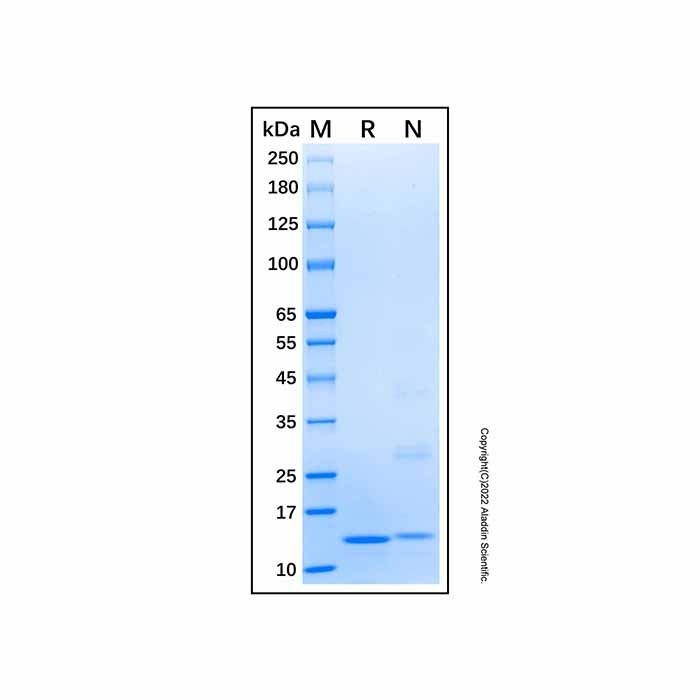
13.2 kDa, under reducing conditions; 13.7 & 28.5 & 41.8 kDa, under non-reducing conditions.
Tipo di molecola
Proteine
Stoccaggio e spedizione
Ricostituzione
We recommend that this vial be briefly centrifuged prior to opening to bring the contents to the bottom. Reconstitute at 0.5 mg/mL in sterile distilled water. Stock solutions should be apportioned into working aliquots and stored at ≤ -20 °C. Further dilutions should be made in appropriate buffered solutions.
Condizioni di conservazione di stoccaggio
Store at -20°C,Avoid repeated freezing and thawing
Spedito in
Ice chest + Ice pads
Stabilità e conservazione
Store at -20°C for 1 year. Avoid freeze/thaw cycle.
Immagini
Recombinant Human EIF1B Protein (rp188382) - SDS-PAGE 3 μg/lane of Recombinant Human EIF1B Protein was resolved with SDS-PAGE under reducing (R) and non-reducing (N) conditions and visualized by Coomassie® Blue staining, showing a band at 13.2 kDa under reducing conditions and 13.7 & 28.5 & 41.8 kDa under non-reducing conditions.
Documentazione
📋 Safety Data Sheet (SDS)
Comprehensive hazard, handling, storage, and regulatory compliance document.
Determine the necessary mass, volume, or concentration for preparing a solution.
Dilution Calculator
Determine the dilution needed to prepare a stock solution.
Reconstitution Calculator
Recensioni
Recensioni dei clienti
Application Protocols
Item-specific, validated protocols are not provided in the Product Data. The following are general starting-point protocols for recombinant His-tagged proteins; optimize for your system and consult the CoA/Spec Sheet where available.
Reconstitution (if supplied lyophilized; see Storage & Reconstitution):
Equilibrate vial to room temperature in a desiccator. 2) Briefly spin to collect contents. 3) Add ice-cold buffer (e.g., PBS, HEPES, or Tris, pH ~7.4) to desired concentration. 4) Gently mix without vortexing; allow 5–10 minutes for full dissolution on ice.
Immobilize EIF1B via His tag on Ni-NTA resin pre-equilibrated in binding buffer (20–50 mM HEPES/Tris, 150 mM NaCl, 10–20 mM imidazole, pH 7.5). Incubate lysate or purified partner protein at 4°C with gentle mixing. Wash with 20–40 mM imidazole; elute with 200–300 mM imidazole. Include protease inhibitors if using cell lysate.
SPR/BLI (His-capture format):
Capture onto NTA sensor with Ni2+ charge; aim for low surface density to minimize mass transport. Run buffer: 10 mM HEPES, 150 mM NaCl, 0.005% Tween-20, pH 7.4 (HBS-T) or equivalent. Regenerate per sensor vendor guidelines.
In vitro complex assembly (general):
Combine EIF1B with other initiation factors/40S subunits in Mg2+-containing buffer; incubate at 25–30°C as required. Validate stoichiometry by native PAGE, sucrose gradients, or MS-based complex mapping.
These are generalized procedures; confirm compatibility with your downstream readouts.
EIF1B is associated with early steps of eukaryotic translation initiation, contributing to assembly and stability of the 43S/48S preinitiation complex on the 40S ribosomal subunit during cap-dependent scanning and start-codon selection. It functions in concert with other initiation factors (e.g., eIF1, eIF1A, eIF2, eIF3).
Molecular interactions:
Initiation factors engage both ribosomal RNA/proteins and mRNA/Met-tRNAi to coordinate start site selection. EIF1B-family proteins typically possess basic surfaces that facilitate nucleic acid and factor interactions (protein-family generalization).
Cellular context:
Expression of initiation factors is tightly linked to cellular growth and proteostasis. Modulation of initiation factor levels can influence global translation rates and translational control pathways (e.g., responses to stress via eIF2α phosphorylation), although the specific regulatory circuits for EIF1B should be confirmed per the primary literature before drawing mechanistic conclusions.
Research utility of recombinant EIF1B:
Provides a defined component for bottom-up reconstitution of translation initiation, enabling quantitative dissection of factor dependencies, kinetics, and fidelity.
Note: The above describes biological roles in general terms. No clinical or diagnostic use is implied. This product is for research use only (per Product Data).
Buffer Applications
Conventional buffer-system selection (pH control for enzymatic assays or electrophoresis) is generally applicable at the level of the user’s assay rather than the protein itself.
Practical guidance (general):
For most protein interaction and biophysical assays, neutral buffers such as 20–50 mM HEPES or Tris, pH 7.4–8.0, with 50–300 mM NaCl provide good baseline stability. Add 1–5 mM DTT or TCEP if reduction is required and compatible with downstream steps.
Include 0.005–0.05% nonionic detergent (e.g., Tween-20) to limit nonspecific adsorption in microplate or SPR/BLI assays if it does not interfere with binding.
For metal-affinity manipulations via His tag, avoid high concentrations of chelators (EDTA/EGTA) and use imidazole judiciously.
Item-specific buffer composition, pH, and excipients shipped with the protein: Not specified for this item; refer to CoA/Spec Sheet.
Green Alternatives
Green chemistry comparisons among organic solvents are not directly applicable to a recombinant protein product. Nevertheless, sustainable handling practices can reduce environmental impact:
Buffer preparation
Use minimal volumes and prepare only what is needed; favor concentrated stock buffers to reduce packaging waste.
Choose readily biodegradable buffering agents where feasible (e.g., HEPES over some less degradable alternatives), balancing with assay requirements.
Cold-chain and storage
Consolidate shipments to minimize dry-ice/ice-pack waste when possible, consistent with product stability.
Employ energy-efficient ultra-low freezers and maintain proper frost management to improve efficiency.
Consumables
Use reusable, autoclavable containers for buffer prep and storage when compatible.
Select low-binding plastics judiciously to reduce protein adsorption losses and material waste.
No greener “substitute solvent” is relevant for this protein; optimize buffer composition for function and stability while minimizing hazardous additives.
Pharmaceutical Uses
This recombinant protein is supplied for research use only (per Product Data) and is not intended for human or veterinary use, clinical diagnostics, or as an active pharmaceutical ingredient.
Potential roles in pharma R&D workflows (general, non-clinical):
Reference standard or control reagent in biochemical assays investigating translation initiation pathways.
Antigen for generating or screening research antibodies (anti-EIF1B) or for anti-His assay development, followed by rigorous validation.
Tool protein for mechanism-of-action studies and target engagement assays in discovery research.
Regulatory/compendial status: No pharmacopeial status indicated. Any GMP status, viral/bacterial safety testing, bioburden, endotoxin, or residual host-cell impurity limits are Not specified for this item; refer to CoA/Spec Sheet if such data are available for specific lots.
Physical Properties
Item-specific physical constants are not provided in the Product Data for this recombinant protein.
Appearance: Not specified for this item; refer to CoA/Spec Sheet.
Molecular weight (apparent, SDS-PAGE): Not specified for this item; refer to CoA/Spec Sheet.
Isoelectric point (pI): Not specified for this item; refer to CoA/Spec Sheet.
Extinction coefficient (ε280) and A280-to-concentration conversion: Not specified for this item; refer to CoA/Spec Sheet.
Formulation/excipients: Carrier Free per Product Data (no BSA or stabilizing carrier proteins). Specific buffer components, salts, or cryoprotectants: Not specified for this item; refer to CoA/Spec Sheet.
General/literature guidance for recombinant proteins (contextual, not item-specific):
Proteins are non-volatile solids in aqueous buffers; they do not have meaningful BP/MP in the conventional sense.
Solubility is governed by sequence, buffer composition, pH, and ionic strength; most basic initiation factors are water-soluble under neutral physiological buffers.
If UV–Vis quantification is required, determine ε280 from the exact sequence or rely on CoA-reported value; verify tag contribution to ε.
Practical notes:
Upon receipt, briefly spin vials to collect contents, keep on ice during handling, and avoid foaming which can denature proteins at air–liquid interfaces.
For concentration and buffer exchange, use low-binding plastics and centrifugal filters with an appropriate MWCO, validating recovery and activity empirically.
Carrier Free: Supplied without protein carriers (e.g., BSA, gelatin). This is important for applications sensitive to protein additives, such as biophysical measurements, enzymology, or conjugation chemistry where carriers could interfere.
His Tag: Facilitates affinity capture (Ni2+/Co2+ IMAC), detection with anti-His antibodies, and oriented immobilization on NTA-chelated surfaces.
What “Carrier Free” implies in practice:
Minimizes background in binding assays (e.g., pull-downs, SPR/BLI) and avoids mass spectral interference in proteomics.
Enables accurate protein quantification and labeling stoichiometry calculations without carrier correction.
Typically indicates minimal excipients; verify any salts, buffers, or preservatives on the CoA/Spec Sheet (not specified for this item).
Purity notation:
“Grade/Purity: Carrier Free, His Tag” is provided. Exact purity percentage, host cell protein/DNA limits, endotoxin level, and specific activity are Not specified for this item; refer to CoA/Spec Sheet.
Batch-specific documentation:
For regulated or critical experiments, request the lot-specific Certificate of Analysis for sequence confirmation, tag orientation, calculated molecular weight, SDS-PAGE profile, and QC methods (e.g., MS, SEC, endotoxin, binding/activity readouts if applicable).
Reaction and Applications
As a recombinant translation factor, EIF1B is primarily used as a protein reagent rather than a chemical reactant. Typical research applications include:
In vitro translation and initiation studies (general/literature):
Reconstitution of early cap-dependent initiation complexes to probe 40S recruitment, start-codon selection, and scanning fidelity, often alongside eIF1/eIF1A/eIF2/eIF3 complexes.
Mapping protein–protein and protein–RNA interactions using pull-downs, crosslinking-MS, or filter-binding assays.
Affinity and interaction assays:
Use the His tag for immobilization on Ni-NTA/Co-IDA resins to capture binding partners from lysates, or for oriented presentation on NTA sensor chips (SPR/BLI). Include mild detergents (e.g., 0.005–0.05% Tween-20) and non-specific blockers as needed to reduce background.
Structural/biophysical studies:
Circular dichroism (CD), DSF/Thermofluor, MST, ITC, and fluorescence anisotropy to quantify binding thermodynamics and conformational stability.
Analytical/assay development:
Use as a positive control or standard in immunoassays (if compatible with available anti-EIF1B or anti-His antibodies), or for generating calibration curves in mass spectrometry-based quantification. Note that assay-specific validation is required.
Item-specific activity assay conditions, cofactors, or required partners: Not specified for this item; refer to CoA/Spec Sheet.
Reaction Conditions
Classical chemical reaction-condition guidance (solvent, temperature, catalyst) does not apply. For biochemical assays involving EIF1B, consider the following general (literature-informed) conditions tailored to protein stability and binding studies:
Temperature: Perform binding and assembly reactions for initiation complexes at 4–30°C depending on assay kinetics and stability; keep on ice during setup.
Buffer: 20–50 mM HEPES or Tris, pH 7.4–8.0, with 50–150 mM KCl/NaCl is a common starting point. Include Mg2+ (1–5 mM) when reconstituting ribosomal complexes.
Redox: Add 1–5 mM DTT or 0.5–1 mM TCEP to maintain reduced cysteines if required by the system.
Additives: 0.005–0.05% nonionic detergent to minimize nonspecific adsorption; 5–10% glycerol can improve stability at room temperature during short incubations.
Assembly order: For reconstitution with 40S subunits and other eIFs, pre-equilibration steps and titrations may be necessary; consult primary methods papers to optimize stoichiometries and incubation times.
Item-specific optimal activity conditions, cofactor requirements, and kinetics are Not specified for this item; refer to CoA/Spec Sheet and validate empirically for your assay.
Safety and Handling
GHS classification, signal word, pictograms, H-statements: Not specified for this item; refer to the product SDS for authoritative safety information.
General laboratory precautions for recombinant proteins:
Use standard PPE: lab coat, safety glasses, and disposable nitrile gloves.
Work on ice or at 2–8°C during manipulations to preserve protein integrity.
Avoid aerosol generation when opening lyophilized or powdered materials; if applicable, reconstitute gently along tube walls.
Incompatibilities and stability concerns:
Avoid repeated freeze–thaw cycles (explicitly noted in Product Data) to prevent aggregation and loss of activity.
Minimize exposure to elevated temperatures, extreme pH, oxidizing agents, and proteases.
For His-tagged proteins, avoid prolonged exposure to high concentrations of strong chelators (e.g., EDTA) if downstream Ni-affinity capture is planned; EDTA is otherwise acceptable if no metal-affinity step is needed.
First aid (general guidance; consult SDS):
Skin/eye contact: Rinse with water for several minutes; remove contaminated clothing; seek medical advice if irritation persists.
Inhalation of powders/aerosols: Move to fresh air; seek medical attention if symptoms occur.
Ingestion: Rinse mouth; do not induce vomiting; seek medical advice.
Waste disposal: Dispose of protein-containing materials as non-hazardous laboratory waste unless combined with hazardous reagents; follow institutional and local regulations.
Solvent Selection
This product is an aqueous protein reagent rather than a small-molecule solute. Conventional solvent-selection guidance (e.g., choosing among organic solvents) is not typically applicable.
Practical guidance for handling buffers (general):
Use physiological or assay-compatible buffers (e.g., PBS, HEPES, or Tris) at neutral pH unless your protocol specifies otherwise.
Maintain low ionic strength for electrostatic interaction studies; increase salt (e.g., 150–300 mM NaCl) to reduce nonspecific binding.
Include glycerol (10–50%) for freeze–thaw protection if long-term storage at –20°C is required, provided it does not interfere with downstream assays.
Item-specific buffer composition and recommended diluents: Not specified for this item; refer to CoA/Spec Sheet.
Storage and Reconstitution
Storage conditions (from Product Data): Store at –20°C. Avoid repeated freezing and thawing.
Shipping: Shipped in an ice chest with ice pads (per Product Data) to maintain cold chain.
Aliquoting and handling (general best practices):
Upon first thaw, mix gently, briefly spin, and make single-use aliquots at working concentrations to prevent freeze–thaw damage.
For storage at –20°C, consider adding sterile glycerol to a final concentration of 10–50% to reduce freeze–thaw stress, provided this is compatible with your downstream applications. If long-term storage is needed, –80°C is commonly used for many proteins; verify stability empirically.
Keep on ice during use and minimize time at ambient temperature.
Reconstitution guidance (if lyophilized; item-specific form not specified):
Reconstitute with ice-cold buffer (e.g., PBS, HEPES, or Tris, pH 7.4–8.0). Avoid vigorous vortexing; gently pipette or rock to dissolve. Allow several minutes for full hydration. Filter-sterilize with a low protein-binding 0.22 μm filter if sterility is required and protein stability allows.
Concentration determination:
Use A280 with an appropriate extinction coefficient derived from the exact sequence (tag included) or rely on lot-specific CoA. Confirm with BCA or Bradford if compatible with buffer components.
Item-specific formulation, exact concentration, and excipients: Not specified for this item; refer to CoA/Spec Sheet.
Structure and Identity
Recombinant Human EIF1B Protein (carrier-free, His-tagged) intended for research use in translation biology and protein-interaction studies.
Product-specific identifiers
SKU: rp188382
Name: Recombinant Human EIF1B Protein (His Tag)
Grade/Purity: Carrier Free, His Tag (per Product Data)
Molecular formula: Not specified for this item; refer to CoA/Spec Sheet.
Molecular weight: Not specified for this item; refer to CoA/Spec Sheet.
CAS, CID, InChIKey, SMILES: Not applicable to recombinant protein listings; not specified for this item; refer to CoA/Spec Sheet.
Protein identity (general/literature context)
Target: Human EIF1B (Eukaryotic translation initiation factor 1B), a component associated with early steps of cap-dependent translation initiation.
Tag: Polyhistidine (His) tag for affinity capture/detection; tag position (N- vs C-terminal) not specified for this item.
Structural features (general): EIF-family initiation factors are typically small, basic proteins that interact with the 40S ribosomal subunit and other initiation factors during preinitiation complex formation. No disulfide requirement is typically reported for cytosolic initiation factors (literature, protein family context).
2D/primary structure description (general)
Linear polypeptide chain corresponding to human EIF1B sequence (exact isoform, sequence length, and tag junction not specified for this item). The His tag adds an affinity handle and may introduce a short linker depending on construct design (not specified here).
Synthetic Utility
Not typically applicable. This product is a recombinant human protein reagent and is not used as a synthetic building block or reagent in organic synthesis. For practical usage information, see Reaction & Applications and Application Protocols sections focusing on biochemical and biophysical workflows.
Target Specificity
This listing is for the recombinant human EIF1B protein itself.
Species: Human origin sequence (general description); exact isoform and any sequence modifications (beyond His tag) are Not specified for this item; refer to CoA/Spec Sheet.
Reactivity/cross-species information: Not specified for this item; refer to CoA/Spec Sheet. Any cross-reactivity would depend on sequence conservation in assays employing antibodies or binding partners.
Note: Antigen/epitope, clone, or isotype information does not apply because this is not an antibody product.
Need help choosing the grade?
Our grade selection guide covers purity, stabilizer status, and application suitability for all variants in our catalog.
We use cookies to ensure the website functions properly and, where permitted, to improve your experience. You can manage your preferences at any time in Settings. Learn more in our Cookie Policy.
Shall we send you a message when we have discounts available?
Remind me later
Thank you! Please check your email inbox to confirm.
Products are supplied to verified businesses, institutions, and qualified professionals for research and development use only. Not for use in humans, animals, diagnosis, or therapy.

 ZJ25F0217479