GRADE & PURITYCarrier Free?Carrier-free — supplied without added carrier protein/stabilizer. Use when carriers (e.g. BSA) would interfere with conjugation or sensitive assays.Bioactive?Bioactive grade — verified to retain biological activity in functional assays. Use when the molecule must be functionally active, not just pure.ActiBioPure™?ActiBioPure™ — Aladdin's premier line for bioactive and recombinant products. Use when both high purity and preserved biological activity are required.High Performance?High-performance grade with optimized purity and performance characteristics. Use for sensitive analyses where ordinary grades fall short.≥95%(SDS-PAGE)See COA
Accession #
P09920
Protein Tag
No tag
Expression system
E. coli
Endotoxin Concentration
<1.0 EU/μg
Bioactivity
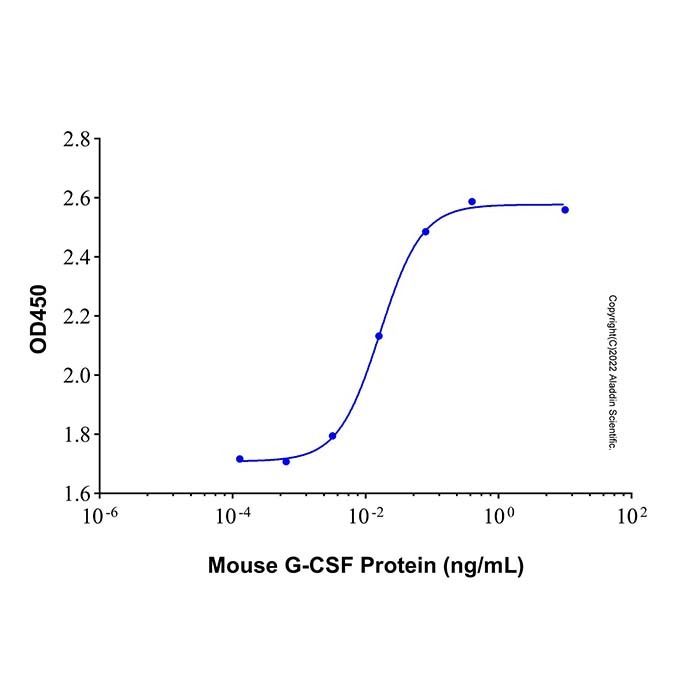
Measured in a cell proliferation assay using NFS-60 mouse myelogenous leukemia lymphoblast cells. The ED50 for this effect is typically 16.5 pg/mL.
Carrier Free, Bioactive, ActiBioPure™, High Performance, ≥95%(SDS-PAGE), See COA ActiBioPure™,Bioactive,Carrier Free,High Performance for sensitive chromatographic and analytical workflows requiring minimal baseline interference.
🌡
Storage & shipping
Store at -20°C,Avoid repeated freezing and thawing Ships Ice chest + Ice pads Check lot-specific COA for exact specifications.
📋
Quality documents
SDS, COA, datasheet, and spec sheet available for download. Lot-specific COA accessible via lot number lookup.
📚
Literature proof
Cited in 0 peer-reviewed publications across chromatography, organic synthesis, and cross-coupling reactions.
ActiBioPure™, Bioactive, Carrier Free, High Performance
Specifiche e purezza
Carrier Free, Bioactive, ActiBioPure™, High Performance, ≥95%(SDS-PAGE), See COA
Meccanismi biochimici e fisiologici
G-CSF is a pleiotropic cytokine best known for its specific effects on the proliferation, differentiation, and activation of hematopoietic cells of the neutrophilic granulocyte lineage. It is produced mainly by monocytes and macrophages upon activation by
Bioattività
Measured in a cell proliferation assay using NFS-60 mouse myelogenous leukemia lymphoblast cells. The ED50 for this effect is typically 16.5 pg/mL.
18.1 kDa, under reducing conditions; 16.9 & 19.0 kDa, under non-reducing conditions.
Tipo di molecola
Proteine
Product Line
Prodotti biologici
Stoccaggio e spedizione
Concentrazione
See COA
Condizioni di conservazione di stoccaggio
Store at -20°C,Avoid repeated freezing and thawing
Spedito in
Ice chest + Ice pads
Stabilità e conservazione
Store at -20°C for 1 year. Avoid freeze/thaw cycle.
Immagini
Recombinant Mouse G-CSF Protein (rp181569) - Protein Bioactivity Measured in a cell proliferation assay using NFS-60 mouse myelogenous leukemia lymphoblast cells. The ED₅₀ for this effect is typically 16.5 pg/mL
Recombinant Mouse G-CSF Protein (rp181569) - SDS-PAGE 3 μg/lane of Recombinant Mouse G-CSF Protein was resolved with SDS-PAGE under reducing (R) and non-reducing (N) conditions and visualized by Coomassie® Blue staining, showing a band at 18.1 kDa under reducing conditions and 16.9 & 19.0 kDa under non-reducing conditions.
Documentazione
📋 Safety Data Sheet (SDS)
Comprehensive hazard, handling, storage, and regulatory compliance document.
Determine the necessary mass, volume, or concentration for preparing a solution.
Dilution Calculator
Determine the dilution needed to prepare a stock solution.
Reconstitution Calculator
Recensioni
Recensioni dei clienti
Application Protocols
No item-specific validated application protocols are provided in the product data. The following are general, literature-based examples to aid experimental design; they are not specifications for this item.
Example A: Cell proliferation assay (literature)
Cells: G-CSF–responsive murine myeloid line (e.g., NFS-60 or 32D/csfr3).
Culture: RPMI 1640 + 10% FBS (or defined serum per cell line guidance). Reduce serum during stimulation to enhance dynamic range.
Dosing: Prepare a 10-point, half-log serial dilution of G-CSF (e.g., 0.01–100 ng/mL). Incubate 48–72 h.
Readout: Measure viability/proliferation (e.g., resazurin, MTS, or CellTiter-Glo). Fit a four-parameter logistic curve to determine EC50.
Example B: Acute signaling (pSTAT3) assay (literature)
Serum-starve responsive cells 4–16 h. Stimulate with G-CSF (e.g., 1–50 ng/mL) for 15–30 min.
Lyse cells and detect pSTAT3 (Y705) by Western blot or phospho-ELISA/flow cytometry.
Example C: ELISA standard curve (literature)
Reconstitute protein in assay diluent per kit instructions. Prepare serial standards spanning the kit’s dynamic range to generate a standard curve.
Optimize all parameters (buffer, dose, time, cell density) for your specific model. Consult the CoA/Spec Sheet for any lot-specific guidance.
Biological Roles
Granulocyte colony-stimulating factor (G-CSF; CSF3) is a key hematopoietic cytokine that regulates granulopoiesis and neutrophil function.
Receptor and signaling (literature)
Binds the G-CSF receptor (CSF3R), a Class I cytokine receptor expressed on myeloid progenitors and neutrophils.
Activates JAK/STAT (primarily STAT3), PI3K/AKT, and MAPK/ERK pathways, driving survival, proliferation, differentiation, and effector functions.
Hematopoietic effects (literature)
Promotes commitment and maturation of granulocyte progenitors into neutrophils.
Enhances neutrophil mobilization, chemotaxis, and antimicrobial functionality in vitro.
Broader biological context (literature)
Influences bone marrow niche dynamics and myeloid lineage bias under stress hematopoiesis.
Crosstalk with other cytokines (e.g., GM-CSF, IL-3) can modulate lineage outcomes, with context-dependent synergy or redundancy in signaling outputs.
Experimental utility
Serves as a defined input to dissect CSF3R-dependent transcriptional programs, receptor internalization/turnover, and feedback regulators (e.g., SOCS proteins).
Useful for calibrating cytokine measurement platforms (ELISA, multiplex bead assays) as a quantitative standard.
Note: The above describes general, literature-based biology of mouse G-CSF. Item-specific bioactivity, EC50 ranges, and potency specifications are not provided here; consult the CoA/Spec Sheet for lot-verified activity data. For research use only.
Buffer Applications
This product is a recombinant cytokine and is not itself a buffering agent. However, appropriate buffer selection is critical for preserving bioactivity.
Common buffer systems for reconstitution/dilution (general, literature)
PBS, pH ~7.2–7.4: Isotonic, widely compatible with mammalian cells.
Sterile water: Acceptable for initial dissolution when promptly adjusted to physiological buffer; stability may be limited in pure water.
Additives (user’s discretion; product is Carrier Free)
Low levels of inert excipients (e.g., trehalose, sucrose) may mitigate aggregation/adsorption in working solutions.
Filtration
If sterile filtration is necessary, validate recovery with low-protein-binding membranes; proteins can adsorb and reduce apparent potency.
Item-specific reconstitution buffer, pH, and recommended final concentration are not specified for this item; refer to the CoA/Spec Sheet.
Green Alternatives
Green chemistry considerations are limited for protein biologics compared with organic solvents or reagents.
Process and use-phase considerations (general)
Aqueous buffers at neutral pH are inherently greener than organic solvent systems.
Minimizing single-use plastics by using low-binding, reusable glassware where compatible can reduce waste; verify protein recovery.
Right-sizing aliquots reduces product waste from freeze–thaw losses.
Supply considerations
Recombinant production enables animal component–free manufacturing when appropriate expression systems are chosen (item-specific production system not specified).
Tradeoffs
Adding carrier proteins can improve stability but increases animal-derived content and background; this item is Carrier Free to provide flexibility.
Lyophilized formats can improve transport sustainability; this item’s exact physical format is not specified.
No item-specific sustainability metrics (e.g., endotoxin level, host-cell protein/DNA, animal-free status) are provided; consult the CoA or contact technical support for detailed sourcing and process information.
Pharmaceutical Uses
This recombinant protein is provided strictly for research use. No clinical or therapeutic use is endorsed or implied.
Relevant non-clinical, preformulation, and manufacturing contexts (general, literature)
Reference material/assay control for analytical method development (e.g., ligand-binding assays targeting CSF3 or CSF3R, ELISA standards).
In vitro pharmacology: Benchmark ligand in receptor binding and signaling assays to establish assay dynamic range and system suitability.
Formulation research: Screening of stabilizing excipients and buffer systems for cytokines, including thermal/aggregation stress models (DSF, DLS, SEC-MALS) using G-CSF as a model protein.
Bioprocess development: Positive control for cell-based potency assays during development of CSF3R pathway modulators.
No pharmacopeial monograph, GMP status, or clinical-grade attributes are claimed for this item. For regulated applications, obtain and review the CoA and consult Quality Assurance regarding suitability.
Physical Properties
As a recombinant protein, conventional small-molecule physical constants (bp, mp, logP) are not applicable. Practical handling properties are summarized below.
Appearance: Not specified for this item; refer to CoA/Spec Sheet.
Solubility (general, literature)
Readily soluble in aqueous buffers (e.g., water, PBS) at appropriate ionic strength; solubility and stability often enhanced with low concentrations of carrier proteins or inert sugars. This product is specified as Carrier Free; any use of carrier for working solutions is at user discretion.
Isoelectric point (pI): Not specified for this item; literature values for mouse G-CSF vary by isoform and glycosylation.
Extinction coefficient: Not specified for this item; can be computed from sequence if provided (literature practice).
Aggregation propensity (general)
Proteins may self-associate at high concentration or upon freeze–thaw; minimize by gentle handling, avoiding extremes of pH and temperature, and by using aliquots.
Endotoxin level: Not specified for this item; refer to CoA/Spec Sheet if required for cell-based assays.
Purity format: Grade/Purity listed as Carrier Free, Bioactive, ActiBioPure™, High Performance; quantitative purity metrics not specified for this item.
Note: For any quantitative property (exact mass, concentration after reconstitution, SDS-PAGE banding), rely on lot-specific documentation (CoA/Spec Sheet).
Quality and Grades
This item is offered with the following quality designations; item-specific numeric specs are not provided here and should be confirmed on the CoA.
Carrier Free
No added carrier proteins (e.g., BSA, HSA, gelatin). Advantages: precise mass-based dosing, compatibility with downstream conjugation, reduced background in bioassays. Consider adsorption losses at very low concentrations; preconditioning plastics or adding inert excipients to working solutions may be beneficial (user’s discretion).
Bioactive
Indicates functional activity has been demonstrated in an appropriate biological assay (e.g., cell proliferation or receptor activation). The specific assay type, EC50 range, and acceptance criteria are not specified for this item; refer to CoA/Spec Sheet.
ActiBioPure™ (brand attribute)
Denotes high purity and performance suitable for sensitive biological workflows. Typical evidence may include SDS-PAGE homogeneity, low aggregates, and low host-cell proteins/DNA (literature expectations). Item-specific results are not specified here.
High Performance
Emphasizes consistency, lot-to-lot reproducibility, and suitability for demanding cell-based applications. Quantitative metrics (purity %, endotoxin EU/µg, specific activity) are not specified for this item.
Documentation and verification
For regulated workflows or quantitative studies, obtain the lot-specific CoA to verify purity, identity (e.g., MS, SDS-PAGE), bioactivity (e.g., EC50), and contaminants (e.g., endotoxin).
Reaction and Applications
This is a bioactive recombinant protein, not a small-molecule reagent; it is not typically used as a solvent or in chemical synthesis reactions.
Applicable research applications (general, literature)
Cell signaling studies involving CSF3R activation and downstream JAK/STAT, PI3K/AKT, and MAPK pathways.
Hematopoietic biology experiments: differentiation and proliferation of granulocyte progenitors in vitro; neutrophil maturation and function assays.
Reference standard or positive control for cytokine detection assays (e.g., ELISA standard curves for mouse G-CSF quantitation).
Chemotaxis and survival assays in G-CSF–responsive lines.
Practical tips (general)
Titrate across a broad concentration range in pilot studies; EC50 can vary with cell line, serum conditions, and receptor density (literature).
Maintain sterility; filter (0.2 µm) only if validated not to reduce recovery/activity, as proteins may adsorb to membranes.
Prepare single-use aliquots immediately after initial reconstitution to preserve activity.
Item-specific validated applications and activity data are not provided here; consult the CoA/Spec Sheet for lot-specific bioassay information.
Reaction Conditions
Not applicable to chemical reactions. For biological assays, the following general, literature-based culture conditions are commonly used with cytokines such as G-CSF; they are provided as non-item-specific guidance.
Cell-based assays (general)
Temperature: 37°C, 5% CO2 for mammalian cell culture.
Media: Appropriate basal medium (e.g., RPMI 1640) with defined serum levels as required by the chosen cell line; serum-free or low-serum conditions may be used to enhance signal-to-noise in responsiveness.
Dosing: Titrate across several logs (e.g., 0.01–100 ng/mL) to identify EC50 and dynamic range; actual effective concentrations depend on cell model and assay design.
Time course: 15–60 min for acute signaling readouts (pSTAT3), 24–72 h for proliferation/differentiation outcomes.
Biophysical/analytical assays (general)
Buffer: Neutral pH, isotonic buffers for receptor binding or SPR/BLI studies; minimize non-specific binding with appropriate detergents or blockers validated for proteins.
Item-specific potency, recommended concentration ranges, and validated assay conditions are not provided; consult the CoA/Spec Sheet and optimize empirically for your system.
Safety and Handling
GHS classification, signal word, pictograms, H-statements: Not specified for this item; consult the Safety Data Sheet (SDS) for authoritative safety information.
General hazards (proteins, research use)
Recombinant cytokines are typically considered low hazard but may cause irritation or allergic sensitization upon inhalation, ingestion, or skin/eye contact. Avoid aerosol generation.
Personal protective equipment (PPE)
Laboratory coat, nitrile gloves, and safety glasses as minimum. Use biological safety cabinet (BSC) when preparing sterile working solutions for cell culture.
Handling guidance
Use aseptic technique for cell-based applications.
Avoid repeated freeze–thaw cycles; prepare single-use aliquots upon first thaw.
Do not vortex harshly; mix by gentle inversion to minimize foaming/denaturation.
Incompatibilities (general)
Avoid strong oxidizers, extreme pH (<5 or >9), organic solvents, and surfactants not validated for proteins.
Avoid adsorption losses to untreated plastic; low-binding tubes or addition of inert excipients to working solutions can mitigate (user’s discretion; this product is Carrier Free).
First aid (general)
Skin/eye contact: Rinse with water. Inhalation: Move to fresh air. Ingestion: Rinse mouth. Seek medical attention if symptoms persist. Provide SDS to responders.
Waste disposal
Dispose according to institutional biosafety procedures for non-hazardous biologicals and local regulations.
Always defer to the product SDS and institutional EHS policies for definitive guidance.
Solvent Selection
As a recombinant cytokine, this product is intended for aqueous use.
Primary solvent system (general, literature)
Sterile water, PBS, or physiological buffers are commonly used to reconstitute and dilute G-CSF. Final buffer choice should match the downstream bioassay and cell type requirements.
pH and ionic strength
Neutral pH (~7.2–7.4) and moderate ionic strength help maintain protein stability; avoid extreme pH.
Additives (user’s discretion; product is Carrier Free)
Low concentrations of inert stabilizers (e.g., trehalose, low levels of carrier protein) may reduce adsorption and stabilize at working dilutions; their use depends on experimental goals and detection background.
Incompatible solvents
Avoid most organic solvents (acetonitrile, methanol, DMSO) as primary vehicles for protein stock; if present in assay mixtures, keep to minimal percentages validated not to impair bioactivity.
Comparison (general guidance)
Water: Maximizes flexibility; may require immediate dilution into buffer to maintain stability.
PBS: Isotonic, maintains pH; widely used for cell-based studies.
Serum-free media: Convenient for direct dosing to cells; verify no excipient interactions.
Item-specific recommended solvent and final stock concentration: Not specified for this item; refer to CoA/Spec Sheet.
Storage and Reconstitution
Storage conditions (item-specific)
Store at -20°C.
Avoid repeated freezing and thawing.
Shipped in ice chest with ice pads.
Format and appearance: Not specified for this item; refer to CoA/Spec Sheet for physical state (e.g., liquid or lyophilized) and concentration if applicable.
Reconstitution (general guidance; not item-specific)
Use sterile, endotoxin-free water or buffer (e.g., PBS) appropriate for downstream biology. If initially dissolved in water, promptly adjust to physiological buffer.
Gently mix to dissolve; avoid vigorous vortexing and foaming.
Prepare single-use aliquots immediately after first thaw/reconstitution; snap-freeze aliquots if long-term storage is required.
Working concentrations should be determined empirically; literature titrations for G-CSF in cell assays often span 0.01–100 ng/mL depending on model.
Stability (general)
Keep on ice during handling. Minimize time at ambient temperature. Avoid light only if the formulation includes light-sensitive components (not specified for this item).
Thawing
Thaw on ice. If precipitates form, gently flick to resuspend; do not heat above room temperature unless validated.
For definitive instructions on reconstitution volume, buffer, and storage after reconstitution, consult the lot-specific CoA/Spec Sheet. For research use only.
Structure and Identity
Recombinant Mouse G-CSF (granulocyte colony-stimulating factor; gene name Csf3) is a cytokine protein produced in a recombinant expression system. As a protein biologic, its identity is defined by amino-acid sequence and bioactivity rather than classical small-molecule identifiers.
Item-specific identifiers
Molecular formula: Not specified for this item; refer to CoA/Spec Sheet.
Molecular weight: Not specified for this item; refer to CoA/Spec Sheet.
SMILES / InChI / InChIKey: Not applicable to proteins; not provided for this item.
Structural features (general, literature)
Protein class: Secreted cytokine of the CSF3 family; binds the G-CSF receptor (CSF3R).
Typical architecture: Single-chain polypeptide rich in α-helical content, forming a four-helix bundle common to many hematopoietic cytokines.
Post-translational features: Recombinant preparations may be glycosylated or non-glycosylated depending on expression host (literature); item-specific glycosylation state not specified.
Disulfide bonds: Conserved cysteines form intramolecular disulfide(s) in native G-CSF (literature).
2D/primary structure description (general)
Linear amino-acid sequence corresponding to mouse G-CSF (Csf3), comprising an N-terminal signal peptide in the native precursor; the mature secreted form is a single polypeptide chain (exact sequence length and isoform for this item not specified).
For definitive identity (sequence, isoform, exact mass) and lot-specific verification (SDS-PAGE, MS, activity assay), consult the item’s Certificate of Analysis (CoA).
Synthetic Utility
Not typically applicable. Recombinant Mouse G-CSF is a bioactive protein, not a synthetic building block or catalyst.
If chemical modification is intended (general, literature)
Site-specific conjugation (e.g., amine-directed NHS ester, thiol-directed maleimide) can be performed if the application requires labels or immobilization. Sequence, accessible residues, and activity retention must be validated empirically. This item is Carrier Free, which can facilitate direct conjugation.
Immobilization (general)
Capture on affinity matrices (e.g., anti-tag or anti-G-CSF antibodies) for pull-downs or receptor binding studies may be employed; conditions should preserve native conformation.
Item-specific sequence, accessible cysteine/lysine counts, and conjugation compatibility are not specified; consult CoA/Spec Sheet and perform pilot studies.
Target Specificity
This section is primarily relevant to antibodies. As a recombinant protein (Mouse G-CSF), there is no antibody target specificity, clone, isotype, or species reactivity to report for this item.
Biological interaction (general, literature)
Ligand specificity: Mouse G-CSF binds the G-CSF receptor (CSF3R). Cross-species activity can be model-dependent; verify responsiveness of your system empirically.
No item-specific binding constants or cross-reactivity data are provided; refer to CoA/Spec Sheet for any available characterization.
Domande frequenti
What is the purity of this product, and how is it determined?
This product is supplied at ≥95% purity, determined by SDS-PAGE. Lot-specific values are stated on the Certificate of Analysis.
What does Carrier Free mean?
Carrier Free indicates that the material has been processed and tested for specialty industrial processing. Specifications focus on the impurities that affect performance in that application — for example, metal content for electronics, particle size for batteries, refractive index for optics, or moisture content for moisture-sensitive processes.
What does Bioactive mean?
Bioactive indicates that the product has been processed and tested for biological and biochemical applications. Specifications may include endotoxin limits, microbial controls, sterility, low DNase/RNase/protease activity, and verified biological activity where relevant.
How should this product be stored?
Store at ?20 °C. Avoid repeated freeze–thaw cycles. Aliquot into single-use volumes before freezing.
How is this product shipped?
This product ships in an insulated container with ice pads. Unpack on arrival and transfer it to the storage condition stated above.
What documentation is provided?
Available product documentation, including Certificates of Analysis (COA), Safety Data Sheets (SDS), and specification sheets, is shown in the product document area. Document availability and access follow the current site policy.
Need help choosing the grade?
Our grade selection guide covers purity, stabilizer status, and application suitability for all variants in our catalog.
Utilizziamo i cookie per garantire il corretto funzionamento del sito web e, ove consentito, per migliorare la tua esperienza. Puoi gestire le tue preferenze in qualsiasi momento nelle Impostazioni. Per saperne di più, consulta la nostra Cookie Policy.
Desidera che le inviamo un messaggio quando avremo sconti disponibili?
Ricordamelo più tardi
Grazie! Controlli la sua casella di posta per confermare.
Products are supplied to verified businesses, institutions, and qualified professionals for research and development use only. Not for use in humans, animals, diagnosis, or therapy.

 ZJ24F1114279