QUALITÀ & PUREZZAAnimal Free?Animal-free — produced without animal-derived components to reduce contamination risk. Use in biomanufacturing and culture avoiding animal-origin material.Carrier Free?Carrier-free — supplied without added carrier protein/stabilizer. Use when carriers (e.g. BSA) would interfere with conjugation or sensitive assays.Bioactive?Bioactive grade — verified to retain biological activity in functional assays. Use when the molecule must be functionally active, not just pure.ActiBioPure™?ActiBioPure™ — Aladdin's premier line for bioactive and recombinant products. Use when both high purity and preserved biological activity are required.Azide Free?Azide-free — without sodium azide preservative. Use in conjugations, cell work, or assays where azide is toxic or inhibitory.High Performance?High-performance grade with optimized purity and performance characteristics. Use for sensitive analyses where ordinary grades fall short.His Tag?His tag grade — recombinant protein bearing a His tag for affinity purification/detection. Use to purify, immobilize, or detect the tagged protein.≥95%(SDS-PAGE)
Accession #
Q3U4F9
Protein Tag
C-His
Expression system
HEK293
Endotoxin Concentration
<0.1 EU/μg
Bioactivity
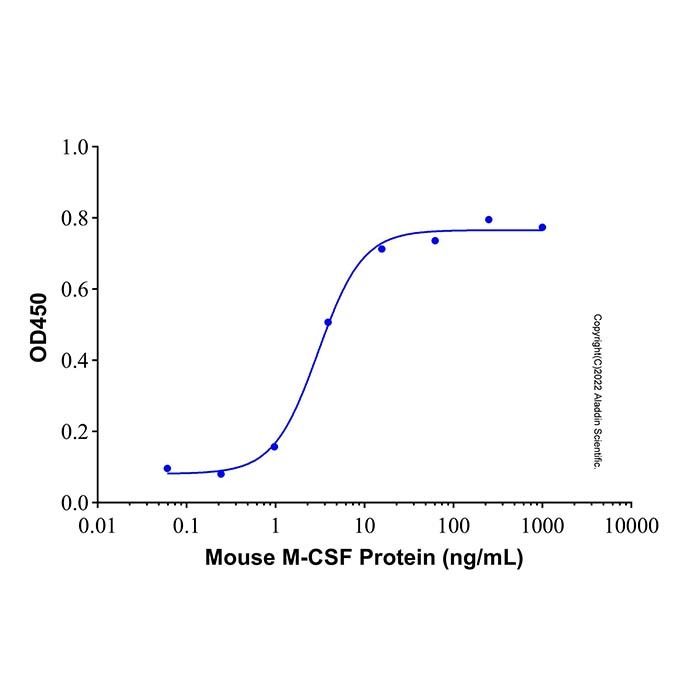
Measured in a cell proliferation assay using M‑NFS‑60 mouse myelogenous leukemia lymphoblast cells. The ED₅₀ for this effect is typically 3.02 ng/mL.
Animal Free,Carrier Free,Bioactive,ActiBioPure™,Azide Free,High Performance,His-Tag,≥95%(SDS-PAGE) ActiBioPure™,Animal Free,Azide Free,Bioactive,Carrier Free,High Performance,His Tag per flussi di lavoro cromatografici e analitici sensibili che richiedono un'interferenza minima della linea di base.
🌡
Stoccaggio e spedizione
Store at -20°C,Avoid repeated freezing and thawing Spedizione Ice chest + Ice pads. Consultare il COA specifico del lotto per le specifiche esatte.
📋
Documenti di qualità
SDS, COA, scheda tecnica e scheda delle specifiche disponibili per il download. COA specifico del lotto accessibile tramite ricerca per numero di lotto.
📚
Prova documentale
Citato in 0 pubblicazioni peer-reviewed su cromatografia, sintesi organica e reazioni di accoppiamento incrociato.
Panoramica
Purity ≥95% (SDS-PAGE) Endotoxin level <0.1 EU/μg Function Granulocyte/macrophage colony-stimulating factors are cytokines that act in hematopoiesis by controlling the production, differentiation, and function of 2 related white cell populations of the blood, the granulocytes and the monocytes-macrophages. CSF-1 induces cells of the monocyte/macrophage lineage. It plays a role in immunological defenses, bone metabolism, lipoproteins clearance, fertility and pregnancy.
35 - 60 kDa, under reducing conditions; 60 - 120 kDa, under non-reducing conditions.
Nota
This product can replace rp154365
Tipo di molecola
Proteine
Product Line
Prodotti biologici
Stoccaggio e spedizione
Forma
Lyophilized
Ricostituzione
Reconstitute in sterile water to a concentration of 0.1-0.5 mg/ml.
Condizioni di conservazione di stoccaggio
Store at -20°C,Avoid repeated freezing and thawing
Spedito in
Ice chest + Ice pads
Stabilità e conservazione
Store at -20~-80℃ for more than 1 year. Upon receipt, it is recommended to aliquot. Avoid freeze/thaw cycle.
Immagini
Recombinant Mouse M-CSF Protein (rp154367) - Protein Bioactivity Measured in a cell proliferation assay using M‑NFS‑60 mouse myelogenous leukemia lymphoblast cells. The ED₅₀ for this effect is typically 3.02 ng/mL.
Recombinant Mouse M-CSF Protein (rp154367) - SDS-PAGE 3 μg/lane of Recombinant Mouse M-CSF Protein was resolved with SDS-PAGE under reducing (R) and non-reducing (N) conditions and visualized by Coomassie® Blue staining, showing the band at 35 - 60 kDa under reducing condition and 60 - 120 kDa under non-reducing condition.
Documentazione
📋 Scheda di dati di sicurezza (SDS)
Documento completo su pericoli, manipolazione, stoccaggio e conformità normativa.
Determine the necessary mass, volume, or concentration for preparing a solution.
Dilution Calculator
Determine the dilution needed to prepare a stock solution.
Reconstitution Calculator
Recensioni
Recensioni dei clienti
Application Protocols
Only product-validated protocols can be listed here. The Product Data for SKU rp154367 does not include tested applications or recommended dilutions.
Item-specific tested applications: Not specified for this item; refer to CoA/Spec Sheet.
Recommended working ranges/dilutions: Not specified for this item; refer to CoA/Spec Sheet.
For general, literature-based usage ideas, see Reaction & Applications and Buffer Applications; however, users must independently optimize conditions for their systems.
Biological Roles
Macrophage Colony-Stimulating Factor (M-CSF; CSF1) is a central regulator of the mononuclear phagocyte system in mice and other mammals.
Core functions (literature)
Governs survival, proliferation, and differentiation of monocyte and macrophage lineage cells through its cognate receptor, CSF1R (a receptor tyrosine kinase).
Influences macrophage polarization, phagocytic capacity, and cytokine secretion profiles, thereby shaping innate immune responses in vitro models.
Modulates osteoclastogenesis in cooperation with RANKL in bone biology models; supports development of tissue-resident macrophage-like phenotypes under defined conditions.
Signaling (literature)
Ligand binding promotes CSF1R dimerization and autophosphorylation, activating downstream PI3K–AKT, MAPK–ERK, and JAK–STAT pathways.
Temporal dynamics of signaling can be interrogated by pulse stimulation followed by phospho-protein analysis (e.g., immunoblot or phospho-flow).
Experimental context (literature best practice)
Source, purity, and exact isoform of recombinant M-CSF affect potency; titration is required for each cell system.
Serum levels of endogenous factors and the presence of LPS/other cytokines can alter outcomes; include appropriate controls to deconvolute direct vs. combinatorial effects.
Note: This section summarizes general biological knowledge about mouse M-CSF. Item-specific sequence boundaries, isoform, and activity data are Not specified for this item; refer to the CoA/Spec Sheet.
Buffer Applications
M-CSF performance depends on buffer composition, pH, and excipients—especially for carrier-free formulations.
Reconstitution (general guidance)
Use sterile, neutral aqueous buffer (e.g., PBS, 10–20 mM HEPES, or 10 mM sodium acetate adjusted to pH ~7.0). Add buffer gently along vial wall and mix by slow inversion to avoid foaming.
Initial concentration should be sufficiently high to limit surface adsorption; prepare working dilutions immediately before use.
Working buffers for assays (general guidance)
For cell culture, dilute into serum-free or defined media compatible with the target cells. Consider addition of 0.1% recombinant human serum albumin or 0.05–0.1% polysorbate 20 only if adsorption-related loss is suspected and compatible with downstream assays.
Maintain physiological pH (7.2–7.4) and isotonicity. Avoid chelators or reductants that could disrupt disulfide bonds unless specifically required by the assay.
Storage buffers (general guidance)
For aliquots, low-ionic strength buffer at pH 6.5–7.5 is typically used. Filter-sterilize if needed (0.22 µm) and store frozen to preserve activity.
Item-specific recommended buffer, pH range, and excipient composition are Not specified for this item; refer to CoA/Spec Sheet.
Green Alternatives
While “green alternatives” typically target solvent and reagent choices, protein reagents can also be sourced and handled with sustainability in mind.
Production and formulation (product attributes)
Animal Free manufacturing (per Product Data) reduces reliance on animal-derived components, aligning with ethical and sustainability goals.
Azide Free minimizes hazardous preservative use and associated waste streams.
Laboratory practices (general recommendations)
Aliquot strategically to avoid product loss and repeated freeze–thaw, reducing re-order frequency and cold-chain burden.
Use right-sized reaction vessels and low-bind plastics to minimize adsorption losses and plastic waste.
Opt for CO2-independent buffering (e.g., HEPES) for certain workflows to reduce incubator door-open times and energy use, where appropriate.
Consolidate shipments when possible; this item ships cold (ice chest + ice pads per Product Data), so planning reduces packaging waste.
Comparison with common alternatives (general, literature-based)
M-CSF sourced with carrier proteins can extend shelf-life but introduces animal-derived materials; carrier-free, animal-free products improve sustainability and experimental clarity at the expense of potentially higher adsorption—users can add recombinant or inert carriers only where necessary.
No item-specific environmental metrics (e.g., carbon footprint, endotoxin testing method) are provided; refer to CoA/Spec Sheet if available.
Pharmaceutical Uses
This recombinant protein is supplied strictly for research use only (per Product Data). It is not intended for diagnostic, clinical, or therapeutic applications.
Formulation and analytical contexts (general, non-clinical)
May serve as a research reference material or process control in bioassays that quantify M-CSF activity or in ligand–receptor binding studies with CSF1R in discovery settings.
Useful as a spike-in standard for method development in cell-based assays, ELISAs, or ligand-binding analytics where permitted by institutional policies.
Excipient considerations (general)
Carrier-free and azide-free status enhances compatibility with a wide range of bioanalytical platforms and reduces interference in mass-based dosing or label-based detection.
Any pharmacopeial status, GMP grade, or clinical formulation guidance is Not specified for this item; refer to CoA/Spec Sheet. Do not use in humans or animals for therapeutic or diagnostic purposes.
Physical Properties
Appearance: Not specified for this item; refer to CoA/Spec Sheet.
Molecular Weight (item-specific): Not specified for this item; refer to CoA/Spec Sheet.
Isoelectric point (pI), extinction coefficient, and amino-acid composition: Not specified for this item; refer to CoA/Spec Sheet.
Solubility (general literature): Recombinant M-CSF proteins are typically soluble in neutral, low-salt aqueous buffers (e.g., PBS, HEPES, or acetate) and may require brief gentle mixing to fully dissolve. Carrier-free preparations can be more adsorption-prone at very low concentrations; addition of inert protein (e.g., 0.1% BSA) after initial activity testing can reduce losses (literature best practice).
Stability (general literature): Cytokines are generally stable for short periods at 2–8°C once reconstituted, but for long-term storage aliquots are kept at ≤−20°C/−80°C to minimize activity loss. Avoid repeated freeze–thaw cycles.
Aggregation (general literature): Like many cytokines, M-CSF can form higher-order species upon repeated thawing or at high concentration; gentle handling and avoiding vigorous vortexing are recommended.
Note: No definitive physicochemical specifications (e.g., exact MW of tag-fusion, purity %, UV absorbance ratios) are provided for this item; refer to the CoA/Spec Sheet for item-specific values.
Quality and Grades
This product is supplied with multiple performance designations. The following clarifies their typical implications for professional users.
Animal Free
Manufactured without animal-derived components, reducing variability and the risk of adventitious agents. Useful for serum-free workflows and xenogeneic-sensitive studies.
Carrier Free
No stabilizing carrier protein (e.g., BSA) is added to the final formulation. This maximizes mass accuracy for dosing and minimizes potential carrier interference in sensitive assays. Users may add a carrier post-qualification to mitigate adsorption losses in dilute solutions.
Bioactive / High Performance
Indicates the lot has been qualified in a biological activity assay appropriate for M-CSF (e.g., cell proliferation or differentiation readout; exact method Not specified for this item; refer to CoA/Spec Sheet). High Performance suggests stringent in-process controls and consistency across lots.
ActiBioPure™ (brand designation)
Denotes Aladdin’s high-purity, functionally active recombinant protein line. Typical attributes include low endotoxin and high homogeneity; item-specific specifications are Not specified for this item; refer to CoA/Spec Sheet.
Azide Free
No sodium azide preservative, improving compatibility with azide-sensitive downstream uses (e.g., copper-containing systems) and live-cell assays.
His Tag
Facilitates purification and potential capture/detection. Tag length, position, and cleavage option are Not specified for this item; refer to CoA/Spec Sheet.
Note: Purity %, endotoxin level, host system, sequence boundaries, and formulation excipients are Not specified for this item; refer to the CoA/Spec Sheet.
Reaction and Applications
This is a recombinant cytokine for biological research, not a small-molecule reagent for synthetic chemistry. Accordingly, “reactions” refer to bioassays and cellular responses rather than chemical transformations.
Typical research applications (literature-based; user should optimize)
Myeloid cell biology: Induction of survival, proliferation, and differentiation of monocyte/macrophage lineage cells via CSF1R signaling.
In vitro macrophage generation: Supplementation of mouse bone-marrow or embryonic stem cell cultures to generate bone-marrow-derived macrophages (BMDMs) or tissue-like macrophages.
Signaling studies: Time-course phosphorylation of CSF1R pathway components (e.g., ERK1/2, AKT, STATs) for receptor biology and inhibitor profiling.
Immunology: Polarization studies in combination with other cytokines; evaluation of phagocytosis, cytokine secretion, and gene expression programs.
Hematopoiesis models: Supportive factor in myeloid progenitor cultures.
Practical tips (general guidance)
Prepare fresh working dilutions just before use; avoid low-binding losses by using low-retention plastics.
Titrate across a broad range (e.g., 0.1–100 ng/mL) to identify cell line- and assay-specific EC50 and maximal response; do not assume a fixed potency.
Include appropriate negative controls (vehicle only) and, where possible, neutralizing antibodies or CSF1R inhibitors to confirm pathway specificity.
Item-specific potency units, assay system, and recommended working ranges are Not specified for this item; refer to CoA/Spec Sheet.
Reaction Conditions
Classical chemical reaction conditions are not applicable to a recombinant cytokine. For experimental use, consider the following general, literature-based biological handling conditions:
Temperature and timing
Cell stimulation typically occurs at 37°C in appropriate culture media; kinetics vary from minutes (signaling) to days (differentiation). Exact timings are cell- and assay-dependent.
Concentration ranges
Reported working concentrations in the literature often span 0.1–100 ng/mL for in vitro systems. Users must titrate to determine optimal dosing for their specific cells and readouts. Item-specific potency is Not specified for this item; refer to CoA/Spec Sheet.
Matrix and cofactors
Serum content, presence of complementary cytokines (e.g., RANKL for osteoclast studies), and matrix proteins can strongly influence outcomes; include appropriate controls and factorial designs.
Readouts
Phospho-protein immunoblot/flow, cell proliferation/viability assays, and differentiation markers (e.g., F4/80, CD11b) are commonly used endpoints in research.
These are general guidelines from the literature and are not item-specific recommendations.
Safety and Handling
GHS/SDS
Signal Word: Not specified for this item; refer to SDS.
H-Statements / P-Statements: Not specified for this item; refer to SDS.
GHS Classification and Pictograms: Not specified for this item; refer to SDS.
General safety considerations for recombinant proteins (general guidance)
Handle using standard laboratory practices for non-hazardous biological reagents: lab coat, gloves, and eye protection.
Azide Free (per Product Data) indicates no sodium azide preservative is present, reducing risks associated with azide exposure or copper plumbing formation of metal azides.
Animal Free (per Product Data) indicates no animal-derived materials are used during production, reducing adventitious agent concerns in research environments.
Handling and hygiene (general guidance)
Avoid aerosol generation; open vials carefully at the bench or in a biosafety cabinet if working with cells.
Avoid repeated freeze–thaw; prepare single-use aliquots after first thaw to preserve bioactivity.
Incompatibilities and stability (general guidance)
Avoid strong oxidants and extreme pH; cytokines are generally most stable near neutral pH with low ionic strength.
Avoid adsorption to glass or untreated plastic at low nanogram/mL levels by using low-bind plastics and, if compatible with your assay, inert protein or surfactant additives.
Always consult the product SDS for authoritative hazard, first-aid, spill, and disposal information.
Solvent Selection
For recombinant proteins, “solvent selection” primarily concerns buffer systems used for reconstitution, dilution, and storage rather than organic solvents.
Buffer polarity and miscibility (general guidance)
Use aqueous, isotonic buffers compatible with downstream bioassays: PBS, HEPES, Tris, or sodium acetate. Avoid organic solvents, which can denature proteins.
Practical choices by use case (literature-based)
Reconstitution: Low-ionic-strength buffers at pH 6.5–7.5 are commonly used. For carrier-free proteins, initial reconstitution in sterile water or PBS followed by immediate dilution into working buffer minimizes adsorption.
Cell culture: Serum-free media or basal media supplemented as needed. Ensure osmolarity and pH match cell requirements.
Storage: Buffers containing 0.1% inert protein (e.g., BSA) or 0.05–0.1% non-ionic surfactant (e.g., polysorbate 20) can reduce surface losses and aggregation, if compatible with your assay. Not part of this item’s formulation; user-added only after performance verification.
Comparison (general)
PBS vs HEPES: PBS is widely compatible; HEPES offers superior pH buffering near neutral in CO2-independent settings. Tris may interfere with some labeling chemistries.
Item-specific formulation/excipient details are Not specified for this item; refer to CoA/Spec Sheet.
Storage and Reconstitution
Item-specific storage and shipping (from Product Data)
Storage Conditions: Store at -20°C. Avoid repeated freezing and thawing.
Shipped In: Ice chest + Ice pads.
General reconstitution guidance (literature; not item-specific)
Centrifuge briefly to collect contents before opening.
Reconstitute with sterile, neutral buffer (e.g., PBS or HEPES, pH ~7.0) to a convenient stock concentration. Mix gently—do not vortex vigorously.
After first reconstitution, prepare single-use aliquots in low-bind tubes to prevent adsorption and freeze immediately at ≤−20°C (or colder) per laboratory practice.
Thaw on ice and use promptly. Discard any material that has been repeatedly frozen and thawed or shows visible precipitate/turbidity inconsistent with prior use.
Stability notes
Exact shelf life, freeze–thaw tolerance, and formulation excipients are Not specified for this item; refer to CoA/Spec Sheet and SDS.
For research use only.
Structure and Identity
Recombinant Mouse M-CSF (Macrophage Colony-Stimulating Factor; gene: Csf1) is a cytokine protein produced in a recombinant expression system and furnished with a His-tag per Product Data.
Item-specific identifiers
SKU: rp154367
Product Name: Recombinant Mouse M-CSF Protein
CAS: Not specified for this item; refer to CoA/Spec Sheet.
Molecular Formula: Not specified for this item; refer to CoA/Spec Sheet.
Molecular Weight: Not specified for this item; refer to CoA/Spec Sheet.
SMILES / InChIKey: Not applicable for proteins; Not specified for this item; refer to CoA/Spec Sheet.
Structural features (general literature description)
M-CSF (CSF1) is a secreted cytokine that can exist as monomeric and dimeric forms; active species are commonly disulfide-linked homodimers in vivo (literature).
Typical domain architecture includes a cytokine core adopting a four-helix bundle fold characteristic of class III hematopoietic growth factors (literature).
The recombinant construct here includes a His-tag (per Product Data) to facilitate affinity purification and detection.
2D/primary structure description (literature)
Linear polypeptide chain with an N-terminal signal peptide in native precursors; recombinant products are supplied as mature domains with/without tags depending on construct (literature). Sequence length, exact isoform, and tag position are Not specified for this item; refer to CoA/Spec Sheet.
Synthetic Utility
Not applicable. This product is a recombinant protein used as a biological reagent rather than a small-molecule building block or catalyst.
Guidance
For experimental planning, see the Biological Roles, Reaction & Applications, and Buffer Applications sections, which address how M-CSF is utilized in cell biology and signaling assays.
No named organic reactions, protection/deprotection strategies, or cross-couplings are relevant to this material.
Target Specificity
Only item-specific target details may be listed here. No application-validated target specificity information is provided in the Product Data for SKU rp154367.
Item-specific data: Not specified for this item; refer to CoA/Spec Sheet.
Note: Although M-CSF is known in the literature to interact with CSF1R, such information is general background and not a validated attribute of this specific lot/formulation.
Domande frequenti
What is the purity of this product, and how is it determined?
This product is supplied at ≥95% purity, determined by SDS-PAGE. Lot-specific values are stated on the Certificate of Analysis.
What does Animal Free mean?
Animal Free indicates that the material has been processed and tested for specialty industrial processing. Specifications focus on the impurities that affect performance in that application — for example, metal content for electronics, particle size for batteries, refractive index for optics, or moisture content for moisture-sensitive processes.
What does Carrier Free mean?
Carrier Free indicates that the material has been processed and tested for specialty industrial processing. Specifications focus on the impurities that affect performance in that application — for example, metal content for electronics, particle size for batteries, refractive index for optics, or moisture content for moisture-sensitive processes.
How should this product be stored?
Store at ?20 °C. Avoid repeated freeze–thaw cycles. Aliquot into single-use volumes before freezing.
How is this product shipped?
This product ships in an insulated container with ice pads. Unpack on arrival and transfer it to the storage condition stated above.
What documentation is provided?
Available product documentation, including Certificates of Analysis (COA), Safety Data Sheets (SDS), and specification sheets, is shown in the product document area. Document availability and access follow the current site policy.
Hai bisogno di aiuto per scegliere la qualità?
La nostra guida alla selezione delle qualità copre purezza, stato dello stabilizzatore e idoneità all'applicazione per tutte le varianti del nostro catalogo.
Utilizziamo i cookie per garantire il corretto funzionamento del sito web e, ove consentito, per migliorare la tua esperienza. Puoi gestire le tue preferenze in qualsiasi momento nelle Impostazioni. Per saperne di più, consulta la nostra Cookie Policy.
Desidera che le inviamo un messaggio quando avremo sconti disponibili?
Ricordamelo più tardi
Grazie! Controlli la sua casella di posta per confermare.
Products are supplied to verified businesses, institutions, and qualified professionals for research and development use only. Not for use in humans, animals, diagnosis, or therapy.

 ZJ26F0838274