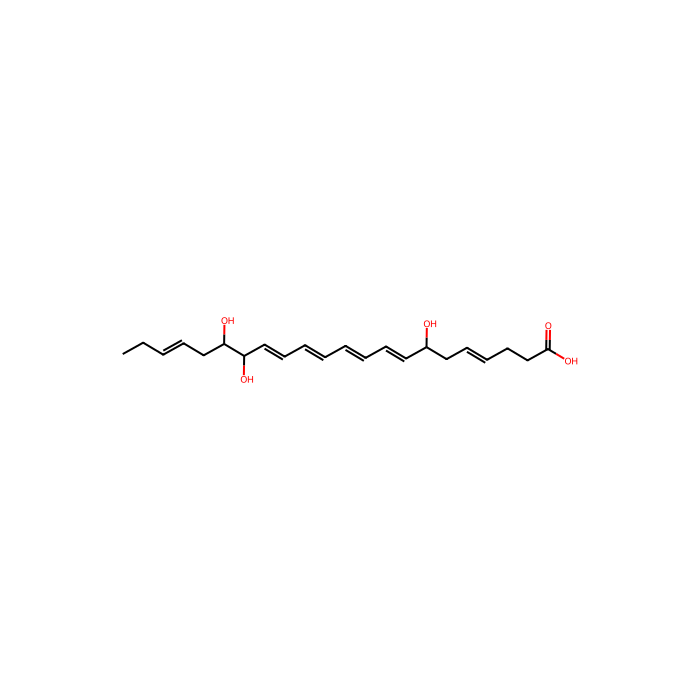
Resolvin D2 - ≥95%, 100μg/mL in ethanol , CAS No.810668-37-2

CAS: 810668-37-2 Cat. No.: R342426 Formula: C22H32O5 Peso molecolare: 376.5 PubChem CID: 11383310
Disponibile su ordine
QUALITÀ & PUREZZA ≥95% 100μg/mL in ethanol
Synonyms
RvD2|Resolvin D2-[d5]|(4Z,7R,8E,10Z,12E,14E,16R,17S,19Z)-7,16,17-trihydroxydocosa-4,8,10,12,14,19-hexaenoic acid|Resolvin D2|(4Z,7S,8E,10Z,12E,14E,16R,17S,19Z)-7,16,17-Trihydroxy-4,8,10,12,14,19-docosahexaenoic acid|7S,16R,17S-trihydroxy-4Z,8E,10Z,12E,14E,19Z-docosahexaenoic acid|(4Z,7S,8E,10Z,12E,14E,16R,17S,19Z)-7,16,17-trihydroxydocosa-4,8,10,12,14,19-hexaenoic Acid|starbld0018119
Storage
Store at -80°C
Shipped In
Dry ice packs + Cold packs
★
Dimensione
Germania (EU)
USA*
Prezzo
Qtà
10μg
R342426-10μg
Su ordinazione · 8–12 settimane
520,56€
Enter a quantity for the sizes you want to add.

Panoramica

Resolvins are a family of potent lipid mediators derived from both eicosapentaenoic acid (EPA) and docosahexaenoic acid (DHA). In addition to being anti-inflammatory, resolvins promote the resolution of the inflammatory response back to a non-inflamed state. Resolvin D2 is produced physiologically from the sequential oxygenation of DHA by 15- and 5-lipoxygenase and functions to dampen excessive neutrophil trafficking to sites of inflammation. It reduces zymosan-stimulated PMN infiltration by 70% at doses as low as 10 pg per mouse and significantly reduces PAF-stimulated leukocyte adherence and emigration at 1 nM. Also, by stimulating nitric oxide production, resolvin D2 dose dependently decreases leukocyte-endothelial interactions. In a murine model of sepsis, resolvin D2 reduces leukocyte and PMN infiltration, decreases production of pro-inflammatory cytokines, and promotes phagocyte-mediated bacterial clearance.

Specifiche

Sinonimi
RvD2 | Resolvin D2-[d5] | (4Z,7R,8E,10Z,12E,14E,16R,17S,19Z)-7,16,17-trihydroxydocosa-4,8,10,12,14,19-hexaenoic acid | Resolvin D2 | (4Z,7S,8E,10Z,12E,14E,16R,17S,19Z)-7,16,17-Trihydroxy-4,8,10,12,14,19-docosahexaenoic acid | 7S,16R,17S-trihydroxy-4Z,8E,10Z,12E,14E,19Z-docosahexaenoic acid | (4Z,7S,8E,10Z,12E,14E,16R,17S,19Z)-7,16,17-trih Mostra altro
Specifiche e purezza
≥95%, 100μg/mL in ethanol
Condizioni di conservazione di stoccaggio
Store at -80°C
Spedito in
Dry ice packs + Cold packs
Questo prodotto richiede spedizione a catena fredda. I servizi di terra e altri servizi economici non sono disponibili.
Purezza
≥95%
Nomi e identificatori
SMILES
CCC=CCC(C(C=CC=CC=CC=CC(CC=CCCC(=O)O)O)O)O
IUPAC Name
(4Z,7S,8E,10Z,12E,14E,16R,17S,19Z)-7,16,17-trihydroxydocosa-4,8,10,12,14,19-hexaenoic acid
InChIKey
IKFAUGXNBOBQDM-XFMPMKITSA-N
InChI
1S/C22H32O5/c1-2-3-9-16-20(24)21(25)17-12-7-5-4-6-10-14-19(23)15-11-8-13-18-22(26)27/h3-12,14,17,19-21,23-25H,2,13,15-16,18H2,1H3,(H,26,27)/b6-4-,7-5+,9-3-,11-8-,14-10+,17-12+/t19-,20+,21-/m1/s1
Isomeri SMILES
CC/C=C\C[C@@H]([C@@H](/C=C/C=C/C=C\C=C\[C@H](C/C=C\CCC(=O)O)O)O)O
PubChem CID
11383310
Numero UN
1170
Gruppo di imballaggio
II
Peso molecolare
376.5

Dati avanzati

Taxonomic Classification

Taxonomy Tree

KingdomOrganic compounds
SuperclassLipids and lipid-like molecules
ClasseFatty Acyls
SubclassFatty acids and conjugates
Intermediate Tree Nodes Not available
Direct ParentVery long-chain fatty acids
Alternative Parents Hydroxy fatty acids  Unsaturated fatty acids  Secondary alcohols  Polyols  Monocarboxylic acids and derivatives  Carboxylic acids  Organic oxides  Hydrocarbon derivatives  Carbonyl compounds  
Molecular FrameworkAliphatic acyclic compounds
Substituents Very long-chain fatty acid - Hydroxy fatty acid - Unsaturated fatty acid - Secondary alcohol - Polyol - Monocarboxylic acid or derivatives - Carboxylic acid - Carboxylic acid derivative - Organic oxygen compound - Organic oxide - Hydrocarbon derivative - Organooxygen compound - Carbonyl group - Alcohol - Aliphatic acyclic compound
DescrizioneThis compound belongs to the class of organic compounds known as very long-chain fatty acids. These are fatty acids with an aliphatic tail that contains at least 22 carbon atoms.
External Descriptors Docosanoids
Struttura 3D
Modello di struttura chimica interattiva


Certificati (CoA, COO, BSE/TSE e tabella di analisi)
C of A & Other Certificates(BSE/TSE, COO):
Analytical Chart:
Proprietà chimiche e fisiche
SolubilitàSoluble in PBS pH 7.2 (~0.05 mg/ml), DMSO (~50 mg/ml), and DMF (~50 mg/ml).
Indice di rifrazionen20D1.55 (Predicted)
Punto di ebollizione (°C)78° C
Peso molecolare376.5
XLogP33.100
Hydrogen Bond Donor Count4
Hydrogen Bond Acceptor Count5
Rotatable Bond Count14
Exact Mass376.225 Da
Monoisotopic Mass376.225 Da
Topological Polar Surface Area98.000 Ų
Heavy Atom Count27
Formal Charge0
Complexity555.000
Isotope Atom Count0
Defined Atom Stereocenter Count3
Undefined Atom Stereocenter Count0
Defined Bond Stereocenter Count6
Undefined Bond Stereocenter Count0
The total count of all stereochemical bonds6
Covalently-Bonded Unit Count1
Sicurezza e pericoli (GHS)
Segnale
Danger
Indicazioni di pericolo

H225:Highly Flammable liquid and vapor

H333:May be harmful if inhaled

H350:May cause cancer

Precauzioni

P201:Obtain special instructions before use.

P210:Keep away from heat, hot surface, sparks, open flames and other ignition sources. - No smoking.

P202:Do not handle until all safety precautions have been read and understood.

P233:Keep container tightly closed.

P240:Ground/bond container and receiving equipment.

P242:Use only non-sparking tools.

P243:Take precautionary measures against static discharge.

P281:Use personal protective equipment as required.

Classe
3
Calcolatori di soluzioni
Recensioni

Recensioni dei clienti

Application Protocols

Item-specific validated application protocols were not provided. The following is general, non‑prescriptive guidance for handling and use of lipid mediator standards in research.

  • Stock preparation:
    • Allow vial to equilibrate on ice; briefly centrifuge to collect contents.
    • Dissolve in anhydrous DMSO or ethanol to prepare a concentrated stock (e.g., 1–10 mM). Vortex gently and, if needed, briefly sonicate in an ice‑cold water bath.
    • Immediately aliquot into amber, low‑bind microvials; minimize headspace and purge with N2/Ar; store at −80°C.
  • Working solutions:
    • Prepare fresh on the day of use by diluting the organic stock into buffer or media with vigorous mixing. Keep final co‑solvent low (commonly ≤0.1–0.2% v/v in cell assays, as permitted by your system).
    • To reduce adsorption, pre‑coat plastics with carrier protein (e.g., fatty‑acid–free BSA) if compatible.
  • Analytical QC (for standards use):
    • Verify concentration by UV or quantitative NMR if applicable; for LC‑MS workflows, use stable isotope‑labeled internal standards and bracketed calibration.
  • Documentation:
    • Record lot number, purity, solvent, concentration, and aliquot map; avoid repeated freeze–thaw.

These steps are guidance only; optimize for your specific assay and instrumentation.

Biological Roles

General literature background (not product‑specific and not a therapeutic claim):

  • Origin: Resolvin D2 (RvD2) is enzymatically generated from DHA via lipoxygenase‑mediated oxygenation and subsequent transformations during the resolution phase of inflammation.
  • Chemical biology: RvD2 is a multi‑hydroxylated, stereochemically defined lipid mediator. Its polyene chain and specific alcohol positions/absolute configurations are essential for receptor recognition and signal bias.
  • Functional themes observed in vitro and in model systems (literature):
    • Modulation of leukocyte trafficking and effector functions during the resolution of inflammation.
    • Engagement of GPCR targets reported for D‑series resolvins; RvD2 has been associated in literature with signaling through a receptor referred to as DRV2/GPR18.
    • Influence on endothelial barrier properties and mediator networks within the specialized pro‑resolving mediator (SPM) family.
  • Systems biology relevance:
    • Quantified in lipidomics workflows as an endpoint of DHA metabolism; used as a biomarker for resolution phase dynamics in research settings.

Important note: The above describes general biochemical roles reported in the literature. This product is supplied strictly for research use only and is not intended for diagnostic, therapeutic, or clinical use.

Buffer Applications

RvD2 is a hydrophobic lipid mediator and is not used as a buffer component. When introducing RvD2 into aqueous buffers for research assays:

  • Pre‑dissolve in a suitable organic solvent (e.g., DMSO or ethanol), then dilute into the target buffer immediately before use.
  • To enhance apparent solubility and reduce adsorption to plastics, consider adding fatty‑acid–free BSA or other compatible carriers.
  • Maintain neutral pH to minimize isomerization; avoid strong bases or acids.

For general buffer formulations, refer instead to conventional buffering agents (e.g., phosphate, HEPES, Tris), which are more appropriate for controlling pH.

Green Alternatives

As a bioactive lipid standard, RvD2’s environmental footprint is dominated by solvent choice and cold‑chain logistics rather than by the molecule itself. Greener practice focuses on solvent selection and process minimization.

Greener considerations (general):

  • Prefer EtOH or MeOH (renewable feedstock options available) over halogenated solvents for routine handling.
  • Use aqueous buffers with minimal co‑solvent where compatible; consider cyclodextrin carriers to reduce DMSO/EtOH load in assays.
  • Minimize dry‑ice consumption by coordinating shipments and consolidating orders to maintain cold chain efficiently.
  • Scale down: Optimize analytical methods (e.g., micro‑LC, low‑volume extractions) to reduce solvent consumption and waste.

Comparison of common solvents (general):

  • Ethanol: Renewable routes available; low toxicity; biodegradable; flammable.
  • Methanol: Widely available; toxic; less green than ethanol but far safer than chlorinated solvents.
  • Acetonitrile: Useful for LC; recyclable in many labs; moderate toxicity.
  • DMSO: Low volatility; good solvency; not particularly hazardous; disposal typically straightforward; derived from sulfite process byproducts.

Trade‑offs:

  • While ethanol is greener, DMSO often offers superior stability and solubility for highly unsaturated lipids. A hybrid approach (concentrated DMSO stocks, final dilution into ethanol‑buffer or buffer with carriers) can balance performance with greener principles.
Pharmaceutical Uses

No pharmaceutical or clinical uses are claimed for this product. It is provided strictly for research use only.

Relevant research/manufacturing contexts (general):

  • Reference standard in analytical development and QC for lipidomics platforms supporting discovery research.
  • Excipient compatibility studies: screening of carrier systems (e.g., albumin, cyclodextrins, lipid nanoparticles) in preclinical research settings to understand stability and delivery of labile polyunsaturated lipids in vitro.
  • Forced‑degradation and stability‑indicating method development, to validate handling and storage conditions for highly unsaturated, multi‑hydroxylated fatty acid derivatives.

Note: RvD2 is not an approved excipient and is not listed here with any compendial status. Do not use in humans or for diagnostic/therapeutic purposes.

Physical Properties

Item-specific physicochemical specifications were not provided for this catalog entry. Refer to the CoA/Spec Sheet for definitive values. The following notes are general/literature guidance for Resolvin-class DHA metabolites and should not be construed as product specifications.

  • Appearance: Not specified for this item; refer to CoA/Spec Sheet.
  • Molecular Weight: Not specified for this item; refer to CoA/Spec Sheet.
  • Molecular Formula: Not specified for this item; refer to CoA/Spec Sheet.
  • Solubility (general/literature):
    • Practically insoluble in water as the free acid; readily soluble in polar aprotic organics (DMSO) and lower alcohols (ethanol, methanol).
    • Can be formulated in aqueous buffers by prior dissolution in EtOH/DMSO followed by dilution with carrier proteins (e.g., fatty‑acid–free BSA) if compatible with the experiment.
  • Partitioning (general): Expected high logP due to long aliphatic chain; ionization of the carboxyl group reduces apparent lipophilicity at higher pH.
  • pKa (general for long‑chain fatty acids): ca. 4.5–5 (literature), affected by microenvironment and substitution.
  • Stability considerations (general):
    • Sensitive to oxidation, isomerization, and light due to multiple double bonds; store under inert gas, protected from light, at low temperature.
    • Avoid repeated freeze–thaw; use single‑use aliquots.

Always confirm experimental solubility and stability empirically under your conditions.

Quality and Grades
  • Grade/Purity (item-specific): Not specified for this item; refer to CoA/Spec Sheet.

Interpretation and considerations for lipid mediator standards (general guidance):

  • Research-grade RvD2 is typically supplied at high purity to preserve stereochemical integrity and avoid confounding bioassay readouts. Purity is commonly assessed by LC‑MS and UV; stereochemical identity may require chiral/positional analysis and comparison to reference spectra.
  • Stabilizers/antioxidants: Sometimes trace antioxidants (e.g., BHT) or inert-atmosphere packaging are used for highly unsaturated lipids. If present, they should be disclosed on the CoA. Verify compatibility with downstream assays.
  • Low‑temperature logistics: Shipment on dry ice and storage at −80°C limit oxidative degradation and isomerization of polyunsaturated motifs.
  • Documentation: For quantitative work (e.g., LC‑MS calibration), obtain the exact purity assay, water content, and residual solvent data from the CoA to enable correction to mass balance and preparation of accurate standard solutions.

Recommendation: For bioassays sensitive to isomeric purity, request chromatographic traces and any available stereochemical confirmation supporting the assigned RvD2 configuration for this lot.

Reaction and Applications

This product is primarily used as a bioactive lipid standard and research tool rather than as a synthetic reagent. Accordingly, classical synthetic reaction families (e.g., cross‑couplings, nucleophilic substitutions) are not typical end‑uses. However, RvD2 is frequently applied in the following research contexts:

  • Analytical/standards:
    • Calibration standard for LC‑MS/MS quantitation of endogenous specialized pro‑resolving mediators in biological matrices (plasma, tissues, cell culture supernatants).
    • Method development for targeted lipidomics, including MRM transitions and retention time alignment with authentic standards.
  • Mechanistic biology:
    • Tool compound to interrogate resolution-phase signaling pathways downstream of DHA metabolism in immune cells (general/literature). Used to benchmark assay responsiveness and receptor engagement under controlled in vitro conditions.
  • Formulation/science of delivery:
    • Studies on carrier systems for lab delivery of labile polyunsaturated mediators (e.g., albumin binding, cyclodextrin inclusion, liposomes) and their effects on stability and apparent potency in vitro.

Practical tips for use as a standard:

  • Work under dim light, cold conditions; add internal standards immediately after sample collection in lipidomics workflows.
  • Employ antioxidant‑containing extraction solvents where appropriate; validate recovery and matrix effects with spiked QC samples.

Note: For synthesis of RvD2 itself, see the Synthetic Utility section.

Reaction Conditions

Typical laboratory manipulations involving RvD2 focus on solution preparation and analytical workflows rather than chemical reactions. The following guidance is general and literature‑based:

  • Solution preparation:
    • Dissolve under inert atmosphere in anhydrous DMSO or ethanol at low temperature and subdued light. Prepare concentrated stocks (e.g., mM range), then aliquot into amber vials, purge headspace with N2/Ar, and store at −80°C.
    • For aqueous dosing, add the organic stock to buffer with vigorous mixing; maintain final co‑solvent at minimal levels tolerated by your system.
  • Stability testing (forced degradation for method development):
    • Oxidative stress: Trace peroxide in solvents or air exposure leads to rapid degradation; include antioxidants in extraction solvents where validated, and run time‑zero controls.
    • Thermal/light stress: Evaluate at 4°C, RT, and 37°C in the dark vs light to define handling windows.
  • Chromatographic conditions (literature examples):
    • Reversed‑phase LC (C18) with water/acetonitrile or water/methanol gradients containing 0.01–0.1% acetic or formic acid; detection by MS/MS in negative ESI mode for carboxylates.
    • Use stable isotope‑labeled internal standards for accurate quantitation.

Note: No item‑specific reaction parameters are claimed; consult primary literature for any synthetic preparation of RvD2 or analogs.

Safety and Handling

Hazard information was not provided for this item. Always consult the product SDS for authoritative safety data.

  • GHS/Classification (item-specific): Not specified for this item; refer to SDS.
  • Signal word / H‑statements / pictograms: Not specified for this item; refer to SDS.

General laboratory handling for polyunsaturated lipid mediators:

  • PPE: Wear lab coat, safety glasses, and nitrile gloves. Handle solutions in a chemical fume hood when preparing volatile solvents (e.g., ethanol, DMSO) or when aerosol formation is possible.
  • Incompatibilities: Strong oxidizers, radical initiators, bases/acids that may promote isomerization or hydrolysis; minimize exposure to air and light.
  • Special risks: Multiple olefinic bonds make the compound prone to autoxidation. Work quickly at low temperature with amber glassware; consider purging vials with inert gas (N2/Ar) after opening.
  • First aid (general):
    • Skin/eye contact: Rinse with water for several minutes; remove contaminated clothing; seek medical attention if irritation persists.
    • Inhalation: Move to fresh air; seek medical attention if symptoms occur.
    • Ingestion: Rinse mouth; do not induce vomiting; seek medical attention.
  • Spill response: Absorb with inert material, collect in sealed container, and dispose per institutional and local regulations.

Storage and shipping (item-specific): Store at −80°C. Shipped on dry ice packs + cold packs (as provided).

Solvent Selection

RvD2, as a long‑chain polyunsaturated fatty acid derivative, behaves as a lipophilic weak acid. Choose solvents that minimize oxidation and enable accurate dosing.

  • Primary dissolution (general best practice):
    • DMSO: Excellent solvating power; prepare concentrated stocks (e.g., 1–10 mM), aliquot, and store at −80°C. Avoid water uptake.
    • Ethanol (absolute) or methanol (anhydrous): Common for lipid stocks; compatible with many in vitro systems at low final percentages.
    • Acetonitrile: Useful for LC‑MS sample prep.
  • Aqueous use:
    • Pre‑dissolve in DMSO/EtOH then dilute into buffered media. To improve dispersion, include fatty‑acid–free BSA or cyclodextrins if compatible; avoid exceeding tolerated co‑solvent levels in biological assays.
  • Polarity and miscibility (general):
    • Nonpolar/weakly polar solvents (hexane, MTBE) dissolve the neutral acid but are less convenient for dosing; suitable for extraction/cleanup.
  • Handling tips:
    • Use amber vials, minimize headspace, and purge with inert gas after aliquoting.
    • Avoid basic aqueous solutions that can induce isomerization or hydrolysis of sensitive motifs.

Comparison (general):

  • DMSO vs ethanol: DMSO gives higher stock concentrations and lower volatility; ethanol may be preferable for cell compatibility at very low final percentages. Choose based on assay tolerance and analytical needs.
Storage and Reconstitution

Item-specific storage and logistics (from Product Data):

  • Storage Conditions: Store at −80°C.
  • Shipped In: Dry ice packs + Cold packs.

Reconstitution and handling (general best practice for polyunsaturated lipid mediators):

  • Upon receipt: Keep frozen. Inspect for container integrity and any signs of warming during transit. Record lot and reception date.
  • Thawing: Handle on ice, protected from light. Briefly centrifuge to collect material before opening.
  • Solvent choice: Reconstitute in anhydrous DMSO or ethanol to prepare a concentrated stock. Use amber, low‑bind vials. If preparing aqueous formulations, first dissolve in organic solvent, then dilute into buffer immediately before use.
  • Aliquoting: Prepare single‑use aliquots to avoid repeated freeze–thaw. Minimize headspace and, if possible, blanket with inert gas (N2/Ar) before re‑freezing.
  • Storage stability: Maintain at −80°C. Avoid exposure to air, light, and elevated temperatures, which accelerate oxidation and isomerization of polyunsaturated chains.
  • Compatibility: Verify that any carriers (e.g., albumin) or excipients are suitable for your downstream assay and do not introduce confounding background.

Note: If the product is supplied as a solution or with any stabilizers, consult the CoA/Spec Sheet for exact solvent composition, concentration, and reconstitution instructions specific to this lot.

Structure and Identity

Resolvin D2 is a specialized pro‑resolving mediator (SPM) biosynthetically derived from docosahexaenoic acid (DHA; n‑3, C22:6). It is a polyunsaturated, multi‑hydroxylated lipid with defined E/Z geometry and stereochemistry along the carbon chain.

  • Item-specific identifiers (from Product Data):

    • CAS: 810668-37-2
    • InChIKey: 143159 (as provided)
    • SMILES: Not specified for this item; refer to CoA/Spec Sheet.
    • Molecular Formula: Not specified for this item; refer to CoA/Spec Sheet.
    • Molecular Weight: Not specified for this item; refer to CoA/Spec Sheet.
  • Structural features (general/literature):

    • Derived from DHA, retaining a C22 polyunsaturated backbone with multiple conjugated/trans‑cis double bonds.
    • Contains multiple secondary alcohols (polyhydroxylated) at defined positions; specific absolute configurations are critical for bioactivity.
    • No ring systems; linear aliphatic chain ending in a carboxylic acid.
    • Typical 2D depiction: a carboxylate headgroup (–CO2H) at C1, followed by alternating double/single bonds along the chain, bearing three hydroxyl substituents at stereodefined positions.
  • Nomenclature (general):

    • Common name: Resolvin D2 (RvD2)
    • Class: Docosahexaenoic acid-derived specialized pro-resolving mediator (SPM)

Note: Exact stereochemical descriptors, formula, and mass for this catalog item are not specified above; consult the product CoA/Spec Sheet for definitive identity parameters.

Synthetic Utility

While RvD2 itself is typically an end‑product reference standard rather than a building block, its structure exemplifies several synthetic challenges and strategies of interest to practitioners:

  • Functional motif inventory (general):
    • Polyene chain with defined E/Z geometry.
    • Multiple secondary alcohols at set positions and stereochemistry.
    • Terminal carboxylic acid.
  • Strategic elements (literature):
    • Convergent assembly of the C22 backbone via fragment coupling (e.g., Wittig/Julia–Kocienski olefinations, HWE) with geometry control.
    • Asymmetric introduction of hydroxyls by Sharpless epoxidation/diol opening, Brown allylation, or enantioselective dihydroxylation, followed by protecting‑group choreography (e.g., silyl ethers) to manage chemoselectivity.
    • Late‑stage global deprotection and careful isomerization control under mild conditions to preserve the native double‑bond pattern.
  • Analytical control:
    • Extensive use of high‑resolution LC‑MS and 1D/2D NMR to confirm regiochemistry and stereochemistry; comparison to biosynthetic or previously authenticated material is common.

For researchers synthesizing analogs or isotopologues (e.g., deuterated internal standards), analogous strategies apply, with attention to maintain chromatographic co‑elution and mass shifts suitable for MS quantitation.

Target Specificity

This section typically applies to biologics (e.g., antibodies, enzymes) with defined binding targets. RvD2 is a small‑molecule lipid mediator and does not have a product‑specific “target specificity” entry.

General literature context: D‑series resolvins, including RvD2, have been reported to engage GPCR targets in vitro; RvD2 has been associated with DRV2/GPR18 in the literature. These notes are provided for background only and are not item specifications.

For experimental receptor studies, determine target engagement empirically under your assay conditions and consult primary literature for receptor expression systems and readouts.

Domande frequenti

What are the CAS number, molecular formula and molecular weight?
The CAS Number is 810668-37-2, the molecular formula is C22H32O5, and the molecular weight is 376.5 g/mol. InChIKey IKFAUGXNBOBQDM-XFMPMKITSA-N.
What is the purity of this product?
This product is supplied at ≥95% purity (chemical assay). Lot-specific values are stated on the Certificate of Analysis.
How should this product be stored?
Store at ?80 °C. Ultra-low temperature storage is required to maintain the specified shelf life.
How is this product shipped?
This product ships frozen with dry ice and cold packs. Unpack on arrival and transfer it to the storage condition stated above; handle dry ice with insulated gloves in a ventilated area.
What documentation is provided?
Available product documentation, including Certificates of Analysis (COA), Safety Data Sheets (SDS), and specification sheets, is shown in the product document area. Document availability and access follow the current site policy.

Desidera che le inviamo un messaggio quando avremo sconti disponibili?

Ricordamelo più tardi

Grazie! Controlli la sua casella di posta per confermare.

Ops! Le notifiche sono disabilitate.