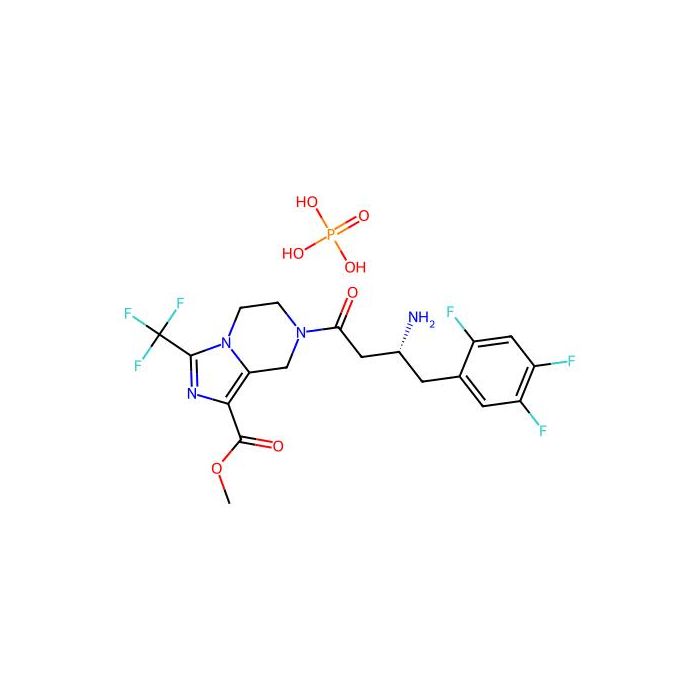
Retagliptin phosphate (SP2086 phosphate) is a selective, competitive and orally active dipeptidyl peptidase-4 (DPP-4) inhibitor. Retagliptin phosphate can be used for type 2 diabetes mellitus (T2DM) research
In Vitro
Retagliptin is a class of compound used for research of type 2 diabetes. Retagliptin inhibits the degradation of GLP-1, thus amplifying the incretin effect. MCE has not independently confirmed the accuracy of these methods. They are for reference only.
IC50& Target:DPP-4
Specifiche
Specifiche e purezza
10mM in DMSO
Meccanismi biochimici e fisiologici
Retagliptin phosphate (SP2086 phosphate) is a selective, competitive and orally active dipeptidyl peptidase-4 (DPP-4) inhibitor. Retagliptin phosphate can be used for type 2 diabetes mellitus (T2DM) research.
Condizioni di conservazione di stoccaggio
Desiccated,Store at -80°C
Spedito in
Dry ice packs + Cold packs
Questo prodotto richiede spedizione a catena fredda. I servizi di terra e altri servizi economici non sono disponibili.
Certificati (CoA, COO, BSE/TSE e tabella di analisi)
C of A & Other Certificates(BSE/TSE, COO):
Analytical Chart:
Calcolatori di soluzioni
Molarity Calculator
Determine the necessary mass, volume, or concentration for preparing a solution.
Dilution Calculator
Determine the dilution needed to prepare a stock solution.
Reconstitution Calculator
Recensioni
Recensioni dei clienti
Application Protocols
Not applicable. No validated biological or analytical application protocols (e.g., WB, IHC, IF, FC) are provided for this item.
General guidance for small-molecule handling in screening workflows:
Prepare concentrated DMSO stocks under dry conditions; aliquot to single-use vials to avoid freeze–thaw.
For biochemical assays, confirm the tolerated DMSO percentage and assess potential assay interference (fluorescence quenching, aggregation, redox cycling) with appropriate controls.
For LC-MS quantification, prepare matrix-matched calibration standards and include internal standards where possible.
Refer to your lab’s SOPs or method development guides for detailed protocols.
Biological Roles
Item-specific (from Product Data)
No target, pathway, or mechanistic information is provided for this item.
General context for research small molecules (not item-specific, no therapeutic claims)
Phosphate salts are frequently chosen to improve aqueous handling for biochemical screening and target engagement studies. The counterion does not impart specific biological activity but can influence solubility, dissolution rate, and sometimes cell permeability through ion-pairing effects.
For mechanistic work, researchers typically characterize: binding affinity/kinetics (e.g., ITC, SPR), target selectivity across related proteins, and cellular potency readouts. Orthogonal assays (biochemical vs cellular) help deconvolute on-target effects from assay artifacts.
ADME-relevant assessments (permeability, metabolic stability, plasma protein binding) can be conducted to contextualize in vitro results; these are research data and should not be construed as clinical attributes.
Please refer to your own experimental data or literature associated with CAS 1256756-88-3 and CID 49820554 to define specific biochemical roles or targets relevant to your program.
Buffer Applications
This product is not a buffering reagent and is not typically used to establish or control pH in biochemical systems.
Practical guidance
When formulating working solutions, use established buffers compatible with your assays (e.g., phosphate, HEPES, Tris) and confirm that the compound remains in solution upon dilution from DMSO stocks.
Avoid buffers or pH ranges that promote degradation or alter ionization state detrimentally; define an acceptable pH window empirically via stability-indicating LC.
For experiments requiring defined ionic strength or pH, select buffer systems based on the biology and analytics rather than the compound itself.
Green Alternatives
While this item is a solid small-molecule phosphate salt rather than a process solvent or bulk reagent, greener handling choices can still be applied.
Solvent considerations (general guidance)
Prefer water or buffered aqueous media for working solutions whenever the molecule’s solubility and stability permit, minimizing reliance on high-boiling organics.
If an organic co-solvent is required, DMSO is commonly used at low percentages; consider ethanol or propylene carbonate as alternatives where compatible with assays and stability.
Operational practices
Use micro-aliquots to reduce waste from freeze–thaw cycles and expired solutions.
Implement LC methods that minimize organic solvent usage (short gradients, narrower columns, higher efficiency stationary phases). Where feasible, employ water-rich mobile phases and volatile buffers to reduce environmental burden.
Adopt miniaturized assay formats (384/1536-well) to reduce reagent volumes.
Comparison (general; not item-specific)
Water/buffer: lowest environmental impact; limited by solubility/stability.
Ethanol: renewable, lower toxicity than many aprotics; may affect assay biology.
DMSO: excellent solubilizer but persistent; keep final assay % low and manage waste streams appropriately.
Document and validate any changes to solvent systems, as solubility, bioassay readouts, and analytical responses can vary with composition.
Pharmaceutical Uses
No therapeutic or clinical use is claimed or supported for this catalog item; it is supplied strictly for research use only.
Research and development context (general)
Can serve as a reference compound or analytical standard during method development (e.g., LC-UV/LC-MS), forced-degradation studies, and salt/form screening.
May be used in pre-formulation experiments to understand solubility, hygroscopicity, and stability as a phosphate salt versus alternative counterions.
If comparing polymorphs or hydrates, employ XRPD/DSC/TGA and humidity-controlled dynamic vapor sorption.
Compliance note
This product is not manufactured to GMP standards unless explicitly stated on the CoA and is not intended for human or veterinary administration. No pharmacopeial monograph is implied.
Consult your institutional policies for handling research-only small molecules and for disposal of unused materials.
Physical Properties
Item-specific (from Product Data)
Appearance: Not specified for this item; refer to CoA/Spec Sheet.
Molecular weight: Not specified for this item; refer to CoA/Spec Sheet.
Literature/general values and expectations (context only; not item specifications)
Salt form: Phosphate salts of basic small molecules typically present as off-white to white crystalline solids with enhanced hygroscopicity relative to the free base.
Solubility: Such salts are often readily soluble in polar protic media (water, aqueous buffers) and polar aprotic solvents (DMSO). Exact solubility and pH–solubility profiles must be determined experimentally for this batch.
Partitioning: Salt formation generally reduces apparent logP in aqueous systems versus the free base; measured logP/logD should be consulted from the CoA or determined internally by shake-flask/HPLC methods.
Melting point, decomposition, and thermal behavior: Phosphate salts may show broader melting/decomposition ranges due to water of crystallization or protonation states; verify by DSC/TGA.
Spectroscopic identifiers: Typical characterization includes 1H/13C NMR, 31P NMR (for phosphate), HRMS, and HPLC purity. UV–vis absorbance depends on chromophores in the cation; verify λmax experimentally.
Note: Where exact numerical values (mp, bp, density, refractive index, pKa, logP/logD) are required for method development, please consult the CoA/Spec Sheet for this specific lot or measure under your intended conditions.
Quality and Grades
Item-specific (from Product Data)
Grade/Purity: Not specified for this item; refer to CoA/Spec Sheet.
How to interpret grade and documentation (general guidance)
Research-grade small molecules are typically provided with HPLC/UPLC purity, identity confirmation (NMR, MS), and sometimes water/solvent content (Karl Fischer, residual solvents) and counterion assay for salts. The exact test suite for this lot should be verified on the CoA.
For phosphate salts, quality control may also include counterion quantification (e.g., ion chromatography), 31P NMR, and pH of a defined aqueous solution to confirm salt stoichiometry.
If “screening grade” is indicated in the CoA, expect emphasis on identity and purity suitable for biochemical/phenotypic screening rather than GMP or pharmacopeial compliance.
Low-temperature shipping and storage indicate stability considerations; analyze promptly after receipt if you require tight impurity control, and consider aliquoting to minimize freeze–thaw and headspace moisture.
Practical notes
If low-UV applications are intended (e.g., HPLC UV quantification), request UV cutoff/ε data or record a reference spectrum.
For quantitative assays, verify salt-to-free-base conversion factors using the exact molecular weight from the CoA to prepare accurate molar solutions.
Reaction and Applications
This product is primarily intended as a research small molecule for screening and analytical workflows rather than as a synthetic reagent.
Item-specific (from Product Data)
Manufacturer applications: Not specified.
Typical research uses for drug-like phosphate salts (general; not item-specific claims)
Biochemical/biophysical screening: Preparation of DMSO stock solutions for high-throughput screening, enzyme assays, target engagement, or binding studies (e.g., SPR, MST, DSF). Validate aggregation and fluorescence artifacts during assay development.
Analytical reference material: Use as a system suitability or retention-time reference for LC-UV/LC-MS. Establish calibration curves in appropriate matrices; monitor for in-source phosphate loss in MS.
Stability assessments: Compare free base vs phosphate salt in forced-degradation studies (pH, oxidative, thermal, photolytic) to identify degradation pathways and develop stability-indicating methods.
Solid-state work: Salt selection, polymorph and hydrate screening under controlled humidity; XRPD/DSC/TGA for form confirmation.
Practical tips
Prepare concentrated anhydrous DMSO stocks (e.g., 10–50 mM), then aliquot and store at -80°C to minimize freeze–thaw and moisture uptake.
When diluting into aqueous buffers, add DMSO stock slowly with mixing to avoid precipitation; maintain final DMSO typically ≤1% v/v for biochemical assays, adjusting per assay tolerance.
Verify activity/identity post-thaw by LC-MS to ensure no hydrolysis or counterion exchange has occurred.
Reaction Conditions
This product is not supplied as a reagent for chemical synthesis; therefore, canonical reaction conditions are not typically defined.
General handling conditions for assay preparation (not synthetic reactions)
Stock solution preparation: Dissolve in anhydrous DMSO to the desired concentration (e.g., 10–50 mM); vortex and, if needed, sonicate briefly. Filter through 0.2 µm PTFE for particulate removal if required by analytical methods.
Dilution into assay buffer: Add DMSO stock slowly with mixing to avoid local supersaturation; maintain final DMSO at minimal levels compatible with the assay.
Temperature: Keep on ice or at ambient temperature briefly during handling; return to -80°C storage promptly. Avoid repeated freeze–thaw.
Analytical method development (general)
LC: Use water/ACN or water/MeOH with volatile modifiers (e.g., 0.1% formic acid or 5–10 mM ammonium formate) for MS compatibility. Adjust gradient to resolve potential degradants.
MS: Electrospray in positive mode commonly ionizes basic small molecules; monitor for in-source phosphate dissociation and adducts.
For any chemical transformations involving this molecule, develop bespoke conditions and confirm identity and purity at each step.
Safety and Handling
Item-specific (from Product Data)
Storage conditions: Desiccated; store at -80°C.
Shipping: Dry ice packs + cold packs.
GHS signal word/H-statements/classification/pictograms: Not specified for this item; refer to SDS.
General laboratory precautions (context; defer to SDS for authoritative guidance)
Handle in a chemical fume hood with appropriate PPE: lab coat, nitrile gloves, and safety glasses or face shield. Avoid inhalation of dust and contact with skin or eyes.
Hygroscopicity: Phosphate salts can be moisture-sensitive; minimize ambient exposure. Reseal promptly under dry atmosphere (e.g., desiccator or glovebox purge) after use.
Incompatibilities: Strong oxidizers, strong bases/acids may alter the salt form or degrade the molecule. Avoid prolonged exposure to elevated temperatures and light until stability is established.
First aid (general): If inhaled, move to fresh air; if on skin, wash with soap and water; if in eyes, rinse cautiously with water for several minutes; if swallowed, rinse mouth. Seek medical attention if symptoms persist.
Spill and disposal: Collect solids with minimal dust generation; absorb solutions with inert material. Dispose of according to institutional and local regulations for organic research chemicals.
Always consult the product-specific SDS and CoA for definitive hazard information, exposure limits, and emergency measures.
Solvent Selection
Item-specific (from Product Data)
No explicit solvent recommendations provided. Storage indicates a dry, low-temperature requirement; formulate immediately before use to limit hydrolysis or hydration if applicable.
General guidance for phosphate salts of basic small molecules (not item-specific)
Primary solvents for stock solutions: DMSO (anhydrous) for high-concentration screening stocks; water or aqueous buffers for working dilutions when solubility permits.
Miscibility profile: DMSO is miscible with water and most polar organics, enabling stepwise dilution into assay buffers. Pre-wet plasticware to minimize adsorption at low concentrations.
Aqueous handling: Phosphate salts often dissolve readily in water; assess pH sensitivity and avoid extreme pH that could shift the salt/base equilibrium or promote degradation.
Alternative solvents: Methanol or ethanol for analytical sample prep; acetonitrile/water mixtures for LC-MS. For sparingly soluble lots, co-solvent systems (DMSO + buffer with 0.5–1% surfactant) may improve performance.
Quick comparison (general)
DMSO: maximal solubilizing power, excellent for -80°C stable aliquots; potential assay interference at high %.
Water/phosphate buffer: physiologically relevant, low toxicity; limited by intrinsic solubility and stability.
ACN: good for LC-MS; lower solubility for many salts; volatile and compatible with ESI.
Confirm solvent choice and concentrations empirically; consult CoA/SDS for any specific incompatibilities.
Storage and Reconstitution
Item-specific (from Product Data)
Storage conditions: Desiccated; store at -80°C. Protect from moisture uptake.
Shipping: Dry ice packs + cold packs to maintain low temperature and dryness during transit.
Reconstitution (general guidance; verify with CoA)
Solvents: Use anhydrous DMSO for primary stock solutions. If aqueous use is required and compatible, dissolve or dilute into water or buffered solutions immediately before use to minimize hydrolysis or form conversion.
Concentration: Prepare stocks at convenient concentrations for your workflow (e.g., 10–50 mM), based on the exact molecular weight from the CoA to ensure accurate molarity.
Aliquoting: Dispense into single-use portions in moisture-tight vials or plate wells; flush headspace with dry inert gas if available. Store aliquots at -80°C.
Freeze–thaw: Avoid repeated cycles; thaw quickly at room temperature, use promptly, and discard leftovers to maintain data reproducibility.
Stability monitoring
Periodically verify integrity by LC-UV/LC-MS (and 31P NMR if assessing phosphate content). Track any changes in purity, retention time, or mass that indicate degradation or counterion exchange.
Follow the SDS and CoA for any item-specific restrictions, pH limits, or light sensitivity notes not captured here.
Structure and Identity
Brief overview: Retagliptin phosphate is supplied as a defined small-molecule research chemical in its phosphate salt form, suitable for screening and analytical workflows.
Item-specific (from Product Data)
Product name: Retagliptin phosphate
SKU: R654851
CAS: 1256756-88-3
Category: Small molecules and compound libraries (研究/筛选用途)
Molecular formula: Not specified for this item; refer to CoA/Spec Sheet.
Molecular weight: Not specified for this item; refer to CoA/Spec Sheet.
SMILES: Not specified for this item; refer to CoA/Spec Sheet.
InChIKey: Not specified for this item; refer to CoA/Spec Sheet.
PubChem CID: 49820554
Literature/general notes (not item-specific; for context only)
“Phosphate” indicates a salt of a basic small molecule with phosphoric acid, often used to enhance aqueous solubility and solid-state stability relative to the free base.
Structural features for this class typically include multiple heteroatoms and ionizable centers; exact functional groups for this item should be confirmed from the CoA/SDS or primary references tied to the CAS.
2D structure (descriptive, general)
The active cation (free base) is paired with inorganic phosphate anions. The cationic portion bears the pharmacophore; phosphate serves as counterion. Exact ring systems, stereochemistry, and substituents are not provided in the Product Data and should be verified in the supplied documentation or PubChem record (CID 49820554).
Synthetic Utility
Retagliptin phosphate is a finished small molecule in a salt form rather than a common synthetic building block. As such, it is not typically employed as a reagent or intermediate.
Applicability
Not commonly used in bond-forming reactions or as a catalyst/ligand.
The phosphate counterion is inorganic and not intended as a phosphorylating agent in this context.
When synthetic context is relevant (general)
Researchers may convert the phosphate salt to the free base (e.g., by basification and extraction) to conduct structural elucidation, derivatization for SAR, or to prepare analytical derivatives. Any such transformations should be validated and are outside the scope of the supplied product specification.
Characterization following any conversion should include salt content assessment, residual counterion quantification, and confirmation of the stoichiometry.
For projects seeking building blocks, consider procuring the corresponding intermediates or core scaffolds explicitly designed for synthetic use.
Target Specificity
Not applicable. This product is a small-molecule research chemical; no target, isoform selectivity, or binding data are provided in the Product Data. If you intend to use it as a probe, determine target specificity experimentally (e.g., enzyme panels, binding assays) and consult primary literature associated with CAS 1256756-88-3.
Domande frequenti
What are the CAS number, molecular formula and molecular weight?
The CAS Number is 1256756-88-3, the molecular formula is C19H21F6N4O7P, and the molecular weight is 562.36 g/mol.
What documentation is provided?
Available product documentation, including Certificates of Analysis (COA), Safety Data Sheets (SDS), and specification sheets, is shown in the product document area. Document availability and access follow the current site policy.
How should this product be stored?
Store at ?80 °C, desiccated. Keep the container tightly closed with desiccant — the material is moisture-sensitive.
How is this product shipped?
This product ships frozen with dry ice and cold packs. Unpack on arrival and transfer it to the storage condition stated above; handle dry ice with insulated gloves in a ventilated area.
Utilizziamo i cookie per garantire il corretto funzionamento del sito web e, ove consentito, per migliorare la tua esperienza. Puoi gestire le tue preferenze in qualsiasi momento nelle Impostazioni. Per saperne di più, consulta la nostra Cookie Policy.
Desidera che le inviamo un messaggio quando avremo sconti disponibili?
Ricordamelo più tardi
Grazie! Controlli la sua casella di posta per confermare.
Products are supplied to verified businesses, institutions, and qualified professionals for research and development use only. Not for use in humans, animals, diagnosis, or therapy.