GRADE & PURITYMoligand™?Moligand™ — Aladdin's line of ligands and bioactive small molecules. Use for receptor, pathway, and binding studies needing defined small-molecule tools.10 mM in DMSO
Moligand™, 10 mM in DMSO Moligand™ for sensitive chromatographic and analytical workflows requiring minimal baseline interference.
🌡
Storage & shipping
Protected from light,Argon charged,Store at -80°C Ships Dry ice packs + Cold packs Check lot-specific COA for exact specifications.
📋
Quality documents
SDS, COA, datasheet, and spec sheet available for download. Lot-specific COA accessible via lot number lookup.
📚
Literature proof
Cited in 9 peer-reviewed publications across chromatography, organic synthesis, and cross-coupling reactions.
Panoramica
Rhodamine 110 is a sensitive and selective substrate for assaying proteinases in solution or inside living cells. The excitation wavelength is 498 nm and the emission wavelength is 521 nm.
Specifications
Specifiche e purezza
Moligand™, 10 mM in DMSO
Condizioni di conservazione di stoccaggio
Protected from light,Argon charged,Store at -80°C
Spedito in
Dry ice packs + Cold packs
Questo prodotto richiede spedizione a catena fredda. I servizi di terra e altri servizi economici non sono disponibili.
Determine the necessary mass, volume, or concentration for preparing a solution.
Dilution Calculator
Determine the dilution needed to prepare a stock solution.
Reconstitution Calculator
Recensioni
Recensioni dei clienti
Application Protocols
These are general, literature-based workflows for handling Rhodamine 110 in fluorescence assays. They are not item-specific specifications.
Preparation of stock solutions
Under low light, dissolve Rhodamine 110 in anhydrous DMSO to 10 mM. Vortex gently until fully dissolved. Optionally filter through 0.2 µm PTFE. Aliquot into amber vials, argon-backfill, and store at −80 °C.
Fluorescence measurement (plate reader)
Dilute stock into assay buffer (e.g., PBS or HEPES, pH 7.4) to 10–500 nM final, keeping DMSO ≤1% v/v. Include a buffer-only blank.
Instrument settings: excitation ~495–500 nm; emission 520–540 nm; bandwidths 5–10 nm; adjust gain to avoid saturation. Read in black plates; minimize edge effects by equilibrating plates to room temperature.
Minimizing adsorption and background
Add 0.01% Tween-20 or 0.1 mg/mL BSA to reduce loss to plastics at low concentrations.
Pre-rinse tips and wells with working solution when operating in the nM range.
Photostability practices
Work under subdued light; use amber labware. For long reads or imaging, consider antifade systems compatible with your biology.
Calibration/standard curve
Prepare serial dilutions (e.g., 1:3 series) from a verified stock. Plot RFU versus concentration to assess linear range and inner-filter effects.
Note: For enzyme assays, R110 is typically generated in situ from a fluorogenic substrate; in such cases, measure kinetics against an R110 standard curve to convert RFU to concentration.
Biological Roles
Rhodamine 110 is a synthetic fluorophore with no known endogenous biological role. The following reflects general knowledge about its behavior in biological research contexts (for reference only; not item specifications):
Reporter function: Free R110 is strongly fluorescent in the green channel and is frequently used as the released reporter in fluorogenic enzyme substrates. Enzymatic cleavage (e.g., of peptide or acyl protecting groups) liberates R110, producing a robust fluorescence increase useful for kinetic measurements and screening.
Cellular compatibility: Like other rhodamines, R110 derivatives can exhibit cell permeability depending on masking groups (e.g., acetoxymethyl esters) and charge state. The unmodified free base has limited aqueous solubility; salt forms or conjugation strategies may be needed for cellular delivery (literature).
Photophysics: High quantum yield and relatively good photostability make R110 a reliable signal generator in microscopy and plate-reader assays. pH can modulate fluorescence intensity; near-neutral pH typically gives strong emission (literature).
Non-specific interactions: At low concentrations, adsorption to plastics or serum proteins can reduce free dye levels; inclusion of carrier protein or nonionic surfactant is often beneficial in biological buffers.
Important: This product is for research use only. It is not intended for diagnostic, clinical, or therapeutic applications. Behavior in biological systems depends on formulation, concentration, and conjugation; validate empirically for your specific model.
Buffer Applications
As a small-molecule dye, Rhodamine 110 is not a buffering agent. However, effective buffer selection is crucial for its fluorescence performance in assays.
Practical guidance (general/literature):
Common buffers: phosphate (PBS), HEPES, or Tris at pH 7.2–8.0 support strong green fluorescence. Avoid unbuffered solutions where pH drift can alter signal.
pH effects: acidic conditions can alter protonation and dampen signal; excessively basic conditions can promote chromophore degradation. Validate pH-dependence for your setup by recording spectra across the pH range of interest.
Additives: include 0.01–0.05% Tween-20 or 0.1 mg/mL BSA to minimize adsorption losses at nM–µM concentrations. Add 1–2 mM DTT or TCEP only if required by the biology; reducing agents can impact photophysics and background.
Ionic strength: moderate salt (e.g., 100–150 mM NaCl) usually has minimal effect; high salt can influence aggregation and instrument baselines—check with controls.
Compatibility: Mg2+/Ca2+ generally acceptable. Avoid strong oxidants and heavy metal contaminants that may quench fluorescence.
Example preparation (for reference):
Make a 10 mM R110 stock in anhydrous DMSO under low light. Dilute into PBS, HEPES, or assay buffer to nM–µM final with ≤1% DMSO. Read fluorescence with excitation near 495–500 nm and emission 520–540 nm. Adjust slit widths to avoid saturation.
Green Alternatives
Although Rhodamine 110 itself is a dye (not replaceable in-kind for its spectral signature), greener choices can be made around its use, primarily in solvent selection and process design.
Greener solvent choices (general guidance):
Replace DMF with DMSO or aqueous/ethanol mixtures when feasible—DMSO has a better safety and environmental profile than DMF.
Use ethanol/water co-solvent systems for dilutions and rinses where solubility permits; prefer HPLC-grade ethanol (bio-based) over methanol when compatible with the assay.
Minimize DMSO content in biological assays (≤0.5–1% v/v) to reduce environmental and biological impact.
Operational improvements:
Prepare higher-concentration master stocks to reduce solvent volume footprint; aliquot to minimize waste from repeated freeze–thaw.
Employ amber glassware and low-light workflows to extend solution life and reduce discarded, photobleached material.
Evaluate surfactant choice: nonionic, biodegradable surfactants at the lowest effective concentration help reduce environmental load.
Comparison (literature-based, qualitative):
DMF: high solvency, reproductive toxicity concerns; difficult waste stream.
DMSO: excellent solvency, low volatility/tox profile; easier handling.
Ethanol/water: renewable and low-toxicity; limited solubility for free-base R110 may necessitate co-solvent.
Note: Selection must balance green metrics with analytical performance (background fluorescence, spectral interference). Validate greener substitutions empirically for your method.
Pharmaceutical Uses
This product is supplied for research use only and is not intended for human or veterinary use. Rhodamine 110 is not a pharmacopeial excipient. Nevertheless, dyes of this class may have roles in pharmaceutical R&D workflows (general/literature context):
Analytical tracer: used as a fluorescent tag or reporter in in vitro assays supporting drug discovery (e.g., enzyme activity assays, HTS readouts). R110’s high quantum yield yields strong signal-to-background.
Process studies: fluorescent visualization in microfluidic or formulation screening setups, where leakage, mixing, or diffusion properties are monitored using a non-reactive tracer dye.
Device qualification: green-channel calibration of optical instruments (plate readers, confocal setups) used in pharmaceutical labs.
Notes and limitations:
Not a GMP-qualified material; no pharmacopeial monograph expected. For any work that interfaces with regulated studies, use appropriate qualified reference standards and document traceability.
Extractables/leachables: when used in contact with plastics or elastomers, adsorption and potential dye extraction should be evaluated; perform compatibility studies.
Do not use in clinical diagnostics or as a drug substance/excipient. Any in vivo or clinical use is strictly outside the scope of this product.
Appearance: Not specified for this item; refer to CoA/Spec Sheet.
Molecular weight: Not specified for this item; refer to CoA/Spec Sheet.
Other analytical limits (water, metals, UV cutoff, etc.): Not specified for this item; refer to CoA/Spec Sheet.
General/literature properties (for reference; not item specifications):
Optical spectra (typical, in aqueous buffer or alcohols):
Excitation (λmax): ~495–500 nm (literature)
Emission (λmax): ~520–525 nm (literature)
Molar absorptivity: on the order of 7×10^4–9×10^4 M⁻1 cm⁻1 (literature, solvent-dependent)
Quantum yield: high (often ≥0.8 in favorable media; literature)
Solubility profile: readily soluble in polar aprotic solvents (DMSO, DMF); limited intrinsic aqueous solubility for the free base; increased solubility upon protonation or as salts/derivatives (literature). Adsorbs to plastics at low nM; glass/surfactant can mitigate.
pKa (amine protonation, qualitative): primary amino groups protonate in mildly acidic media; spectral shifts with pH are characteristic of rhodamines (literature).
Partitioning: amphiphilic dye; apparent logP/logD depends strongly on ionization state and derivatization (literature).
Thermal properties: dyes of this class generally decompose before boiling; handle under subdued light/low temperature to minimize photobleaching (literature).
Important: The above values are general literature guidance for Rhodamine 110 and may vary with solvent, pH, and derivatization. For lot-specific data, consult the CoA/Spec Sheet.
Quality and Grades
Grade/Purity designation: Moligand™.
What this means (general explanation):
Moligand™ is Aladdin’s branded research-use grade used across advanced ligands, probes, and building blocks. It indicates the material is intended for laboratory R&D, not for human or veterinary use. It does not by itself specify pharmaceutical or GMP compliance.
What is specified for this item:
Purity grade beyond Moligand™: Not specified for this item; refer to CoA/Spec Sheet.
Stabilizers/additives: Not specified for this item; refer to CoA/Spec Sheet.
Analytical controls: Not specified for this item; refer to CoA/Spec Sheet.
How to interpret this for Rhodamine 110 work:
Spectroscopic applications (e.g., fluorescence assays) are sensitive to trace fluorescent impurities. Verify purity and background fluorescence by recording an excitation/emission scan of a blank solvent versus a dilute sample.
If LC/UV or LC/MS purity is critical (e.g., for probe synthesis), request or consult the CoA/Spec Sheet for chromatographic purity, residual solvent content, and identity confirmation (HRMS/NMR).
Low-UV/fluorescence solvent use is recommended for analytical work (HPLC-grade DMSO/MeOH). Filter through PTFE or PVDF (0.2 µm) for trace analysis to remove particulates that can scatter light.
Documentation:
For any application requiring traceability, retain batch number and request the CoA/SDS. Quality claims should be based on the lot-specific documentation, not on generalized literature values.
Reaction and Applications
Applications (research use only):
Fluorogenic reporter core: R110 is widely employed in “caged” forms (e.g., diacylated/dipeptidyl substrates) that are weakly fluorescent until enzymatic or chemical deprotection releases free Rhodamine 110, yielding a strong green signal. This underpins protease activity assays and peptide-/polymer-activated probes (literature).
Reference fluorophore: serves as a standard for instrument calibration in the green channel due to its high quantum yield and photostability (literature).
Probe synthesis building block: the 3,6-diamino functionality enables formation of amides, carbamates, ureas, and thioureas to tune solubility, target binding, or install reactive handles (e.g., NHS esters prepared from R110-derived carboxylates in multi-step sequences; literature).
Practical notes:
Stock preparation: prepare concentrated anhydrous DMSO stocks; filter (0.2 µm PTFE) if needed. Protect from light at all times.
Spectral setup: typical excitation near 495–500 nm and emission collection near 520–540 nm; optimize bandwidths and gain to avoid detector saturation (literature values; instrument-dependent).
Controls: include solvent-only and quencher controls; assess inner-filter effects at higher concentrations by dilution series.
Photostability: reduce light exposure; add antifade agents (e.g., ROXS systems) when necessary in imaging/SM assays (literature).
Compatibility:
Generally compatible with common biological buffers and salts. Avoid strong oxidants or prolonged high-pH exposure which may diminish fluorescence through chromophore degradation (literature).
Reaction Conditions
General literature guidance for common transformations of Rhodamine 110 (not item-specific specifications):
N-Acylation (to make fluorogenic substrates):
Typical solvents: anhydrous DCM, DMF, or DMSO.
Base: triethylamine or DIPEA (1.5–3.0 equiv) for acyl chlorides/anhydrides.
Temperature: 0 °C to rt; monitor by TLC/LC–MS to control mono- vs diacylation.
Time: 0.5–12 h depending on reagent and sterics. Protect from light.
Carbamate formation:
CDI activation route: treat alcohol (R–OH) with CDI, then couple to R110 to form carbamate; or react R110 with chloroformates.
Solvent: DMF or DCM; base: DIPEA; 0 °C to rt; 1–16 h.
Urea/thiourea formation:
Reagents: isocyanates/isothiocyanates or CDI with amines.
Solvent: DCM/DMF; base as needed; rt; 2–16 h.
Workup/purification:
Minimize exposure to light; quench with aqueous buffer; extract into suitable organic phase (if applicable). Purify by silica gel chromatography using low-light conditions or by preparative RP-HPLC (beneficial for closely related fluorescent impurities).
Analytical control:
Monitor by LC–UV/fluorescence; excitation ~495–500 nm, emission ~520–540 nm.
Notes:
Amino groups can be differentially protected to direct monoacylation (e.g., Boc protection strategies; literature).
Water content influences acylation efficiency; use anhydrous reagents and dry glassware. Inert gas (argon) helps limit oxidation and photobleaching.
These conditions are representative examples from the literature and should be optimized for each substrate/reagent set.
Safety and Handling
Authoritative safety information for this specific item:
GHS classification, signal word, pictograms, H/P statements: Not specified for this item; refer to the current SDS.
General laboratory safety guidance for rhodamine dyes (literature/practice-based):
PPE: wear lab coat, gloves (nitrile), and safety glasses. Avoid inhalation of powders and contact with skin/eyes. Use in a fume hood when weighing dry material or preparing stock solutions.
Light sensitivity: photosensitive; minimize exposure to ambient/UV light. Work under dim light or with amber glassware. Keep solutions and solids protected from light.
Handling: dyes can strongly stain; prevent spills and promptly clean with appropriate solvents/detergents. At low concentrations, adsorption to plastics and glass can occur—precondition surfaces with buffer containing 0.01–0.1% nonionic surfactant if losses are critical.
Incompatibilities: strong oxidizers and strong acids/bases may degrade the chromophore; avoid prolonged exposure. Avoid reactive acylating/alkylating agents unless derivatization is intended.
First-aid overview (general): in case of eye/skin contact, rinse with water for at least 15 minutes; remove contaminated clothing. If inhaled, move to fresh air. If ingested, rinse mouth with water. Seek medical attention as appropriate. Provide SDS to responders.
Waste: collect dye-containing solutions as hazardous organic waste per institutional and regulatory guidance. Do not discharge to drains.
Always consult the product’s SDS for definitive hazard, exposure limits, and emergency measures.
Solvent Selection
Context: Rhodamine 110 is a small-molecule fluorophore, not a bulk solvent. This section addresses solvent choice for dissolving and using R110.
Primary stock solvents (practice-based):
DMSO (anhydrous): excellent solubility; minimal absorbance in visible range; commonly used for high-concentration stocks (1–10 mM or higher, application-dependent).
DMF (anhydrous): similar solvating power; slightly higher background in some fluorescence readouts.
Alcohols (MeOH, EtOH): moderate solubility; can be used for intermediate stocks; watch for water content and potential spectral shifts.
Aqueous use: The free base may have limited water solubility. For aqueous assays, dilute a DMSO stock into buffer; final DMSO often kept ≤1% v/v to minimize biological interference (assay-dependent). Protonated/salt forms or derivatized substrates typically improve aqueous solubility.
Buffer compatibility: phosphate, HEPES, or Tris buffers at neutral pH are commonly used for fluorescence measurements. Avoid strong acids/bases that can alter the chromophore or quench fluorescence; ionic strength can modestly affect spectra.
Adsorption mitigation: at nM–low µM levels, add 0.01–0.05% nonionic surfactant (e.g., Tween-20 or Pluronic F-127) or 0.1 mg/mL BSA to reduce loss to plastics/glass.
Degassing: not typically required, but oxygen and light can promote photobleaching. Work under subdued light; consider oxygen-scavenging systems for single-molecule studies.
Quick comparison (general):
DMSO: best solvency/lowest visible absorbance; most common carrier.
DMF: good solvency; slightly more hygroscopic, may carry higher background.
Alcohols: greener, but lower capacity and potential spectral effects.
Storage and Reconstitution
Item-specific storage and shipping (from Product Data):
Storage: Protect from light; Argon charged; Store at −80 °C.
Shipping: Dry ice packs + Cold packs.
General handling guidance (practice-based):
Upon receipt: Keep container closed and protected from light. Maintain at −80 °C until first use. Allow the sealed container to equilibrate to room temperature before opening to prevent moisture condensation.
Aliquoting: If frequent use is anticipated, divide into small amber vials under inert gas (argon or nitrogen) to minimize headspace oxygen and moisture ingress. Avoid repeated freeze–thaw cycles.
Reconstitution: For analytical or assay use, dissolve in anhydrous DMSO to prepare concentrated stocks (e.g., 1–10 mM or as needed). Mix gently until fully dissolved. Optionally filter through a 0.2 µm PTFE syringe filter to remove particulates. Record stock concentration by UV/Vis where possible.
Working solutions: Prepare immediately before use by diluting stock into the desired buffer. Keep solutions protected from light and, if possible, on ice for short-term use. Discard working solutions after the experiment, especially if color/signal degradation is observed.
Container/material compatibility: Use amber glass vials for stocks. For low-concentration aqueous solutions, precondition plasticware or include 0.01–0.05% nonionic surfactant to reduce adsorption.
For any lot-specific stability or re-test date information, consult the CoA/Spec Sheet and SDS.
Structure and Identity
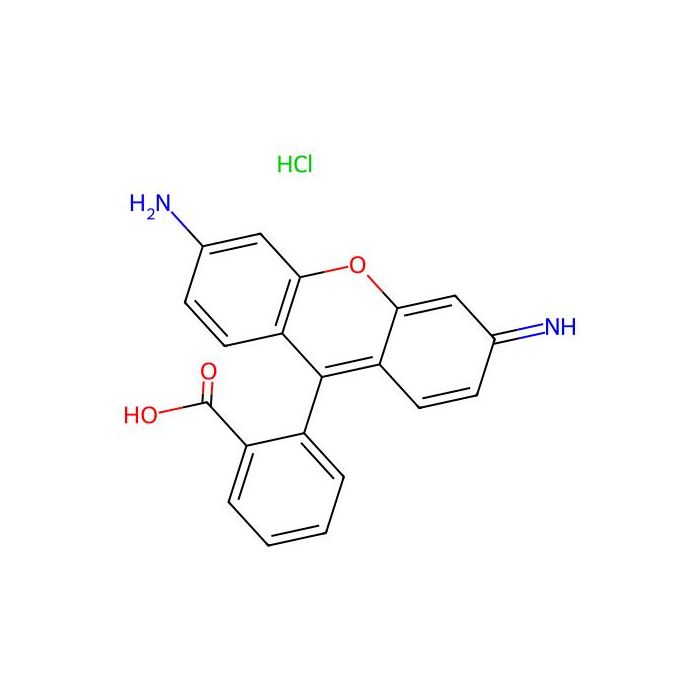
Brief overview: Rhodamine 110 (R110) is a green-fluorescent xanthene dye of the rhodamine family, widely used as a fluorogenic reporter core in enzyme substrates and probe synthesis.
SKU: R1499683
CAS: 13558-31-1 (literature)
PubChem CID: 11617572 (literature)
Molecular formula: Not specified for this item; refer to CoA/Spec Sheet.
Molecular weight: Not specified for this item; refer to CoA/Spec Sheet.
InChIKey: Not specified for this item; refer to CoA/Spec Sheet.
SMILES: Not specified for this item; refer to CoA/Spec Sheet.
Structural features (general/literature):
Core scaffold: xanthene (triarylmethane-derived) chromophore typical of rhodamines.
Functional groups: two primary amino groups at the 3,6-positions on the xanthene ring (diamino-rhodamine core); a central carbonyl (lactam-like xanthone feature) that participates in the delocalized chromophore.
Charge state: neutral/free base in many organic media; can be protonated under acidic conditions, affecting spectral properties.
Conjugation: extended π-system across the xanthene ring supports strong absorption in the blue-green with bright green emission.
2D structure in words (general description): a tricyclic xanthene framework bearing two para-disposed anilino-type amino substituents on the outer rings, bridged through an oxygen-bearing central ring to a carbonyl at the 9-position. The planar, rigid π-system underlies high fluorescence quantum yield. R110 lacks the N-alkyl substituents common to rhodamine 6G/123, which shifts its spectra toward shorter wavelength and leaves nucleophilic amino sites for derivatization.
Synthetic Utility
Rhodamine 110 serves as a versatile intermediate for constructing fluorogenic probes and labeled ligands (general/literature perspective):
N-Acylation: The 3,6-diamino groups undergo acylation with acyl chlorides/anhydrides to give mono- or diacylated derivatives (e.g., diacetates, dipeptidyl conjugates). Properly designed acyl groups can suppress fluorescence until hydrolysis or enzymatic cleavage releases R110.
Carbamate/urea formation: Reaction with chloroformates or CDI-activated carboxylates affords carbamates; reaction with isocyanates or CDI-mediated coupling gives ureas/thioureas—useful for tuning lipophilicity and target interactions.
Isothiocyanate generation (indirect): Conversion of amines to isothiocyanates via thiophosgene or safer equivalents (e.g., 1,1′-thiocarbonyldiimidazole) produces reactive handles for labeling nucleophiles (literature caution: handle thiocarbonyl reagents with appropriate safety measures).
Supramolecular assemblies: Attachment to peptides, polymers, or dendrimers through amide linkages to create responsive materials and FRET pairs.
Solid-phase compatibility: R110 derivatives can be coupled on solid support via standard peptide-coupling chemistry (HATU/EDC) to form fluorogenic substrates.
Strategic value:
Bright green emission complements blue-excited platforms and pairs well with red-emitting reporters in multiplex assays.
Diamine functionality offers orthogonal derivatization routes to tailor response, solubility, and targeting while retaining a robust chromophore.
All transformations should be performed under subdued light and inert atmosphere to minimize photobleaching and oxidative degradation.
Target Specificity
Not applicable. This product is a small-molecule fluorophore and is not an antibody or affinity reagent. No antigen/epitope, clone, isotype, or species reactivity information applies. For use as a reporter in biochemical assays, see Reaction & Applications and Application Protocols.
We use cookies to ensure the website functions properly and, where permitted, to improve your experience. You can manage your preferences at any time in Settings. Learn more in our Cookie Policy.
Shall we send you a message when we have discounts available?
Remind me later
Thank you! Please check your email inbox to confirm.
Products are supplied to verified businesses, institutions, and qualified professionals for research and development use only. Not for use in humans, animals, diagnosis, or therapy.