Determine the necessary mass, volume, or concentration for preparing a solution.
| Activity Type | Relation | Activity value | Units | Action Type | Journal | PubMed Id | doi | Assay Aladdin ID |
|---|

≥99% for sensitive chromatographic and analytical workflows requiring minimal baseline interference.
Store at 2-8°C,Desiccated Ships Wet ice Check lot-specific COA for exact specifications.
SDS, COA, datasheet, and spec sheet available for download. Lot-specific COA accessible via lot number lookup.
Cited in 0 peer-reviewed publications across chromatography, organic synthesis, and cross-coupling reactions.
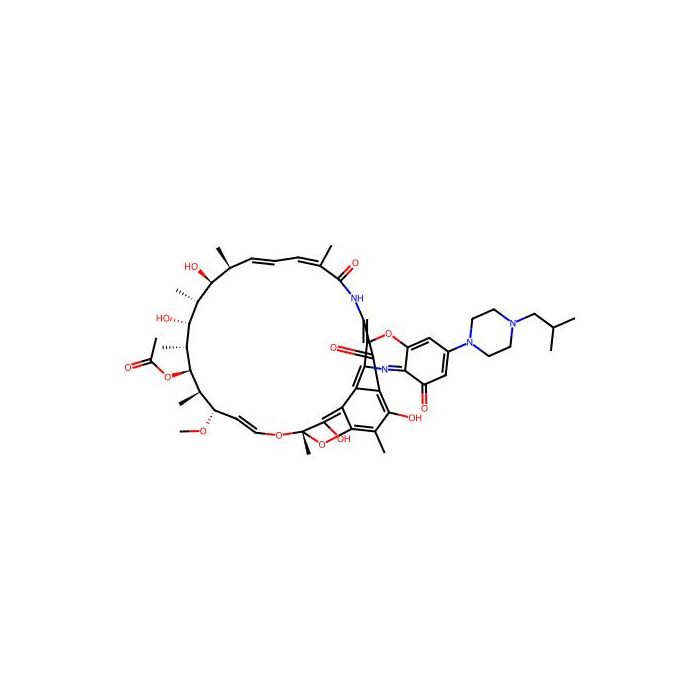
Rifalazil (KRM-1648; ABI-1648), a rifamycin derivative, inhibits the bacterial DNA-dependent RNA polymerase and kills bacterial cells by blocking off the β-subunit in RNA polymerase Rifalazil (KRM-1648; ABI-1648) is an antibiotic , exhibits high potency against mycobacteria, gram-positive bacteria, Helicobacter pylori , C. pneumoniae and C. trachomatis with MIC values from 0.00025 to 0.0025 μg/ml Rifalazil (KRM-1648; ABI-1648) has the potential for the treatment of Chlamydia infection, Clostridium difficile associated diarrhea (CDAD), and tuberculosis (TB)
In Vitro
Rifalazil exhibits antimicrobal activity against Gram-positive enteric bacteria, inhibits Clostridium difficile , Clostridium perfringens , Bacteroides fragilis with MIC 50 value of 0.0015, 0.0039, 0.0313 µg/ml, respectively. Rifalazil exhibits antimicrobal activity against Gram-negative enteric bacteria, inhibits Escherichia coli and Klebsiella pneumoniae with MIC 50 value of 16 and 16 µg/ml, respectively. Rifalazil exhibits antimicrobal activity against non-enteric Gram-positive bacteria, inhibits Methicillin-susceptible Staphylococcus aureus , Methicillin-resistant S. aureus , Methicillin- and quinolone-resistant S. aureus , Staphylococcus epidermidis , Streptococcus pyogenes , Streptococcus pneumoniae with MIC 50 value of 0.0078, 0.0078, 0.0078, 0.0078, 0.0002, 0.0001 µg/ml, respectively. Rifalazil exhibits antimicrobal activity against Helicobacter pylori , Chlamydia pneumoniae and Chlamydia trachomatis with MIC 50 value of 0.004, 0.000125 and 0.00025 µg/ml, respectively. MCE has not independently confirmed the accuracy of these methods. They are for reference only.
In Vivo
Rifalazil (oral gavage; 20, 25, and 150 mg/kg; 6-8 weeks) combines with isoniazid (INH) for 6 weeks or greater significantly reduced the number of mice per group in which M. tuberculosis is detected in both spleens and lungs compared to the reductions for the early and late controls. And the addition of Pyrazinamide (PZA) does not significantly improve RLZ-INH therapy at any time point. MCE has not independently confirmed the accuracy of these methods. They are for reference only. Animal Model: Female CD-1 mice infected with 5.2 × 10 7 viable mycobacteriaDosage: 20, 25, and 150 mg/kg; 6-8 weeks Administration: Oral gavage Result: Combined with isoniazid (INH) showed its potential for short-course treatment of Mycobacterium tuberculosis infection.
Form:Solid
IC50& Target:IC50: RNA polymerase
Comprehensive hazard, handling, storage, and regulatory compliance document.
Download SDS →Lot-specific quality data. Enter your lot number to retrieve the exact COA.
Look up COA →Full quality attributes and acceptance criteria for this grade.
View spec sheet →Taxonomy Tree
| Kingdom | Organic compounds |
|---|---|
| Superclass | Organoheterocyclic compounds |
| Classe | Benzoxazines |
| Subclass | Phenoxazines |
| Intermediate Tree Nodes | Not available |
| Direct Parent | Phenoxazines |
| Alternative Parents | N-arylpiperazines Naphthols and derivatives Dialkylarylamines N-alkylpiperazines Ketals Vinylogous amides Vinylogous acids Heteroaromatic compounds Cyclic carboximidic acids Trialkylamines Secondary alcohols Carboxylic acid esters Amino acids and derivatives Propargyl-type 1,3-dipolar organic compounds Polyols Oxacyclic compounds Monocarboxylic acids and derivatives Dialkyl ethers Azacyclic compounds Organopnictogen compounds Organic oxides Hydrocarbon derivatives Carbonyl compounds |
| Molecular Framework | Aromatic heteropolycyclic compounds |
| Substituents | Phenoxazine - N-arylpiperazine - 1-naphthol - Naphthalene - Dialkylarylamine - Tertiary aliphatic/aromatic amine - Ketal - N-alkylpiperazine - Benzenoid - Piperazine - 1,4-diazinane - Heteroaromatic compound - Vinylogous amide - Vinylogous acid - Cyclic carboximidic acid - Tertiary aliphatic amine - Tertiary amine - Secondary alcohol - Carboxylic acid ester - Amino acid or derivatives - Oxacycle - Azacycle - Organic 1,3-dipolar compound - Propargyl-type 1,3-dipolar organic compound - Polyol - Monocarboxylic acid or derivatives - Ether - Dialkyl ether - Carboxylic acid derivative - Acetal - Organic nitrogen compound - Organic oxygen compound - Organopnictogen compound - Organic oxide - Hydrocarbon derivative - Organooxygen compound - Organonitrogen compound - Carbonyl group - Amine - Alcohol - Aromatic heteropolycyclic compound |
| Descrizione | This compound belongs to the class of organic compounds known as phenoxazines. These are polycyclic aromatic compounds containing a phenoxazine moiety, which is a linear tricyclic system that consists of a two benzene rings joined by a 1,4-oxazine ring. |
| External Descriptors | Not available |
| Activity Type | Relation | Activity value | Units | Action Type | Journal | PubMed Id | doi | Assay Aladdin ID |
|---|
| Activity Type | Relation | Activity value | Units | Action Type | Journal | PubMed Id | doi | Assay Aladdin ID |
|---|
| Activity Type | Relation | Activity value | Units | Action Type | Journal | PubMed Id | doi | Assay Aladdin ID |
|---|
| Activity Type | Relation | Activity value | Units | Action Type | Journal | PubMed Id | doi | Assay Aladdin ID |
|---|
| Activity Type | Relation | Activity value | Units | Action Type | Journal | PubMed Id | doi | Assay Aladdin ID |
|---|
| Activity Type | Relation | Activity value | Units | Action Type | Journal | PubMed Id | doi | Assay Aladdin ID |
|---|
| Activity Type | Relation | Activity value | Units | Action Type | Journal | PubMed Id | doi | Assay Aladdin ID |
|---|
| Activity Type | Relation | Activity value | Units | Action Type | Journal | PubMed Id | doi | Assay Aladdin ID |
|---|
| Solubilità | DMSO : 8.33 mg/mL (8.85 mM; Need ultrasonic) |
|---|---|
| Peso molecolare | 941.100 g/mol |
| XLogP3 | 3.300 |
| Hydrogen Bond Donor Count | 5 |
| Hydrogen Bond Acceptor Count | 16 |
| Rotatable Bond Count | 6 |
| Exact Mass | 940.447 Da |
| Monoisotopic Mass | 940.447 Da |
| Topological Polar Surface Area | 226.000 Ų |
| Heavy Atom Count | 68 |
| Formal Charge | 0 |
| Complexity | 2510.000 |
| Isotope Atom Count | 0 |
| Defined Atom Stereocenter Count | 9 |
| Undefined Atom Stereocenter Count | 0 |
| Defined Bond Stereocenter Count | 3 |
| Undefined Bond Stereocenter Count | 0 |
| The total count of all stereochemical bonds | 3 |
| Covalently-Bonded Unit Count | 1 |
No tested application protocols, dilutions, or assay validations are provided for this item. For research use, typical small-molecule handling practices apply (general guidance; not product specifications):
For any biological assay or screening application, develop and validate an internal protocol specific to your system. Refer to the SDS for handling and the CoA for lot-specific identity/purity before use.
The following describes literature knowledge about the rifamycin class to contextualize rifalazil’s use as a research tool compound; these are not medical/clinical claims.
Note: Specific potency values, spectra, and ADME parameters for this item are not provided here. Consult primary literature and perform in-house characterization for your experimental system.
This compound is not a buffering reagent and is not typically used to prepare pH buffer systems. Due to its poor aqueous solubility (literature, rifamycin class), aqueous buffers generally require co-solvent strategies (e.g., low-percent DMSO) if rifalazil must be delivered into an aqueous environment for research assays. For solution preparation guidance, see Solvent Selection and Storage & Reconstitution.
While rifalazil itself is a fixed scaffold, greener choices can be made for its handling and analysis by selecting more sustainable solvents and processes. The following points are general, literature-based considerations and not item-specific specifications.
Preferred greener solvents for stock/dilution (where feasible):
Stability tradeoffs:
Comparison snapshot (general):
Process suggestions:
Always validate solvent changes for solubility and assay compatibility.
No excipient or formulation-grade information is provided for this catalog item. This product is supplied strictly for research use only.
General, literature-based context (not a claim for this product):
For this specific listing:
Item-specific specifications are not provided for this catalog entry. Do not treat the following as product specifications; they are general literature characteristics for rifalazil to aid method development.
Always verify working values empirically for your lot.
This product is listed within a small-molecule/compound library context. As a complex natural-product derivative, rifalazil is primarily used as:
Synthetic and analytical applications (literature/general):
Practical tips:
No item-specific reactivity data are provided. The following general, literature-based conditions are commonly applied to rifamycin/ansamycin scaffolds and may guide method development for rifalazil derivatives:
Carbonate/carbamate formation on alcohols/phenols:
Etherification of phenols:
Ester hydrolysis/exchange (where applicable):
Redox adjustments of the quinone/hydroquinone:
Purification:
Expected yields vary widely (20–80%) depending on site selectivity and protection strategy. Always verify conditions on micro-scale before scale-up.
Rifalazil is a highly lipophilic, polyoxygenated macrocycle. Effective solvent choice is essential for stock preparation and analytical work.
Polarity and miscibility (literature, class-level):
Practical recommendations:
Comparison (general):
Always verify solubility and stability for your specific lot; item-specific solvent specifications are not provided here.
Storage conditions (from Product Data):
Light/atmosphere: Given the rifamycin chromophore, protect from light; keep tightly closed to limit oxygen and moisture exposure (general best practice for this class).
Reconstitution (general, literature-based guidance; not item-specific specifications):
Aliquoting and freeze–thaw:
Stability checks: Periodically assess by HPLC/LC–MS for degradation (quinone/hydroquinone interconversion) and by UV–Vis for spectral changes.
Always defer to the lot-specific CoA/SDS for definitive instructions.
Rifalazil is a rifamycin-class ansamycin macrocycle used as a research small molecule in compound libraries.
Item-specific identifiers (from Product Data):
Literature structural features (for context; not item-specific specifications):
Molecular formula and molecular weight: Not specified for this item; see literature values below or consult CoA/Spec Sheet.
As a complex, highly functionalized ansamycin, rifalazil serves primarily as a reference scaffold rather than a routine building block. Nevertheless, literature demonstrates several productive transformations for probe and SAR generation (general guidance; not item-specific specifications):
Practical considerations:
Item-specific biological target data (e.g., antigen/epitope, species reactivity, clone/isotype) are not provided for this product and are not applicable to this small-molecule compound. For literature context, rifamycin-class compounds bind the β-subunit of bacterial RNA polymerase; however, no target qualification is claimed for this specific catalog lot.