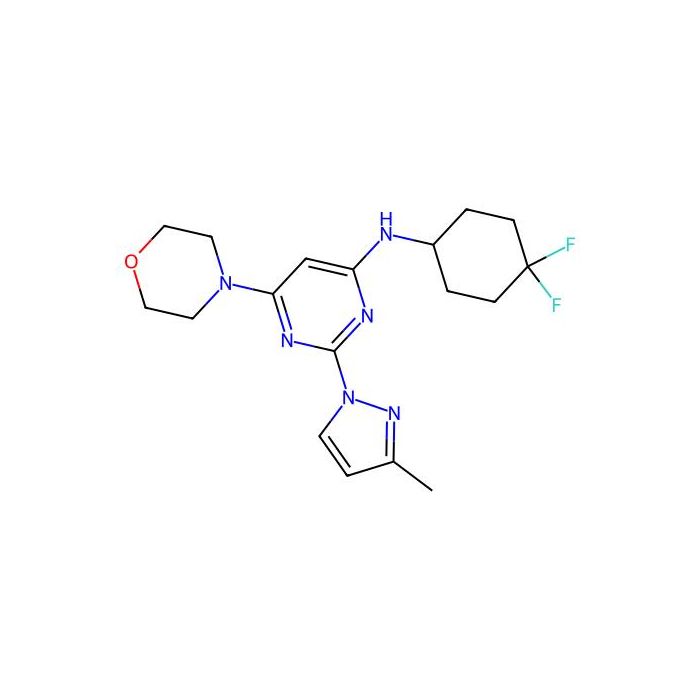
Determine the necessary mass, volume, or concentration for preparing a solution.
≥99% for sensitive chromatographic and analytical workflows requiring minimal baseline interference.
Protected from light,Store at -80°C Ships Dry ice packs + Cold packs Check lot-specific COA for exact specifications.
SDS, COA, datasheet, and spec sheet available for download. Lot-specific COA accessible via lot number lookup.
Cited in 0 peer-reviewed publications across chromatography, organic synthesis, and cross-coupling reactions.
Rimtuzalcap (CAD-1883) is a first-in-class selective positive allosteric modulator of small-conductance calcium-activated potassium channels (SK channels). Rimtuzalcap can be used for the research of movement disorders including essential tremor (ET) and spinocerebellar ataxia (SCA).
In Vitro
Rimtuzalcap (Compound 1) is a small molecule modulator of potassium ion channels showing great therapeutic potential for treating a variety of diseases characterized by dysfunction of potassium ion channels and dysfunction from other causes which influence these potassium channels. MCE has not independently confirmed the accuracy of these methods. They are for reference only.
In Vivo
Rimtuzalcap (CAD-1883) reduces the firing rate of Purkinje cells by approximately 40%, consistent with the anticipated therapeutic mechanism of positive allosteric modulation of SK channels. Sequential bath application of 1 or 3 µM CAD-1883 results in a partial reversal of the increased coefficient of variation of the interspike interval which is seen in cerebellar slices from 11-month-old spinocerebellar ataxia-2 58Q mice . MCE has not independently confirmed the accuracy of these methods. They are for reference only.
Form:Solid
Comprehensive hazard, handling, storage, and regulatory compliance document.
Download SDS →Lot-specific quality data. Enter your lot number to retrieve the exact COA.
Look up COA →Full quality attributes and acceptance criteria for this grade.
View spec sheet →| Solubilità | DMSO : 250 mg/mL (660.64 mM; Need ultrasonic) |
|---|---|
| Peso molecolare | 378.400 g/mol |
| XLogP3 | 3.200 |
| Hydrogen Bond Donor Count | 1 |
| Hydrogen Bond Acceptor Count | 8 |
| Rotatable Bond Count | 4 |
| Exact Mass | 378.198 Da |
| Monoisotopic Mass | 378.198 Da |
| Topological Polar Surface Area | 68.100 Ų |
| Heavy Atom Count | 27 |
| Formal Charge | 0 |
| Complexity | 482.000 |
| Isotope Atom Count | 0 |
| Defined Atom Stereocenter Count | 0 |
| Undefined Atom Stereocenter Count | 0 |
| Defined Bond Stereocenter Count | 0 |
| Undefined Bond Stereocenter Count | 0 |
| The total count of all stereochemical bonds | 0 |
| Covalently-Bonded Unit Count | 1 |
No item-specific, validated protocols are provided in the Product Data. The following is general guidance for deploying small-molecule library compounds in biochemical or cell-based assays; adapt to your system and consult your SDS and CoA.
General handling and assay preparation (not item-specific):
These steps are provided as general best practices; adapt based on your assay readout and compound behavior.
No biological target, pathway, or mode-of-action information is provided in the Product Data for Rimtuzalcap. Accordingly, no claims are made about biological function or selectivity for this item.
General considerations for small-molecule library members (not item-specific):
Important: This product is designated for research use only. It is not intended for human or veterinary use, clinical diagnostics, or as a therapeutic. For any claims of biological activity, rely on peer-reviewed literature or your internal data tied to a verified structure and batch-specific CoA.
As a small-molecule library compound, Rimtuzalcap is not a buffering agent. However, proper buffer handling is essential for preparing assay-ready solutions.
General guidance for preparing working solutions (not item-specific):
Not specified for this item: pKa, solubility limits, and buffer compatibility. Verify experimentally at small scale before committing to large screening runs.
In the absence of structural details, green chemistry considerations focus on handling solvents and workflows rather than the compound itself.
Greener solvent choices for dissolution and processing (general guidance):
Small comparison (general, not item-specific):
Operational improvements:
These recommendations are general and should be adapted once the compound’s structure and assay context are confirmed.
No pharmaceutical or excipient use is specified or implied for this product. This item is supplied strictly for research use only and is not intended for human or veterinary use, clinical applications, or as an active pharmaceutical ingredient (API).
General context for discovery compounds (not item-specific):
If you need a specific grade or documentation for regulated applications, contact Technical Support. At present, the Product Data does not specify any pharmaceutical excipient role, GMP status, or clinical formulation guidance.
Only general guidance can be provided because key physicochemical data are not included in the Product Data for this item.
Item-specific values from Product Data:
General notes for small-molecule library members (literature/practice-based, not item-specific):
Item-specific grade/purity is not specified in the Product Data. For this catalog entry, please refer to the CoA/Spec Sheet accompanying your lot for assay, purity method (e.g., HPLC/UPLC), and impurity profile.
What to expect in the CoA (typical for discovery compounds; not item-specific):
Interpreting common grades (general guidance):
Stabilizers/additives:
If you require a specific analytical threshold (e.g., metal content, peroxide limits, UV cutoffs), contact Technical Support with your SKU and lot number for the most recent CoA.
This product is listed as a small-molecule/compound library member intended for research use. Without structural information, specific synthetic transformations cannot be prescribed. The following use-cases are general for discovery compounds and are not item-specific claims:
Practical tips (general):
If you intend to use the material as a synthetic intermediate, obtain the structure (SMILES/InChI) from the CoA or authoritative databases and plan transformations accordingly (e.g., protection/deprotection, cross-coupling), mindful that no functional group information is provided in the Product Data.
Specific reaction conditions cannot be provided because the Product Data does not disclose the functional groups or scaffold of Rimtuzalcap. The guidance below is general and not item-specific, applicable only after the structure is confirmed.
General conditions for common transformations (literature; not specific to this item):
These examples illustrate standard conditions only. Do not apply them to this product without verifying that the corresponding functional groups are present. For batch-specific guidance, consult the CoA and structure, then design conditions accordingly.
GHS hazard information is not provided in the Product Data for this item; always consult the Safety Data Sheet (SDS) supplied with the batch for authoritative classification and first-aid measures.
Item-specific safety fields:
General laboratory precautions (good practice; not item-specific):
Always defer to the SDS and institutional EHS guidance for definitive handling instructions.
No structural information is provided, so solvent choice should be guided by empirical solubility screening and your assay constraints.
Practical approach for small-molecule stocks (general guidance):
Compatibility notes:
Comparison (general, not item-specific):
Always confirm solvent compatibility with your assay and consult the CoA/Spec Sheet for any lot-specific guidance.
Item-specific storage and shipping (from Product Data):
Reconstitution guidance (general; not item-specific):
Additional notes:
Always refer to the CoA and SDS for definitive, lot-specific instructions on storage, reconstitution, and stability.
Brief overview: Rimtuzalcap is listed in our small-molecule/compound library collection for research use. The Product Data provided for this listing does not include structural descriptors.
Item-specific identifiers (from Product Data):
Structural features (general note):
2D structure description (availability):
Rimtuzalcap, as listed, is intended as a small-molecule library compound for screening and research. Without structural information, its use as a synthetic intermediate cannot be assessed.
General considerations (not item-specific):
If you aim to derivatize this scaffold, please obtain the structural file (SMILES/SDF) from the CoA or authoritative databases for in silico planning, reactivity assessment, and to avoid conflicting isomer/tautomer issues. No item-specific reactivity or transformation data are available in the Product Data.
Not applicable. This listing is a small-molecule research compound with no target, selectivity, or binding profile provided in the Product Data. No claims are made regarding biological targets, potency, or selectivity for Rimtuzalcap.
If you have internal or literature data tied to a verified structure and batch, document assay conditions (target, species, format, readout, controls) and report specificity metrics (e.g., Ki, IC50, EC50) with appropriate counter-screens.