≥99% for sensitive chromatographic and analytical workflows requiring minimal baseline interference.
🌡
Storage & shipping
Store at 2-8°C,Desiccated Ships Wet ice Check lot-specific COA for exact specifications.
📋
Quality documents
SDS, COA, datasheet, and spec sheet available for download. Lot-specific COA accessible via lot number lookup.
📚
Literature proof
Cited in 0 peer-reviewed publications across chromatography, organic synthesis, and cross-coupling reactions.
Panoramica
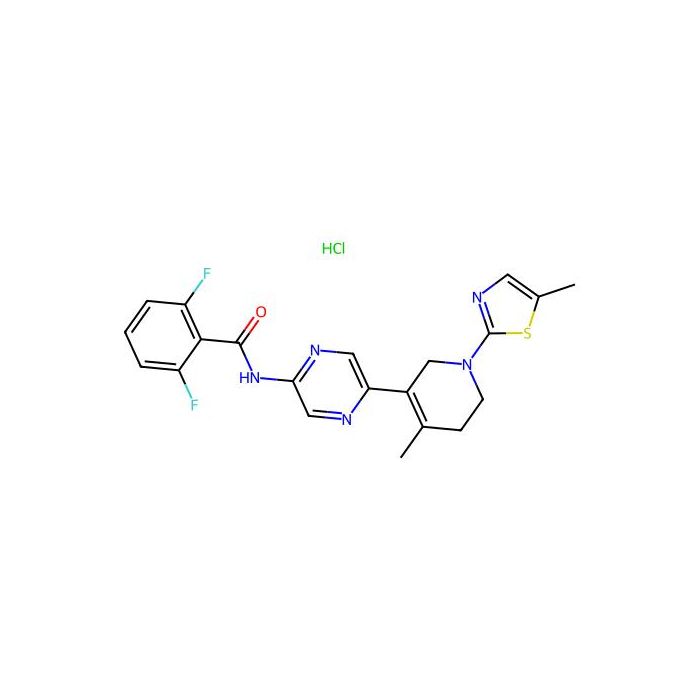
RO2959 monohydrochloride is a potent and selective CRAC channel inhibitor with an IC 50 of 402 nM. RO2959 monohydrochloride is a potent blocker of store operated calcium entry (SOCE) mediated by Orai1/Stim1 channels with an IC 50 of 25 nM. RO2959 monohydrochloride is also a potent inhibitor of human IL-2 production, and potently blocks T cell receptor triggered gene expression and T cell functional pathways
In Vitro
RO2959 inhibits Orai1 and Orai3 with IC 50 values of 25 nM and 530 nM, respectively. RO2959 blocks store operated calcium entry (SOCE) in activated CD4+T lymphocytes with an IC 50 value of 265 nM. RO2959 is a potent SOCE inhibitor that blocks an IP3-dependent current in CRAC-expressing RBL-2H3 cells and CHO cells stably expressing human Orai1 and Stim1, as well as SOCE in human primary CD4 + T cells triggered by either T cell receptor (TCR) stimulation or thapsigargin treatment. RO2959 completely inhibits cytokine production as well as T cell proliferation mediated by TCR stimulation or MLR (mixed lymphocyte reaction). MCE has not independently confirmed the accuracy of these methods. They are for reference only.
RO2959 monohydrochloride is a potent and selective CRAC channel inhibitor with an IC 50 of 402 nM. RO2959 monohydrochloride is a potent blocker of store operated calcium entry (SOCE) mediated by Orai1/Stim1 channels with an IC 50 of 25 nM. RO2959 monohydr
Condizioni di conservazione di stoccaggio
Store at 2-8°C,Desiccated
Spedito in
Wet ice
Questo prodotto richiede spedizione a catena fredda. I servizi di terra e altri servizi economici non sono disponibili.
This compound belongs to the class of organic compounds known as 2-halobenzoic acids and derivatives. These are benzoic acids or derivatives carrying a halogen atom at the 2-position of the benzene ring.
External Descriptors
Not available
1. Djoumbou Feunang Y, Eisner R, Knox C, Chepelev L, Hastings J, Owen G, Fahy E, Steinbeck C, Subramanian S, Bolton E, Greiner R, and Wishart DS. ClassyFire: Automated Chemical Classification With A Comprehensive, Computable Taxonomy. Journal of Cheminformatics, 2016, 8:61.
Certificati (CoA, COO, BSE/TSE e tabella di analisi)
C of A & Other Certificates(BSE/TSE, COO):
Analytical Chart:
Proprietà chimiche e fisiche
Solubilità
DMSO : 25 mg/mL (53.89 mM; Need ultrasonic) H2O : <0.1 mg/mL (ultrasonic;warming;heat to 60°C) (insoluble)
Peso molecolare
463.900 g/mol
XLogP3
Hydrogen Bond Donor Count
2
Hydrogen Bond Acceptor Count
8
Rotatable Bond Count
4
Exact Mass
463.105 Da
Monoisotopic Mass
463.105 Da
Topological Polar Surface Area
99.300 Ų
Heavy Atom Count
31
Formal Charge
0
Complexity
655.000
Isotope Atom Count
0
Defined Atom Stereocenter Count
0
Undefined Atom Stereocenter Count
0
Defined Bond Stereocenter Count
0
Undefined Bond Stereocenter Count
0
The total count of all stereochemical bonds
0
Covalently-Bonded Unit Count
2
Calcolatori di soluzioni
Molarity Calculator
Determine the necessary mass, volume, or concentration for preparing a solution.
Dilution Calculator
Determine the dilution needed to prepare a stock solution.
Reconstitution Calculator
Recensioni
Recensioni dei clienti
Application Protocols
The Product Data do not list validated application protocols for RO2959 monohydrochloride.
General starting points for small-molecule screening stocks (non-item-specific):
DMSO master stock: Prepare at 10–50 mM depending on solubility. Vortex and, if needed, warm gently (≤40°C). Filter (0.22 µm PTFE) if particulate persists.
Aqueous working solutions: Dilute the DMSO stock into buffer or media to the desired final concentration, keeping final DMSO ≤0.1–0.5% v/v. Mix thoroughly and inspect for precipitation.
Plate handling: Use low-binding plates/tubes for hydrophobic scaffolds. Seal plates to minimize evaporation; equilibrate to assay temperature before use.
Stability checks: Reassess concentration by UV or LC–MS after 24–48 h at assay conditions to confirm stability.
These are general recommendations. For any item-specific protocol, consult the CoA or contact technical support with the lot number.
Biological Roles
No target profile, mechanism, or biological function is provided for RO2959 monohydrochloride in the Product Data.
General guidance for researchers using screening compounds:
Treat the compound as a chemical probe candidate of unknown selectivity pending your own profiling.
Establish identity and purity (LC–MS, HPLC) before biological testing. Record lot numbers and exact solvent composition for reproducibility.
Begin with broad cytotoxicity/viability controls (e.g., ATP or resazurin assays) to bracket non-specific effects from vehicle or compound at working concentrations.
Evaluate stability in assay media (pH, protein, redox conditions). Amine salts can shift pH locally upon dilution; check buffering capacity.
Consider binders/aggregators: Some small molecules form colloids at µM–mM ranges. Use detergent controls (0.01–0.05% Tween‑20) or orthogonal readouts to exclude artifacts.
All statements above are general, not compound-specific. For any known biological annotations, consult the CoA, vendor datasheet, or primary literature associated with the CAS 2309172-44-7 if available.
Buffer Applications
This product is a small-molecule research compound, not a buffering reagent. Accordingly, it is not typically used to prepare buffers.
Practical notes for solution preparation (general for HCl salts):
If dissolution in aqueous buffers is needed, start with phosphate (pH 6.5–7.4), HEPES (pH 7.2–7.6), or citrate/acetate (pH 4–6) depending on stability. Avoid high pH that may free-base the salt and lead to precipitation.
Filter sterilize through 0.22 µm if solutions are intended for sterile workflows; assess adsorption losses for hydrophobic scaffolds.
For buffer recipes and pH ranges, refer to standard biochemistry references; no item-specific buffer parameters are provided in the Product Data.
Green Alternatives
Because the specific structure and use-case for RO2959 monohydrochloride are not provided, green chemistry advice is framed generally for dissolution, handling, and routine manipulations of amine hydrochloride salts.
Greener choices (general guidance):
Solvents for stock solutions: Prefer water or biocompatible buffers where chemically compatible. If organic solvent is needed, consider bio-based solvents (e.g., 2‑MeTHF, Cyrene) only after verifying solubility/stability of the free base; many hydrochloride salts will not dissolve in these directly.
Minimize DMSO load: Keep final assay DMSO ≤0.1–0.5% v/v to reduce toxicity and environmental burden; prepare higher concentration master stocks to minimize usage.
Solid handling: Use precision microtubes and dispense systems to reduce material loss and plastic waste.
Energy efficiency: Room-temperature operations when feasible; avoid unnecessary heating that can promote salt decomposition.
Comparison snapshot (general):
Water/buffer: renewable, non-flammable, minimal VOC; limited for hydrolysis-prone scaffolds.
EtOH: greener than MeCN/DMF by several metrics; flammable; may not dissolve ionic salts well without water.
DMSO: high solvency; not VOC, but persistent and can complicate waste streams.
Waste considerations:
Segregate halide-containing aqueous waste if local regulations require.
Neutralize acidic solutions appropriately before disposal; follow institutional and regulatory guidance.
Pharmaceutical Uses
No pharmacopeial status, excipient role, or formulation guidance is provided for RO2959 monohydrochloride in the Product Data. This item is supplied for research use only and is not intended for human or veterinary use.
General formulation considerations for small-molecule hydrochloride salts in a research context (non-clinical):
Aqueous stock solutions can often be prepared due to increased ionization; confirm actual solubility and stability at the intended pH and ionic strength.
If needed for in vivo research in non-clinical models, typical vehicles include saline, citrate/phosphate buffers, or aqueous cosolvent systems (e.g., 5–10% DMSO + 20–40% PEG400 + saline). Verify compatibility and stability; adhere to institutional approvals.
Record the salt form precisely in notebooks and any reports to avoid ambiguity in dosing calculations (salt vs free-base equivalents).
No regulatory claims or therapeutic indications are made or implied for this product.
Physical Properties
Item-specific physicochemical specifications are not provided in the Product Data for RO2959 monohydrochloride.
Appearance: Not specified for this item; refer to CoA/Spec Sheet.
Melting point (MP): Not specified for this item; refer to CoA/Spec Sheet.
Boiling point (BP): Not applicable for salts in practice (decompose) — item-specific value not specified.
Density: Not specified for this item; refer to CoA/Spec Sheet.
Solubility: Not specified for this item; refer to CoA/Spec Sheet.
LogP/LogD: Not specified for this item; refer to CoA/Spec Sheet.
pKa: Not specified for this item; refer to CoA/Spec Sheet.
Refractive index: Not applicable to solids; not specified.
General guidance for hydrochloride salts (literature, non-item-specific):
Aqueous handling: Amine monohydrochloride salts typically show enhanced water solubility compared to the free base. Many dissolve readily in water, methanol, ethanol, and DMSO; solubility still depends strongly on the parent scaffold.
Thermal behavior: Organic HCl salts usually do not have a true boiling point; they may decompose on heating above the melting/softening range.
Hygroscopicity: Some HCl salts are moderately hygroscopic and can absorb moisture, potentially altering mass accuracy; desiccated storage is advised (see Storage & Reconstitution).
For quantitative properties, please consult the item’s Certificate of Analysis (CoA).
Quality and Grades
Grade/Purity: Not specified for this item; refer to CoA/Spec Sheet.
Context and guidance for researchers:
For screening compounds and discovery chemistry building blocks, vendors often provide a purity threshold (e.g., ≥95% by HPLC) and analytical identity (LC–MS, 1H NMR). Because no grade is listed here, consult the CoA for actual purity, analytical method, and acceptance criteria.
Hydrochloride salts may be provided anhydrous or as hydrates; the water of crystallization (if any) affects calculated assay and solution preparation. If hydration state is not stated, confirm by KF titration, elemental analysis, or NMR integration.
If your workflow involves cell-based assays or spectroscopy, request or review data on:
UV–Vis profile and LC–MS chromatogram to rule out strongly absorbing impurities
If a stabilizer is present, it will appear on the CoA or label; none is listed in the current Product Data.
Recommendation: For reproducible SAR and screening data, archive the lot-specific CoA in ELN/LIMS and verify identity upon receipt (quick LC–MS or 1H NMR check).
Reaction and Applications
The Product Data do not specify intended reaction roles for RO2959 monohydrochloride. As a small-molecule HCl salt in a screening library context, typical research applications include:
Chemical biology and screening: Preparation of DMSO stocks (e.g., 10 mM) for biochemical, biophysical, or cell-based screens. Track pH changes upon dilution—amine salts can influence medium pH at high concentrations.
Analytical characterization: Routine LC–MS (positive ESI for protonated molecular ion), 1H/13C NMR in DMSO‑d6/D2O with gentle warming if needed. For chloride counterion, note potential line broadening of exchangeable protons.
Salt/base interconversion: Conversion to the free base (partition into organic solvents) or to alternative salts (e.g., mesylate, citrate) to tune solubility/crystallinity for studies.
Solid-form work: Screening for polymorphs or solvates (XRPD/DSC/TGA) when aiming for consistent handling properties in libraries.
Micro-scale transformations (general): If the parent scaffold contains nucleophilic amines or other heteroatoms, protect/deprotect operations, coupling to tags (e.g., NHS esters), or immobilization onto solid supports may be feasible. These are scaffold-dependent and not item-specific.
Practical tips:
Dry solvents and anhydrous handling matter when interconverting salts and free bases.
Confirm mass balance when calculating stock concentrations: adjust for HCl and any water of crystallization if present (check CoA).
Reaction Conditions
No reaction condition set is specified for RO2959 monohydrochloride. Below are general, literature-based conditions relevant to transforming amine hydrochloride salts to value-added derivatives; adapt to the actual scaffold.
Liberation of free base:
Suspend the HCl salt in water or MeOH/H₂O, add NaHCO₃ or Na₂CO₃ until pH 9–10, extract with DCM/EtOAc. Dry and use immediately.
Convert to free base; Solvent: MeCN, DMF; Base: K₂CO₃, Cs₂CO₃; Electrophiles: alkyl halides, sulfonates; 25–60°C, 2–24 h.
Salt exchange (metathesis):
Dissolve in minimal EtOH/Acetone/MeOH, add equimolar acid (e.g., TsOH, MsOH) or dibasic acid for dicarboxylate salts; crystallize by antisolvent.
All values above are general literature guidance, not specifications for this item. Verify compatibility with the actual compound and consult the CoA/SDS.
Safety and Handling
Safety information specific to RO2959 monohydrochloride is not provided in the Product Data and may vary with the scaffold. The following guidance is general and does not replace the SDS.
GHS classification, signal word, pictograms, H-statements: Not specified for this item; refer to SDS.
Primary hazards (general for small-molecule HCl salts): May cause skin/eye irritation or respiratory irritation if dust is generated. Avoid aerosolization and inhalation.
PPE recommendations:
Lab coat, safety glasses or chemical splash goggles
Nitrile gloves (change regularly); double-glove for extended handling
Work in a fume hood when weighing or preparing solutions to avoid dust exposure
Handling tips:
Minimize exposure to ambient humidity; keep container closed when not in use.
Use clean, dry spatulas; weigh rapidly to limit hygroscopic mass gain.
Incompatibilities (general): Strong oxidizers and strong bases (which can deprotonate the salt to free base), and silver salts (precipitation of AgCl). Avoid contact with reactive acylating/alkylating agents if the molecule contains free amines.
First aid (overview):
Skin/eye contact: Rinse with water for at least 15 minutes; remove contaminated clothing.
Inhalation: Move to fresh air; seek medical attention if symptoms persist.
Ingestion: Rinse mouth; seek medical advice.
Always defer to the product’s SDS for authoritative hazard classifications and emergency procedures. Product is for research use only.
Solvent Selection
Item-specific solubility data are not provided for RO2959 monohydrochloride. The following guidance is general for small-molecule hydrochloride salts and should be verified experimentally.
Primary vehicles (typical):
Water: Often increased solubility relative to the free base. Adjust pH mildly acidic if precipitation occurs.
DMSO: Widely used for stock solutions in screening (10–50 mM); ensure water content control to maintain consistency.
Methanol/Ethanol: Common for preparative work; may aid co-solubilization with water.
Buffer systems: Acetate, citrate, or phosphate buffers at pH 4.5–7 may help maintain the salt form.
Dielectric/polarity considerations (general): Polar aprotic solvents (DMSO, DMF) and protic solvents (water, MeOH) best support ionic species; less polar media (THF, EtOAc) tend to be poor for direct dissolution of the salt.
When to switch to the free base: If organic-soluble conditions are required (e.g., in nonpolar reaction media), convert a test aliquot to the free base and extract into an organic solvent.
Quick comparison (general):
Water: maximal biocompatibility; may limit stability for hydrolysis-prone motifs.
DMSO: excellent solvency; consider hygroscopic uptake and potential biological assay interference at >0.5% v/v.
MeOH/EtOH: good balance for prep; flammable and may alter assay readouts.
Always confirm solubility and stability with a small-scale test.
Storage and Reconstitution
Storage conditions (from Product Data): Store at 2–8°C, desiccated.
Shipping condition (from Product Data):Wet ice.
Appearance: Not specified for this item; refer to CoA/Spec Sheet.
General handling and reconstitution guidance for small-molecule hydrochloride salts:
Upon receipt, allow the vial to equilibrate to room temperature in a desiccator before opening to prevent moisture condensation.
Open quickly in a dry environment; reseal promptly. If the material is hygroscopic, consider storing under inert gas or with fresh desiccant.
For stock solutions:
Prefer freshly opened, anhydrous DMSO or water/buffer as appropriate. Record solvent lot and water content if critical.
Prepare concentrated master stocks (e.g., 10–50 mM in DMSO) to minimize freeze–thaw cycles.
Aliquoting: Divide solutions into single-use aliquots; store at 2–8°C for short term or −20°C for longer term unless the CoA advises otherwise. Avoid repeated freeze–thaw; thaw at room temp and mix before use.
Stability: No item-specific stability window is provided. If long-term storage is required, monitor by LC–MS/HPLC periodically.
For definitive instructions (e.g., hydration state, solution stability, and re-test date), consult the lot-specific CoA and SDS.
Structure and Identity
Brief overview: RO2959 monohydrochloride is listed as a small-molecule research compound supplied as the hydrochloride salt. Item-specific structural identifiers beyond CAS are not provided in the current entry.
SMILES: Not specified for this item; refer to CoA/Spec Sheet.
Molecular formula: Not specified for this item; refer to CoA/Spec Sheet.
Molecular weight: Not specified for this item; refer to CoA/Spec Sheet.
Structural features (general for hydrochloride salts; not item-specific):
Many research compounds are supplied as amine-containing free bases converted to monohydrochloride salts, improving stability, crystallinity, and aqueous handling.
Expected 2D depiction (general): an organic framework (aromatic/heteroaromatic or aliphatic scaffold) bearing at least one basic nitrogen, present as a protonated ammonium (R–NH₃⁺ or R₂NH₂⁺) counterbalanced by Cl⁻.
Notes
Without an item-specific structure (SMILES/InChI), stereochemistry, ring count, and functional group inventory cannot be confirmed for this catalog entry. Consult the CoA or SDS for definitive identifiers.
Synthetic Utility
Item-specific functional groups and reactivity are not disclosed for RO2959 monohydrochloride. The following points describe general synthetic considerations for small-molecule hydrochloride salts derived from amines:
Handling in synthesis: Protonated amines as HCl salts are convenient for storage but often require basification (e.g., NaHCO₃/Na₂CO₃, NaOH) to liberate the free base prior to participating in nucleophilic reactions (e.g., acylation, alkylation, coupling).
Coupling strategies: After free-basing, amines can be coupled to acids using carbodiimides (EDC/HOBt, DIC/HOAt) or uroniuim reagents (HATU, TBTU). In situ neutralization protocols exist but require careful control to avoid over-acylation or O→N acyl transfer.
Salt metathesis: Exchange to different counterions (e.g., tosylate, mesylate, fumarate) can tune crystallinity and solubility for purification or formulation purposes.
Protection/deprotection: If additional nucleophiles are present, consider Boc/CBz/Fmoc protection after free-basing. Conversely, amino protecting groups may be installed or removed depending on the synthetic plan.
Analytical monitoring: Track reactions by LC–MS (positive ESI) and qNMR to quantify conversion and residual inorganic chloride.
Because the specific scaffold is unknown here, perform a small feasibility screen to verify compatibility with bases, oxidants, and coupling reagents prior to scale-up.
Target Specificity
No target, pathway, or selectivity information is provided in the Product Data for RO2959 monohydrochloride. As supplied, it should be regarded as a research compound with unspecified biological target(s).
For mechanistic or selectivity data, consult primary literature associated with CAS 2309172-44-7 if available, or generate internal data using orthogonal assays (biochemical vs. cellular, counterscreens for off-targets, and profiling panels).
Domande frequenti
What are the CAS number, molecular formula and molecular weight?
The CAS Number is 2309172-44-7, the molecular formula is C21H20ClF2N5OS, and the molecular weight is 463.93 g/mol. InChIKey GMLSDODALBRLPE-UHFFFAOYSA-N.
What is the purity of this product?
This product is supplied at ≥99% purity (chemical assay). Lot-specific values are stated on the Certificate of Analysis.
How should this product be stored?
Store at 2–8 °C, desiccated. Keep the container tightly closed with desiccant — the material is moisture-sensitive.
How is this product shipped?
This product ships chilled on wet ice. Unpack on arrival and transfer it to the storage condition stated above.
Utilizziamo i cookie per garantire il corretto funzionamento del sito web e, ove consentito, per migliorare la tua esperienza. Puoi gestire le tue preferenze in qualsiasi momento nelle Impostazioni. Per saperne di più, consulta la nostra Cookie Policy.
Desidera che le inviamo un messaggio quando avremo sconti disponibili?
Ricordamelo più tardi
Grazie! Controlli la sua casella di posta per confermare.
Products are supplied to verified businesses, institutions, and qualified professionals for research and development use only. Not for use in humans, animals, diagnosis, or therapy.