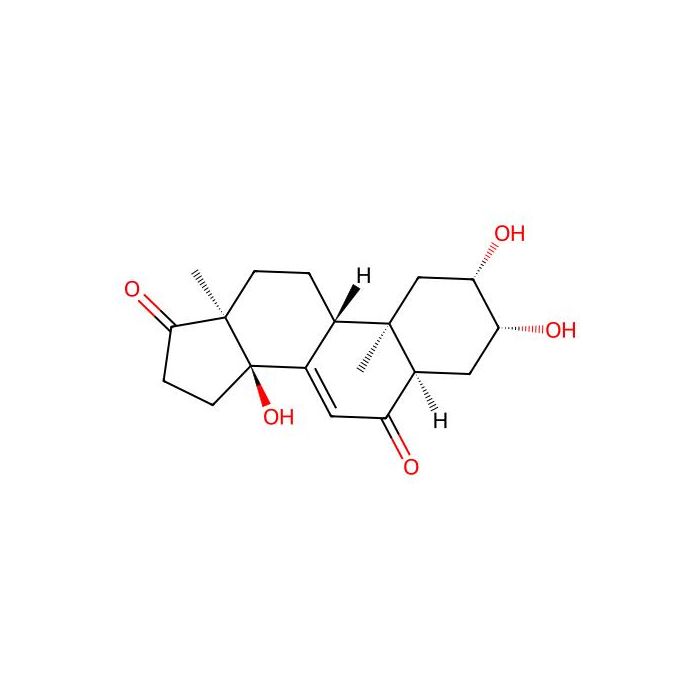
This compound belongs to the class of organic compounds known as androgens and derivatives. These are 3-hydroxylated C19 steroid hormones. They are known to favor the development of masculine characteristics. They also show profound effects on scalp and body hair in humans.
External Descriptors
Not available
1. Djoumbou Feunang Y, Eisner R, Knox C, Chepelev L, Hastings J, Owen G, Fahy E, Steinbeck C, Subramanian S, Bolton E, Greiner R, and Wishart DS. ClassyFire: Automated Chemical Classification With A Comprehensive, Computable Taxonomy. Journal of Cheminformatics, 2016, 8:61.
Certificati (CoA, COO, BSE/TSE e tabella di analisi)
C of A & Other Certificates(BSE/TSE, COO):
Analytical Chart:
Proprietà chimiche e fisiche
Peso molecolare
334.400 g/mol
XLogP3
-0.300
Hydrogen Bond Donor Count
3
Hydrogen Bond Acceptor Count
5
Rotatable Bond Count
0
Exact Mass
334.178 Da
Monoisotopic Mass
334.178 Da
Topological Polar Surface Area
94.800 Ų
Heavy Atom Count
24
Formal Charge
0
Complexity
654.000
Isotope Atom Count
0
Defined Atom Stereocenter Count
7
Undefined Atom Stereocenter Count
0
Defined Bond Stereocenter Count
0
Undefined Bond Stereocenter Count
0
The total count of all stereochemical bonds
0
Covalently-Bonded Unit Count
1
Calcolatori di soluzioni
Molarity Calculator
Determine the necessary mass, volume, or concentration for preparing a solution.
Dilution Calculator
Determine the dilution needed to prepare a stock solution.
Reconstitution Calculator
Recensioni
Recensioni dei clienti
Application Protocols
No manufacturer-tested application protocols are provided in the Product Data for this item.
General research-use guidance (non-validated; optimize per lab):
Preparation of stock solutions
Dissolve rubrosterone in DMSO or methanol to make a concentrated stock (e.g., 10–50 mM depending on solubility). Sonication and gentle warming (≤40 °C) may aid dissolution. Record exact concentration gravimetrically.
HPLC/LC–MS method development
Start with a C18 column, water–acetonitrile or water–methanol gradient (5–95% organic). Use volatile modifiers (e.g., 0.05% formic acid or 5–10 mM ammonium formate) for MS compatibility. Adjust gradient slope to resolve closely eluting congeners.
Bioassay dosing
Dilute DMSO stocks into assay buffer or media slowly with mixing to keep final DMSO ≤1% v/v unless otherwise validated. Verify solubility visually and by test runs to avoid precipitation.
Storage of working solutions
Aliquot to minimize freeze–thaw cycles; protect from light; test stability by periodic LC–MS.
These are illustrative starting points only. Validate all conditions and performance characteristics in your own laboratory.
Biological Roles
Rubrosterone is described in the literature as an ecdysteroid-type metabolite associated with arthropod molting hormones and phytoecdysteroids in plants. The following points summarize general biological context; they are not medical or clinical claims.
In arthropods (literature/general)
Ecdysteroids regulate molting and metamorphosis via nuclear hormone receptor complexes (e.g., EcR/USP). Compounds like rubrosterone serve as structural analogs/probes in binding and metabolism studies.
Enzymatic transformations include oxidation/reduction at A/B ring positions and conjugation (e.g., sulfation, glucuronidation in some organisms) affecting activity and clearance.
In plants (literature/general)
Phytoecdysteroids are secondary metabolites implicated in defense against herbivory. Rubrosterone-like structures are tracked in chemotaxonomic surveys and ecological interaction studies.
Biophysical/biochemical behavior
Multiple hydroxyl groups promote hydrogen bonding with proteins and membranes, while the steroid core confers shape complementarity to hydrophobic pockets.
Research utility
Serves as a reference marker in metabolomics workflows interrogating ecdysteroid biosynthesis, degradation, and transport.
Note: Specific receptor affinities, metabolic rates, and organismal effects are context- and structure-dependent and are not established here for this catalog item. Use appropriate biosafety and ethical practices when employing in biological systems. For research use only.
Buffer Applications
Rubrosterone is not a buffering reagent and does not constitute a defined buffer system. It is typically dissolved in organic solvents (e.g., DMSO, methanol) and then diluted into assay buffers as an analyte or ligand.
Practical notes (general)
When adding to aqueous buffers, pre-dissolve in a miscible organic solvent and add slowly with agitation to avoid precipitation. Maintain final organic content at levels compatible with your biological system (often ≤1% v/v DMSO in cell-based assays, user-validated).
If adsorption to plasticware is observed, use low-bind tubes or include a carrier protein (e.g., 0.1% BSA) where appropriate to reduce nonspecific losses.
For pH control and ionic strength, select conventional buffers (e.g., phosphate, HEPES, Tris) appropriate to your assay; rubrosterone does not substitute for these.
Green Alternatives
Greener practice around rubrosterone focuses on solvent and reagent choices during extraction, purification, and derivatization rather than replacing the analyte itself.
Preferable solvents (literature/general)
Replace chlorinated solvents with alcohols (EtOH), esters (EtOAc), or water/EtOH mixtures where feasible.
For analytical RP-HPLC, prioritize water–ethanol gradients when MS is not required; for LC–MS, water–acetonitrile remains common, with minimal volatile modifiers.
Derivatization alternatives
Use catalytic acylation (e.g., isopropenyl acetate with catalytic DMAP) to reduce stoichiometric acid chloride waste.
Employ organocatalytic or enzymatic acylations for enhanced selectivity under milder conditions.
Workup and purification
Implement solid-phase extraction (SPE) to reduce solvent volumes in plant/insect matrix cleanup.
Crystallization from green solvent pairs (EtOH/water, EtOAc/EtOH) where the compound’s solubility permits.
Comparison snapshot (general):
Conventional vs greener choices
Chlorinated solvents (DCM/CHCl3) → EtOAc or MeTHF (when solubility allows)
Pyridine as base for acylation → Catalytic DMAP with greener bases (e.g., Et3N alternatives like DBU in small amounts) or solvent-free acylations
Large-volume normal-phase silica → Aqueous-compatible RP methods or supercritical CO2 (if available)
Trade-offs: While ethanol and ethyl acetate are greener, they may alter selectivity and recovery for polyhydroxylated steroids; method re-optimization is typically required.
Pharmaceutical Uses
This product is supplied strictly for research use only. No medical, diagnostic, or therapeutic uses are claimed or supported.
In pharmaceutical and biopharma R&D contexts (non-clinical):
Reference standard
Utilized to develop and validate analytical methods (e.g., HPLC/LC–MS) for profiling ecdysteroid-like impurities or natural product components in raw materials and dietary-ingredient research.
Process and formulation studies (general)
Assessed for solubility enhancement strategies (co-solvents, cyclodextrins) and adsorption behavior as a model polyhydroxylated steroid during pre-formulation screening.
Extractables/leachables and stability-indicating methods
Acts as a probe analyte to challenge method selectivity for polyfunctional, mid-polar small molecules.
Pharmacopeial status: Not specified for this item; refer to CoA/Spec Sheet and relevant compendia. Any use in GMP environments requires independent qualification of the lot against internal specifications and applicable regulatory guidance.
Physical Properties
Item-specific physical constants are not provided in the Product Data.
Appearance: Not specified for this item; refer to CoA/Spec Sheet.
Melting point, boiling point, density, refractive index: Not specified for this item; refer to CoA/Spec Sheet.
Solubility (literature/general for ecdysteroids)
Sparingly soluble in water due to the rigid hydrophobic steroid core despite multiple hydroxyls.
Readily soluble in polar organic solvents such as methanol, ethanol, acetonitrile, and DMSO; moderately soluble in acetone and ethyl acetate; limited solubility in nonpolar hydrocarbons (hexanes, heptane).
Partitioning and ionization (literature/general)
Neutral polyol; no strongly ionizable groups in neutral water. Apparent logP is lower than simple steroids because of polyhydroxylation, yet still displays amphiphilic behavior.
Thermal behavior (literature/general)
Polyhydroxylated steroids often exhibit decomposition or darkening prior to clear melting; many show broad melting ranges and are heat-sensitive above ~150–200 °C. Avoid prolonged heating.
Spectroscopic notes (literature/general)
UV absorption may be weak-to-moderate unless an enone or conjugated diene is present; IR shows strong O–H stretches (broad ~3400 cm⁻¹) and C=O if a ketone is present; 1H/13C NMR display characteristic steroidal patterns with multiple oxygenated methines.
Where precise numerical values are required for method development or QC, consult the item’s CoA/Spec Sheet and SDS.
Quality and Grades
Grade/Purity: Not specified for this item; refer to CoA/Spec Sheet.
Context for this product type:
Research-grade natural product standards such as rubrosterone are typically supplied with identification data (e.g., 1H/13C NMR, MS, HPLC/UPLC purity). When the grade is unspecified, users should rely on the batch CoA for purity percentage, analytical method (UV/ELSD/MS detection), and chromatographic conditions.
Impurity profile considerations
Polyhydroxylated steroids can co-elute with closely related congeners. If using as a quantitative reference standard, verify single, symmetrical peak by your method and matrix. Report purity-corrected assay values when necessary.
Stabilizers/additives
None indicated for this item. If stabilizers or counter-ions are present, they will be listed on the CoA. Absence of such listing generally implies neat material.
Suitability for use
Appropriate for method development (e.g., LC–MS, HPLC), structure-activity evaluation, or synthetic derivatization. For bioassays, confirm endotoxin/bioburden requirements as applicable; this product is intended for research use only.
Recommendation: Request the lot-specific CoA to confirm purity, residual solvents, water content, and spectral identity prior to critical quantitation or reference-standard applications.
Reaction and Applications
This compound is commonly used as a reference standard and as a functionalized steroidal scaffold for derivatization in synthetic and analytical workflows.
Reference and analytical applications
Calibration/qualification for LC–MS or HPLC methods targeting ecdysteroids or related metabolites in botanical or entomological matrices.
System suitability tests for separation of closely related hydroxylated steroids; evaluation of matrix effects in quantitative assays.
Derivatization chemistry (literature/general)
O-acylation: formation of acetates/benzoates using acyl anhydrides or acid chlorides (e.g., Ac2O or BzCl with pyridine/DMAP) to modulate lipophilicity and chromatographic behavior.
O-silylation: TMS or TBDMS protection (e.g., TMSCl/imidazole or TBDMSCl/imidazole) facilitates GC analysis after conversion to volatile derivatives if the core permits.
Selective oxidation/reduction: careful use of mild oxidants (e.g., Dess–Martin periodinane for secondary alcohols) or NaBH4 for enone reduction, observing steroidal stereochemical outcomes.
Carbamate/carbonate formation: reaction with chloroformates to tag hydroxyls for detection or to enable pro-reactivity in coupling.
Use in SAR and receptor studies (general)
Serves as a probe for binding to ecdysteroid-associated proteins in insects or plant extracts; aids in fractionation and identification of ecdysteroid-like activity.
Practical tips
Maintain anhydrous, oxygen-reduced conditions for sensitive transformations. Multiple hydroxyls may require protecting-group strategies to achieve site selectivity. Monitor reactions by LC–MS due to similar UV responses among congeners.
Reaction Conditions
Below are general, literature-style conditions commonly effective for polyhydroxylated steroid scaffolds like rubrosterone. These are guidance starting points and not specifications for this item.
O-Acetylation for protection or chromatography tuning
Reagents: Ac2O (3–10 equiv), catalytic DMAP (0.05–0.2 equiv), pyridine or DCM with Et3N; 0–25 °C, 1–12 h. Workup with saturated NaHCO3 then aqueous washes. Monitor by TLC/LC–MS.
O-Silylation for GC-amenable derivatives
Reagents: TMSCl (excess) with imidazole in dry DMF or pyridine; rt, 0.5–3 h. Alternatively, BSTFA + 1% TMCS in acetonitrile, gentle heating (50–70 °C) for complete derivatization.
Enone reduction (if present)
Luche reduction: NaBH4 (1–2 equiv), CeCl3·7H2O (0.5–1 equiv) in MeOH at 0–5 °C to rt, 0.5–2 h; favors 1,2-reduction to allylic alcohols.
Mild oxidation of secondary alcohols
Dess–Martin periodinane (1.3–1.5 equiv) in DCM, 0–25 °C, 0.5–2 h; quench with Na2S2O3/NaHCO3.
Carbamate/carbonate formation
Reagents: p-nitrophenyl chloroformate or Boc2O with base (Et3N/DMAP) in DCM/THF, 0–25 °C, 1–4 h.
Chromatography
Reversed-phase HPLC: water/MeOH or water/ACN gradients; add 0.05–0.1% formic acid or ammonium formate for LC–MS. Normal-phase often requires EtOAc/hexanes with 1–5% alcohol modifier.
Yield expectations vary widely with substitution pattern and protection strategy; confirm selectivity via NMR. Always dry solvents and exclude moisture/oxygen as needed to limit side reactions.
Safety and Handling
GHS classification, signal word, pictograms, and H-statements: Not specified for this item; refer to SDS.
General hazards (literature/practice for small-molecule research standards)
Low volatility organic solid; dust may cause respiratory/eye irritation. Avoid inhalation and skin contact. No specific acute toxicity data supplied here.
Personal protective equipment (PPE)
Lab coat, nitrile gloves, safety glasses as minimum. Use a certified chemical fume hood when weighing or dissolving powders to control dust/aerosols.
Handling guidance
Hygroscopic uptake is possible for polyols; keep container tightly closed. Minimize exposure to elevated temperature, light, and moisture to limit oxidative or hydrolytic change.
Prepare solutions with dry, oxygen-free solvents if long-term solution stability is needed. Filter sterilize only if required for bioassays; avoid heat sterilization.
Incompatibilities (general)
Strong oxidizers may degrade steroidal polyols; strong acids/bases can promote dehydration, isomerization, or hydrolysis of sensitive motifs.
First aid overview (general; not a substitute for SDS)
Eye/skin contact: Rinse with water for at least 15 minutes; remove contaminated clothing. Inhalation: Move to fresh air. Ingestion: Rinse mouth; seek medical attention in all cases of exposure beyond trivial lab contact.
Waste disposal
Collect organic waste according to institutional and regulatory guidelines. Avoid drain disposal.
Always consult the official SDS for authoritative safety, toxicological, and regulatory information before use.
Solvent Selection
Rubrosterone behaves as an amphiphilic, polyhydroxylated steroid. Solvent choice impacts recovery, stability, and analytical response.
Poorly soluble: water (neutral pH), nonpolar alkanes (hexanes, heptane), and weakly polar ethers unless alcohol is co-solvented.
Practical selections by task
Stock solutions for bioassays: DMSO (e.g., 10–50 mM) with subsequent dilution into aqueous media containing serum or surfactant to mitigate precipitation. Filter if needed through 0.22 µm PTFE.
Preparative handling and recrystallization: alcohols (MeOH/EtOH) or alcohol–ethyl acetate systems are typical for polyols; screen small volumes to determine crystallization behavior.
Analytical chromatography: reversed-phase HPLC/UPLC with water–acetonitrile or water–methanol gradients. Add low levels of formic acid or ammonium formate for LC–MS compatibility if protonation/ionization is desired.
Stability notes (general)
Avoid prolonged residence in basic aqueous media; polyols with enone/keto motifs can isomerize or hydrate. Protect solutions from strong light and elevated temperatures.
Comparison to alternatives
Versus nonpolar steroids, rubrosterone requires more polar organic content for dissolution and elution. Compared to highly polar glycosides, it is less water-soluble but amenable to standard RP columns.
Always verify solubility and stability empirically under your specific conditions.
Storage and Reconstitution
Storage (from Product Data)
Store at -20 °C.
Shipped in an ice chest with ice pads to maintain a cold chain.
Container and atmosphere
Keep tightly closed in the original container with desiccant as appropriate. Purge headspace with inert gas (e.g., nitrogen/argon) after opening to limit oxidative changes.
Stability notes (general)
Polyhydroxylated steroids can be sensitive to heat, moisture, and light. Minimize exposure and avoid repeated warming/cooling cycles. Use aliquots for routine work.
Reconstitution (general guidance)
For analytical or bioassay use, prepare a concentrated stock in anhydrous DMSO or methanol. Vortex and, if needed, sonicate briefly. Filter through 0.22 µm PTFE for particulate removal when required by downstream applications.
For aqueous systems, add organic stock gradually to buffer with vigorous mixing to prevent precipitation. Assess compatibility with proteins or excipients to reduce nonspecific adsorption.
Freeze–thaw
Avoid repeated freeze–thaw of powders and solutions. Store aliquots at -20 °C (solutions) or lower if validated. Thaw at room temperature and use promptly.
For lot-specific stability, expiration dating, and reconstitution limits, consult the CoA/Spec Sheet. Research use only.
Structure and Identity
Rubrosterone is a polyhydroxylated steroidal/ecdysteroid-type natural product standard used in biochemical and natural products research.
Item identifiers (from Product Data)
SKU: R1016662
CAS: 19466-41-2
PubChem CID: 12315102
InChIKey (as provided): 261993
SMILES: Not specified for this item; refer to CoA/Spec Sheet.
Composition
Molecular formula: Not specified for this item; refer to CoA/Spec Sheet.
Molecular weight: Not specified for this item; refer to CoA/Spec Sheet.
Structural class and features (general/literature)
Belongs to the ecdysteroid/steroidal metabolite family, typically featuring a tetracyclic cyclopentanoperhydrophenanthrene core (rings A–D) with multiple secondary/tertiary alcohols and at least one carbonyl (often a 6- or 7-keto) and an alkene in the B-ring.
Side chain at C17 frequently bears additional oxygenation (e.g., secondary alcohols) in ecdysteroid frameworks.
Stereochemistry: numerous fixed centers characteristic of steroids (trans-decalin A/B fusion; defined C/D junction), typically 8+ stereocenters. Exact absolute configuration for this item is not specified here; consult primary spectral data.
2D structure description (general)
Four fused rings (three cyclohexane-like and one cyclopentane), one enone/alkene functionality on ring B in many rubrosterone reports, and multiple hydroxyls dispersed on rings A, B, and side chain, giving a dense hydrogen-bonding pattern.
Note: Structural descriptors above are based on literature for rubrosterone; for definitive identification parameters for this catalog item, refer to the certificate of analysis (CoA) and spectral data.
Synthetic Utility
As a densely functionalized steroidal framework, rubrosterone provides multiple orthogonal handles for selective transformations and for generating analog libraries.
Functional group landscape (general)
Multiple secondary/tertiary alcohols amenable to protection (TBDMS, TBS, MOM) and derivatization (esters, carbonates, carbamates).
Potential enone/keto functionality in the B-ring typical of rubrosterone-like structures allows conjugate additions, reductions, and Michael-type modifications with careful stereocontrol.
Side-chain hydroxyls can be selectively modified to tune polarity and chromatographic retention.
Strategic value
Serves as a chiral, polyfunctional core for late-stage diversification, enabling SAR campaigns around ecdysteroid receptors or transporters.
Protecting-group choreography is central: selective silylation or acylation exploits differential alcohol acidity and sterics.
Typical transformations (literature/general)
Regioselective acylations using DMAP catalysis; Mitsunobu inversions for specific hydroxyl centers when tolerated; periodinane oxidations of secondary alcohols; chemoselective reductions (NaBH4/Luche) of enones without over-reduction.
Formation of glycosidic linkages or hemiacetal derivatives to modulate bioavailability in model systems.
Analytical control: Due to closely spaced polar functionalities, monitor reactions by LC–MS and 2D NMR to confirm regio- and stereochemical outcomes. Minor changes can produce significant shifts in retention and activity.
Target Specificity
No antibody, enzyme, or nucleic-acid targeting information is applicable to this small-molecule standard.
Target details for this catalog item: Not specified for this item; refer to CoA/Spec Sheet.
If used as a probe in biological assays, any receptor binding (e.g., to ecdysteroid receptors) should be established experimentally under the specific assay conditions and is not provided as a product attribute.
We use cookies to ensure the website functions properly and, where permitted, to improve your experience. You can manage your preferences at any time in Settings. Learn more in our Cookie Policy.
Shall we send you a message when we have discounts available?
Remind me later
Thank you! Please check your email inbox to confirm.
Products are supplied to verified businesses, institutions, and qualified professionals for research and development use only. Not for use in humans, animals, diagnosis, or therapy.