per flussi di lavoro cromatografici e analitici sensibili che richiedono un'interferenza minima della linea di base.
🌡
Stoccaggio e spedizione
Store at -20°C Spedizione Ice chest + Ice pads. Consultare il COA specifico del lotto per le specifiche esatte.
📋
Documenti di qualità
SDS, COA, scheda tecnica e scheda delle specifiche disponibili per il download. COA specifico del lotto accessibile tramite ricerca per numero di lotto.
📚
Prova documentale
Citato in 0 pubblicazioni peer-reviewed su cromatografia, sintesi organica e reazioni di accoppiamento incrociato.
Specifiche
Condizioni di conservazione di stoccaggio
Store at -20°C
Spedito in
Ice chest + Ice pads
Questo prodotto richiede spedizione a catena fredda. I servizi di terra e altri servizi economici non sono disponibili.
This compound belongs to the class of organic compounds known as 4-hydroxycoumarins. These are coumarins that contain one or more hydroxyl groups attached to C4-position the coumarin skeleton.
External Descriptors
acenocoumarol
1. Djoumbou Feunang Y, Eisner R, Knox C, Chepelev L, Hastings J, Owen G, Fahy E, Steinbeck C, Subramanian S, Bolton E, Greiner R, and Wishart DS. ClassyFire: Automated Chemical Classification With A Comprehensive, Computable Taxonomy. Journal of Cheminformatics, 2016, 8:61.
Certificati (CoA, COO, BSE/TSE e tabella di analisi)
C of A & Other Certificates(BSE/TSE, COO):
Analytical Chart:
Proprietà chimiche e fisiche
Peso molecolare
353.300 g/mol
XLogP3
2.500
Hydrogen Bond Donor Count
1
Hydrogen Bond Acceptor Count
6
Rotatable Bond Count
4
Exact Mass
353.09 Da
Monoisotopic Mass
353.09 Da
Topological Polar Surface Area
109.000 Ų
Heavy Atom Count
26
Formal Charge
0
Complexity
614.000
Isotope Atom Count
0
Defined Atom Stereocenter Count
1
Undefined Atom Stereocenter Count
0
Defined Bond Stereocenter Count
0
Undefined Bond Stereocenter Count
0
The total count of all stereochemical bonds
0
Covalently-Bonded Unit Count
1
Calcolatori di soluzioni
Molarity Calculator
Determine the necessary mass, volume, or concentration for preparing a solution.
Dilution Calculator
Determine the dilution needed to prepare a stock solution.
Reconstitution Calculator
Recensioni
Recensioni dei clienti
Application Protocols
Not specified for this item; no vendor-validated protocols are provided in the Product Data.
General note: When developing protocols that employ (S)-Acenocoumarol (e.g., enzymology assays, LC–MS quantitation), validate solvent systems, concentrations, and detection parameters in-house. Include appropriate vehicle controls and light protection, and verify identity/concentration of working solutions before use.
Biological Roles
Contextual information (literature; not product-specific and not a clinical claim):
Mechanism of action: (S)-Acenocoumarol is one enantiomer of acenocoumarol, a vitamin K antagonist that inhibits vitamin K epoxide reductase complex subunit 1 (VKORC1). This disrupts the recycling of vitamin K, a cofactor for γ-glutamyl carboxylase, thereby impacting post-translational γ-carboxylation of specific glutamate residues on vitamin K–dependent proteins.
Stereochemistry: The (S)-enantiomer typically displays distinct potency and metabolic profiles from the (R)-enantiomer in VKORC1 inhibition and CYP-mediated clearance; stereospecific interactions are relevant in enzymology studies.
Metabolic pathways: Oxidative metabolism by CYP2C9 and other isoforms has been reported for coumarin VKAs, with phase II conjugation (e.g., glucuronidation) of phenolic metabolites.
Protein binding: VKAs are usually highly plasma protein bound in biological systems (albumin), a consideration in in vitro assay design (e.g., serum content affecting free fraction; literature).
Applications stemming from these roles (research only):
Probing VKORC1 variants and resistance mechanisms in cell-free or cell-based models.
Benchmark control in studies evaluating novel inhibitors of the vitamin K cycle.
Note: For research use only. No medical, diagnostic, or therapeutic uses are implied for this catalog product.
Buffer Applications
This compound is not a buffering reagent and is not typically used to prepare biochemical buffer systems. If used in biological assays, it is commonly introduced as a DMSO or ethanol stock and then diluted into pre-made assay buffers (e.g., HEPES, Tris, PBS) with controlled organic cosolvent content. Refer to Solvent Selection and Reaction & Applications for handling guidance.
Green Alternatives
While (S)-Acenocoumarol itself is the analyte/standard and not replaceable in identity-driven studies, greener choices can be made in the surrounding workflow (solvents and processes).
Replace DMF with safer dipolar aprotics when possible (e.g., DMSO or propylene carbonate) for dissolution and extractions.
Favor ethanol or isopropanol over acetonitrile for routine sample prep if solubility and analytical sensitivity permit.
Minimize DMSO volumes in biological assays; use aqueous co-solvent systems (≤0.5% DMSO) with surfactant-free methods.
Illustrative comparison (general):
DMF vs DMSO: DMSO has lower regulatory concern and often superior solubilizing power for coumarins; both are high-boiling—plan for appropriate waste handling.
ACN vs ethanol: ACN offers volatility and LC–MS compatibility but is petro-derived and toxic; ethanol is bio-derived/safer but less volatile and may affect assay backgrounds.
Operational best practices:
Use amber vials and minimal headspace to reduce waste from photodegradation and repeated thaw–freeze cycles.
Scale experiments to need; prepare only the quantity of stock solution required for a campaign to minimize solvent use and disposal.
Item-specific green attributes or solvent restrictions: Not specified for this item; consult institutional green chemistry guidelines for implementation.
Pharmaceutical Uses
Item-specific pharmacopeial status, excipient roles, or compendial listings: Not specified for this item; refer to CoA/Spec Sheet.
General, non-clinical context (literature; not product-specific):
(S)-Acenocoumarol may be used in pharmaceutical R&D as a reference standard for assay development, chiral separation method validation, and stability-indicating methods related to acenocoumarol.
It can serve in formulation research as a model vitamin K antagonist when evaluating solubilization strategies (cosolvents, cyclodextrins) and assessing drug–excipient interactions.
In quality control laboratories, enantiopure standards are often employed to test chiral method selectivity, resolution, and system suitability.
No therapeutic or clinical claims are made for this catalog item. Use is restricted to research and analytical laboratory applications.
Physical Properties
Only limited item-specific data are provided. Do not treat literature values as product specifications.
Item-specific (from Product Data):
Appearance: Not specified for this item; refer to CoA/Spec Sheet.
Molecular Formula: Not specified for this item; refer to CoA/Spec Sheet.
Molecular Weight: Not specified for this item; refer to CoA/Spec Sheet.
Literature/compiled values (reference only; typical for acenocoumarol):
Molecular formula (literature): C19H15NO6
Molecular weight (literature): ~353.33 g/mol
Physical state: crystalline solid (literature)
Solubility: sparingly soluble in water; soluble in polar organic solvents such as DMSO, DMF, ethanol, and methanol (literature). Typical lab practice is to prepare concentrated DMSO stocks (e.g., 10–50 mM) and dilute into assay media.
pKa: phenolic/4-hydroxycoumarin acidity typically in the range pKa ~4–5 (literature, compound-class typical); exact value for acenocoumarol may vary with medium/ionic strength.
logP: coumarin VKAs are generally lipophilic (literature); reported cLogP values for acenocoumarol are typically in the 2–3.5 range depending on method (reference only).
UV/Vis: strong aromatic absorption; many 4-hydroxycoumarins show bands in near-UV. Specific ε and cutoff: Not specified for this item.
For definitive physicochemical specifications (mp, water content, residual solvents, UV profile, etc.), consult the product’s CoA/Spec Sheet.
Quality and Grades
Item-specific grade/purity: Not specified for this item; refer to CoA/Spec Sheet for assay, impurity profile, and any stabilizers.
Interpretive guidance (general; not product-specific):
For small-molecule research standards such as (S)-Acenocoumarol, vendors may offer:
Analytical/reference grade: tight assay limits (e.g., >98%), low residual solvents, and defined impurity thresholds, suitable for quantitative analytical work (HPLC/LC–MS reference).
Enantiomeric purity: for “(S)-” designation, an enantiomeric excess (ee) or enantiomeric purity (% area by chiral HPLC) is typically specified. Verify on the CoA.
Water/peroxide/metal limits, UV profile: where relevant, these are reported on the Spec Sheet. If not present, request these data when needed for sensitive analytical or mechanistic studies.
Stabilizers: Not specified for this item. Coumarin derivatives generally do not require stabilizers; however, protect from light and moisture to minimize degradation.
Recommendation:
Prior to use in regulated studies or as a quantitative standard, confirm assay, chiral purity, and identity (1H/13C NMR, HRMS) against the supplied CoA/Spec Sheet.
Reaction and Applications
Manufacturer application text: Not specified for this item; the product is designated “For research use only.”
Research-use contexts for (S)-Acenocoumarol (literature; not product-specific):
Mechanistic probe for vitamin K cycle: a well-characterized inhibitor of VKORC1, useful in enzymology to dissect vitamin K epoxide reductase pathways and to benchmark inhibitor potency versus other VKAs.
Pharmacogenetics and metabolism studies: substrate for CYP2C9/CYP3A4-mediated biotransformations; employed in microsomal/S9 fraction assays to study stereoselective metabolism (S vs R) and to evaluate polymorphic effects (e.g., CYP2C9 variants; VKORC1 variants) on activity.
Analytical reference standard: calibration/quality control in LC–UV/LC–MS methods for quantifying acenocoumarol in complex matrices (plasma surrogates, formulation extracts), and for chiral method development (chiral HPLC/UPC2).
Structure–activity relationships: used as a coumarin-scaffold comparative tool when exploring new vitamin K antagonists or 4-hydroxycoumarin analogs.
Laboratory tips (general):
Protect from light during assays; many coumarins are photosensitive.
Ensure accurate chiral identity; use chiral HPLC to distinguish (S) from (R) enantiomer.
Prepare fresh working solutions; verify concentration by UV or quantitative NMR if needed.
Note: No specific synthetic or manufacturing application claims are made for this catalog item beyond research use.
Reaction Conditions
There are no item-specific reaction conditions for this product, as it is supplied for research use (e.g., standards, assays) rather than as a reagent.
General laboratory handling conditions (literature/practice; not specifications):
Stock preparation: dissolve in DMSO at 10–50 mM under subdued light; mix until clear. Warm gently (≤40 °C) if necessary; avoid prolonged heating.
Working solutions: dilute stock into assay buffer with vigorous mixing to achieve final organic content ≤0.5% v/v. Include vehicle controls.
Stability during experiments: protect from light (use amberware); minimize exposure to strong base which may promote degradation of the coumarin core; avoid extended incubation above ambient temperature unless stability has been verified.
Analytical conditions: reverse-phase HPLC or LC–MS using C18 columns, acidic modifiers (e.g., 0.1% formic acid) for improved peak shape; for enantioseparation, chiral stationary phases (e.g., polysaccharide-based) under normal or reversed-phase conditions. Validate parameters per method requirements.
Expected yields, catalysts, or temperatures for chemical reactions are not applicable to this catalog item. For synthetic transformations involving coumarins generally, consult domain-specific literature.
Safety and Handling
GHS classification and H-statements: Not specified for this item; refer to the SDS for authoritative hazard and precautionary statements.
Signal word and pictograms: Not specified for this item; refer to the SDS.
General laboratory safety guidance for coumarin anticoagulants and nitroaromatic solids (informational, not product-specific):
Avoid inhalation/ingestion and minimize dermal exposure. Handle powders in a certified chemical fume hood or ventilated enclosure to prevent dust generation.
PPE: lab coat, nitrile gloves (change regularly), and safety glasses or splash goggles. For weighing, consider double-gloving and using antistatic tools.
Incompatibilities: strong oxidizers and strong bases may affect phenolic and nitroaromatic compounds; avoid contact. Store away from acids/alkalis that could promote degradation.
Thermal/chemical stability: keep away from heat, sparks, and direct sunlight. Avoid prolonged exposure to moisture.
First aid (overview; consult SDS):
Inhalation: move to fresh air; seek medical attention if symptoms occur.
Skin/eye contact: rinse with water for at least 15 minutes; remove contaminated clothing; seek medical advice if irritation persists.
Ingestion: rinse mouth; do not induce vomiting; seek medical attention.
Spill response: avoid dust; collect mechanically and place in suitable waste; ventilate area and decontaminate surfaces.
Note: For research use only; not for human or veterinary use. Always defer to the manufacturer SDS for official hazard classification and disposal guidance.
Solvent Selection
As a lipophilic 4-hydroxycoumarin derivative, (S)-Acenocoumarol is typically handled in polar organics.
Miscibility/solubility (literature):
Highly soluble: DMSO, DMF.
Good solubility: ethanol, methanol, acetonitrile.
Poor solubility: water and nonpolar alkanes.
Polarity considerations:
The phenolic and carbonyl groups permit hydrogen bonding; however, overall aromatic/nitro content imparts lipophilicity. DMSO is preferred for concentrated stock solutions.
Practical guidance:
Prepare 10–50 mM stock in DMSO; vortex/sonicate gently if needed. Filter through 0.22 μm PTFE for sterile applications.
For biochemical assays, limit final DMSO to ≤0.1–0.5% v/v to avoid solvent effects; include vehicle controls.
Comparison notes (literature):
DMSO vs ethanol: DMSO enables higher stock concentrations and better stability; ethanol can be preferable when minimizing DMSO in biological assays.
ACN is suitable for LC–MS sample prep due to volatility and low UV background; verify analyte solubility.
Item-specific solvent specifications (e.g., guaranteed solubility, UV cutoff in specific solvents): Not specified for this item; consult the CoA/Spec Sheet if required.
Storage and Reconstitution
Storage conditions (item-specific): Store at -20°C. Protect from light and moisture. Shipped in ice chest with ice pads.
Container: Keep tightly closed in original amber container when not in use.
Stability/opening guidance (general best practice; not a specification):
Allow container to equilibrate to room temperature in a desiccated environment before opening to avoid condensation.
Minimize freeze–thaw cycles by aliquoting upon first use.
Reconstitution (literature/practice; not item-specific):
Prepare concentrated stock solutions in DMSO (e.g., 10–50 mM). For applications sensitive to DMSO, ethanol may be used at lower concentrations.
Filter sterilize through 0.22 μm PTFE if sterility is required.
Store aliquots at -20°C in amber vials; avoid repeated light exposure.
Shelf life: Not specified for this item; refer to CoA/Spec Sheet.
Note: For research use only. Always consult the product CoA and SDS for definitive guidance on storage limits and handling precautions.
Structure and Identity
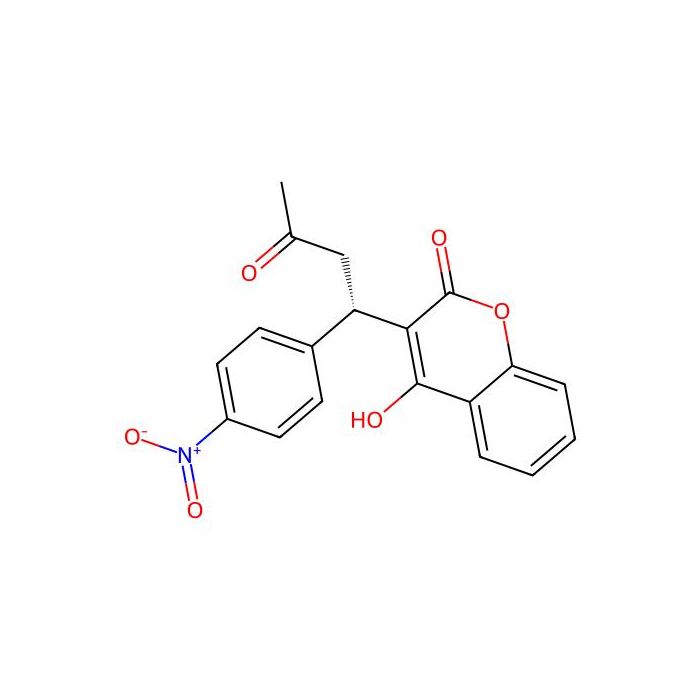
Brief overview: (S)-Acenocoumarol is the single-enantiomer form of the vitamin K antagonist acenocoumarol, a 4-hydroxycoumarin derivative bearing a chiral side chain.
Item-specific identifiers from Product Data:
CAS: 66556-78-3
SKU: S1340608
InChIKey: Not specified for this item; refer to CoA/Spec Sheet. (Provided string appears incomplete)
SMILES: Not specified for this item; refer to CoA/Spec Sheet.
Literature structural data (for reference; not item specifications):
Molecular formula (literature): C19H15NO6
Molecular weight (literature): ~353.33 g/mol
Stereochemistry: (S)-configuration at the single stereogenic center on the side chain attached at C-3 of the 4-hydroxycoumarin core.
Core features: 4-hydroxy-2H-chromen-2-one (4-hydroxycoumarin) ring system; aryl nitro-substituted acyl side chain bearing a tertiary carbon center.
2D structure description (general):
A bicyclic coumarin scaffold (benzopyran-2-one) with a phenolic OH at the 4-position.
At the 3-position, a chiral β-dicarbonyl-type side chain connects to a para-nitrophenyl ketone segment. The nitro group resides para to the benzylic linkage on the phenyl ring.
Notes:
Structure and identifiers above labeled as “literature” are provided for context only and should be verified against the item’s CoA/Spec Sheet before use in regulated workflows.
Synthetic Utility
As a fully elaborated, chiral small molecule, (S)-Acenocoumarol is not a common starting material or synthon for general organic synthesis. Its value in synthesis-adjacent workflows lies in reference and derivatization contexts.
Analytical standard in method development for coumarin derivatives (normal-phase, reverse-phase, chiral HPLC, SFC/UPC2).
Metabolite generation studies: use as a substrate in microsomal or enzymatic systems to produce and characterize oxidation/conjugation products; these metabolites can be isolated for structural elucidation.
Derivatization for mechanistic probes: selective modification of the phenolic OH (e.g., ether/ester capping) or isotopic labeling (2H/13C) to study binding and metabolism; such transformations require protection of sensitive functionalities and control of stereochemistry.
Reactivity notes (general):
Phenolic OH can undergo acylation/alkylation; keto-enol tautomerism of the 4-hydroxycoumarin core can affect reactivity.
Nitroaromatic ring is deactivating; nucleophilic aromatic substitution is limited unless activated further; reductions yield anilines, which dramatically change properties (handle with caution).
If a precursor or fragment-level building block is needed, consider starting from 4-hydroxycoumarin and assembling the side chain rather than modifying the final API-like structure.
Target Specificity
Item-specific biological target validation data (antigen/epitope/clone/isotype) are not applicable—this is a small-molecule standard, not an antibody or protein.
General literature context (not product-specific): (S)-Acenocoumarol is known as a vitamin K epoxide reductase (VKORC1) inhibitor; however, no target-binding data or potency specifications are provided for this item. Refer to primary literature for quantitative affinity/inhibition values if required for study design.
Domande frequenti
How should this product be stored?
Store at ?20 °C. Freezer storage is required to maintain the specified shelf life.
How is this product shipped?
This product ships in an insulated container with ice pads. Unpack on arrival and transfer it to the storage condition stated above.
What are the CAS number, molecular formula and molecular weight?
The CAS Number is 66556-78-3, the molecular formula is C19H15NO6, and the molecular weight is 353.33 g/mol. InChIKey VABCILAOYCMVPS-HNNXBMFYSA-N.
What documentation is provided?
Available product documentation, including Certificates of Analysis (COA), Safety Data Sheets (SDS), and specification sheets, is shown in the product document area. Document availability and access follow the current site policy.
Utilizziamo i cookie per garantire il corretto funzionamento del sito web e, ove consentito, per migliorare la tua esperienza. Puoi gestire le tue preferenze in qualsiasi momento nelle Impostazioni. Per saperne di più, consulta la nostra Cookie Policy.
Desidera che le inviamo un messaggio quando avremo sconti disponibili?
Ricordamelo più tardi
Grazie! Controlli la sua casella di posta per confermare.
Products are supplied to verified businesses, institutions, and qualified professionals for research and development use only. Not for use in humans, animals, diagnosis, or therapy.