Determine the necessary mass, volume, or concentration for preparing a solution.
| Activity Type | Activity Value -log(M) | Mechanism of Action | Activity Reference | Publications (PubMed IDs) |
|---|

Moligand™, 10mM in DMSO Moligand™ for sensitive chromatographic and analytical workflows requiring minimal baseline interference.
Store at -80°C Ships Dry ice packs + Cold packs Check lot-specific COA for exact specifications.
SDS, COA, datasheet, and spec sheet available for download. Lot-specific COA accessible via lot number lookup.
Cited in 5 peer-reviewed publications across chromatography, organic synthesis, and cross-coupling reactions.
Information
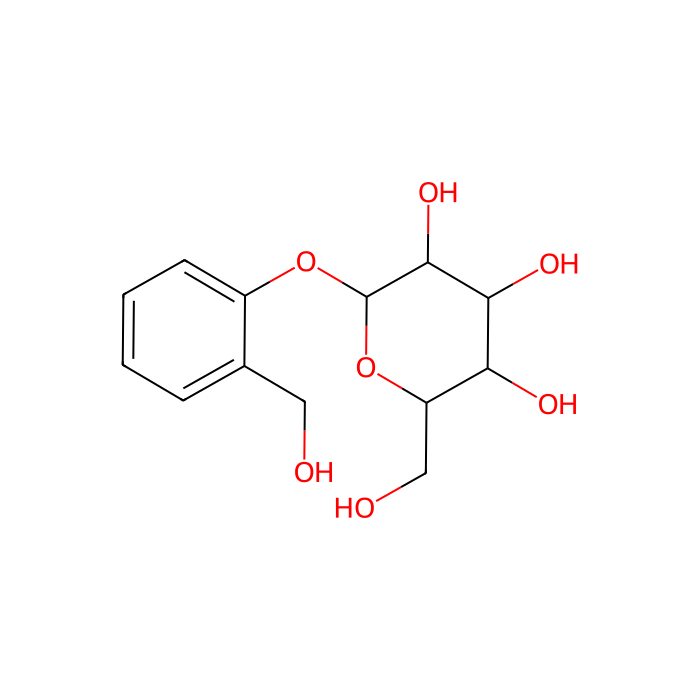
Salicin (Salicoside, Salicine) is a phenol β-glycosid produced from willow bark that shows anti-inflammatory effects. It is a natural, non-selectiveCOX-1andCOX-2inhibitor.
In vitro
Salicin (Salicoside, Salicine) is a phenol β-glycosid produced from willow bark that shows anti-inflammatory effects. Salicin is a prodrug which is gradually transported to the lower part of the intestine, hydrolyzed to saligenin by intestinal bacteria, and converted to salicylic acid after absorption. It thus produces an antipyretic action without causing gastric injury.
In vivo
Cell Data
cell lines:
Concentrations:
Incubation Time:
Powder Purity:≥98%
| Isomeri SMILES | C1=CC=C(C(=C1)CO)O[C@H]2[C@@H]([C@H]([C@@H]([C@H](O2)CO)O)O)O |
|---|---|
| WGK Germania | 3 |
| RTECS | LZ5901700 |
| CAS alternativo | 138-52-3 |
| PubChem CID | 439503 |
| Numero NSC | 758201 |
| Termini MeSH | salicin;salicyl alcohol glucoside |
| Peso molecolare | 286.28 |
| Beilstein | 89593 |
| Reaxy-Rn | 89593 |
Comprehensive hazard, handling, storage, and regulatory compliance document.
Download SDS →Lot-specific quality data. Enter your lot number to retrieve the exact COA.
Look up COA →Full quality attributes and acceptance criteria for this grade.
View spec sheet →| Activity Type | Activity Value -log(M) | Mechanism of Action | Activity Reference | Publications (PubMed IDs) |
|---|
| Solubilità | Solubility (25°C) In vitro DMSO: 41 mg/mL (197.79 mM); Ethanol: 41 mg/mL (197.79 mM); Water: Insoluble; |
|---|---|
| Rotazione specifica [α] | -62 ° (C=3, H2O) |
| Punto di fusione (°C) | 199-202°C |
| 1. Lei Chen, Ning Li, Min-Hua Zong. (2011) A glucose-tolerant β-glucosidase from Prunus domestica seeds: Purification and characterization. PROCESS BIOCHEMISTRY, [PMID:] [10.1016/j.procbio.2011.10.023] |
| 2. Zhenyue Wang, Faidah Arina Nur, Jingyi Ma, Jianguo Wang, Chuanwang Cao. (2019) Effects of poplar secondary metabolites on performance and detoxification enzyme activity of Lymantria dispar. COMPARATIVE BIOCHEMISTRY AND PHYSIOLOGY C-TOXICOLOGY & PHARMACOLOGY, [PMID:31401083] [10.1016/j.cbpc.2019.108587] |
| 3. Xinqi Gao, Yafang Lei, Teng Sun, Yuanze Ma, Hao Guan, Li Yan. (2025) Evaluation of Anti-Fungal Activities of Environmentally Friendly Wood Preservative from Thermal-Induced Lignified Twigs. Forests, 16 (1): (119). [PMID:] [10.3390/f16010119] |
| 4. Shangguang Du, Hao Wan, Jun Luo, Xiaohua Duan, Zhengrong Zou. (2024) Metabolic profiling of Citrus maxima L. seedlings in response to cadmium stress using UPLC-QTOF-MS. PLANT PHYSIOLOGY AND BIOCHEMISTRY, [PMID:38996714] [10.1016/j.plaphy.2024.108920] |
| 5. Mingzhen Zhang, Cong Liu, Yan Zhang, Zhangyaoyu Yuan, Shi Chen, Huihui Zhang, Xianju Huang, Lvyi Chen, Zhinan Mei, Yuebin Ge. (2025) Bioactive Components, Untargeted Metabolomics and Bioinformatics of Chaenomeles speciosa Fruit on Uric Acid-Lowering Activity Assessment. Foods, 15 (1): (20). [PMID:41517086] [10.3390/foods15010020] |
Our grade selection guide covers purity, stabilizer status, and application suitability for all variants in our catalog.
View Moligand™ grade guide →