Determine the necessary mass, volume, or concentration for preparing a solution.
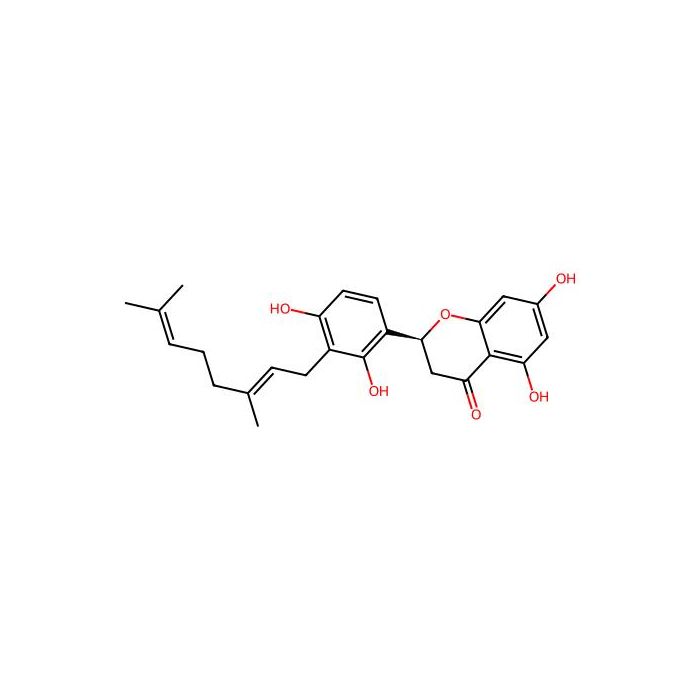
Sanggenol A , CAS No.174423-30-4
Disponibile su ordine
Storage
Store at -20°C
Shipped In
Ice chest + Ice pads

for sensitive chromatographic and analytical workflows requiring minimal baseline interference.
Store at -20°C Ships Ice chest + Ice pads Check lot-specific COA for exact specifications.
SDS, COA, datasheet, and spec sheet available for download. Lot-specific COA accessible via lot number lookup.
Cited in 0 peer-reviewed publications across chromatography, organic synthesis, and cross-coupling reactions.
| Sorrisi canonici | CC(=CCCC(=CCC1=C(C=CC(=C1O)C2CC(=O)C3=C(C=C(C=C3O2)O)O)O)C)C |
|---|---|
| IUPAC Name | (2S)-2-[3-[(2E)-3,7-dimethylocta-2,6-dienyl]-2,4-dihydroxyphenyl]-5,7-dihydroxy-2,3-dihydrochromen-4-one |
| InChIKey | QNPMSYLDWCXEOI-CEMXSPGASA-N |
| INCHI | 1S/C25H28O6/c1-14(2)5-4-6-15(3)7-8-17-19(27)10-9-18(25(17)30)22-13-21(29)24-20(28)11-16(26)12-23(24)31-22/h5,7,9-12,22,26-28,30H,4,6,8,13H2,1-3H3/b15-7+/t22-/m0/s1 |
| Isomeri SMILES | CC(=CCC/C(=C/CC1=C(C=CC(=C1O)[C@@H]2CC(=O)C3=C(C=C(C=C3O2)O)O)O)/C)C |
| PubChem CID | 15233693 |
Comprehensive hazard, handling, storage, and regulatory compliance document.
Download SDS →Lot-specific quality data. Enter your lot number to retrieve the exact COA.
Look up COA →Full quality attributes and acceptance criteria for this grade.
View spec sheet →Taxonomy Tree
| Kingdom | Organic compounds |
|---|---|
| Superclass | Phenylpropanoids and polyketides |
| Classe | Flavonoids |
| Subclass | Flavans |
| Intermediate Tree Nodes | 3'-prenylated flavans |
| Direct Parent | 3'-prenylated flavanones |
| Alternative Parents | 4'-hydroxyflavonoids 5-hydroxyflavonoids Flavanones 7-hydroxyflavonoids Chromones Bicyclic monoterpenoids Aromatic monoterpenoids Resorcinols Aryl alkyl ketones 1-hydroxy-2-unsubstituted benzenoids 1-hydroxy-4-unsubstituted benzenoids Alkyl aryl ethers Benzene and substituted derivatives Vinylogous acids Oxacyclic compounds Hydrocarbon derivatives Organic oxides |
| Molecular Framework | Aromatic heteropolycyclic compounds |
| Substituents | 3'-prenylated flavanone - 4'-hydroxyflavonoid - 5-hydroxyflavonoid - 7-hydroxyflavonoid - Flavanone - Hydroxyflavonoid - Chromone - Bicyclic monoterpenoid - Aromatic monoterpenoid - Benzopyran - 1-benzopyran - Monoterpenoid - Chromane - Aryl alkyl ketone - Aryl ketone - Resorcinol - 1-hydroxy-4-unsubstituted benzenoid - 1-hydroxy-2-unsubstituted benzenoid - Phenol - Alkyl aryl ether - Benzenoid - Monocyclic benzene moiety - Vinylogous acid - Ketone - Organoheterocyclic compound - Oxacycle - Ether - Organooxygen compound - Organic oxygen compound - Hydrocarbon derivative - Organic oxide - Aromatic heteropolycyclic compound |
| Descrizione | This compound belongs to the class of organic compounds known as 3'-prenylated flavanones. These are flavanones that features a C5-isoprenoid substituent at the 3'-position. |
| External Descriptors | Flavanones |
| Peso molecolare | 424.500 g/mol |
|---|---|
| XLogP3 | 5.800 |
| Hydrogen Bond Donor Count | 4 |
| Hydrogen Bond Acceptor Count | 6 |
| Rotatable Bond Count | 6 |
| Exact Mass | 424.189 Da |
| Monoisotopic Mass | 424.189 Da |
| Topological Polar Surface Area | 107.000 Ų |
| Heavy Atom Count | 31 |
| Formal Charge | 0 |
| Complexity | 681.000 |
| Isotope Atom Count | 0 |
| Defined Atom Stereocenter Count | 1 |
| Undefined Atom Stereocenter Count | 0 |
| Defined Bond Stereocenter Count | 1 |
| Undefined Bond Stereocenter Count | 0 |
| The total count of all stereochemical bonds | 1 |
| Covalently-Bonded Unit Count | 1 |
The Product Data do not list validated application protocols for this item. General guidance for common research uses is provided below as non-binding starting points:
Preparation of stock solutions (analytical):
LC–MS quantitation (example framework):
In vitro biochemical assay dosing:
These are illustrative only; adapt to your instrumentation and consult the batch CoA for identity/purity details.
Scope: Research-use-only information on natural occurrence and general biochemical themes; no medical or clinical claims.
Natural occurrence (literature/general):
Biochemical features (literature/general):
Research contexts:
Caution:
For any biological experimentation, maintain DMSO ≤1–2% v/v in final assay media and include matching vehicle controls to decouple solvent effects.
Sanggenol A is not a buffering reagent and is not used to prepare pH buffer systems. For experiments requiring Sanggenol A in aqueous media, prepare concentrated stocks in DMSO or ethanol and dilute into the desired buffer (e.g., PBS, HEPES) with vigorous mixing. Include solvent controls and confirm solubility to avoid precipitation.
While Sanggenol A itself is the target analyte/standard, greener choices pertain to solvent systems for extraction, synthesis, and analysis.
Greener solvent considerations (general):
Comparison (general guidance):
Operational best practices:
Trade-offs should be balanced with analytical performance requirements (e.g., sensitivity, peak shape, and matrix effects).
No pharmacopeial/excipient status is specified for this item; Sanggenol A is provided strictly for research use only.
Potential roles in a pharmaceutical R&D context (general, non-clinical):
Regulatory note:
Documentation:
Item-specific (from Product Data):
Literature/general expectations for Sanggenol-type polyphenolics:
Important:
Item-specific (from Product Data):
Guidance on interpreting grade/purity (general):
Recommended verification (best practice):
This item is principally used as a research reference standard and probe in chemical biology, phytochemistry, and analytical method development.
Analytical/assay applications (general):
Chemical reactivity/derivatization (literature/general):
Purification/analysis tips:
Note: There are no manufacturer-specified “applications” in the Product Data for this catalog entry; the above represent common literature practices for polyphenolic standards like Sanggenol A.
General, literature-style conditions for typical transformations on polyphenolic, prenylated natural products like Sanggenol A (not item-specific specifications):
O-Acetylation (for per-acetates):
O-Methylation:
Prenyl epoxidation:
Hydrogenation (C=C reduction of prenyl unit):
Analytical monitoring:
Note: Reaction outcomes are scaffold- and substitution-dependent. Optimize stoichiometry and protective group strategy. Always confirm by NMR (1H, 13C, HSQC/HMBC) and HRMS.
Item-specific (from Product Data):
General laboratory safety guidance (non-specific; consult SDS for authoritative instructions):
Always defer to the product’s Safety Data Sheet (SDS) for definitive hazard classification, exposure controls, and emergency measures.
Sanggenol A is a non-ionic, polyphenolic natural product with limited aqueous solubility. Solvent choice primarily targets dissolution for analytical or biological assays.
Practical solvent choices (literature/general):
Polarity/miscibility profile (general):
Tips:
Item-specific (from Product Data):
General best practices for polyphenolic natural products:
Documentation:
Note: If the CoA specifies additional stabilizers or alternative storage conditions for a given lot, those directions supersede the general guidance above.
Brief overview: Sanggenol A is a polyphenolic natural product (prenylated flavonoid–type, Diels–Alder–type adduct; literature) isolated from Morus spp. Used primarily as an analytical reference and for mechanistic/chemical-biology studies.
Item-specific (from Product Data):
Structural features (literature/general):
2D structural description (literature/general):
Notes:
Although supplied as a natural product standard rather than a reagent, Sanggenol A provides a richly functionalized scaffold for semisynthetic derivatization and methodological studies.
Functional group handles (literature/general):
Retrosynthetic value:
Practical use-cases:
Cautions:
No target specificity data are provided for this catalog item. Sanggenol A is supplied as a research-use chemical standard without a defined biological target profile in the Product Data. Any enzyme or receptor interactions reported in literature are context- and assay-dependent and should not be considered product specifications.