
Determine the necessary mass, volume, or concentration for preparing a solution.
| Activity Type | Activity Value -log(M) | Mechanism of Action | Activity Reference | Publications (PubMed IDs) |
|---|
Moligand™, 10mM in DMSO Moligand™ for sensitive chromatographic and analytical workflows requiring minimal baseline interference.
Store at -80°C Ships Dry ice packs + Cold packs Check lot-specific COA for exact specifications.
SDS, COA, datasheet, and spec sheet available for download. Lot-specific COA accessible via lot number lookup.
Cited in 0 peer-reviewed publications across chromatography, organic synthesis, and cross-coupling reactions.
Information
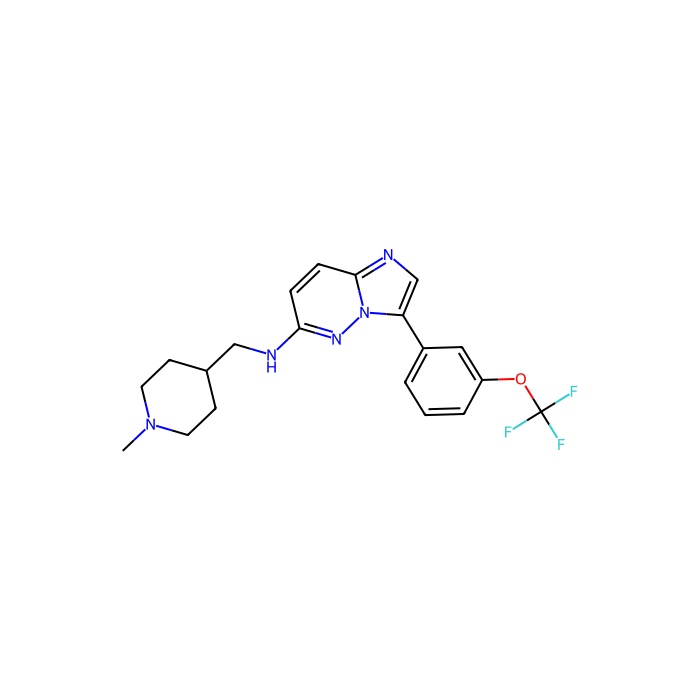
SGI-1776 free base is a novel ATP competitive inhibitor ofPim1withIC50of 7 nM in a cell-free assay, 50- and 10-fold selective versus Pim2 and Pim3, also potent to Flt3 and haspin. SGI-1776 inducesapoptosisandautophagy. Phase 1.
In vitro
In addition to Pim, SGI-1776 also potently targets FLT3 (IC50 = 44nM). Treatment of AML cells with SGI-1776 results in a concentration-dependent induction of apoptosis. Importantly, SGI-1776 is also cytotoxic in AML primary cells, irrespective of FLT3 mutation status and results in Mcl-1 protein decline. Treatment of CLL cells with SGI-1776 results in a concentration-dependent induction of apoptosis. SGI-1776 induces apoptosis in CLL and that the mechanism involves Mcl-1 reduction. Apoptosis induction coupled with the inhibition of RNA synthesis is observed in CLL cells treated with SGI-1776. SGI-1776 exhibites cytotoxic activity in vitro with a median relative IC50 of 3.1 mM. SGI-1776 induces tumor growth inhibition meeting criteria for intermediate EFS T/C activity in 1 of 39 evaluable models. In contrast, SGI-1776 induces complete responses of subcutaneous MV4;11.
In vivo
Consistent with cell line data, xenograft model studies with mice bearing MV-4-11 tumors shows efficacy with SGI-1776. SGI-1776 has shown preclinical activity against leukemia and solid tumor cell line models with IC50 values of 0.005–11.68 mM. SGI-1776 induces significant differences in EFS distribution in vivo in 9 of 31 solid tumor xenografts and in 1 of 8 of the evaluable ALL xenografts.
Cell Data
cell lines:
Concentrations:0.1-10 μM
Incubation Time:24 hours
Powder Purity:≥96%
| Isomeric SMILES | CN1CCC(CC1)CNC2=NN3C(=NC=C3C4=CC(=CC=C4)OC(F)(F)F)C=C2 |
|---|---|
| PubChem CID | 24795070 |
| Molecular Weight | 405.42 |
Comprehensive hazard, handling, storage, and regulatory compliance document.
Download SDS →Lot-specific quality data. Enter your lot number to retrieve the exact COA.
Look up COA →Full quality attributes and acceptance criteria for this grade.
View spec sheet →| Activity Type | Activity Value -log(M) | Mechanism of Action | Activity Reference | Publications (PubMed IDs) |
|---|
| Activity Type | Activity Value -log(M) | Mechanism of Action | Activity Reference | Publications (PubMed IDs) |
|---|
| Activity Type | Activity Value -log(M) | Mechanism of Action | Activity Reference | Publications (PubMed IDs) |
|---|
| Activity Type | Activity Value -log(M) | Mechanism of Action | Activity Reference | Publications (PubMed IDs) |
|---|
| Activity Type | Activity Value -log(M) | Mechanism of Action | Activity Reference | Publications (PubMed IDs) |
|---|
| Activity Type | Activity Value -log(M) | Mechanism of Action | Activity Reference | Publications (PubMed IDs) |
|---|
| Activity Type | Activity Value -log(M) | Mechanism of Action | Activity Reference | Publications (PubMed IDs) |
|---|
| Activity Type | Activity Value -log(M) | Mechanism of Action | Activity Reference | Publications (PubMed IDs) |
|---|
| Solubility | Solubility (25°C) In vitro DMSO: 49 mg/mL (198.94 mM); Water: Insoluble; Ethanol: Insoluble; |
|---|
Our grade selection guide covers purity, stabilizer status, and application suitability for all variants in our catalog.
View Moligand™ grade guide →