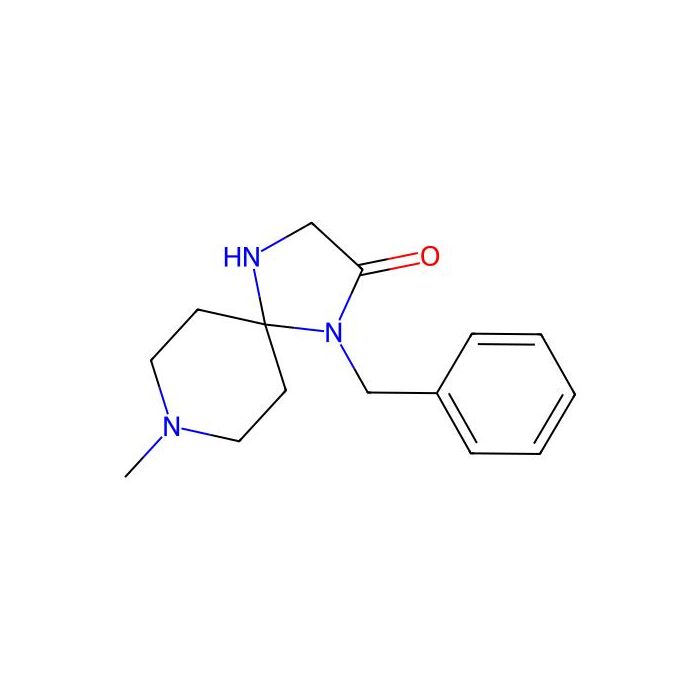
This compound belongs to the class of organic compounds known as azaspirodecane derivatives. These are organic compounds containing a spirodecane moiety with at least one nitrogen atom.
External Descriptors
Not available
1. Djoumbou Feunang Y, Eisner R, Knox C, Chepelev L, Hastings J, Owen G, Fahy E, Steinbeck C, Subramanian S, Bolton E, Greiner R, and Wishart DS. ClassyFire: Automated Chemical Classification With A Comprehensive, Computable Taxonomy. Journal of Cheminformatics, 2016, 8:61.
Certificati (CoA, COO, BSE/TSE e tabella di analisi)
C of A & Other Certificates(BSE/TSE, COO):
Analytical Chart:
Proprietà chimiche e fisiche
Peso molecolare
259.350 g/mol
XLogP3
1.100
Hydrogen Bond Donor Count
1
Hydrogen Bond Acceptor Count
3
Rotatable Bond Count
2
Exact Mass
259.168 Da
Monoisotopic Mass
259.168 Da
Topological Polar Surface Area
35.600 Ų
Heavy Atom Count
19
Formal Charge
0
Complexity
330.000
Isotope Atom Count
0
Defined Atom Stereocenter Count
0
Undefined Atom Stereocenter Count
0
Defined Bond Stereocenter Count
0
Undefined Bond Stereocenter Count
0
The total count of all stereochemical bonds
0
Covalently-Bonded Unit Count
1
Calcolatori di soluzioni
Molarity Calculator
Determine the necessary mass, volume, or concentration for preparing a solution.
Dilution Calculator
Determine the dilution needed to prepare a stock solution.
Reconstitution Calculator
Recensioni
Recensioni dei clienti
Application Protocols
No item-specific, validated in-house protocols are provided for this product. The following are general best-practice outlines to assist method development.
A. Preparation of stock solutions (general):
Equilibrate vial to room temperature in a desiccator. Weigh desired amount quickly. Add anhydrous DMSO to achieve 10–50 mM. Vortex and, if needed, sonicate briefly. Filter through 0.22 µm PTFE if particulate remains.
Aliquot into low-binding microtubes (amber if light-sensitive). Store at −20 °C or −80 °C. Avoid repeated freeze–thaw.
B. Cell-based dosing (general):
Prepare serial dilutions in culture medium to achieve the target concentration range; keep final DMSO ≤0.1–0.5% v/v. Include vehicle controls. Pre-warm media to 37 °C.
Optional: Assess compound adsorption by comparing glass vs. plastic ware or by using BSA-supplemented media.
C. Biophysical binding assay setup (general):
For SPR/BLI, confirm solubility in running buffer with ≤1–2% DMSO; perform solvent correction. Start with a concentration series spanning at least 0.1× to 10× the expected KD. Include reference channels and blank injections.
D. Analytical QC (general):
Verify identity and purity by LC–MS and HPLC before biological testing. Establish a short stability study of the working solution under assay conditions.
These outlines are starting points and must be adapted to your instrumentation and assay design.
Biological Roles
General literature context (no medical or clinical claims):
Simufilam is reported in the scientific literature as a small-molecule modulator that binds to the cytoskeletal scaffolding protein filamin A (FLNA). FLNA is involved in actin crosslinking, membrane protein organization, and coordination of signaling complexes for GPCRs and other receptors.
By engaging FLNA, research with this compound explores hypotheses around cytoskeleton-associated signaling, receptor trafficking, and potential normalization of aberrant protein–protein interactions. Such investigations may extend to neuronal cell biology, receptor pharmacology, and proteostasis pathways. Researchers often evaluate downstream markers such as GPCR pathway readouts, cytoskeletal dynamics, or changes in receptor localization.
Tool-compound usage: The molecule can serve as a biochemical probe in binding studies (e.g., pull-downs with recombinant FLNA domains, surface plasmon resonance) and in cell-based assays to assess target engagement using thermal shift or CETSA-like approaches. Proteomic methods (affinity capture/MS) may be applied for off-target profiling.
ADME-facing studies (in vitro): Microsomal stability, plasma protein binding, and permeability (e.g., MDCK/CMC) are commonly profiled for such tool compounds to inform exposure in cell assays. Exact values for Simufilam are not provided here; verify from primary literature or internal measurements.
Note: All uses are for research purposes only. Verify target engagement with orthogonal assays, including genetic perturbation (siRNA/CRISPR) as appropriate.
Buffer Applications
This product is not a buffering reagent and is not used to set or maintain pH. However, it is frequently dosed into biological buffers for assays.
Practical guidance for buffer-based assays (general):
Vehicle control: Prepare a DMSO (or chosen co-solvent) vehicle control matched to the highest solvent percentage used in treated samples (commonly ≤0.1–0.5% v/v final).
Typical assay buffers: PBS, HBSS, HEPES-buffered saline, or Tris-buffered saline supplemented with 0.01–0.1% polysorbate or 0.1% BSA can help reduce nonspecific adsorption of hydrophobic compounds to plastics and glass.
Solubilization: Pre-dilute the DMSO stock 10–100× into buffer with rapid mixing to avoid local supersaturation. Consider using low-binding tubes and plates.
Sterility: For cell assays, 0.22 µm filtration of the working solution is recommended; verify filter compatibility with any organic co-solvents.
Light and temperature: Protect from strong light if photolabile; maintain consistent temperature across controls and treated samples.
These are general best practices; optimize composition (salt, pH, protein/cosolvent content) for the specific assay readout and ensure the vehicle does not affect biological endpoints.
Green Alternatives
As a research tool compound, Simufilam itself does not have a “greener substitute” in the sense of a solvent or reagent replacement. However, greener choices can be made around its handling and analysis:
Stock solutions: Prefer ethanol or aqueous cyclodextrin formulations where scientifically acceptable, reducing reliance on high-boiling aprotic solvents. Validate biological compatibility and stability.
Analytical methods: Use water–acetonitrile gradients over water–methanol when appropriate energy and waste profiles favor MeCN (or vice versa depending on your local solvent recovery). Implement shorter UPLC methods to cut solvent consumption.
Workup and cleaning: Minimize chlorinated solvents. Use ethyl acetate and heptane/isooctane systems over DCM/CHCl3 where feasible.
Energy: Favor ambient-temperature operations and room-temperature dissolution with sonication over heating; avoid prolonged lyophilization when not necessary.
Trade-offs (general):
Ethanol is greener but may limit solubility versus DMSO/DMF.
Cyclodextrin vehicles can improve aqueous delivery but may complicate assay readouts and quantification; perform control experiments.
Switching LC eluents may affect ionization efficiency in MS; re-optimize source parameters accordingly.
Pharmaceutical Uses
No therapeutic or clinical claims are made. The information below concerns research, analytical, and development contexts only.
Reference standard: Simufilam can serve as a reference analyte for developing and validating LC–UV or LC–MS/MS assays (e.g., stability-indicating methods, impurity profiling, or bioanalytical quantitation in in vitro matrices). Calibrate with gravimetrically prepared reference solutions and assess linearity, accuracy, precision, and stability per ICH/FDA guidance.
Formulation research tool: In preformulation-style studies, researchers may evaluate solubility as a function of pH, cosolvent content, and excipients (e.g., cyclodextrins, surfactants) to support in vitro dosing or exploratory delivery to cell systems. Solid-state characterization (XRPD, DSC/TGA, Karl Fischer) helps understand polymorphism and hygroscopicity—none of which are specified for this item and should be determined experimentally if relevant.
Impurity/degradation tracking: Use forced-degradation studies (acid/base, oxidative, thermal, photolytic) to design stability-indicating analytical methods. Identify degradants by HRMS and, where possible, isolate for NMR confirmation.
Regulatory context: No pharmacopeial monograph is indicated for Simufilam. For any regulated work, document chain of custody, CoA verification, and method qualification tailored to your use case.
Physical Properties
Item-specific specifications were not provided for this catalog entry. Do not assume values for method or process qualification.
Appearance: Not specified for this item; refer to CoA/Spec Sheet.
Melting point: Not specified for this item; refer to CoA/Spec Sheet.
Boiling point: Not applicable/Not specified for this high-MW organic solid; refer to CoA/Spec Sheet.
Density: Not specified for this item; refer to CoA/Spec Sheet.
Solubility: Not specified for this item; refer to CoA/Spec Sheet.
LogP/logD: Not specified for this item; refer to CoA/Spec Sheet.
pKa(s): Not specified for this item; refer to CoA/Spec Sheet.
Refractive index/UV cutoff: Not specified for this item; refer to CoA/Spec Sheet.
General laboratory guidance (literature/common practice; verify for your assay):
Small-molecule tool compounds of this class are commonly prepared as concentrated stock solutions in anhydrous DMSO (e.g., 10–50 mM), then diluted into assay buffers or media. If aqueous solubility is limited, co-solvents (≤1–2% v/v DMSO or ethanol in final assays) or solubilization aids (e.g., 2-hydroxypropyl-β-cyclodextrin) can be used.
For analytical development, first establish a stability-indicating LC–UV or LC–MS method and perform a short-term solubility screen across DMSO, MeCN, MeOH, and buffer (pH 2–9) to determine suitable conditions for your application.
Quality and Grades
Grade/Purity: Not specified for this item; refer to CoA/Spec Sheet.
Guidance on quality considerations for this compound class:
Identity confirmation: Verify by orthogonal methods (e.g., 1H/13C NMR, HRMS/accurate mass, and HPLC/UPLC purity by area percent with appropriate detection). If a chiral center exists in the final structure, confirm enantiomeric/diastereomeric purity as applicable (chiral HPLC or NMR with chiral shift reagents).
Purity reporting: For small-molecule research tools, area% by HPLC at multiple wavelengths (210–280 nm and at compound λmax if known) is recommended. If UV chromophores are weak, use ELSD or MS detection.
Residual solvents and water: Where method-critical, assess by GC (residual solvents per ICH Q3C) and Karl Fischer for water. Unless specified on the CoA, do not assume limits.
Stabilizers: None specified for this item. If stability concerns arise (e.g., hydrolysis, oxidation, photolysis), consider storing under inert gas, in amber vials, and including desiccants in secondary containment.
Batch documentation: Use the item-specific CoA for exact assay, impurity profile, and test conditions. For regulated or critical experiments, qualify each lot with your in-house method prior to use.
Reaction and Applications
This product is a finished small-molecule research tool rather than a general synthetic reagent. It is not typically used as a solvent, catalyst, or stoichiometric reagent in standard organic reactions.
Research application contexts (general, literature-based):
Utilized as a reference compound in biochemical and biophysical assays aimed at characterizing interactions with cytoskeletal or scaffolding proteins (e.g., filamin A, per literature). Applicable assay modalities may include ligand-binding/target engagement (SPR, BLI), calorimetry (ITC), thermal shift (DSF/CETSA-like formats), and cellular phenotypic readouts.
In cell-based studies, stock solutions are typically prepared in DMSO and dosed at a range of concentrations to construct concentration–response curves; ensure DMSO controls and vehicle-matched conditions.
Analytical applications include developing stability-indicating HPLC/UPLC methods, LC–MS/MS quantitation (as an analyte or reference standard), and forced-degradation studies to understand solution/solid-state robustness.
Practical tips:
Establish compound-specific solubility and stability windows before screening. Perform a preliminary cosolvent screen at relevant temperatures.
Confirm identity/purity against the lot-specific CoA prior to in-depth studies. Where feasible, verify by independent NMR and LC–MS.
Reaction Conditions
This product is not intended for use as a reagent in named organic reactions; therefore, specific reaction conditions (solvents, temperatures, catalysts, typical yields) are not applicable.
General handling conditions for solution preparation (best practices):
Dissolution: Add solvent (commonly anhydrous DMSO) to the weighed solid to reach the desired molarity (e.g., 10–50 mM). Gentle warming (≤40 °C) and vortex/sonication may aid dissolution.
Dilution: For biological assays, dilute stock into pre-equilibrated buffer or media with rapid mixing. Maintain final co-solvent below your assay’s tolerance (often ≤0.1–0.5% v/v DMSO).
Stability checks: Verify short-term stability in chosen solvent at room temperature and 4 °C; for long-term, evaluate at −20 °C or −80 °C per your storage plan.
Materials: Use amber vials or foil wrapping if the compound is light-sensitive; low-binding plastics or silanized glass can reduce adsorption.
If you intend to use this molecule in custom chemistry (e.g., conjugation), establish reaction conditions empirically after confirming the precise structure and functional groups from a trusted source.
Safety and Handling
Hazard data were not provided for this item listing. Always consult the product-specific SDS before use.
GHS signal word/classification/pictograms: Not specified for this item; refer to SDS.
H-statements: Not specified for this item; refer to SDS.
General laboratory precautions (good practice):
Handle in a chemical fume hood. Avoid inhalation of dusts or aerosols and prevent skin/eye contact. Use appropriate PPE: lab coat, safety glasses, and chemically resistant gloves (nitrile recommended). For weighed solids, consider antistatic measures and micro-spatulas to minimize airborne particulates.
Solvent handling: If preparing DMSO or DMF stocks, note these solvents can enhance dermal absorption of solutes; avoid skin contact.
Incompatibilities: Until specific data are available, avoid strong oxidizers and strong acids/bases that could promote degradation. Keep away from heat and light during handling to minimize potential decomposition.
First aid (overview; defer to SDS): In case of skin contact, wash with soap and water; for eye contact, rinse with water for several minutes and seek medical attention; if inhaled, move to fresh air; if ingested, rinse mouth and seek medical attention. Provide SDS to responders.
Waste: Dispose according to institutional hazardous waste procedures for organic research chemicals.
Transport/storage: See Storage & Reconstitution tab; maintain cold chain as provided.
Solvent Selection
This product is a small organic molecule typically handled as a solid that is reconstituted into an organic solvent for stock preparation.
General solvent guidance (best practices for small-molecule tool compounds):
Primary stock solvent: DMSO (anhydrous) is commonly used due to broad solvating power and assay compatibility at low final percentages (≤0.1–0.5% v/v). Prepare 10–50 mM stocks as solubility permits.
Alternative solvents: DMF, ethanol, or methanol can be used depending on downstream application. For LC–MS sample prep, MeCN or MeOH are typical. For NMR, DMSO-d6, CD3OD, or CDCl3 may be selected based on solubility.
Aqueous use: If aqueous solubility is limited, dilute DMSO stocks into buffer with vigorous mixing; maintain final DMSO below your assay’s tolerated limit. Solubilization aids (e.g., 1–5% v/v ethanol co-solvent, mild heating to 30–40°C, or cyclodextrins) can help; validate no impact on biology.
Filtration: For cell-based assays, sterile-filter final working solutions through 0.22 µm PTFE or PVDF filters compatible with the chosen solvent system.
Stability: Assess solution stability at intended storage and use temperatures; minimize freeze–thaw by aliquoting stocks.
Comparison (general):
DMSO: highest solvency, biocompatible at low %; can increase dermal absorption.
DMF: strong solvency but less desirable for bioassays; reserve for prep/analytical contexts.
Storage and Reconstitution
Item-specific storage and shipping:
Storage conditions: Store at −20 °C (as provided in Product Data). Protect from moisture and, if applicable, from light. Keep container tightly closed.
Shipping: Shipped in an ice chest with ice pads to maintain low temperature during transit.
Reconstitution (general guidance):
Solvent: Use anhydrous DMSO to prepare concentrated stock solutions (e.g., 10–50 mM), unless your application dictates another solvent. If aqueous working solutions are required, dilute the DMSO stock into buffer/media with vigorous mixing to avoid precipitation.
Aliquoting: Immediately aliquot freshly prepared stock solutions into single-use portions to minimize freeze–thaw cycles.
Freeze–thaw: Avoid repeated freeze–thaw. If necessary, limit to ≤2 cycles and assess potency/purity via LC–MS or HPLC.
Short-term handling: When removing from cold storage, allow sealed vials to equilibrate to room temperature before opening to prevent moisture condensation.
Stability notes:
Specific shelf-life, solution stability, and photostability are not provided for this item; consult the CoA/Spec Sheet and perform application-specific stability assessments.
General reminder: For research use only. Use appropriate aseptic technique if preparing solutions for cell culture or biochemical assays.
Structure and Identity
Product name: Simufilam (also known in the literature as PTI-125)
CAS: 1224591-33-6 (item-specific)
PubChem CID: 46195331 (item-specific)
InChIKey: 33272 (as provided; note this is not a standard full InChIKey string)
SMILES: Not specified for this item; refer to CoA/Spec Sheet.
Molecular formula: Not specified for this item; refer to CoA/Spec Sheet.
Molecular weight: Not specified for this item; refer to CoA/Spec Sheet.
Structural features (general, literature-based):
Simufilam is a small-molecule organic compound reported in the literature as a modulator of the cytoskeletal protein filamin A (FLNA). Detailed 2D structure, functional groups, and stereochemistry should be confirmed from an authoritative structure source (e.g., PubChem CID 46195331 or supplier CoA) before planning analytical or synthetic work.
2D structure description (general guidance):
The literature describes a drug-like, heteroatom-containing, aromatic-rich scaffold typical of CNS-directed tool compounds; confirm exact ring systems and heterocycles from a verified structure source prior to method development (NMR assignments, LC–MS transitions, and HPLC method conditions depend critically on the exact structure).
Synthetic Utility
Simufilam is supplied as a finished small molecule for research use, not as a general-purpose building block. It is not typically employed as a reagent, catalyst, or protecting group in organic synthesis.
Contextual notes for chemists (general):
If structure–activity relationship (SAR) exploration is of interest, medicinal chemists may use the published scaffold as a starting point for designing analogs. However, the present product is not offered as a functionalized intermediate, and no reactive handle specifications are provided.
For analytical and characterization method development, Simufilam can be used as a system suitability compound to challenge separation selectivity for closely related impurities or synthetic byproducts in internal projects.
Any bespoke synthetic transformations (e.g., derivatization for probe synthesis such as biotinylation or photoaffinity tagging) should be designed based on a verified structure from a primary database (e.g., PubChem CID 46195331). Ensure that derivatization sites do not abolish target binding if biological studies are intended.
In summary, view this item as an end-product probe molecule rather than a synthetic reagent; leverage it for biological, analytical, and reference applications.
Target Specificity
This section is primarily applicable to biologics (e.g., antibodies) with defined antigen/epitope data. For this small-molecule research compound, item-specific target validation data are not provided.
Item-specific specificity data: Not specified for this item; refer to primary literature and your own target engagement assays.
General literature context:
Simufilam has been reported to bind filamin A (FLNA). Researchers should validate specificity through orthogonal methods (e.g., thermal shift/DSF or CETSA in cells, SPR/BLI with recombinant domains, and genetic controls such as FLNA knockdown/knockout). Off-target profiling (broad receptor/enzyme panels, chemoproteomics) is recommended where specificity is critical for interpretation.
All uses are for research only; no clinical or diagnostic claims are made.
Domande frequenti
How should this product be stored?
Store at ?20 °C. Freezer storage is required to maintain the specified shelf life.
We use cookies to ensure the website functions properly and, where permitted, to improve your experience. You can manage your preferences at any time in Settings. Learn more in our Cookie Policy.
Shall we send you a message when we have discounts available?
Remind me later
Thank you! Please check your email inbox to confirm.
Products are supplied to verified businesses, institutions, and qualified professionals for research and development use only. Not for use in humans, animals, diagnosis, or therapy.