GRADE & PURITYMoligand™?Moligand™ — Aladdin's line of ligands and bioactive small molecules. Use for receptor, pathway, and binding studies needing defined small-molecule tools.10 mM in DMSO
Determine the necessary mass, volume, or concentration for preparing a solution.
Dilution Calculator
Determine the dilution needed to prepare a stock solution.
Reconstitution Calculator
Recensioni
Recensioni dei clienti
Application Protocols
No vendor-tested application protocols are provided in the Product Data for this SKU.
General guidance for small-molecule library compounds (adapt to your assay and validate in pilot runs):
Stock solution (example workflow):
Equilibrate vial to room temperature in a desiccator. Weigh quickly. Dissolve in anhydrous DMSO to prepare a 10–50 mM stock (literature practice). Vortex/sonicate briefly if needed. Protect from light.
Optionally sterile-filter (0.22 µm PTFE) for cell-based assays.
Aliquot into amber vials or 96-well plates; argon backfill if possible; store frozen.
Working solution:
Dilute stock into assay buffer or culture medium to the desired final concentration. Keep final DMSO ≤0.5–1% v/v unless your system tolerates more.
Include vehicle controls matched for DMSO content.
Controls and data quality:
Run a concentration–response series (e.g., 8–12 points, 1:3 serial dilutions) and include positive/negative controls suitable for your assay.
Monitor for precipitation or turbidity; adjust solvent ratio or concentration as needed.
These are general, literature-aligned practices and not item-specific validated protocols.
Biological Roles
Context for research use (literature-based; no clinical claims):
Sitagliptin phosphate is widely recognized in the literature as a small-molecule tool compound that modulates dipeptidyl peptidase-related pathways; it is used in biochemical research to study enzyme inhibition mechanisms, kinetics, and structure–activity relationships.
As a heteroatom-rich, basic small molecule supplied as a phosphate salt, it serves as a reference standard in analytical and bioanalytical method development, supporting quantification and stability assessments in in vitro systems.
In chemical biology, such compounds are used to probe target engagement and to benchmark assay windows in enzyme activity assays, thermal shift assays, and biophysical binding measurements (e.g., SPR, ITC), subject to local SOPs.
Practical research considerations:
When interpreting biological data, report the exact salt form and concentration (molar) to ensure reproducibility.
Control for potential off-target effects by employing counter-screens and orthogonal assays; heteroaromatic small molecules can occasionally interfere with fluorescence/absorbance readouts.
For cell-based work, pre-validate cytotoxicity/viability impacts at the intended exposure window; maintain DMSO ≤0.5–1% v/v in culture media unless otherwise justified.
Reminder: This product is designated For research use only. No use in humans or animals is implied or permitted under this listing outside of approved laboratory research protocols.
Buffer Applications
This product is a small-molecule library compound and is not a buffering agent. Therefore, it is not typically used to establish or maintain pH in laboratory buffers.
Not typically applicable: Does not serve as a primary buffer component or pH modifier.
Practical note: When preparing solutions for biochemical assays, dissolve first in DMSO (common practice) and dilute into your chosen buffer (e.g., PBS, HEPES, Tris) that is appropriate for the biological system under study. Validate that the final buffer composition does not precipitate the compound.
For buffer formulation guidance, consult dedicated buffering reagents in the catalog.
Green Alternatives
This product is a specific small-molecule active (library compound) rather than a commodity solvent or reagent, so “green alternative” considerations focus on handling and solvent choices rather than substituting the molecule itself.
Greener handling strategies (general best practices):
Use minimal DMSO volumes compatible with assay performance; consider aqueous-first dissolution if feasible for your protocol.
Favor water-based buffers for dilutions and washing steps; keep DMSO in the final assay at the lowest effective level (often ≤0.5% v/v).
Consolidate weighing and solution preparation to reduce container waste; aliquot for single-use to prevent degradation and disposal of partially used material.
Employ microscale assays and miniaturized plate formats to decrease chemical footprint.
Solvent choice tradeoffs (general):
DMSO: High solubilizing power for salts and polar organics; EHS considerations are moderate; minimize use and ensure proper waste segregation.
DMF/NMP: Strong solvents but with higher EHS concerns; avoid when DMSO or aqueous media suffice.
Alcohols (EtOH/MeOH): Potentially greener than DMF/NMP; validate compatibility with your assay.
Waste and end-of-life:
Segregate halogenated vs non-halogenated organic waste per institutional policy.
Note: No alternative “substitute molecule” is suggested, as this SKU is itself the intended structure for screening.
Pharmaceutical Uses
This listing is provided strictly for research use as part of a small-molecule library (Moligand grade). No clinical or therapeutic use is implied.
Not specified for this item; refer to CoA/Spec Sheet regarding any compendial references or analytical standards status (if applicable).
General, non-clinical context (literature): Compounds of this structural class are often used as reference standards in pharmaceutical analytical development to validate chromatographic methods, mass spectrometry transitions, and stability-indicating assays; such use requires appropriate qualification within your quality system.
Formulation development in regulated settings is out of scope for this research-grade product. If excipient status or pharmacopeial compliance is required, source pharmacopeial-grade reference standards or GMP-grade materials.
Reminder: For research use only. Not for human or animal therapeutic, diagnostic, or clinical applications.
Physical Properties
Item-specific specifications are not provided in the Product Data. For any critical parameters, consult the lot-specific CoA/SDS.
Not specified for this item; refer to CoA/Spec Sheet:
Molecular formula and exact molecular weight (salt/hydrate state dependent)
Melting point, solubility limits, pKa values, logP/logD, refractive index, water content, residual solvents, elemental analysis
Literature/general expectations for sitagliptin phosphate (for planning only; verify experimentally):
Physical state: typically a crystalline solid (literature)
Aqueous/DMSO solubility: commonly prepared as DMSO stock solutions (e.g., 10–50 mM) with subsequent dilution into aqueous assay buffers; water solubility enhanced by phosphate salt form (literature)
Ionization: multiple basic nitrogens; salt form improves handling and dissolution in polar media (literature)
Practical preparation notes (general guidance):
For plate-based screening, dissolve in anhydrous DMSO to a defined concentration, verify clarity, and sterile-filter if sterility is required by the assay.
Avoid prolonged exposure to ambient humidity and light to maintain material integrity (aligns with storage guidance below).
Important: Because different commercial offerings may correspond to different salt stoichiometries or hydrates, only the CoA for SKU S1496605 should be used to assign exact numerical values for this item.
Quality and Grades
Grade provided: Moligand™ (as listed in Product Data)
What Moligand™ typically signifies (general description; check the CoA for item-specific criteria):
Intended for discovery chemistry and screening workflows as a small-molecule library member.
Emphasis on structural identity and purity suitable for biochemical/biophysical assays and medicinal chemistry triage.
Often supported by key documentation such as CoA, SDS, and, where applicable, NMR/LC–MS identity confirmation. Exact acceptance criteria, residual solvent limits, salt stoichiometry, and water content are lot-specific and should be verified on the CoA.
Implications for use:
Designed for high-throughput screening, hit validation, and probe development where reproducible performance is critical.
Low adventitious reactivity and clean chromatographic behavior are typically prioritized to minimize assay interference; however, confirmatory orthogonal assays are recommended for library compounds.
What is NOT specified for this item:
Numerical purity, solvent cutoffs for HPLC/UV, metal content, residual solvents, and hydrate level are Not specified for this item; refer to CoA/Spec Sheet.
Documentation best practices:
Cite the SKU (S1496605), CAS, and lot number in reports.
Archive the CoA with project records, noting salt/hydrate form to avoid miscalculation of molar concentrations.
Reaction and Applications
This SKU is supplied as a research library compound rather than a synthetic reagent. As such, it is primarily used in discovery biology/chemistry workflows rather than as a substrate or catalyst.
Typical research applications (general, literature-based for sitagliptin-class tool compounds):
Biochemical and cell-based assay benchmarking as a reference small molecule; concentration–response curve generation and control experiments (literature). No clinical/therapeutic claims are implied.
Method development for LC–MS quantification in complex matrices (e.g., establishing retention time, ionization behavior) using small-molecule standards (literature).
Physicochemical profiling: solubility, permeability, pKa/logD estimation, salt screening, and crystallization studies (general medicinal chemistry practices).
Assay and handling tips:
Prepare accurately weighed quantities using the documented salt form to compute molarities.
Use fresh DMSO stocks or aliquot to avoid repeated freeze–thaw that can introduce variability.
Include orthogonal readouts (e.g., enzymatic vs thermal-shift) to rule out assay interference typical of some heteroaromatic, polyfunctional small molecules.
Not a typical reagent for:
Stoichiometric organic transformations, cross-couplings, or catalysis. For those purposes, consult dedicated reagents in the catalog.
Important: Follow the Research Use Only restriction and your institution’s chemical hygiene plan.
Reaction Conditions
Because this product is intended as a small-molecule research compound rather than a synthetic reagent, there are no standardized “reaction conditions” associated with it.
Instead, the following preparation/handling conditions are commonly applied in research assays (general guidance):
Stock preparation: Dissolve in anhydrous DMSO to 10–50 mM (literature practice), ensuring complete dissolution. Record the exact salt form for accurate molarity.
Dilution: Add DMSO stock to assay buffer with vigorous mixing to avoid local supersaturation; keep final DMSO content low (often ≤0.5–1% v/v).
Temperature: Prepare and store solutions at low temperature when feasible; avoid extended exposure to elevated temperatures.
Light/atmosphere: Prepare under subdued light; minimize air and moisture exposure to align with solid storage guidance.
Filtration: 0.22 µm filtration is recommended for optical assays or sterile applications.
Expected outcomes: Concentration–response curves and biochemical readouts will depend on the specific assay design and target. Establish controls and replicate measurements to quantify variability and potential assay interference.
Note: The above are general literature and best-practice guidelines; they are not item-specific specifications.
Safety and Handling
Safety information specific to this SKU has not been provided in the Product Data. Always consult the SDS for authoritative guidance.
GHS classification, pictograms, hazard and precautionary statements: Not specified for this item; refer to SDS.
General laboratory precautions (good practice):
Handle solids in a fume hood to minimize dust/aerosol exposure.
Wear appropriate PPE: lab coat, gloves, and eye protection.
Avoid inhalation, ingestion, and skin or eye contact. Wash thoroughly after handling.
Storage incompatibilities and stability (general):
Follow item-specific storage: protect from light, store under inert gas (argon), at −80 °C.
Keep container tightly closed; minimize freeze–thaw and moisture exposure to prevent hydrolysis or polymorph changes.
First-aid overview (general):
Skin/eye contact: Rinse with water for at least 15 minutes; remove contaminated clothing; seek medical attention as needed.
Inhalation: Move to fresh air; seek medical attention if symptoms persist.
Ingestion: Rinse mouth; do not induce vomiting unless directed; seek medical attention.
Spill/accidental release (general):
Avoid dust formation; collect by gentle sweeping or HEPA vacuum; place in suitable, labeled waste container.
Fire safety (general):
Use water spray, CO2, dry chemical, or foam per surrounding fire; combustion may produce COx/NOx and phosphorus oxides.
Note: This product is designated For research use only.
Solvent Selection
Guidance below is based on common practices for small, polar, salt-form library compounds and general literature for sitagliptin phosphate. Confirm solubility empirically for your lot.
Primary stock solvent (typical):
Anhydrous DMSO is commonly used to prepare concentrated stocks (e.g., 10–50 mM; literature). Verify clarity and stability over the intended storage window.
Aqueous handling:
Phosphate salt form generally exhibits improved aqueous solubility versus the free base (literature). Dilute DMSO stocks into buffered media (e.g., PBS, HEPES) to reach final assay concentration while keeping DMSO ≤0.5–1% v/v to limit assay artifacts.
Miscibility and alternatives (general):
Water: typically compatible after initial dissolution in DMSO.
Alcohols (MeOH/EtOH): may dissolve at modest concentrations; test small-scale first.
Nonpolar solvents (EtOAc, hexanes, toluene): generally poor for ionic salts; not recommended for primary dissolution.
Practical tips:
Sonication or gentle warming (≤37 °C) can aid dissolution; avoid prolonged heating or light exposure.
Filter 0.22 µm if optical assays require low particulate background.
Record the exact salt form to compute molarity correctly.
Quick comparison (general expectations):
DMSO: highest solvating power for library stocks; hygroscopic, so keep dry.
Water/buffer: compatible at low to moderate concentrations once initially solubilized.
DMF: alternative polar aprotic solvent if DMSO is incompatible with the assay; assess toxicity/interference.
Storage and Reconstitution
Item-specific storage (from Product Data):
Store at −80 °C.
Protect from light.
Argon charged (maintain inert atmosphere when possible).
Shipped on dry ice packs + cold packs to preserve integrity.
Reconstitution and handling (general guidance for library compounds; verify in your system):
Allow the sealed vial to warm to room temperature in a desiccator before opening to prevent moisture condensation.
Weigh promptly and reseal under inert gas if partial quantities are used.
Prepare concentrated stock solutions in anhydrous DMSO (literature practice, e.g., 10–50 mM). Mix until fully dissolved; avoid prolonged light exposure.
Aliquot stocks into amber, airtight vials or plate wells. Backfill with argon or nitrogen when feasible. Freeze promptly.
Minimize freeze–thaw cycles by using single-use aliquots. Thaw on ice or at room temperature; do not heat above ambient for extended periods.
For aqueous use, dilute DMSO stocks into buffer with vigorous mixing to avoid local supersaturation/precipitation.
Stability notes:
Exact shelf life and solution stability are Not specified for this item; refer to CoA/Spec Sheet and perform in-house stability checks (e.g., LC–MS purity) on working solutions stored >24–48 h.
Research Use Only: Not for human or animal use.
Structure and Identity
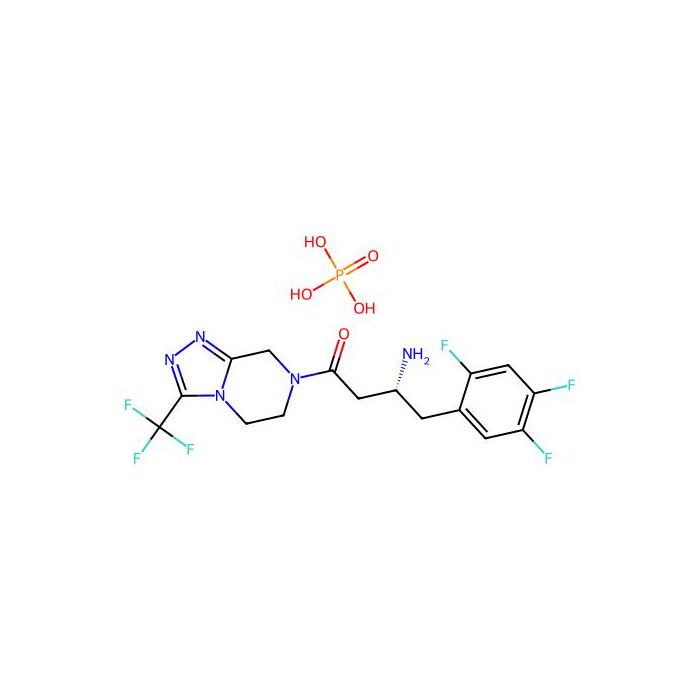
Brief overview: This product is supplied as Sitagliptin phosphate for research use as a small-molecule library member (Moligand grade).
Item-specific identifiers (from Product Data):
CAS: 654671-78-0
PubChem CID: 6451150
Grade: Moligand™
Product category: Small-molecule and compound library (screening-grade)
Not specified for this item; refer to CoA/Spec Sheet:
Structural features (general, literature-based description of sitagliptin phosphate; for reference only):
Heteroaromatic, amide-containing, basic small molecule typically formulated as a phosphate salt (literature)
Contains multiple heteroatoms (N, O; phosphate counterion) and a fluorinated aryl motif (literature)
Expected to exist as a crystalline solid as its phosphate salt (literature)
2D structure in words (literature, general):
A polyfunctional scaffold comprising an amide-linked chiral center and a bicyclic/heterocycle-rich region; protonation balanced by inorganic phosphate. Exact atom connectivity and stereochemistry should be confirmed against the CoA/SDS for this specific lot.
Notes:
When reporting structure-derived parameters (e.g., formula, mass), use the lot-specific CoA to avoid ambiguity between free base vs specific phosphate/hydrate forms.
Synthetic Utility
This SKU is a finished small-molecule library compound and is not typically employed as a building block or reagent in synthetic organic chemistry.
Not typically applicable: It is not designed for use as a coupling partner, catalyst, or protecting group reagent.
Potential niche uses (general):
Reference substrate for validating sample preparation workflows (solid handling, salting, desalting) prior to analyzing discovery samples by LC–MS.
Benchmark for chiral or salt-state analysis (e.g., confirming method selectivity for distinguishing free base vs salt forms), where appropriate reference data are available.
If your objective is to perform synthetic transformations, consider sourcing the corresponding building blocks or intermediates rather than modifying the final library compound, to avoid generating complex impurity profiles or altering the salt state unpredictably.
Target Specificity
No target/antigen specificity, clone, or isotype information is provided for this SKU.
Not specified for this item; refer to CoA/Spec Sheet.
Note: While literature sources discuss biological targets associated with sitagliptin-class molecules, Aladdin provides no item-specific target certification for SKU S1496605. Users should independently verify target engagement within their assay systems.
We use cookies to ensure the website functions properly and, where permitted, to improve your experience. You can manage your preferences at any time in Settings. Learn more in our Cookie Policy.
Shall we send you a message when we have discounts available?
Remind me later
Thank you! Please check your email inbox to confirm.
Products are supplied to verified businesses, institutions, and qualified professionals for research and development use only. Not for use in humans, animals, diagnosis, or therapy.