QUALITÀ & PUREZZAHydrogen-storage grade?Hydrogen-storage grade — purity/structure optimized for hydrogen uptake and release. Use in hydrogen-storage materials research and testing.
We are committed to bringing you Greener Alternative Products, which adhere to one or more of The 12 Principles of Greener Chemistry. This product has been enhanced for energy efficiency. Find details here .
Application
Sodium amide (NH 2 Na) can be used for a variety of applications such as: production of a hydrogen storage system adsorption of CO 2 fabrication of fuel cells
Alkali metal nitride - Inorganic sodium salt - Inorganic nitride - Inorganic salt
Descrizione
This compound belongs to the class of inorganic compounds known as alkali metal nitrides. These are inorganic compounds of nitrogen where nitrogen has a formal oxidation state of -3, and the heaviest metal atom is an alkali metal.
External Descriptors
Not available
1. Djoumbou Feunang Y, Eisner R, Knox C, Chepelev L, Hastings J, Owen G, Fahy E, Steinbeck C, Subramanian S, Bolton E, Greiner R, and Wishart DS. ClassyFire: Automated Chemical Classification With A Comprehensive, Computable Taxonomy. Journal of Cheminformatics, 2016, 8:61.
Determine the necessary mass, volume, or concentration for preparing a solution.
Dilution Calculator
Determine the dilution needed to prepare a stock solution.
Reconstitution Calculator
Recensioni
Recensioni dei clienti
Application Protocols
No standardized bioanalytical application protocols (e.g., WB, IHC, IF, FC) apply to sodium amide. Usage protocols are reaction-specific synthetic procedures under anhydrous conditions. For practical chemical protocols, refer to the Reaction Conditions, Reaction & Applications, and Synthetic Utility sections.
Biological Roles
Sodium amide is an inorganic, strongly basic salt without physiological function and is not used in biological systems. The following points are general background for context only.
No natural occurrence: NaNH2 is not a metabolite or biomolecule; it does not participate in enzymatic pathways.
Biological interactions (general)
Contact with biological tissues is destructive due to its extreme basicity and hydrolysis to NaOH and NH3; any “activity” is nonspecific caustic damage rather than targeted biochemical effect.
Laboratory interface with biology
Because it reacts violently with water and protic media, NaNH2 is not used in aqueous biochemistry, cell culture, or enzyme assays.
In synthetic chemistry supporting chemical biology (e.g., preparation of probes or scaffolds), NaNH2 may be used upstream in strictly anhydrous steps; all residues must be rigorously removed before biological testing.
No clinical or therapeutic roles are claimed or implied. For research use only (per Product Data).
Buffer Applications
Not typically applicable. Sodium amide is violently incompatible with water and protic buffers and therefore has no role in preparing or adjusting aqueous buffer systems. For pH control or buffering, use appropriate water-compatible bases (e.g., NaOH, Tris) and refer instead to sections on Reaction & Applications and Synthetic Utility for its non-aqueous uses.
Green Alternatives
Sodium amide offers unique basicity but poses significant safety and environmental burdens (water reactivity, corrosivity, ammonia handling). Depending on the transformation, greener or safer substitutes may be viable.
Potential alternatives (literature/general)
Sodium tert-butoxide (NaOtBu): Strong, non-nucleophilic base useful for many E2 eliminations and deprotonations; safer handling, compatible with common ethers/hydrocarbons. Lower basicity vs NaNH2.
Potassium tert-butoxide (KOtBu): Higher reactivity in some eliminations; similarly safer profile compared to NaNH2.
Sodium hexamethyldisilazide (NaHMDS): Strong, sterically hindered base; soluble in THF/CH2Cl2; moisture sensitive but less violently water-reactive than NaNH2.
Organic superbases (DBU, TBD): Catalytic or stoichiometric use in eliminations/condensations where nucleophilicity must be minimized.
Process intensification: Switch to 2-MeTHF or CPME as greener ether media when heterogeneous NaNH2 protocols are retained; ensure strict dryness.
Comparison (general guidance)
NaNH2: very high basicity; classic in liquid NH3; significant hazards; excellent for dihalide → alkyne conversions.
NaOtBu/KOtBu: greener handling; effective for many E2 reactions; may be insufficient for the most demanding deprotonations (e.g., terminal alkyne generation sometimes feasible but conditions differ).
NaHMDS: strong base with better solubility control; increased cost; typically used under inert in dry ethers.
Trade-offs should consider atom economy, solvent choice, waste minimization, and operator safety.
Pharmaceutical Uses
Sodium amide is not an excipient and is not used in dosage forms. Its relevance to the pharmaceutical sector is confined to non-aqueous synthetic steps under controlled conditions.
Role in pharma manufacturing (literature/general)
Strong base for formation of C–C and C–N bonds via eliminations and anionic chemistry in API intermediate synthesis.
Facilitates formation of alkynes or amide/amine functionality via ammonolysis in liquid ammonia.
Handling in GMP settings (general)
Employed in closed, inert systems with rigorous moisture control and validated quench/workup protocols.
Residual sodium/ammonium and basic impurities are removed during downstream processing; specifications are set per process validation.
No therapeutic or clinical claims are made. For research and process development use only.
Physical Properties
Note: Values below are typical literature/general data for sodium amide; they are not item-specific specifications.
Appearance: Typically white to gray crystalline solid or pellets (literature). Actual appearance: Not specified for this item; refer to CoA/Spec Sheet.
Melting point: ~210 °C (decomposes on further heating) (literature)
Boiling point: Not applicable; decomposes before boiling (literature)
Density: ~1.39 g/cm³ at 20 °C (literature)
Solubility/miscibility (literature)
Reacts violently with water; not meaningfully “soluble” in protic media.
Dissolves/reacts in liquid ammonia to give deep blue solutions with electron donors or colorless ion-paired solutions; commonly used as suspensions/solutions in liquid NH3.
Limited dispersion in some ethers (e.g., THF) and aromatic hydrocarbons (e.g., toluene) for heterogeneous use; stability depends on rigorously anhydrous conditions.
Basicity (literature)
Conjugate acid pKa (NH3) ≈ 35 (in DMSO scale; indicates extremely strong base behavior in most organic media).
Hygroscopic/reactivity (literature)
Hydrolyzes with moisture to NH3 and NaOH; can liberate heat and cause ignition of nearby combustibles.
Refractive index, UV cutoff, metal/peroxide/water ppm: Not specified for this item; refer to CoA/Spec Sheet.
Interpretation (general): “Hydrogen-storage grade” typically denotes suitability for research in hydrogen storage materials and related high-reactivity applications where trace protic/oxidic impurities can be detrimental. Such materials are often prepared, packaged, and handled to minimize water, oxygen, and carbonate contamination. Exact impurity limits for this item are Not specified for this item; refer to CoA/Spec Sheet.
What this means for practice (general)
Enhanced consistency for reactions sensitive to adventitious moisture/CO2 (e.g., hydrogen sorbent activation, metal–amide formation, base-catalyzed hydrogen uptake/release studies).
Expect packaging designed to limit atmospheric ingress; open in inert atmosphere when possible.
Stabilizers/additives
None indicated in Product Data. If any processing aids or dispersants are present, they will be listed on the CoA; otherwise assume neat solid. Not specified for this item; refer to CoA/Spec Sheet.
Analytical expectations for this grade (general guidance)
Typical QC may include Karl Fischer moisture, acid/base neutralization capacity, and assay by titration or gravimetry. Specific numeric limits: Not specified for this item; refer to CoA/Spec Sheet.
Regulatory/traceability
For research use only (from Product Data). Not intended for human or animal use or as a food/drug additive.
Reaction and Applications
Sodium amide is a cornerstone strong base for deprotonation and elimination chemistry in synthesis and materials research.
Representative applications (literature/general)
Generation of alkynes via double dehydrohalogenation of vicinal or geminal dihalides (e.g., 1,2-dihaloethanes → acetylene derivatives) in liquid NH3 or ethers.
Formation of metal acetylides and deprotonation of terminal alkynes (pKa ≈ 25) to give Na-acetylides for subsequent alkylation or coupling.
Intramolecular cyclizations via base-induced eliminations and condensations; ring closures in anionic pathways.
Ammonolysis of esters/halides to primary amides or amines when NH3 is the solvent/reactant (procedures often tempered by competing eliminations).
Base for anionic polymerizations and desulfurization steps; precursor to sodium azide under specific nitrosation/amination sequences (specialized, not general-lab practice).
Materials science: precursor/base in the synthesis of metal amides/imides and in hydrogen storage materials R&D (e.g., amide–hydride systems); selection aligns with the "Hydrogen-storage grade" offering.
Practical tips (general)
Ensure anhydrous conditions; titrate base strength if needed (e.g., acid-base back-titration) before critical runs.
For eliminations to alkynes, use excess NaNH2 (often 2–3 equiv per eliminated HX) in liquid NH3 at −33 to 0 °C, then warm as required.
Quenching: cool and add anhydrous alcohols cautiously before aqueous workup to moderate exotherm; never quench bulk solid directly with water.
Reaction Conditions
General literature guidance; adapt to your substrate and scale. Monitor exotherms carefully and consult primary references.
Typical media and temperatures
Liquid ammonia (anhydrous): −78 °C to −33 °C for initial deprotonation/elimination; can warm to 0–25 °C as needed. Concentrations commonly 0.1–1 M in substrate with 2–4 equiv NaNH2.
THF/toluene suspensions: 0–110 °C depending on substrate stability; longer reaction times due to heterogeneity.
Representative procedures
Double dehydrohalogenation to alkynes: Add 2–3 equiv NaNH2 to a stirred solution/suspension of dihalide in liquid NH3 at −33 °C; stir 1–3 h, then allow controlled warming. Quench with anhydrous alcohol (e.g., t-BuOH or i-PrOH) at low temperature before aqueous workup.
Terminal alkyne deprotonation: 1.1–1.5 equiv NaNH2 in liquid NH3 or dry THF at −78 to 0 °C; capture with electrophile (alkyl halide, carbonyl) under inert atmosphere.
Additives and phase behavior
Co-solvents (THF, toluene) can improve wetting/dispersion. Metal salts (e.g., CuI) are introduced after deprotonation when forming acetylide transfer reagents.
Expected outcomes
Eliminations often proceed in good to excellent yields when moisture is excluded; over-elimination or side reactions may occur with sensitive substrates.
Quench and workup
Cool to 0 °C or below. Slowly add anhydrous alcohol to neutralize excess base, then carefully add saturated NH4Cl or water/ice with vigorous stirring. Vent ammonia safely. Never add bulk water to unquenched solid NaNH2.
All conditions above are literature/general and not product specifications.
Safety and Handling
Always consult the SDS for authoritative safety information. The notes below summarize common hazards of sodium amide in laboratory practice.
General hazards (literature/general)
Strongly corrosive, highly basic; causes severe burns to skin, eyes, and mucosa.
Reacts violently with water, alcohols, acids, CO2, and moist air, releasing ammonia and heat; contact with moisture can lead to ignition of surrounding materials.
May form hazardous byproducts with halogenated solvents (e.g., exothermic dehydrohalogenations); avoid chlorinated hydrocarbons.
Dust may be harmful if inhaled; reaction with moisture in air can produce caustic aerosols (NH3/NaOH).
GHS classification, signal word, H-statements, pictograms: Not specified for this item; refer to SDS.
Storage incompatibilities (general)
Keep away from moisture, acids, oxidizers, CO2, and protic solvents. Do not store under nitrogen containing significant CO2; use high-purity dry inert gas (argon or CO2-free nitrogen).
Handling and PPE (general)
Use in a dry inert-atmosphere glovebox or Schlenk line. Wear chemical splash goggles/face shield, lab coat, and resistant gloves (e.g., nitrile over butyl; verify compatibility). Use local exhaust.
First-aid overview (general)
Skin/eye contact: Immediate 15+ min water rinse; remove contaminated clothing; seek medical attention.
Inhalation: Move to fresh air; medical evaluation required due to caustic nature of aerosols.
Ingestion: Rinse mouth; do not induce vomiting; seek urgent medical care.
Special risks (general)
Containers may develop pressure upon contact with moisture. Quench residues cautiously (see Reaction Conditions) and never to drain.
Solvent Selection
Sodium amide is used primarily as a solid or as solutions/suspensions in rigorously anhydrous, aprotic media.
Polarity and medium compatibility (literature/general)
Liquid ammonia: Classic solvent for NaNH2—provides excellent solvation of the amide anion and Na+, enabling high basicity and reactivity at −78 to −33 °C and up to ambient.
Ethers (THF, diethyl ether): Heterogeneous suspensions can be used; ensure absolute dryness. THF offers better dispersion than Et2O but may be deprotonated at elevated temperatures.
Aromatics (toluene, xylene): Often used as inert media for heterogeneous E2/elimination chemistry when solubility is not required.
Polar amides (DMF, DMAc): Risk of side reactions (e.g., formylation with DMF under strongly basic conditions); use with caution.
Practical selection tips (general)
Choose liquid ammonia when fast, homogeneous deprotonation or double dehydrohalogenation to alkynes is desired.
For base-induced eliminations where solubility is not essential, toluene or THF suspensions at controlled temperature are common.
Avoid chlorinated solvents; sodium amide can promote hazardous dehydrohalogenation and decomposition.
THF: convenient, anhydrous; may require longer times and careful temperature control.
Toluene/xylene: safest inert media for heterogeneous protocols; slower kinetics.
Storage and Reconstitution
Storage (from Product Data)
Storage Conditions: Room temperature.
Shipped In: Normal.
Best practices (general, aligned with item data)
Store tightly sealed under dry inert gas (argon or CO2-free nitrogen) at ambient temperature, in a desiccator or glovebox. Protect from moisture, CO2, and incompatible materials.
Use air/moisture-impermeable secondary containment. Minimize headspace exchange; consider crimp-sealed or screw-cap containers with PTFE liners.
Handling after opening (general)
Open only in a dry glovebox or on a Schlenk line. Reseal promptly. Record opening date and consider periodic assay/titration for critical work.
Reconstitution
Not applicable: supplied as a solid. If a solution/suspension is required, prepare freshly in anhydrous, compatible media (e.g., liquid NH3, dry THF/toluene) under inert atmosphere.
Stability notes (general)
Gradual degradation occurs upon exposure to moisture/CO2, forming NaOH/Na2CO3 and releasing NH3; avoid repeated exposure cycles.
Disposal
Destroy reactive residues by cautious alcohol quench at low temperature, followed by aqueous neutralization. Dispose according to institutional and local regulations.
For research use only (per Product Data).
Structure and Identity
Sodium amide (sodamide) is a salt-like, highly basic inorganic reagent composed of sodium cation and amide anion.
Item identifiers (from Product Data)
SKU: S434058
Product Name: Sodium amide
CAS: 7782-92-5
CID: 24533
InChIKey: 255436 (as provided)
Core identity (literature/general)
Preferred name: Sodium amide; Sodamide
Molecular formula: NaNH2 (literature)
Molecular weight: 39.01 g/mol (literature)
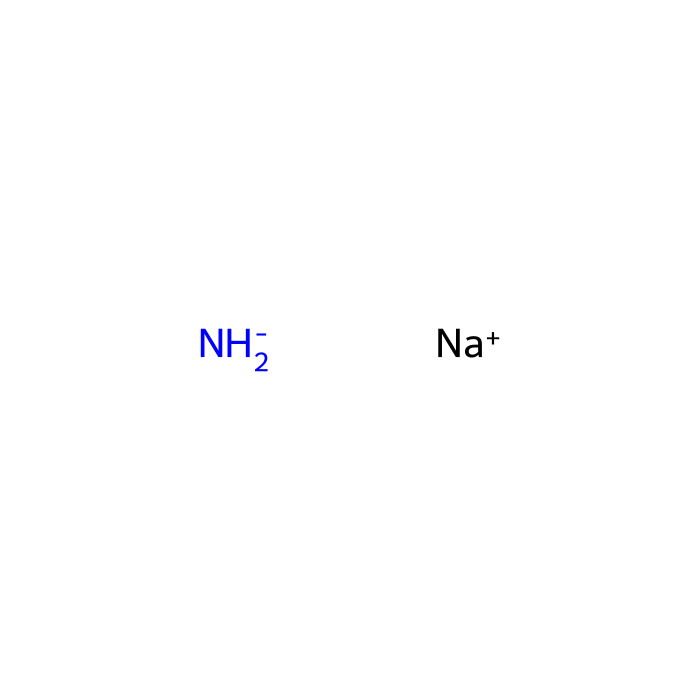
SMILES: [NH2-].[Na+] (literature)
Inorganic salt comprised of Na+ and NH2−; no stereocenters.
Structural features (general description)
Ionic compound with a sodium cation electrostatically paired to the amide anion (NH2−).
In the solid state, forms ionic lattices; in coordinating solvents (e.g., liquid NH3, ethers) exists as ion pairs/aggregates influenced by solvation and counterion coordination.
Functional group: amide anion (strong Brønsted base, weak nucleophile toward many substrates but can be reactive in certain eliminations and deprotonations).
2D structural description (general)
A sodium center (Na+) associated with a deprotonated ammonia fragment (−NH2). The nitrogen bears a lone pair and negative charge; two N–H bonds are present; the Na+ counterion balances charge without covalent N–Na bonding.
Synthetic Utility
Functional profile (literature/general)
Superb Brønsted base (conjugate acid pKa ≈ 35), enabling deprotonation of relatively weak C–H acids (terminal alkynes, activated methylenes) and driving eliminations to olefins/alkynes.
Limited nucleophilicity toward many substrates but promotes E2 eliminations effectively, especially in liquid NH3.
Named/typical transformations
Double dehydrohalogenation of dihalides to alkynes (classic texts often cite NaNH2/NH3 for vic-dihalides).
Formation of sodium acetylides from terminal alkynes, enabling subsequent alkylation, carbonyl addition (via Cu-mediated chemistry), or coupling.
Intramolecular cyclizations via anionic pathways (e.g., generation of enolates/carbanions from activated methylenes followed by SN2 or conjugate additions).
Ammonolysis: conversion of acid derivatives to amides/amines when NH3 is present as solvent/reagent.
Advantages: cost-effective, high driving force, compatibility with NH3 enabling low-temperature control.
Limitations: severe moisture sensitivity; incompatible with many solvents (chlorinated, protic); heterogeneous in common organic media; safety considerations often motivate use of NaHMDS/alkoxides as substitutes when feasible.
Target Specificity
Not applicable. This product is an inorganic base, not a biological targeting reagent (e.g., antibody, ligand, or probe). There is no antigen/epitope specificity or species reactivity associated with sodium amide.
La nostra guida alla selezione delle qualità copre purezza, stato dello stabilizzatore e idoneità all'applicazione per tutte le varianti del nostro catalogo.
Utilizziamo i cookie per garantire il corretto funzionamento del sito web e, ove consentito, per migliorare la tua esperienza. Puoi gestire le tue preferenze in qualsiasi momento nelle Impostazioni. Per saperne di più, consulta la nostra Cookie Policy.
Desidera che le inviamo un messaggio quando avremo sconti disponibili?
Ricordamelo più tardi
Grazie! Controlli la sua casella di posta per confermare.
Products are supplied to verified businesses, institutions, and qualified professionals for research and development use only. Not for use in humans, animals, diagnosis, or therapy.

 D2615087