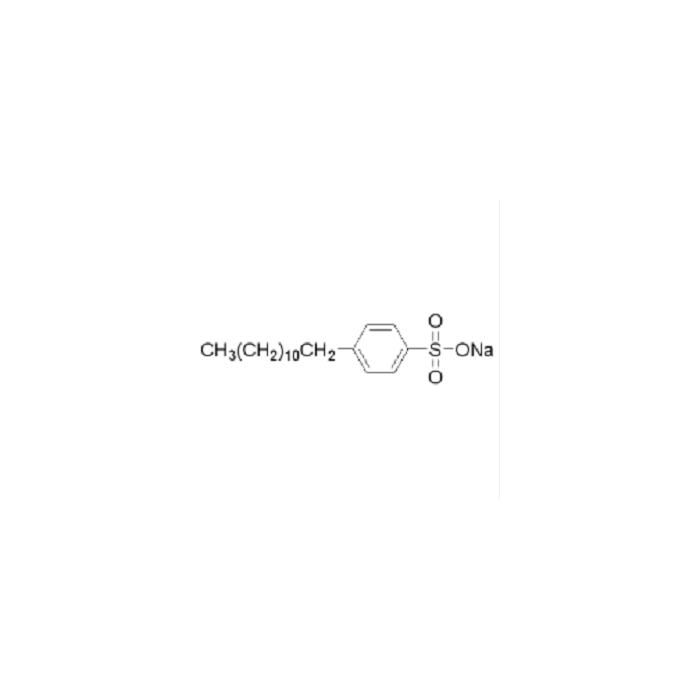
Sodium Dodecylbenzenesulfonate(mixture) solution(SDBS) - 1000mg/L , CAS No.25155-30-0

CAS: 25155-30-0 Cat. No.: S196342 Formula: C18H29NaO3S Peso molecolare: 348.48 Beilstein Registry Number: 4171051 Numero EC: 910-308-5
Disponibile su ordine
QUALITÀ & PUREZZA 1000mg/L
Synonyms
sodium;4-dodecan-3-ylbenzenesulfonate|Benzenesulfonic acid, 4-(1-ethyldecyl)-, sodium salt|Benzenesulfonic acid, 4-(1-ethyldecyl)-, sodium salt (1:1)
Storage
Store at 2-8°C,Argon charged
Shipped In
Wet ice
★
Dimensione
Germania (EU)
USA*
Prezzo
Qtà
20ml
S196342-20ml
—
1 Disponibile
40,70€
50ml
S196342-50ml
Su ordinazione · 8–12 settimane
81,48€
Enter a quantity for the sizes you want to add.

Panoramica

Sodium dodecylbenzenesulfonate is a surfactant used in proteomics research.
A surfactant used in proteomics research.

Specifiche

Sinonimi
sodium;4-dodecan-3-ylbenzenesulfonate | Benzenesulfonic acid, 4-(1-ethyldecyl)-, sodium salt | Benzenesulfonic acid, 4-(1-ethyldecyl)-, sodium salt (1:1)
Specifiche e purezza
1000mg/L
Condizioni di conservazione di stoccaggio
Store at 2-8°C,Argon charged
Spedito in
Wet ice
Questo prodotto richiede spedizione a catena fredda. I servizi di terra e altri servizi economici non sono disponibili.
Nomi e identificatori
Pubchem Sid
Isomeri SMILES
CCCCCCCCCC(CC)C1=CC=C(C=C1)S(=O)(=O)[O-].[Na+]
WGK Germania
2
RTECS
DB6825000
CAS alternativo
2211-98-5
Peso molecolare
348.48
Beilstein
4171051
Reaxys
4171051

Dati avanzati

Obiettivi associati (umani)
ESR1 Tclin Estrogen receptor alpha (17718 Activities)
Activity TypeRelationActivity valueUnitsAction TypeJournalPubMed IddoiAssay Aladdin ID
VDR Tclin Vitamin D receptor (26531 Activities)
Activity TypeRelationActivity valueUnitsAction TypeJournalPubMed IddoiAssay Aladdin ID
AHR Tclin Aryl hydrocarbon receptor (1071 Activities)
Activity TypeRelationActivity valueUnitsAction TypeJournalPubMed IddoiAssay Aladdin ID
NR1I2 Tchem Pregnane X receptor (6667 Activities)
Activity TypeRelationActivity valueUnitsAction TypeJournalPubMed IddoiAssay Aladdin ID
POLK Tbio DNA polymerase kappa (8653 Activities)
Activity TypeRelationActivity valueUnitsAction TypeJournalPubMed IddoiAssay Aladdin ID
GMNN Tbio Geminin (128009 Activities)
Activity TypeRelationActivity valueUnitsAction TypeJournalPubMed IddoiAssay Aladdin ID
Obiettivi associati (non umani)
GCN5 Histone acetyltransferase GCN5 (89 Activities)
Activity TypeRelationActivity valueUnitsAction TypeJournalPubMed IddoiAssay Aladdin ID
Nfe2l2 Nuclear factor erythroid 2-related factor 2 (214 Activities)
Activity TypeRelationActivity valueUnitsAction TypeJournalPubMed IddoiAssay Aladdin ID
Nr1i2 Nuclear receptor subfamily 1 group I member 2 (14 Activities)
Activity TypeRelationActivity valueUnitsAction TypeJournalPubMed IddoiAssay Aladdin ID
Meccanismi d'azione
Certificati (CoA, COO, BSE/TSE e tabella di analisi)
C of A & Other Certificates(BSE/TSE, COO):
Analytical Chart:

Find and download the COA for your product by matching the lot number on the packaging.

4 results found

Lot NumberCertificate TypeDataOggetto
K2513593K2513593Certificate of AnalysisNov 10, 2025 S196342
J2529756J2529756Certificate of AnalysisMay 24, 2025 S196342
F2510415F2510415Certificate of AnalysisMay 24, 2025 S196342
F2510416F2510416Certificate of AnalysisMay 24, 2025 S196342
Proprietà chimiche e fisiche
SolubilitàSoluble in 10% aqueous, and water (0.8 mg/ml at 25 °C).
SensibilitàMoisture sensitive
Punto di infiammabilità (°C)170℃
Peso molecolare348.5
XLogP3
Hydrogen Bond Donor Count0
Hydrogen Bond Acceptor Count3
Rotatable Bond Count11
Exact Mass348.174 Da
Monoisotopic Mass348.174 Da
Topological Polar Surface Area65.600 Ų
Heavy Atom Count23
Formal Charge0
Complexity370.000
Isotope Atom Count0
Defined Atom Stereocenter Count0
Undefined Atom Stereocenter Count1
Defined Bond Stereocenter Count0
Undefined Bond Stereocenter Count0
The total count of all stereochemical bonds0
Covalently-Bonded Unit Count2
Sicurezza e pericoli (GHS)
Pictogrammi
Segnale
Warning
Indicazioni di pericolo

H302:Harmful if swallowed

H315:Causes skin irritation

H318:Causes serious eye damage

H335:May cause respiratory irritation

H400:Very toxic to aquatic life

Precauzioni

P261:Avoid breathing dust/fume/gas/mist/vapors/spray.

P270:Do not eat, drink or smoke when using this product.

P273:Avoid release to the environment.

P280:Wear protective gloves/protective clothing/eye protection/face protection.

P330:Rinse mouth.

P301+P312:IF SWALLOWED: call a POISON CENTER/doctor/... IF you feel unwell.

P302+P352:IF ON SKIN: wash with plenty of water.

P305+P351+P338:IF IN EYES: Rinse cautiously with water for several minutes. Remove contact lenses if present and easy to do - continue rinsing.

P332+P313:IF SKIN irritation occurs: Get medical advice/attention.

P337+P313:IF eye irritation persists: Get medical advice/attention.

P501:Dispose of contents/container to an approved waste disposal plant.

WGK Germania
2
RTECS
DB6825000
Reaxys
4171051
Domande frequenti e articoli
A Complete Guide to Ion-Pair Reversed-Phase Chromatography (IPC / IP-RP): Mechanisms, Four Tuning Knobs, Troubleshooting, and Ion-Pair Reagent Families (Tables 1–4)
A Panoramic Guide to Surfactants: Definitions & Mechanisms, Key Metrics, Application Scenarios, and Selection Navigation (Tables 1–3)
Practical Guide to Carbon Nanotube (CNT) Dispersion: Three Key Knobs, SOP, and Selection Roadmap (Tables A–F)
Structural and Performance Design of Acrylic Resins for Coatings: Monomer Composition, Key Parameters, and Film Formation/Curing Mechanisms
Potassium Fatty Acid Soaps: Structure and Formulation Applications—Production Processes, Alkalinity, Foam Control, and Low-Foam Cleaning
Vinyl Acetate-Acrylic Emulsion (Vinyl Acrylic Emulsion): A Cost-Performance Balance Solution for Architectural Coatings
PVAc, VAE, and Vinyl Acetate-Based Emulsions: Film-Forming Logic and Performance Boundaries in Architectural Coatings
How to Select Vinyl-Related Resins: Building Formulation Judgment Based on Substrate, Performance Targets, and Failure Risks
Waterborne Resin Technology Explained: Waterborne Forms, Performance Balance, and a Technology Map
Waterborne Resin Application Guide: Formulation Synergy, Troubleshooting, and Technology Development Trends
Why LABSA (Sulfonic Acid) Is Commonly Used in Household Cleaning Formulations: Neutralization Mechanism, Detergency Action, and Formulation Application Points
Application of Fatty Acid Methyl Ester Sulfonate (MES) in Household Detergent and Cleaning Formulations: Detergency, Hard-Water Tolerance, and Selection Criteria
K12 (Sodium Lauryl Sulfate/SLS) Is More Than a Foaming Agent: Structure, Properties, and Applications in Personal Care and Household Care Formulations
Differences, Functions, and Selection Guidelines for Sodium Hydroxide Flakes, Granules, Liquid Caustic Soda, and Caustic Soda in Household and Personal Care Product Manufacturing: The Functional and Application Logic of Sodium Hydroxide
AES (Fatty Alcohol Polyoxyethylene Ether Sulfate) in Personal and Home-Care Cleansing Formulations: An Analysis of Structure, Performance, and Low-Temperature Flowability
Xiao Fang Bai, Da Fang Bai, PnB and DPnB: Mechanisms and Selection of Butyl Glycol Ethers in Hard-Surface Cleaning Formulations
Degreasing Agents from a Molecular-Structure Perspective: How AEO, APG, and Related Surfactants Can Replace Nonylphenol Ethoxylates (NPE)
Interfacial Mechanism and Formulation Applications of AEO-9 (Fatty Alcohol Polyoxyethylene Ether): An Analysis of Emulsification, Wetting, Oil Soil Removal, and Co-Formulation Compatibility
What Are the Differences Among Sodium Dodecylbenzenesulfonate/SDBS, LAS, and Sodium α-Olefin Sulfonate/AOS: A Comparative Overview of Synthesis, Structure, Mechanism of Action, and Formulation Selection
Sodium Metasilicate in Cleaning Applications: Hydration-Form Differences, Mechanisms of Action, and Selection Logic
Analysis of the Foaming Performance Differences Between K12 and AOS: Structure, Acid–Base Stability, and Formulation Selection
Understanding Anionic Surfactants in Household and Personal-Care Formulations from a Structural Perspective: Structural and Performance Differences among Representative Raw Materials such as LAS, AES, K12, AOS, MES, and FMES
Structural Characteristics, Low-Temperature Flowability, and Home-Care Cleaning Applications of Palm-Derived Isomeric Alcohol Polyoxyethylene Ether PLE-S9
Why Are Daily Chemical Products Prone to Viscosity Thinning in Summer? Core Mechanisms, Troubleshooting Methods, and Solutions
Understanding the Four Classes of Surfactants Through Molecular Charge: Application Logic of Anionic, Cationic, Amphoteric and Zwitterionic, and Nonionic Surfactants in Personal Care and Home Care
Citations of This Product
Calcolatori di soluzioni
Recensioni

Recensioni dei clienti

Desidera che le inviamo un messaggio quando avremo sconti disponibili?

Ricordamelo più tardi

Grazie! Controlli la sua casella di posta per confermare.

Ops! Le notifiche sono disabilitate.