QUALITÀ & PUREZZAMoligand™?Moligand™ — Aladdin's line of ligands and bioactive small molecules. Use for receptor, pathway, and binding studies needing defined small-molecule tools.10 mM in Water
Moligand™, 10 mM in Water Moligand™ per flussi di lavoro cromatografici e analitici sensibili che richiedono un'interferenza minima della linea di base.
🌡
Stoccaggio e spedizione
Protected from light,Store at -80°C Spedizione Dry ice packs + Cold packs. Consultare il COA specifico del lotto per le specifiche esatte.
📋
Documenti di qualità
SDS, COA, scheda tecnica e scheda delle specifiche disponibili per il download. COA specifico del lotto accessibile tramite ricerca per numero di lotto.
📚
Prova documentale
Citato in 0 pubblicazioni peer-reviewed su cromatografia, sintesi organica e reazioni di accoppiamento incrociato.
Panoramica
SPQ is being used to examine and measure membrane chloride transport mechanisms.
Specifiche
Specifiche e purezza
Moligand™, 10 mM in Water
Condizioni di conservazione di stoccaggio
Protected from light,Store at -80°C
Spedito in
Dry ice packs + Cold packs
Questo prodotto richiede spedizione a catena fredda. I servizi di terra e altri servizi economici non sono disponibili.
Grado
Moligand™
Nomi e identificatori
Isomeri SMILES
COC1=CC2=C(C=C1)[N+](=CC=C2)CCCS(=O)(=O)[O-]
PubChem CID
123936
Peso molecolare
281.33
Documentazione
📋 Scheda di dati di sicurezza (SDS)
Documento completo su pericoli, manipolazione, stoccaggio e conformità normativa.
Determine the necessary mass, volume, or concentration for preparing a solution.
Dilution Calculator
Determine the dilution needed to prepare a stock solution.
Reconstitution Calculator
Recensioni
Recensioni dei clienti
Application Protocols
General literature-style protocols are provided for guidance. Optimize for your system.
A. Vesicle or liposome chloride transport assay:
Prepare chloride-free internal solution (e.g., Na-gluconate buffer, pH 7.3). Dissolve SPQ to 1–5 mM and encapsulate during vesicle/liposome formation.
Remove external dye via gel filtration or dialysis into chloride-free buffer.
Initiate transport by switching external buffer to defined [Cl−].
Monitor fluorescence decrease over time at Ex 344–350 nm/Em 440–450 nm. Fit initial rates and/or apply Stern–Volmer calibration to convert signal to [Cl−].
B. Cell-based chloride flux (permeabilization-assisted loading):
Prepare SPQ stock in water or DMSO (10–50 mM). Dilute into HEPES-buffered saline to the desired working concentration (commonly tens to hundreds of µM; minimize DMSO ≤0.5%).
Load cells using a suitable method (e.g., brief permeabilization or hypotonic swelling) as per literature for your cell type.
Wash and equilibrate in chloride-controlled buffers. Include halide-free control.
Acquire fluorescence with minimal UV exposure. Use ionophores for in situ calibration if quantitative [Cl−] is required.
C. Cuvette-based calibration:
Prepare a fixed SPQ concentration in buffer.
Titrate NaCl (or other halide) across a suitable range.
Record I0/I and determine KSV; verify linear Stern–Volmer behavior over the intended range.
Note: These are literature-style procedures for research use only. Refer to primary publications and instrument manuals for detailed parameters.
Biological Roles
SPQ itself has no endogenous biological role; it is a synthetic reporter. The content below summarizes how it interacts with biological systems in research contexts (literature).
Reporting mechanism:
Fluorescence of SPQ is dynamically quenched by halide ions through collisional interactions from the excited state. The quenching efficiency follows I− > SCN− > Br− > Cl− > F− (typically negligible for F−), enabling selective readout of chloride changes against a halide-free baseline.
Use in cellular and membrane systems:
Measures chloride flux across membranes containing channels/transporters by tracking changes in SPQ fluorescence within the accessible compartment (e.g., vesicle lumen or cytosol if successfully loaded).
Calibration typically involves external manipulation of [Cl−] and permeabilizing ionophores to equilibrate intra/extracellular ions for accurate Stern–Volmer parameters.
Spectral considerations:
Excitation in the near-UV (≈344–350 nm) and emission in the blue (≈440–450 nm) fit common microscope/filter sets for UV/blue channels; verify optics to minimize spectral bleed-through.
Compatibility notes:
pH range: commonly used near physiological pH 7.0–7.4 where fluorescence is stable (literature).
Interferences: Thiocyanate and iodide can produce strong quenching; heavy-metal ions or strong oxidants may reduce signal by non-specific dye degradation—include appropriate controls.
Buffer Applications
SPQ is not a buffer reagent. However, its performance depends strongly on the buffer matrix used in halide-sensing assays (literature guidance).
Suitable buffers and composition:
Use Good’s buffers (e.g., 10–20 mM HEPES, pH 7.2–7.4) or phosphate-buffered saline variants modified to control [Cl−].
For halide-free controls, replace chloride salts with gluconate, methanesulfonate, or sulfate equivalents (e.g., Na-gluconate instead of NaCl; Ca-gluconate instead of CaCl2).
Maintain osmolarity (≈290–310 mOsm) using non-quenching anions to avoid confounding volume effects.
Practical recipes (example, literature):
Chloride-free buffer: 140 mM Na-gluconate, 5 mM K-gluconate, 1 mM MgSO4, 1 mM Ca-gluconate, 10 mM HEPES, pH 7.3.
High-chloride buffer: 140 mM NaCl, 5 mM KCl, 1 mM MgCl2, 1 mM CaCl2, 10 mM HEPES, pH 7.3.
Working concentrations and stocks:
Prepare SPQ stocks in water or DMSO (literature: 10–50 mM), protect from light, and dilute into the final buffer to low micromolar to low millimolar ranges depending on the assay geometry (e.g., 0.5–5 mM for vesicle loading; lower for cuvette measurements).
Notes:
Filter buffers (0.22 µm) to reduce background scatter.
Avoid buffers or additives containing iodide/thiocyanate; minimize bromide if chloride selectivity is required.
Green Alternatives
Green chemistry considerations are not central for this type of specialized fluorescent probe, which is used in very small quantities. Nonetheless, thoughtful choices can reduce environmental impact.
Solvent and process choices (general guidance):
Prefer aqueous buffers as the primary medium; limit DMSO to the minimum necessary for stock solutions.
Avoid chlorinated solvents for cleaning or stock preparation; use water/ethanol where feasible.
Probe selection trade-offs (literature):
SPQ requires near-UV excitation (≈350 nm), which can increase phototoxicity and energy use (high-intensity UV sources). Long-wavelength chloride probes (e.g., coumarin- or quinolinium-derived analogs with red-shifted spectra) may reduce phototoxicity but can be less available or have different sensitivity.
MQAE: higher sensitivity in some contexts; also UV-excited; different cellular loading profile.
Protein-based biosensors (genetically encoded): no chemical waste once expressed, but require cell engineering and may have narrower dynamic ranges.
Note: Selection should be driven by data quality and experimental need. Environmental gains are marginal relative to assay performance at the scales used.
Pharmaceutical Uses
This product is a research-use-only fluorescent probe and is not an excipient or active pharmaceutical ingredient.
Regulatory status: Not a pharmacopeial reagent per the provided data. No monograph or pharmaceutical grade is indicated.
R&D utility in pharmaceutical settings (general):
Screening tool in discovery biology: used to monitor chloride flux in cell-based or vesicle-based assays targeting ion channels/transporters (e.g., anion channels) relevant to preclinical research. This is strictly for laboratory investigations and method development.
Formulation role: None. SPQ is not used as a stabilizer, preservative, or colorant in drug products.
Compliance note: For any GLP/GMP-adjacent use, verify lot-specific identity/purity and establish method suitability. All uses remain Research Use Only as stated in the Product Data.
Physical Properties
Only limited item-specific physical data are provided for this catalog entry.
Item-specific values (from Product Data):
Appearance: Not specified for this item; refer to CoA/Spec Sheet.
Other common physicochemical/photophysical properties (literature values; for guidance only):
Form: typically supplied as a solid dye; often used as aqueous or DMSO stock solutions (literature).
Aqueous solubility: generally high due to sulfonate/zwitterionic character (literature qualitative).
Acid–base behavior: behaves as a zwitterion over physiological pH; no well-defined pKa for the sulfonate (very strong acid, deprotonated) (literature).
Typical excitation/emission maxima: Ex ~344–350 nm, Em ~440–450 nm in chloride-free aqueous buffer; emission is dynamically quenched by halides, especially Cl−, Br−, I−, and SCN− (literature).
Partitioning: expected low logP and high polarity; favors water over nonpolar solvents (literature qualitative).
Not specified for this item; refer to CoA/Spec Sheet, unless otherwise stated above:
Melting point, boiling point, density, refractive index, UV cutoff, water content, residual metals/ions.
Quality and Grades
Item-specific grade (from Product Data):
Grade/Purity: Moligand™
What Moligand™ implies (general description):
Moligand™ is Aladdin Scientific’s line focused on high-quality molecular ligands, probes, and modulators for life-science research. For fluorescent probes, this typically emphasizes chemical identity, performance consistency, and suitability for bioanalytical assays.
Practical implications for this item:
Identity and performance: Each lot is expected to meet identity confirmation (e.g., NMR/HRMS/HPLC) and functional performance for fluorescence where applicable. Exact acceptance criteria are defined in the product’s CoA/Spec Sheet (not provided here).
Low background: Dyes intended for chloride sensing are commonly evaluated for baseline fluorescence and halide-induced quenching response. Users should consult the CoA for dye purity, counterion form (if applicable), and residual salts.
Documentation: For exact purity percentage, residual solvents, inorganic content, or trace metal specifications, see the CoA/Spec Sheet. Not specified for this item; refer to CoA/Spec Sheet.
Stabilizers: None are listed in the Product Data. If stabilizers or specific counterions are employed, they will be disclosed on the CoA/Spec Sheet.
Reaction and Applications
This product is primarily used as a functional fluorescent probe rather than a synthetic reagent.
Core application family (literature):
Halide sensing via dynamic (collisional) fluorescence quenching—quantified by Stern–Volmer analysis (I0/I = 1 + KSV[Q], where Q is halide). Commonly used for chloride flux measurements in membrane vesicles, liposomes, and live cells.
Typical research uses:
Monitoring chloride channel and transporter activity (e.g., anion exchangers, CFTR research, GABA_A receptor-linked Cl− flux in model systems). No clinical/diagnostic use is implied.
Assessing anion permeability/selectivity in artificial membranes and ionophores.
Calibrating intracellular Cl− via ionophores (e.g., nigericin/tributyltin) and clamping external Cl− to generate Stern–Volmer plots.
Practical tips (literature):
Light sensitivity: Work under subdued light. Minimize exposure to UV during experiments to reduce photobleaching.
Loading into cells: SPQ is zwitterionic and relatively membrane-impermeant; loading strategies often use hypotonic shock, permeabilization, or electroporation. Alternatively, vesicular systems or liposomes are commonly employed for transport assays.
Controls: Include halide-free (gluconate-based) buffers for baseline fluorescence and known halide concentrations to establish quenching curves. Beware of iodide and thiocyanate, which quench more strongly than chloride.
pH considerations: Maintain constant pH (typically 7.0–7.4) since protonation states and background fluorescence can vary with pH.
Reaction Conditions
This section addresses assay/measurement conditions rather than chemical reaction conditions, as SPQ functions as a fluorescent reporter.
Temperature: room temperature (20–25°C) is common; maintain constant temperature when comparing quenching constants.
pH: 7.0–7.4 is typical; keep constant across calibration and experimental runs.
Ionic strength: match calibration buffers to experimental matrices; halide concentration is the controlled variable.
Stern–Volmer analysis:
Measure fluorescence intensity (or lifetime, if available) across known [Cl−] to determine KSV. Plot I0/I versus [Cl−] to verify linearity in the working range; deviations may suggest microenvironmental effects or competing quenchers.
Sample handling:
Protect from light. Minimize exposure times and illumination intensity to limit photobleaching and phototoxicity in live systems.
For DMSO stocks, ensure final DMSO content is consistent across calibration and test samples to avoid matrix effects.
Expected performance (qualitative):
Rapid, diffusion-controlled quenching with sub-second response times. Signal-to-noise depends on optical setup, dye concentration, and background scatter/absorbance.
Safety and Handling
Safety summary for laboratory research use.
Item-specific hazard data (from Product Data):
GHS Classification: Not specified for this item; refer to SDS.
Signal Word: Not specified for this item; refer to SDS.
H-Statements: Not specified for this item; refer to SDS.
Pictograms: Not specified for this item; refer to SDS.
General handling guidance (good laboratory practice):
Avoid inhalation of dust and contact with skin/eyes. Handle powders in a fume hood or ventilated enclosure.
Protect from light to prevent photobleaching and degradation of the fluorophore.
Use appropriate PPE: lab coat, safety glasses, and chemical-resistant gloves (e.g., nitrile). For weighing fine powders, consider a dust mask/respirator per institutional EHS guidance.
Incompatibilities: strong oxidizers/reductants may degrade organic dyes; avoid strong acids/bases during storage. Keep away from reactive metals and nucleophiles that could attack the quinolinium ring (general precaution).
First aid (overview; consult SDS):
Skin/eye contact: Rinse with plenty of water for at least 15 minutes. Remove contaminated clothing.
Inhalation: Move to fresh air; seek medical attention if symptoms occur.
Ingestion: Rinse mouth; seek medical attention. Do not induce vomiting unless directed by medical personnel.
Waste: Collect solutions and solids as halogen-free organic dye waste unless otherwise directed by local regulations. Defer to institutional EHS and SDS for disposal specifics.
Solvent Selection
SPQ is a zwitterionic, water-compatible fluorophore designed for halide sensing.
Polarity and miscibility (literature/general):
High polarity due to sulfonate and quaternary ammonium centers; readily soluble in water and polar aprotic solvents such as DMSO.
Limited solubility expected in nonpolar media (e.g., hexanes, toluene).
Recommended solvents and use cases:
Water or physiological buffers (e.g., HEPES, phosphate) for biological assays that monitor chloride transport or channel activity.
DMSO for preparing concentrated stock solutions (e.g., 10–50 mM), followed by dilution into aqueous buffers to final working concentrations, keeping final DMSO ≤0.5% v/v to minimize biological perturbation (literature practice).
Avoid strong acids/bases or high ionic strength during stock preparation, which can impact fluorescence baseline or solubility.
Comparison/selection notes (literature):
SPQ vs MQAE: SPQ excites in the near-UV (≈350 nm) with blue emission; MQAE often offers higher sensitivity in some cellular contexts but different spectral windows.
SPQ vs lucigenin: SPQ is less prone to redox cycling artifacts than lucigenin but requires UV excitation which may increase phototoxicity.
For imaging systems lacking UV capability, consider alternative halide probes with longer-wavelength excitation.
Storage Conditions: Protected from light, Store at -80°C.
Shipped In: Dry ice packs + Cold packs.
Research Use Note: For research use only.
Long-term stability guidance:
Keep the solid (or lyophilized) material tightly sealed, desiccated, and protected from light at −80°C as specified. Avoid repeated warming cycles.
Reconstitution (general literature guidance):
Solvents: Water or anhydrous DMSO are common. Begin with high-purity, oxygen-free water if available to minimize oxidative degradation.
Concentration: Prepare concentrated stocks (e.g., 10–50 mM) to minimize freeze–thaw. Filter (0.22 µm) if needed to remove particulates.
Aliquoting: Dispense single-use aliquots into light-protective microtubes (amber or foil-wrapped) and store at −80°C. Avoid more than 2–3 freeze–thaw cycles.
Working solutions: Prepare fresh on the day of use. Store on ice and shield from light during experiments.
Shelf life and specifications:
Exact shelf life, purity, and allowable degradation profile: Not specified for this item; refer to CoA/Spec Sheet.
Always defer to the product’s CoA and SDS for definitive storage, stability, and handling instructions.
Structure and Identity
Brief overview: SPQ is a small-molecule quinolinium-based fluorescent probe widely used for chloride/halide sensing in biological systems.
Item-specific identifiers (from Product Data):
SKU: S1499702
Product Name: SPQ
CAS: 83907-40-8
PubChem CID: 123936
Molecular Formula: Not specified for this item; refer to CoA/Spec Sheet.
Molecular Weight: Not specified for this item; refer to CoA/Spec Sheet.
SMILES: Not specified for this item; refer to CoA/Spec Sheet.
InChIKey: Not specified for this item; refer to CoA/Spec Sheet.
Structural features (general/literature description):
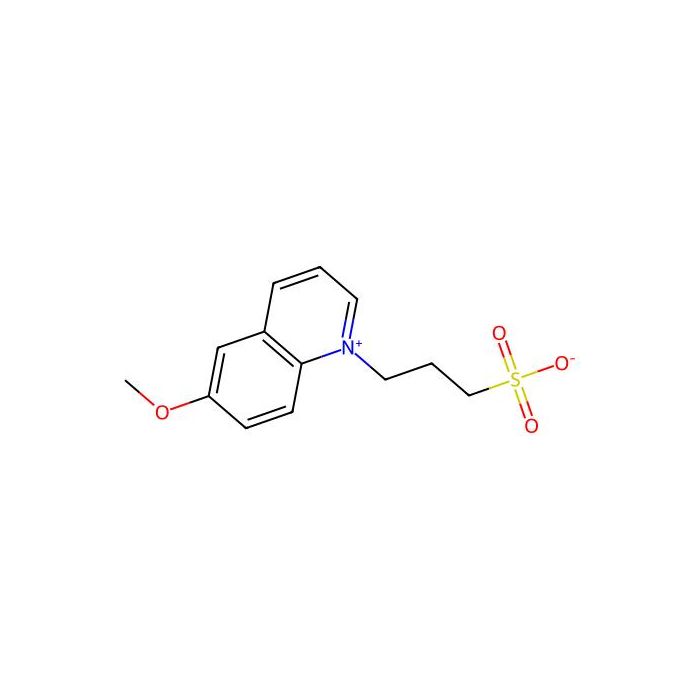
Core scaffold: quinolinium cation substituted at the 6-position with a methoxy group; N-alkylated with a 3-sulfopropyl substituent forming a zwitterionic inner salt (cationic nitrogen, anionic sulfonate).
Charge distribution: internal charge separation (zwitterion) confers good aqueous solubility with reduced membrane permeability compared to neutral fluorophores.
2D description: a fused benzene–pyridinium ring system bearing –OCH3 at C6; the ring nitrogen is quaternized with –(CH2)3–SO3− (inner salt). No stereocenters present.
Synthetic Utility
SPQ is not typically employed as a building block or reagent in synthetic organic chemistry.
Functional-group reactivity (general):
The quinolinium core and sulfonate functionality are generally inert under mild, neutral assay conditions. Strong nucleophiles/bases might attack the ring or cleave substituents, leading to dye degradation rather than productive transformation.
Contexts where chemistry may be relevant:
Conjugation/immobilization: Although SPQ lacks a dedicated reactive handle (e.g., NHS ester) in its common form, researchers sometimes entrap or co-encapsulate SPQ within polymer matrices, liposomes, or hydrogels to create chloride-responsive materials.
Analytical chemistry: Used as a reporter in stopped-flow kinetics and transport assays rather than as a stoichiometric reagent.
Bottom line: Choose SPQ for its sensing properties, not for preparative or synthetic transformations.
Target Specificity
Not an antibody or affinity reagent. No antigen/epitope specificity applies to this product.
Functional specificity (literature context):
SPQ reports the presence and concentration of halide ions via dynamic fluorescence quenching, with greatest sensitivity to I− and SCN−, followed by Br− and Cl−. It does not bind a protein target; specificity arises from collisional quenching physics.
All item-specific target-binding parameters are not applicable.
Hai bisogno di aiuto per scegliere la qualità?
La nostra guida alla selezione delle qualità copre purezza, stato dello stabilizzatore e idoneità all'applicazione per tutte le varianti del nostro catalogo.
Utilizziamo i cookie per garantire il corretto funzionamento del sito web e, ove consentito, per migliorare la tua esperienza. Puoi gestire le tue preferenze in qualsiasi momento nelle Impostazioni. Per saperne di più, consulta la nostra Cookie Policy.
Desidera che le inviamo un messaggio quando avremo sconti disponibili?
Ricordamelo più tardi
Grazie! Controlli la sua casella di posta per confermare.
Products are supplied to verified businesses, institutions, and qualified professionals for research and development use only. Not for use in humans, animals, diagnosis, or therapy.