QUALITÀ & PUREZZAMoligand™?Moligand™ — Aladdin's line of ligands and bioactive small molecules. Use for receptor, pathway, and binding studies needing defined small-molecule tools.≥98%
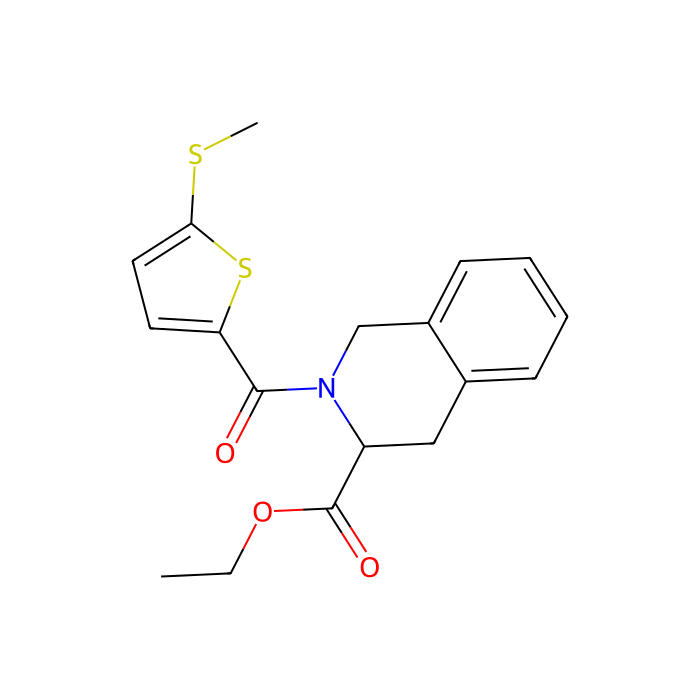
This compound belongs to the class of organic compounds known as alpha amino acid esters. These are ester derivatives of alpha amino acids.
External Descriptors
Not available
1. Djoumbou Feunang Y, Eisner R, Knox C, Chepelev L, Hastings J, Owen G, Fahy E, Steinbeck C, Subramanian S, Bolton E, Greiner R, and Wishart DS. ClassyFire: Automated Chemical Classification With A Comprehensive, Computable Taxonomy. Journal of Cheminformatics, 2016, 8:61.
Solvent:DMSO, Max Conc. mg/mL: 36.15, Max Conc. mM: 100; Solvent:ethanol, Max Conc. mg/mL: 18.07, Max Conc. mM: 50
Peso molecolare
361.5
XLogP3
4.100
Hydrogen Bond Donor Count
0
Hydrogen Bond Acceptor Count
5
Rotatable Bond Count
5
Exact Mass
361.081 Da
Monoisotopic Mass
361.081 Da
Topological Polar Surface Area
100.000 Ų
Heavy Atom Count
24
Formal Charge
0
Complexity
473.000
Isotope Atom Count
0
Defined Atom Stereocenter Count
0
Undefined Atom Stereocenter Count
1
Defined Bond Stereocenter Count
0
Undefined Bond Stereocenter Count
0
The total count of all stereochemical bonds
0
Covalently-Bonded Unit Count
1
Sicurezza e pericoli (GHS)
WGK Germania
3
Calcolatori di soluzioni
Molarity Calculator
Determine the necessary mass, volume, or concentration for preparing a solution.
Dilution Calculator
Determine the dilution needed to prepare a stock solution.
Reconstitution Calculator
Recensioni
Recensioni dei clienti
Application Protocols
No item-specific validated protocols are provided in the Product Data. The following are general, literature-style guidelines for using small-molecule ligands in cell-based and biochemical assays. Adjust to your system.
General cell-based assay protocol (literature guidance):
Prepare a 10 mM DMSO stock; filter if sterility is required.
Seed cells and allow to attach/synchronize as appropriate for circadian studies (e.g., serum shock).
Treat with a serial dilution spanning ~0.03–30 μM final concentration with constant vehicle (%DMSO) across wells.
Incubate for 4–24 h depending on readout; measure reporter activity, gene expression, or protein markers. Include vehicle and, if available, positive/negative control ligands.
Prepare assay buffer per kit recommendations; add ligand from DMSO stock to achieve desired concentrations while maintaining final DMSO ≤1% v/v.
Read TR-FRET/Alpha signals after equilibrating 30–120 min at room temperature.
Data quality tips:
Include replicates, plate controls, and a vehicle-only titration.
Confirm compound integrity by LC-MS before and after assays if stored for extended periods.
Note: For authoritative, item-specific conditions, consult the CoA/Spec Sheet or validated methods in your lab.
Biological Roles
Literature describes SR 8278 as a selective antagonist of the nuclear receptors REV-ERBα (NR1D1) and REV-ERBβ (NR1D2). These receptors are transcriptional repressors integral to the molecular circadian clock and metabolic gene regulation.
Reported roles and effects (research context only):
Antagonism of REV-ERBs relieves repression of clock-associated genes (e.g., increases in BMAL1 reporter activity observed in cell-based assays), thereby modulating circadian phase/amplitude in cellular models.
In metabolic pathways, REV-ERB signaling interfaces with lipid and glucose homeostasis; SR 8278 has been used as a tool to probe these pathways in vitro and in animal research settings (research use only).
In pharmacology studies, SR 8278 is frequently paired with REV-ERB agonists to delineate on-target effects through reciprocal modulation.
Assay modalities:
Reporter assays (luciferase under E-box/BMAL1 promoters), coactivator/corepressor recruitment assays (TR-FRET/Alpha), and gene expression profiling are common.
Important notes:
All roles described are from published research and are not product specifications. Activity can be cell-type and context dependent.
Concentration ranges often explored are in the submicromolar to low-micromolar domain in cell assays, but optimal ranges should be empirically determined for each system.
Buffer Applications
This compound is not a buffering agent and has no conventional role in establishing or maintaining pH in laboratory buffers.
Practical guidance:
When preparing assay solutions, use your standard biological buffer (e.g., PBS, HEPES, or assay-specific media) and add SR 8278 from a concentrated DMSO stock to reach the desired final concentration while keeping the DMSO fraction low (typically ≤0.1–0.5% v/v in cell-based assays, as tolerated).
If precipitation occurs, consider mild co-solvent levels or compatible surfactants. Validate that any additives do not interfere with the biological readout.
Green Alternatives
Because SR 8278 is a specific research ligand rather than a solvent or common reagent, the concept of a “green alternative” pertains mainly to its handling and formulation rather than replacing the compound itself.
Greener handling considerations (general):
Use minimal DMSO percentages in assays to reduce solvent burden; consider aqueous-compatible carriers or cyclodextrin complexes if biologically acceptable.
Employ microscale workflows (low-volume plates, acoustic dispensing) to reduce chemical use and waste.
Optimize stock stability to minimize repeated freeze–thaw and disposal of degraded material.
Comparison of formulation approaches (general):
DMSO-only stocks: Simple; highest solvency; higher environmental load when used at scale.
PEG/EtOH/saline vehicles: Enable dosing in research animals; balance between solvent toxicity and solubilization must be validated.
Note: There is no direct “green replacement” for the bioactivity of SR 8278. Greener practices should focus on dose minimization, efficient screening design, and waste reduction. If a different chemical probe could answer the same biological question, consider probes with better aqueous solubility or higher potency to reduce material usage.
Pharmaceutical Uses
SR 8278 is supplied strictly for research use only and is not an approved drug substance or excipient.
Research-formulation considerations (general; not product specifications):
For in vitro work, prepare sterile-filtered DMSO stocks when sterility is required. Avoid repeated freeze–thaw cycles that may introduce particulates or degradation.
For in vivo research (non-clinical), literature vehicles include combinations such as PEG400/EtOH/saline, corn oil, or cyclodextrin-based formulations; each requires validation for stability, tolerability, and exposure in the specific model.
Photostability and hydrolytic stability should be assessed experimentally; store under light-protective conditions if degradation is observed.
Regulatory note:
No pharmacopeial monograph is associated with this compound. Any use beyond laboratory research (e.g., clinical, diagnostic) is prohibited without appropriate regulatory authorization.
Physical Properties
Only limited item-specific physical data are provided for this catalog entry.
Item-specific (from Product Data):
Appearance: Not specified for this item; refer to CoA/Spec Sheet.
Molecular weight: Not specified for this item; refer to CoA/Spec Sheet.
Commonly referenced properties for SR 8278 (literature/general guidance; not product specifications):
State: Typically a solid organic small molecule.
Solubility: Often prepared as DMSO stock solutions for screening; aqueous solubility expected to be low without co-solvent or surfactant.
LogP/cLogP: Reported to be in a range indicative of moderate-to-high lipophilicity for nuclear receptor ligands; consult original literature for exact values.
pKa: Not broadly reported; behavior is dominated by neutral/weakly basic/acidic functional groups depending on the exact scaffold substitution; verify by experimental titration if needed.
Melting point, boiling point, density, refractive index: Not specified for this item; refer to CoA/Spec Sheet.
Practical notes (general):
For assay preparation, dissolve accurately weighed material in anhydrous DMSO to make a concentrated stock (e.g., 10–50 mM, literature practice), then dilute into assay buffer with final DMSO ≤0.1–0.5% v/v to minimize vehicle effects.
If turbidity occurs on dilution, increase aqueous buffer ionic strength, include minimal co-solvent (e.g., 0.1–1% DMSO) or use surfactant-compatible assay formats.
Quality and Grades
Grade: Moligand™
What Moligand™ implies (general description):
Moligand™ designates small-molecule ligands suitable for screening, target validation, and chemical biology. Emphasis is typically placed on identity confirmation and suitability for research assays. It is not a pharmacopeial or clinical grade.
Item-specific notes:
Purity: Not specified for this item; refer to CoA/Spec Sheet for assay and purity determination method (e.g., HPLC/LC-MS).
Stabilizers: Not specified for this item; refer to CoA/Spec Sheet.
UV cutoff, residual solvents, water/peroxides/metals: Not specified for this item; refer to CoA/Spec Sheet.
What to expect on documentation:
Certificate of Analysis (CoA) typically includes: identity confirmation (NMR/LC-MS), chromatographic purity, and lot-specific handling notes. For quantitative bioassays, verify batch-to-batch consistency and any salt form or solvate state.
Practical guidance for users:
Verify the counterion/salt form (if any) on the CoA; solubility and molecular weight for dosing calculations depend on form.
For HTS/assay use, consider secondary verification (orthogonal purity method, e.g., ^1H NMR integration) and run vehicle controls to account for residual solvent or DMSO effects.
Record lot number in data packages to ensure traceability in SAR or reproducibility studies.
Reaction and Applications
This product is primarily used as a biological probe ligand rather than a synthetic reagent. Consequently, it is not typically chosen to promote or participate in standard organic transformations.
Research applications (literature/general):
Employed as a tool compound to interrogate the REV-ERB nuclear receptors in circadian biology and metabolic regulation studies. Often used in parallel with agonists for pathway deconvolution in cell-based reporter assays.
Utilized in target validation and mechanism-of-action studies where modulation of clock-controlled gene expression is measured (e.g., BMAL1 promoter activity, PER/CRY expression profiles) via luciferase reporters, qPCR, or transcriptomics.
Assay implementation notes:
Prepare high-concentration DMSO stock (e.g., 10 mM; literature practice). Verify solubility visually and by LC before screening.
Include vehicle controls and, when applicable, an orthogonal assay (e.g., receptor coactivator recruitment TR-FRET vs. reporter gene assay) to confirm on-target effects.
Account for time-of-day/circadian variables in cell models; pre-synchronization with serum-shock or dexamethasone pulses is common in clock studies.
Synthetic chemistry usage:
Not typically used as a reagent, catalyst, or protecting group. If derivatized, it may serve as a template for SAR exploration, but this falls under medicinal chemistry rather than general synthetic methodology.
Reaction Conditions
This product is not intended for use as a reagent or catalyst in synthetic transformations, so standard “reaction conditions” are not typically applicable.
Assay preparation conditions (general research practice):
Stock solution: Dissolve in anhydrous DMSO (e.g., 10 mM); vortex and, if needed, sonicate briefly to ensure complete dissolution.
Working solutions: Dilute into assay buffer or culture media to the desired final concentration while maintaining low DMSO content (commonly ≤0.1–0.5% v/v in cell assays, as tolerated).
Temperature: Prepare and store stocks at ambient to refrigerated temperatures; warm gently to room temperature before pipetting to prevent precipitation.
Light/moisture: Protect from moisture uptake and, if the compound shows photosensitivity, from strong light during handling.
If the compound is used in chemical synthesis (atypical):
No established reaction conditions are recommended. Any usage would require de novo method development based on the verified functional groups in the actual lot.
Safety and Handling
Follow standard laboratory precautions for handling research chemicals. Always consult the product SDS for authoritative guidance.
From Product Data:
Signal word: Not specified for this item; refer to SDS.
H-statements: Not specified for this item; refer to SDS.
GHS classification: Not specified for this item; refer to SDS.
Pictograms: Not specified for this item; refer to SDS.
Storage: Store at 2–8°C. Shipped on wet ice.
General safety guidance (not product specifications):
PPE: Lab coat, safety glasses, nitrile gloves. Avoid inhalation of dust or aerosols; handle powders in a fume hood.
Incompatibilities: Avoid strong oxidizers and strong acids/bases until specific functional group compatibility is confirmed from CoA/SDS.
Hygiene: Prevent skin/eye contact; wash thoroughly after handling. Do not pipette by mouth. Keep containers tightly closed to prevent moisture uptake and contamination.
First aid (overview): If inhaled—fresh air; skin/eye contact—rinse with water for several minutes; ingestion—rinse mouth. Seek medical attention if symptoms persist. Provide SDS to responders.
Spill response: Avoid dust generation; collect with inert absorbent, dispose per institutional and local regulations.
Waste: Dispose as organic laboratory chemical waste in accordance with your facility and local regulations.
Note: Some nuclear receptor ligands can be biologically active at low concentrations; minimize exposure and use engineering controls.
Solvent Selection
SR 8278 is typically handled as a hydrophobic research ligand.
General solvent behavior (literature/experience-based; not product specifications):
Primary stock solvent: DMSO (high solubility relative to aqueous media).
Alternative organic solvents: DMF, ethanol, methanol, acetonitrile can dissolve moderate amounts; actual solubility depends on exact form.
Aqueous media: Low intrinsic solubility is expected; use co-solvent strategies or surfactants (e.g., 0.01–0.1% Tween-20) when compatible with assays.
Polarity and miscibility considerations:
Anticipated moderate-to-high lipophilicity suggests better compatibility with polar aprotic solvents (DMSO/DMF) than with purely aqueous buffers.
When to choose what:
Biochemical/cell assays: Prepare concentrated DMSO stocks and dilute into buffer or media; maintain final DMSO ≤0.1–0.5% v/v for sensitive cells.
In vivo formulation (research only): Vehicles often include PEG400/EtOH/saline or captisol-based systems; determine per IACUC and literature precedent. Validate stability and homogeneity.
Quick comparison (general):
DMSO: Highest solvating power; potential cellular effects at >0.5%.
DMF: Strong solvent but less favored in bioassays; cytotoxic at low percentages.
Ethanol: Useful but volatility and cell sensitivity limit final %.
Acetonitrile: Good solvent for analytics; limited for biology due to volatility/cell effects.
Storage and Reconstitution
From Product Data (item-specific):
Storage conditions: Store at 2–8°C.
Shipping: Shipped on wet ice.
Item-specific details not provided:
Appearance, exact solvent content, stabilizers, and reconstitution solvent: Not specified for this item; refer to CoA/Spec Sheet.
General guidance for reconstitution (literature/typical practice for small-molecule probes):
Allow container to equilibrate to room temperature before opening to avoid moisture condensation.
Reconstitute the solid (or concentrate) in anhydrous DMSO to a convenient stock (e.g., 10–50 mM). Mix thoroughly until fully dissolved.
If long-term storage is needed, aliquot DMSO stocks into inert vials, flush with inert gas if feasible, and store at −20 to −80°C. Avoid repeated freeze–thaw cycles.
Protect from light if the compound exhibits photosensitivity; use amber vials.
Stability note:
Lot-specific stability and any known degradation pathways are not provided here. For critical studies, periodically verify purity by HPLC/LC-MS and adjust handling accordingly.
Structure and Identity
SR 8278 is a research-use small molecule commonly employed as a nuclear receptor probe in chemical biology.
Product name: SR 8278 (SKU: S132222)
CAS: 1254944-66-5
Category: Small molecules and compound libraries (Moligand™)
Item-specific identifiers from Product Data:
Molecular formula: Not specified for this item; refer to CoA/Spec Sheet.
Molecular weight: Not specified for this item; refer to CoA/Spec Sheet.
SMILES: Not specified for this item; refer to CoA/Spec Sheet.
InChIKey: Not specified for this item; refer to CoA/Spec Sheet.
General structural notes (literature):
Compound type: Synthetic, aromatic small molecule reported as a ligand for nuclear receptors in the REV-ERB subfamily (antagonist activity reported in literature studies).
Typical features: Polycyclic/aromatic core with heteroatom-containing substituents enabling receptor engagement and moderate lipophilicity. Exact ring/connectivity should be confirmed against the CoA/Spec for this catalog item.
2D structure (verbal description, literature):
The scaffold is described in the literature as a multi-ring, substituted aromatic framework consistent with ligands that occupy the hydrophobic pocket of REV-ERB receptors; functional groups enable hydrogen-bonding and shape complementarity. Precise atom connectivity and stereochemistry must be verified from the certificate of analysis for this specific lot.
Synthetic Utility
SR 8278 is a finalized small-molecule probe and is not generally employed as a building block or reagent in synthetic chemistry.
Context for chemists:
Medicinal chemistry groups may use SR 8278 as a reference ligand to benchmark structure–activity relationships (SAR) during lead optimization around REV-ERB receptors.
Derivatization campaigns (literature) often explore modifications to aromatic substituents and heteroatom-bearing groups to tune potency, selectivity, solubility, and metabolic stability.
If modification is desired (general guidance):
Map potential synthetic handles (e.g., anilide/sulfonamide/aryl halide motifs—verify actual presence from CoA/structure) for cross-coupling, amide formation, or SNAr, depending on the true scaffold.
Maintain three-dimensional shape and H-bonding vectors that govern binding within the REV-ERB ligand-binding domain; in silico docking or crystallographic data (where available) can guide modifications.
Note: Because the precise substitution pattern and functional groups for the cataloged item are not specified here, any synthetic planning should begin with a verified structure (CoA/spec sheet) and appropriate analytical confirmation after modification.
Target Specificity
Only target information explicitly present in the Product Data can be listed here.
Target, epitope, species reactivity, clone/isotype: Not specified for this item; refer to CoA/Spec Sheet.
Note: While literature frequently discusses SR 8278 as a REV-ERB receptor antagonist, target specificity for this catalog entry is not provided in the Product Data and should be verified independently for your application.
Domande frequenti
What is the purity of this product?
This product is supplied at ≥98% purity (chemical assay). Lot-specific values are stated on the Certificate of Analysis.
What is Moligand??
Moligand? is one of Aladdin Scientific's premium product lines, formulated for high-purity applications across multiple workflows. Compared to standard grades in the same workflow, Moligand? products typically offer tighter specifications, more rigorous QC, and stronger lot-to-lot consistency.
How should this product be stored?
Store at 2–8 °C. Refrigerated storage is required to maintain the specified shelf life.
How is this product shipped?
This product ships chilled on wet ice. Unpack on arrival and transfer it to the storage condition stated above.
What are the CAS number, molecular formula and molecular weight?
The CAS Number is 1254944-66-5, the molecular formula is C18H19NO3S2, and the molecular weight is 361.48 g/mol. InChIKey UIEBLUZPSFAFOC-UHFFFAOYSA-N.
What documentation is provided?
Available product documentation, including Certificates of Analysis (COA), Safety Data Sheets (SDS), and specification sheets, is shown in the product document area. Document availability and access follow the current site policy.
Hai bisogno di aiuto per scegliere la qualità?
La nostra guida alla selezione delle qualità copre purezza, stato dello stabilizzatore e idoneità all'applicazione per tutte le varianti del nostro catalogo.
Utilizziamo i cookie per garantire il corretto funzionamento del sito web e, ove consentito, per migliorare la tua esperienza. Puoi gestire le tue preferenze in qualsiasi momento nelle Impostazioni. Per saperne di più, consulta la nostra Cookie Policy.
Desidera che le inviamo un messaggio quando avremo sconti disponibili?
Ricordamelo più tardi
Grazie! Controlli la sua casella di posta per confermare.
Products are supplied to verified businesses, institutions, and qualified professionals for research and development use only. Not for use in humans, animals, diagnosis, or therapy.
 G2201437
