≥98% per flussi di lavoro cromatografici e analitici sensibili che richiedono un'interferenza minima della linea di base.
🌡
Stoccaggio e spedizione
Store at -20°C Spedizione Ice chest + Ice pads. Consultare il COA specifico del lotto per le specifiche esatte.
📋
Documenti di qualità
SDS, COA, scheda tecnica e scheda delle specifiche disponibili per il download. COA specifico del lotto accessibile tramite ricerca per numero di lotto.
📚
Prova documentale
Citato in 0 pubblicazioni peer-reviewed su cromatografia, sintesi organica e reazioni di accoppiamento incrociato.
Panoramica
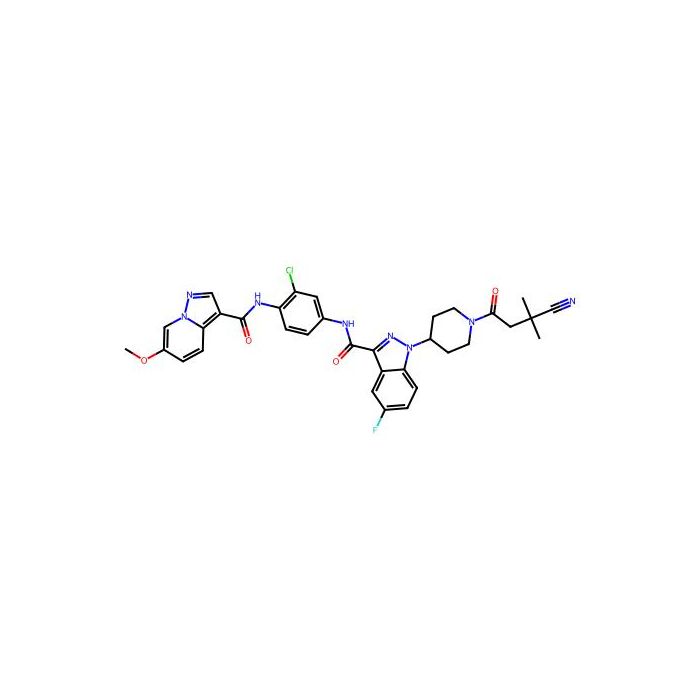
Src Inhibitor 3 is a potent, orally active c-terminal Src kinase (CSK) with IC 50 values below 3 nM and 4 nM in CSK HTRF and Caliper assay, respectively. Src Inhibitor 3 shows the ability to increase T cell proliferation induced by T cell receptor signaling
In Vivo
Src Inhibitor 3 reduces inhibitory LCK phosphorylation in vivo upon oral dosing and shows the ability to enhance T cell activation in response to antigen stimulation . MCE has not independently confirmed the accuracy of these methods. They are for reference only.
Form:Solid
IC50& Target:IC50: <3 nM (c-terminal Src kinase in CSK HTRF assay), 4 nM (c-terminal Src kinase in Caliper assay)
Specifiche
Specifiche e purezza
≥98%
Meccanismi biochimici e fisiologici
Src Inhibitor 3 is a potent, orally active c-terminal Src kinase (CSK) with IC 50 values below 3 nM and 4 nM in CSK HTRF and Caliper assay, respectively. Src Inhibitor 3 shows the ability to increase T cell proliferation induced by T cell receptor signali
Condizioni di conservazione di stoccaggio
Store at -20°C
Spedito in
Ice chest + Ice pads
Questo prodotto richiede spedizione a catena fredda. I servizi di terra e altri servizi economici non sono disponibili.
This compound belongs to the class of organic compounds known as aromatic anilides. These are aromatic compounds containing an anilide group in which the carboxamide group is substituted with an aromatic group. They have the general structure RNC(=O)R', where R= benzene, and R = aryl group.
External Descriptors
Not available
1. Djoumbou Feunang Y, Eisner R, Knox C, Chepelev L, Hastings J, Owen G, Fahy E, Steinbeck C, Subramanian S, Bolton E, Greiner R, and Wishart DS. ClassyFire: Automated Chemical Classification With A Comprehensive, Computable Taxonomy. Journal of Cheminformatics, 2016, 8:61.
Certificati (CoA, COO, BSE/TSE e tabella di analisi)
C of A & Other Certificates(BSE/TSE, COO):
Analytical Chart:
Proprietà chimiche e fisiche
Solubilità
DMSO : 100 mg/mL (149.00 mM; Need ultrasonic)
Calcolatori di soluzioni
Molarity Calculator
Determine the necessary mass, volume, or concentration for preparing a solution.
Dilution Calculator
Determine the dilution needed to prepare a stock solution.
Reconstitution Calculator
Recensioni
Recensioni dei clienti
Application Protocols
Protocols and tested applications must come from the product data. None are provided for this item.
Tested applications: Not specified for this item.
Recommended working concentrations/dilutions: Not specified for this item.
Positive controls/standards: Not specified for this item.
Guidance
Please consult the CoA/Spec Sheet for any available internal test methods. For experimental design, refer to peer-reviewed literature on Src-pathway inhibitors and validate conditions in your laboratory system.
Biological Roles
General biology of the Src pathway (class information; not specific to this item)
Src-family kinases (SFKs) are non-receptor tyrosine kinases that transduce signals from integrins, receptor tyrosine kinases, and G-protein-coupled receptors. They regulate cytoskeletal dynamics, adhesion, migration, endocytosis, and growth-factor signaling.
Canonical substrates/partners include FAK, paxillin, p130Cas, and components of the MAPK and PI3K pathways.
Modulating SFK activity with small-molecule inhibitors is a common strategy in chemical biology to dissect pathway dependencies, feedback loops, and crosstalk with Ras/ERK and AKT/mTOR.
Use of Src inhibitors as research tools (general)
In biochemical assays: Define ATP-competitive inhibition parameters (IC50, Ki, residence time) versus purified kinase domains.
In cells: Evaluate changes in phosphorylation patterns (e.g., p-FAK Y397, p-Src Y416/Y527), cell spreading, focal adhesion turnover, and migration.
Systems biology: Perturbation experiments combined with phosphoproteomics or live-cell imaging to map network responses and temporal dynamics.
Important caveats
Selectivity across the kinome varies widely among inhibitors; apparent phenotypes can reflect off-target effects. Employ genetic controls (siRNA/CRISPR) and multiple chemotypes.
Assay conditions (ATP concentration, protein partners, localization) can markedly affect apparent potency; report ATP concentrations and time-dependence alongside inhibition data.
No item-specific biological or potency data are provided for this product. Refer to the primary literature and the product CoA/SDS for further information.
Buffer Applications
This product is a bioactive small molecule, not a buffering agent. Therefore, it is not typically used to establish or maintain pH.
General practical notes for assay buffers when using small-molecule inhibitors (class guidance; not item-specific)
Enzymatic kinase assays: Common buffers include HEPES (pH 7.0–7.5) or Tris (pH 7.5–8.0) with Mg2+/Mn2+ for ATP binding, plus DTT or TCEP to maintain reduced cysteines. Include 0.01–0.05% non-ionic surfactant to minimize non-specific adsorption/aggregation when appropriate.
Cellular assays: Culture media supplemented with serum can bind hydrophobic inhibitors; consider serum-free pre-incubations or use BSA for controlled protein binding studies.
Vehicle control: Maintain constant final DMSO (or chosen co-solvent) across all wells, typically ≤0.1–0.5% v/v depending on assay tolerance.
Note: No item-specific buffer compatibility or pH stability data are provided. Validate buffer composition empirically for your system.
Green Alternatives
While bioactive small molecules are often dissolved in DMSO for assay compatibility, greener or lower-toxicity options may be considered where feasible. The following is general guidance and not item-specific.
Comparison (general)
DMSO: Benchmark solvent for inhibitor stocks; excellent solvating power, fully miscible with water. Downsides: enhances dermal absorption, high boiling point complicates removal, potential biological effects at higher percentages.
Ethanol/Water cosolvent: Greener, lower toxicity; may be suitable for moderately soluble compounds. Risk: precipitation upon dilution and potential assay interference.
PEG 300/400: Low volatility, reduced exposure risk; can solubilize lipophilic agents for certain in vivo formulation research (not a use claim). Often viscous; limited compatibility with some assays.
Captisol (sulfobutyl ether-β-cyclodextrin) or HP-β-CD: Can improve aqueous solubility via inclusion complexes; cost and assay background can be limiting.
Strategies to reduce solvent burden
Use the lowest effective final solvent concentration; verify vehicle controls.
Pre-dilute DMSO stocks stepwise into buffer with gentle mixing to avoid local over-concentration and precipitation.
Evaluate buffer additives (low % surfactant, BSA) to maintain solubility during dilutions.
Trade-offs
Greener systems may reduce operator exposure and environmental impact but can change compound availability at the target and assay performance. Validate rigorously for your specific readout.
Pharmaceutical Uses
No pharmaceutical or clinical use is claimed or supported for this product. It is supplied strictly for research use only.
General information (context; not item-specific)
In the pharmaceutical R&D workflow, Src kinase inhibitors may be investigated as chemical probes in target validation, ADME profiling, and preformulation studies. Such activities are research-stage and do not imply suitability for human or veterinary use.
Excipients/formulation roles: Not applicable to this product; it is not an excipient. For in vitro work, vehicles like DMSO or ethanol are commonly used; any in vivo formulation research must follow institutional and regulatory guidelines, recognizing this product is for research use only.
Documentation reminder
For any regulated application (e.g., GLP toxicology studies), suppliers typically provide extended documentation (CoA, stability data, impurity profiles). For this item, such details are not listed and must be requested if required.
Physical Properties
Item-specific
Appearance: Not specified for this item; refer to CoA/Spec Sheet.
Melting point (MP): Not specified for this item; refer to CoA/Spec Sheet.
Boiling point (BP): Not applicable/Not specified for this item (typical solids decompose before boiling); refer to CoA/Spec Sheet.
Density: Not specified for this item; refer to CoA/Spec Sheet.
Refractive index: Not applicable for solids; not specified for this item.
Solubility: Not specified for this item; refer to CoA/Spec Sheet.
logP/logD: Not specified for this item; refer to CoA/Spec Sheet.
General/literature context for Src inhibitor class (not specific to this item)
Physical form: Frequently isolated as crystalline solids or amorphous powders.
Solubility tendencies: Many ATP-competitive kinase inhibitors show low aqueous solubility and are commonly dissolved in anhydrous DMSO to prepare concentrated stocks (e.g., 10–50 mM), then diluted into assay buffers containing modest amounts of co-solvent. Specific values vary by compound.
pKa patterns: Heteroaromatic hinge binders may contain weakly basic nitrogens (typical pKa of conjugate acids ~1–6) or anilide/urea motifs with weakly acidic protons; exact pKa(s) depend on the scaffold.
Stability: Inhibitors with multiple heteroatoms may be light- and moisture-sensitive to varying degrees. Protecting from light and air is good practice; always consult the CoA/SDS for item-specific stability.
Note: No numeric physico-chemical values are specified for this item. For lot-specific, authoritative specifications, consult the CoA/Spec Sheet.
Quality and Grades
Item-specific
Grade/Purity: Not specified for this item; refer to CoA/Spec Sheet.
Guidance on grades for small-molecule research reagents (general)
Screening/Library grade: Suitable for discovery screening; typically provided with identity confirmation (NMR/HRMS/LC–MS) and purity specification, often ≥95% by HPLC/LC–MS. Exact thresholds vary by supplier.
Analytical/Reagent grades: Emphasize impurity control relevant to synthetic use; may not ensure bioassay-suitable solvent residues.
Bioassay-ready materials: Low residual solvents/metals/halides and well-characterized polymorph/solvate forms can improve reproducibility in cellular and enzymatic assays.
Identity and documentation
For this item, specific acceptance criteria (purity assay, residual solvent limits, water content, metal content, isomer ratio) are not listed. Obtain the lot-specific CoA/Spec Sheet for:
Purity method and value (e.g., HPLC area% conditions)
Structural confirmation (1H/13C NMR, HRMS/ESI-MS)
Water content (Karl Fischer), residual solvents, and if applicable, salt/form (free base vs. salt)
Stabilizers and form
Stabilizer/additive use: Not specified for this item. If present, stabilizers can influence UV absorbance and biological assay background; confirm on CoA.
Recommendation
For quantitative biology or medicinal chemistry, request full analytical data and verify salt state/polymorph when relevant. Align the grade with your experimental needs.
Reaction and Applications
Item-specific manufacturer applications: Not specified for this item.
Research applications (general class guidance; not specific to this item)
Chemical biology tool: Src-family kinase pathway modulation in biochemical kinase assays (ATP-competitive binding), cellular signaling studies, and phenotypic experiments that interrogate adhesion, migration, and cytoskeletal dynamics.
Selectivity profiling: Employed in kinase panels to benchmark Src versus related SFKs (Fyn, Yes, Lck, Hck, Lyn, Fgr, Blk) and off-target kinases. Use orthogonal assays (biochemical and cellular) to validate findings.
Mechanistic studies: Time-course inhibition to assess phosphorylation events (e.g., changes in phospho-FAK, paxillin) and downstream pathways (MAPK/ERK, PI3K/AKT), with appropriate antibodies and phospho-readouts.
Practical notes
Dosing: Prepare concentrated DMSO stocks; titrate across logarithmic ranges to generate IC50/EC50 curves. Keep final solvent percentage constant across wells.
Controls: Include ATP Km controls in enzymatic assays, inactive analogs where available, and probe-reversal or washout experiments to evaluate reversibility.
Artifacts: Watch for aggregation-based inhibition (test with detergent), fluorescence interference in readouts, and redox cycling in the presence of reducing agents.
Disclaimer: The above describes typical use cases for Src-pathway inhibitors broadly. No compound-specific activities or potencies are claimed for this item.
Reaction Conditions
Conventional chemical reaction conditions are not typically applicable because this item is a finished bioactive small molecule rather than a reagent. The following notes pertain to preparing solutions for biological assays and are general, not item-specific.
General solution preparation for assays (class guidance)
Stock solutions: Commonly prepared in anhydrous DMSO at 10–50 mM. Confirm maximum solubility experimentally and avoid precipitation upon storage/dilution.
Dilution: Add DMSO stock slowly into vigorously mixing buffer/media to reach the desired final concentration while keeping DMSO constant across controls (often ≤0.1–0.5% v/v in biochemical/cellular assays, respectively, depending on tolerance).
Temperature: Prepare and handle at ambient temperature unless stability dictates otherwise; minimize prolonged heating. Protect from light if the chemotype is photosensitive.
Containers: Use low-bind polypropylene or glass vials; pre-rinse with solvent to reduce adsorption for sticky compounds.
Assay timing (general)
Biochemical inhibition: Equilibration times from minutes to tens of minutes are common; determine time to steady-state and consider residence time effects.
Cellular assays: Pre-incubation periods vary (e.g., 0.5–2 h) depending on uptake and target turnover. Validate empirically.
Note: No item-specific conditions, solubility limits, or stability data are provided for this product. Consult CoA/SDS and perform small-scale pilots to define suitable conditions.
Safety and Handling
GHS/Regulatory (item-specific)
Signal Word: Not specified for this item; refer to SDS.
Hazard Statements (H-Statements): Not specified for this item; refer to SDS.
GHS Classification and Pictograms: Not specified for this item; refer to SDS.
General laboratory safety guidance (not item-specific; defer to SDS)
Handle in a chemical fume hood. Avoid inhalation of dust or aerosols and contact with skin/eyes.
Personal protective equipment: lab coat, safety glasses, and appropriate chemically resistant gloves (e.g., nitrile). Consider double-gloving when handling DMSO solutions due to enhanced dermal transport potential of DMSO.
Incompatibilities: Avoid strong oxidizers and strong acids/bases until compatibility is known. Store away from moisture and light unless the CoA/SDS indicates otherwise.
First-aid overview: In case of skin/eye contact, rinse immediately with plenty of water for at least 15 minutes; remove contaminated clothing. If inhaled, move to fresh air. If ingested or in any exposure with symptoms, seek medical attention. Consult the SDS for detailed instructions.
Spills: Avoid dust generation. Absorb small spills with inert material; collect in appropriate waste container. Decontaminate area and ventilate.
Waste: Dispose of in accordance with institutional and local regulations for organic laboratory chemicals.
Special notes
Bioactive small molecules may have unknown toxicological profiles. Treat as potentially harmful. Always consult and follow the product SDS for authoritative safety information.
Solvent Selection
Item-specific solubility data are not provided for this product; consult the CoA/Spec Sheet. The following guidance reflects typical practice for small-molecule kinase inhibitors in research workflows and is not specific to this item.
General solvent considerations (class guidance)
Primary stock solvent: DMSO is commonly used owing to high solvating power for heteroaromatic inhibitors and miscibility with aqueous buffers at low percentages.
Alternative organic solvents: DMF or NMP can dissolve highly lipophilic scaffolds; ethanol or methanol may be suitable for less lipophilic compounds. Verify compatibility with your assay and materials.
Aqueous systems: Direct water/PBS solubility is often limited; gradual dilution from a DMSO stock into buffer containing carrier protein (e.g., 0.1% BSA) or surfactant (e.g., 0.01–0.05% Tween-20) can help maintain solubilization. Validate for your system.
Polarity/miscibility profile (class)
DMSO: Polar aprotic, highly miscible with water; widely used to prepare 10–50 mM frozen stocks.
Ethanol/MeOH: Protic, water-miscible; may affect enzyme and cell viability at higher percentages—keep final concentration low (often ≤0.1–0.5% v/v in biological assays).
Practical tips
Warm gently and vortex/sonicate to aid dissolution; avoid prolonged heating. Filter 0.2 μm if particulate persists.
Control vehicle: Include matched solvent controls at the highest final solvent percentage used in the test conditions.
Light and air: Protect from light and minimize air exposure during dissolution if the scaffold is oxidation/light sensitive (confirm on CoA/SDS).
Storage and Reconstitution
Item-specific (from Product Data)
Storage Conditions: Store at -20°C.
Shipped In: Ice chest + Ice pads.
Additional notes
Container: Keep tightly closed in the original container to minimize moisture and air exposure. If subdividing, use dry, inert vials and label aliquots clearly with date and concentration.
Freeze–thaw: For solution stocks, minimize freeze–thaw cycles by aliquoting. Allow vials to reach room temperature before opening to reduce condensation ingress.
Light: If the compound is light sensitive (not specified), store protected from light (e.g., amber vials, foil wrap).
Reconstitution
Reconstitution solvent, concentration, and stability after reconstitution: Not specified for this item; refer to CoA/Spec Sheet.
Research Use Note
For research use only. Not for human or veterinary use.
Always defer to the lot-specific CoA and SDS for authoritative instructions on storage stability, handling limits, and reconstitution specifics.
Structure and Identity
Brief description: Src Inhibitor 3 is a small‑molecule research tool listed for modulation of Src-family tyrosine kinase activity in laboratory studies.
Item-specific (from Product Data)
SKU: S648046
Product Name: Src Inhibitor 3
CAS: 2380027-49-4
PubChem CID: 139600340
InChIKey: 206634 (as provided; truncated/non-standard format in listing)
SMILES: Not specified for this item; refer to CoA/Spec Sheet.
Molecular Formula: Not specified for this item; refer to CoA/Spec Sheet.
Molecular Weight: Not specified for this item; refer to CoA/Spec Sheet.
Structural features
Item-specific structural motifs and stereochemistry: Not specified for this item; refer to CoA/Spec Sheet.
General chemistry context (literature)
Many Src kinase inhibitors are heteroaromatic scaffolds (e.g., quinazolines, pyrimidines, pyridines) bearing donor–acceptor motifs capable of ATP-site engagement (hinge-binding) and substituents addressing the hydrophobic pocket. This is general information about the class and not specific to this item’s exact structure.
2D structure description
Not available for this item. In absence of a provided SMILES or structural diagram, the precise ring systems and functional groups cannot be described here.
Synthetic Utility
This product is a finished small-molecule Src-pathway inhibitor intended as a biological research tool rather than a general synthetic reagent or building block.
Relevance to synthesis
As supplied, it is not typically used as a coupling partner, catalyst, or protecting-group reagent.
If a medicinal chemist seeks to modify the scaffold, de novo synthesis or late-stage diversification of a structurally related intermediate would generally be preferred over derivatization of the final inhibitor.
General medicinal chemistry considerations (not item-specific)
Many Src inhibitors possess heteroaromatic cores amenable to cross-coupling (e.g., Suzuki–Miyaura, Buchwald–Hartwig) during their synthesis, along with nucleophilic aromatic substitution (SNAr) and urea/amide formations. These notes describe typical routes to such chemotypes and are not instructions for modifying this item.
Bottom line
Treat this item as a tool compound for biological assays, not as a synthetic feedstock. For synthetic applications, obtain the appropriate intermediates or building blocks.
Target Specificity
Only information from product data may be presented here.
Declared target(s): Not specified for this item.
Selectivity profile: Not specified for this item.
Species reactivity: Not specified for this item.
Assay validation: Not specified for this item.
Comment: Although the name suggests activity toward Src-family kinases, no item-specific specificity or selectivity data are provided in the listing. Refer to the CoA/Spec Sheet and primary literature for validated target information.
Domande frequenti
What is the purity of this product?
This product is supplied at ≥98% purity (chemical assay). Lot-specific values are stated on the Certificate of Analysis.
How should this product be stored?
Store at ?20 °C. Freezer storage is required to maintain the specified shelf life.
How is this product shipped?
This product ships in an insulated container with ice pads. Unpack on arrival and transfer it to the storage condition stated above.
What are the CAS number, molecular formula and molecular weight?
The CAS Number is 2380027-49-4, the molecular formula is C34H32ClFN8O4, and the molecular weight is 671.12 g/mol. InChIKey LQQYARMJQBHKQQ-UHFFFAOYSA-N.
What documentation is provided?
Available product documentation, including Certificates of Analysis (COA), Safety Data Sheets (SDS), and specification sheets, is shown in the product document area. Document availability and access follow the current site policy.
Utilizziamo i cookie per garantire il corretto funzionamento del sito web e, ove consentito, per migliorare la tua esperienza. Puoi gestire le tue preferenze in qualsiasi momento nelle Impostazioni. Per saperne di più, consulta la nostra Cookie Policy.
Desidera che le inviamo un messaggio quando avremo sconti disponibili?
Ricordamelo più tardi
Grazie! Controlli la sua casella di posta per confermare.
Products are supplied to verified businesses, institutions, and qualified professionals for research and development use only. Not for use in humans, animals, diagnosis, or therapy.