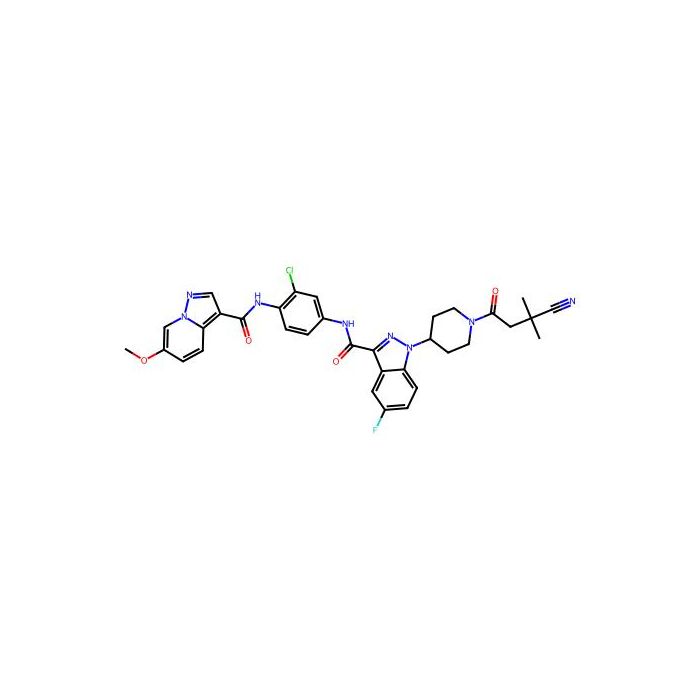
Src Inhibitor 3 - 10mM in DMSO , CAS No.2380027-49-4

CAS: 2380027-49-4 Cat. No.: S655271 Formula: C34H32ClFN8O4 Peso molecolare: 671.12 PubChem CID: 139600340
Disponibile su ordine
QUALITÀ & PUREZZA 10mM in DMSO
Storage
Store at -80°C
Shipped In
Dry ice packs + Cold packs
★
Dimensione
Germania (EU)
USA*
Prezzo
Qtà
1ml
S655271-1ml
Su ordinazione · 8–12 settimane
1.025,58€
Enter a quantity for the sizes you want to add.
🧪
Perché questa qualità

10mM in DMSO per flussi di lavoro cromatografici e analitici sensibili che richiedono un'interferenza minima della linea di base.

🌡

Stoccaggio e spedizione

Store at -80°C Spedizione Dry ice packs + Cold packs. Consultare il COA specifico del lotto per le specifiche esatte.

📋

Documenti di qualità

SDS, COA, scheda tecnica e scheda delle specifiche disponibili per il download. COA specifico del lotto accessibile tramite ricerca per numero di lotto.

📚

Prova documentale

Citato in 0 pubblicazioni peer-reviewed su cromatografia, sintesi organica e reazioni di accoppiamento incrociato.

Panoramica

Src Inhibitor 3 is a potent, orally active c-terminal Src kinase (CSK) with IC 50 values below 3 nM and 4 nM in CSK HTRF and Caliper assay, respectively. Src Inhibitor 3 shows the ability to increase T cell proliferation induced by T cell receptor signaling

In Vivo

Src Inhibitor 3 reduces inhibitory LCK phosphorylation in vivo upon oral dosing and shows the ability to enhance T cell activation in response to antigen stimulation . MCE has not independently confirmed the accuracy of these methods. They are for reference only.

IC50& Target:IC50: <3 nM (c-terminal Src kinase in CSK HTRF assay), 4 nM (c-terminal Src kinase in Caliper assay)

Specifiche

Specifiche e purezza
10mM in DMSO
Meccanismi biochimici e fisiologici
Src Inhibitor 3 is a potent, orally active c-terminal Src kinase (CSK) with IC 50 values below 3 nM and 4 nM in CSK HTRF and Caliper assay, respectively. Src Inhibitor 3 shows the ability to increase T cell proliferation induced by T cell receptor signali
Condizioni di conservazione di stoccaggio
Store at -80°C
Spedito in
Dry ice packs + Cold packs
Questo prodotto richiede spedizione a catena fredda. I servizi di terra e altri servizi economici non sono disponibili.
Nomi e identificatori
Isomeri SMILES
CC(C)(CC(=O)N1CCC(CC1)N2C3=C(C=C(C=C3)F)C(=N2)C(=O)NC4=CC(=C(C=C4)NC(=O)C5=C6C=CC(=CN6N=C5)OC)Cl)C#N
PubChem CID
139600340
Peso molecolare
671.12

Documentazione

📋 Scheda di dati di sicurezza (SDS)

Documento completo su pericoli, manipolazione, stoccaggio e conformità normativa.

<<<<<<< HEAD Scarica SDS → ======= Scarica SDS → >>>>>>> release248-p3

✅ Certificato di analisi (COA)

Dati di qualità specifici del lotto. Inserisci il numero di lotto per recuperare il COA esatto.

Cerca COA →

📊 Scheda tecnica

Riepilogo di riferimento rapido delle specifiche e applicazioni del prodotto.

Visualizza scheda tecnica →

🔬 Scheda delle specifiche

Attributi di qualità completi e criteri di accettazione per questa qualità.

Visualizza scheda delle specifiche →

Dati avanzati

Obiettivi associati (umani)
CSK Tchem Tyrosine-protein kinase CSK (1 Activities)
Activity TypeActivity Value -log(M)Mechanism of ActionActivity ReferencePublications (PubMed IDs)
Certificati (CoA, COO, BSE/TSE e tabella di analisi)
C of A & Other Certificates(BSE/TSE, COO):
Analytical Chart:
Calcolatori di soluzioni
Recensioni

Recensioni dei clienti

Application Protocols

Item-specific validated application protocols are Not specified for this item. The following are general guidelines for small-molecule Src-family kinase inhibitors in research use (not item-specific; optimize per assay):

  • Stock preparation: Dissolve in anhydrous DMSO to a convenient concentration (e.g., 10–50 mM), vortex and sonicate briefly if needed. Filter through 0.22 µm PTFE if particulate persists.
  • Aliquoting: Dispense small, single-use aliquots to minimize freeze–thaw. Store as directed (see Storage & Reconstitution).
  • Biochemical kinase assays: Prepare serial dilutions in assay buffer with final DMSO ≤0.1–1% v/v. Include vehicle controls and a reference inhibitor if available. Monitor phosphorylation endpoints or enzyme activity over time.
  • Cellular assays: Titrate across a broad concentration range (e.g., 0.01–30 µM) to establish potency and window; confirm target engagement with phospho-biomarkers. Validate cell health to exclude nonspecific cytotoxicity from solvent or compound.
  • Data integrity: Track batch/lot numbers and exact stock concentrations; verify solution stability over the experimental timeframe.

Please consult the CoA/Spec Sheet and SDS for any item-specific directions or cautions.

Biological Roles

Context (general, not item-specific): Src Inhibitor 3 is annotated as a small-molecule inhibitor of Src-family kinases (SFKs). SFKs (e.g., SRC, FYN, YES, LYN, HCK, LCK) are non-receptor tyrosine kinases that integrate signals from growth factor receptors, integrins, and immune receptors to regulate phosphorylation cascades controlling proliferation, adhesion, cytoskeletal dynamics, and survival.

How Src inhibitors are used in research:

  • Pathway interrogation: Acute chemical inhibition allows temporal control in cell systems to dissect SFK contributions to downstream nodes such as FAK, PI3K/AKT, MAPK/ERK, and STAT pathways.
  • Phenotypic modulation: In adherent cells, inhibition often impacts focal adhesion turnover and actin remodeling; in immune cells, it can modulate receptor-proximal phosphorylation events.
  • Target validation: Parallel comparison with orthogonal inhibitors and genetic perturbations (siRNA/CRISPR) helps assess on-target versus off-target effects.

Biochemical considerations:

  • ATP-competitive SFK inhibitors typically bind the hinge region of the kinase domain. Potency and selectivity vary across the family due to subtle differences in the active site and gatekeeper residues.
  • Off-targets: Many SFK inhibitors display polypharmacology across kinomes; comprehensive profiling (e.g., KiNativ, KINOMEscan) is recommended when interpreting phenotypes.

Assay deployment tips (general):

  • Use titration series across multiple time points; include DMSO vehicle controls and orthogonal inhibitors.
  • Confirm pathway modulation using phospho-specific readouts (e.g., p-Src Y416/Y527 balance, p-FAK Y397), while recognizing that exact targets for this item are Not specified in the Product Data.
Buffer Applications

This item is a small-molecule inhibitor rather than a buffering agent. Consequently, classical buffer system design (pKa-based buffering capacity, electrophoresis running buffers, etc.) is not applicable.

Practical notes for assay buffers (general, not item-specific):

  • Prepare working solutions by diluting DMSO stocks into biologically compatible buffers (e.g., HEPES or PBS) to a final DMSO fraction typically ≤0.1–1% v/v.
  • Maintain pH stability relevant to the biological system under study (commonly pH 7.2–7.5). Include BSA or mild surfactant only if validated to avoid nonspecific binding and assay interference.

Item-specific buffer recommendations are Not specified for this item; refer to assay SOPs and confirm compatibility experimentally.

Green Alternatives

As a bioactive screening compound, “green alternatives” typically relate to solvent systems and handling practices rather than replacement of the active itself. Item-specific green metrics are Not specified.

Greener handling considerations (general, not item-specific):

  • Prefer aqueous assay buffers with minimal DMSO content consistent with solubility and activity requirements.
  • Use ethanol or 2-propanol as secondary cosolvents where feasible instead of higher-toxicity polar aprotics (e.g., DMF, NMP).
  • Minimize waste by preparing small aliquots at the concentration actually required for screening; avoid repeated thaw/refreeze.
  • Employ closed, small-volume plates or tubes to reduce evaporative losses and VOC emissions.

General solvent comparison (literature-based; not item-specific):

  • DMSO: Broad solubilizer; relatively low volatility; widely accepted in bioassays.
  • Ethanol/2-propanol: Greener, but may have limited solubilizing power for highly lipophilic scaffolds.
  • PEG-400 or aqueous cyclodextrins: Can enhance apparent solubility, though they may interact with targets/assays; validate carefully.

Trade-offs:

  • Reducing DMSO may improve “greenness” but can risk precipitation and variable dosing. Always verify homogeneity (visual inspection or nephelometry) and assay tolerance to the chosen excipients.
Pharmaceutical Uses

This product is supplied strictly for research use only and is not intended for human or veterinary use, diagnostics, or as an API.

  • Formulation/excipient status: Not specified for this item; there is no pharmacopeial monograph indicated.
  • Typical research formulation context (general, not item-specific): Compound library members and kinase tool molecules are commonly formulated as DMSO stocks for screening and mechanism studies. For in vivo research (if performed under appropriate approvals), investigators typically develop bespoke vehicles (e.g., DMSO/PEG-400/saline) after establishing solubility, stability, and exposure; however, such uses fall outside the scope of this listing and require rigorous safety review.
  • Manufacturing/CMC relevance: Without defined structure and specifications for this item, no process-development or GMP considerations can be stated. Any future translational work would require comprehensive impurity profiling, solid-form selection, and stability programs.

Item-specific pharmaceutical-use details are Not specified; consult the CoA/Spec Sheet for available characterization and limit use to laboratory research.

Physical Properties

Item-specific physical data:

  • Appearance: Not specified for this item; refer to CoA/Spec Sheet.
  • Molecular weight: Not specified for this item; refer to CoA/Spec Sheet.
  • Melting point (MP): Not specified for this item; refer to CoA/Spec Sheet.
  • Boiling point (BP): Not specified for this item; refer to CoA/Spec Sheet.
  • Density: Not specified for this item; refer to CoA/Spec Sheet.
  • Refractive index: Not applicable/unknown for a solid; Not specified for this item; refer to CoA/Spec Sheet.
  • Aqueous solubility, logP/logD, pKa: Not specified for this item; refer to CoA/Spec Sheet.

Literature/general expectations for kinase-tool small molecules (not item-specific):

  • Many ATP-competitive kinase inhibitors are moderately lipophilic and are typically formulated for screening as DMSO stock solutions (e.g., 10–50 mM) due to limited aqueous solubility.
  • Stock solutions are commonly diluted into assay buffers with final DMSO ≤0.1–1% v/v to maintain enzyme activity and cell viability in biochemical/cellular assays.
  • Solubility and ionization behavior (pKa) depend strongly on scaffold; confirm using batch-specific data or independent measurement (shake-flask, potentiometric pKa, or kinetic solubility).

Practical notes:

  • If physical constants are required for method development (e.g., LC method, mass balance studies), obtain the structure and CoA/Spec Sheet and/or run rapid screens (DSC for MP, nephelometry for solubility, and pH-dependent solubility profiling). Avoid inferring properties without validated data.
Quality and Grades

Item-specific grade/purity information:

  • Grade/Purity: Not specified for this item; refer to CoA/Spec Sheet.

How to interpret common grades for small-molecule research compounds (general guidance, not item-specific):

  • Screening/Library grade: Typically supplied at high purity suitable for biochemical and cell-based assays. Vendors often target ≥95% by HPLC/LC-MS, but confirm on the CoA.
  • Analytical (AR) or Reagent grade: Indicates suitability for general lab use; may not guarantee low-level impurity profiles demanded by screening.
  • HPLC/LC-MS characterization: Expect a stated purity method (UV/ELSD/MS), retention time, and solvent system; mass spectrum consistent with expected [M+H]+. Verify water/solvent content and counterion where applicable.
  • Stabilizers/salt forms: Some bioactives are provided as salts (HCl, TFA) or with trace stabilizers; these influence solubility and handling. For this item, stabilizer/salt form is not specified; consult the CoA/Spec Sheet.

Best practices:

  • For screening campaigns, request batch-specific CoA including purity method, residual solvents, and identity confirmation (NMR or HRMS). If LC-UV purity is reported, consider orthogonal purity checks (qNMR, CAD/ELSD) when UV chromophores are weak.
  • Record the exact batch number used in experiments to ensure reproducibility across campaigns.
Reaction and Applications

This product is supplied as a bioactive small-molecule annotated as a Src-family kinase inhibitor for research use. It is not typically employed as a reagent or catalyst in preparative synthetic chemistry.

  • Synthetic reaction use: Not commonly applicable. No named-reaction roles or catalyst functions are indicated for this item.
  • Practical deployment: Most users will employ this compound in biochemical kinase assays, target validation studies, or phenotypic screens rather than chemical transformations.
  • If chemical derivatization is planned (e.g., probe development, conjugation), obtain the full structure and functional group map from the CoA/Spec Sheet before attempting protective-group strategies or coupling chemistry.

For actionable guidance, please refer to:

  • Solvent Selection for stock preparation and assay compatibility.
  • Biological Roles for considerations in pathway interrogation.

Any reaction conditions or synthetic roles for this specific item are Not specified; consult primary literature for the exact scaffold once structural information is available.

Reaction Conditions

Not typically applicable. This product is a bioactive small molecule for use as a research tool in biochemical/cellular assays rather than as a reagent in chemical synthesis.

If derivatization is contemplated (general, not item-specific):

  • Solvents: Anhydrous polar aprotic solvents (e.g., DMF, DCM, THF, MeCN) are common, but compatibility depends on the actual scaffold.
  • Temperatures: Many heteroaryl inhibitors tolerate ambient to moderate temperatures; elevated temperatures may induce decomposition or isomerization—validate by LC-MS.
  • Catalysts/bases: Palladium catalysts for cross-coupling (if aryl halides present), or carbodiimide/amide-coupling reagents for linkage to probes. Sensitivity to strong base/acid should be evaluated on small scale.
  • Workup/purification: Reverse-phase preparative HPLC is frequently used for final purification of polar, heteroatom-rich scaffolds.

For this specific item, no reaction conditions are specified. Users should acquire the structure and run limited-scope scouting experiments if chemical modification is required.

Safety and Handling

Item-specific safety data from Product Data:

  • GHS Classification: Not specified for this item; refer to SDS.
  • Signal Word: Not specified for this item; refer to SDS.
  • H-Statements: Not specified for this item; refer to SDS.
  • Pictograms: Not specified for this item; refer to SDS.

General laboratory safety guidance for small-molecule kinase inhibitors (not item-specific; always defer to the SDS):

  • PPE: Use safety glasses, lab coat, and appropriate chemical-resistant gloves (e.g., nitrile). Handle powders/solids in a fume hood to minimize inhalation exposure and prevent dust generation.
  • Avoid ingestion, inhalation, and skin/eye contact. Wash thoroughly after handling. Use local exhaust ventilation during weighing, dissolution in solvents (e.g., DMSO), and aliquoting.
  • Storage incompatibilities: Segregate from strong oxidizers and strong acids/bases unless compatibility is confirmed. Keep tightly closed, moisture-protected, and protected from light as appropriate for the compound.
  • First aid (general): If on skin, wash with soap/water; if in eyes, rinse cautiously with water for several minutes; if inhaled, move to fresh air; if ingested, rinse mouth and seek medical attention. Provide the SDS to medical personnel.
  • Environmental precautions: Avoid release to the environment. Collect spills with inert absorbent; dispose via approved chemical waste streams.

Special notes:

  • This item ships on dry ice/cold packs and is stored at −80°C (see Storage tab). Warm only enough to aliquot, then promptly return to long-term storage to limit degradation and moisture uptake.
Solvent Selection

Item-specific solvent data are not provided. The following guidance reflects common practice for small-molecule kinase inhibitors (not item-specific):

  • Primary stock solvent: DMSO is typically preferred due to its broad solubilizing power and compatibility with biochemical and cellular assays. Prepare concentrated stocks (e.g., 10–50 mM) if solubility permits.
  • Cosolvent systems: For aqueous assays, dilute DMSO stocks into buffer to a final DMSO fraction typically ≤0.1–1% v/v. If precipitation occurs, consider adding a small proportion of ethanol or PEG-400, or warming gently and sonicating during preparation.
  • Aqueous buffers: Maintain physiological pH for enzyme/cell studies (e.g., pH 7.2–7.5) and include surfactants (0.01–0.05% Tween-20) only if validated to not perturb activity.
  • Avoid adsorptive losses: Use low-bind plastics or silanized glass for low-concentration solutions; pre-rinse tips/vials with dilute compound solution to minimize surface adsorption.
  • Light/moisture sensitivity: In absence of item-specific data, protect solutions from light and moisture; prepare fresh working dilutions daily.

Comparison (general):

  • DMSO: Highest success rate for dissolving lipophilic inhibitors; fully miscible with water.
  • DMF/NMP: Strong solvents but less favored in bioassays due to cytotoxicity and regulatory constraints.
  • Ethanol: Useful secondary solvent; lower solvating power for highly lipophilic scaffolds.

For this specific item, solvent recommendations and solubility limits are Not specified; confirm with the CoA/Spec Sheet or perform a kinetic solubility screen.

Storage and Reconstitution

Item-specific storage and shipping (from Product Data):

  • Storage Conditions: Store at −80°C.
  • Shipped In: Dry ice packs + Cold packs.

General reconstitution guidance for small-molecule kinase inhibitors (not item-specific):

  • Recommended solvent: Anhydrous DMSO is typically used to prepare concentrated stock solutions. Exact solubility for this item is Not specified; determine empirically or consult the CoA/Spec Sheet.
  • Aliquoting: Upon first receipt, allow the container to equilibrate briefly at low temperature to avoid condensation ingress, then open in a dry environment. Prepare single-use aliquots to avoid repeated freeze–thaw cycles.
  • Light/moisture protection: Store in amber vials or wrap with foil if the compound is light-sensitive; include desiccant as appropriate. Specific light sensitivity for this item is Not specified.
  • Working solutions: Prepare fresh dilutions in assay buffer on the day of use. Keep on ice during setup if stability is uncertain and discard unused diluted solutions after the experiment.

Stability notes:

  • Long-term stability at −80°C is generally favorable for many small molecules; however, stability of this specific compound is Not specified. Monitor by LC-MS or HPLC before critical studies.

Research Use Note: For research use only.

Structure and Identity

Brief overview: Src Inhibitor 3 is a small-molecule tool compound categorized for small-molecule/compound library use and nominally annotated as an inhibitor of Src-family kinases (research use only).

Item-specific facts (from Product Data):

  • CAS: 2380027-49-4
  • PubChem CID: 139600340
  • SKU: S655271
  • Product Name: Src Inhibitor 3
  • SMILES: Not specified for this item; refer to CoA/Spec Sheet.
  • InChIKey: Not specified for this item; refer to CoA/Spec Sheet.
  • Molecular formula: Not specified for this item; refer to CoA/Spec Sheet.
  • Molecular weight: Not specified for this item; refer to CoA/Spec Sheet.

Structural features (general note):

  • This listing is a designated “Src inhibitor” small molecule; specific scaffold, ring systems, and stereochemistry are not provided in the current Product Data. Many Src inhibitors feature heteroaromatic cores and hinge-binding motifs; however, the exact functional groups for this item are not specified here and should be confirmed from the Certificate of Analysis (CoA) or structure file supplied with the batch.

2D structure description (general guidance):

  • Without the SMILES/InChI, a textual 2D description cannot be given for this item. Please consult the CoA/Spec Sheet for the definitive chemical structure and any stereochemical annotations.
Synthetic Utility

This item is sold as a finished small-molecule Src-family kinase inhibitor for biological research. It is not typically used as a synthetic building block or reagent.

  • Building-block value: Not applicable without the disclosed structure. If derivatization or probe development is desired, obtain the exact scaffold and functional group map from the CoA/Spec Sheet to assess synthetic handles (e.g., anilines, heteroaryl halides, nitriles, amides) and compatibility with common coupling methods.
  • Stability under reaction conditions: Unknown for this item. Many kinase inhibitors contain heteroaryl motifs that can be sensitive to strong acids/bases, high temperatures, or metal-catalyzed conditions.

Recommendation:

  • If synthetic modification is intended, first confirm structure and perform small-scale compatibility screens (acid/base, redox, metal-catalysis) and analytical tracking (LC-MS, 1H NMR) to ensure scaffold integrity.

Given the lack of item-specific structural data, no named-reaction applications or retrosynthetic insights can be responsibly provided for this compound.

Target Specificity

Target specificity data (antigen/epitope/clone/isotype) are applicable to biologicals (antibodies, proteins), not small molecules. For this product (a small-molecule Src inhibitor), antibody-style specificity parameters do not apply.

Item-specific target panel, selectivity, and potency metrics (e.g., IC50, KD, kinome profiling) are Not specified for this item; refer to the CoA/Spec Sheet or primary literature associated with CAS 2380027-49-4 if available. Users are encouraged to verify on-target activity in their system using orthogonal controls.

Domande frequenti

How should this product be stored?
Store at ?80 °C. Ultra-low temperature storage is required to maintain the specified shelf life.
How is this product shipped?
This product ships frozen with dry ice and cold packs. Unpack on arrival and transfer it to the storage condition stated above; handle dry ice with insulated gloves in a ventilated area.
What are the CAS number, molecular formula and molecular weight?
The CAS Number is 2380027-49-4, the molecular formula is C34H32ClFN8O4, and the molecular weight is 671.12 g/mol.
What documentation is provided?
Available product documentation, including Certificates of Analysis (COA), Safety Data Sheets (SDS), and specification sheets, is shown in the product document area. Document availability and access follow the current site policy.

Desidera che le inviamo un messaggio quando avremo sconti disponibili?

Ricordamelo più tardi

Grazie! Controlli la sua casella di posta per confermare.

Ops! Le notifiche sono disabilitate.