QUALITÀ & PUREZZAPrimorTrace™?PrimorTrace™ — Aladdin's trace-metal-analysis line with ultra-low metal background. Use for ICP/AAS trace-metal work where contamination must be minimal.≥99.99% metals basis
PrimorTrace™, ≥99.99% metals basis PrimorTrace™ per flussi di lavoro cromatografici e analitici sensibili che richiedono un'interferenza minima della linea di base.
🌡
Stoccaggio e spedizione
Spedizione Normal. Consultare il COA specifico del lotto per le specifiche esatte.
📋
Documenti di qualità
SDS, COA, scheda tecnica e scheda delle specifiche disponibili per il download. COA specifico del lotto accessibile tramite ricerca per numero di lotto.
📚
Prova documentale
Citato in 17 pubblicazioni peer-reviewed su cromatografia, sintesi organica e reazioni di accoppiamento incrociato.
Alkaline earth metal oxide - Inorganic oxide - Inorganic salt
Descrizione
This compound belongs to the class of inorganic compounds known as alkaline earth metal oxides. These are inorganic compounds containing an oxygen atom of an oxidation state of -2, in which the heaviest atom bonded to the oxygen is an alkaline earth metal.
External Descriptors
Not available
1. Djoumbou Feunang Y, Eisner R, Knox C, Chepelev L, Hastings J, Owen G, Fahy E, Steinbeck C, Subramanian S, Bolton E, Greiner R, and Wishart DS. ClassyFire: Automated Chemical Classification With A Comprehensive, Computable Taxonomy. Journal of Cheminformatics, 2016, 8:61.
Determine the necessary mass, volume, or concentration for preparing a solution.
Dilution Calculator
Determine the dilution needed to prepare a stock solution.
Reconstitution Calculator
Recensioni
Recensioni dei clienti
Application Protocols
No antibody or biochemical assay protocols are applicable to this inorganic ceramic. For materials applications, representative workflow outlines (literature/general) include:
Powder processing (dielectric ceramics)
Weigh SrTiO3 powder; disperse in water/alcohol with dispersant; ball‑mill; cast green bodies (tape‑casting or uniaxial pressing); binder burn‑out (300–600 °C); sinter 1200–1450 °C; polish/electrode as needed.
Substrate preparation (epitaxy)
Solvent clean (acetone/IPA), rinse DI water; optional buffered etch to produce TiO2 termination; anneal in O2 at 900–1100 °C to create atomically flat terraces; verify by AFM before film growth.
Photocatalysis screening
Disperse SrTiO3 powder in aqueous reactant; purge with inert gas; irradiate with UV source; analyze products (GC/IC). Add cocatalyst (e.g., Rh/Cr2O3) if evaluating H2 evolution. Optimize pH and sacrificial agents per literature.
These are general examples; tailor conditions to your equipment and safety protocols. Item‑specific processing parameters are not provided; refer to CoA/Spec Sheet.
Biological Roles
Not a biomolecule; strontium titanate is an inorganic solid with no direct biological role. The following points are general background (literature):
Elemental context: Strontium and titanium are not essential elements for human biochemistry; titanium compounds are generally inert/insoluble, and strontium can substitute partially for calcium in some mineral lattices, but SrTiO3 is highly insoluble and not bioavailable under physiological conditions.
Biointeractions: As a ceramic, SrTiO3 shows minimal solubility in aqueous media; interactions are primarily surface‑based (e.g., potential adsorption of proteins or ions), relevant only for materials science studies rather than biology.
Use context: Employed in materials and physical chemistry research; not intended for in vivo, diagnostic, or therapeutic use.
Item‑specific biological data (binding targets, metabolic pathways, toxicity benchmarks): Not specified for this item; refer to CoA/Spec Sheet and SDS. For research use only.
Buffer Applications
Not typically applicable. Strontium titanate is an insoluble inorganic oxide/ceramic and is not used to prepare aqueous buffer systems. For laboratory use, focus instead on its roles as a dielectric ceramic, photocatalyst, or epitaxial substrate as outlined in the Applications and Synthetic Utility sections.
Green Alternatives
Perspective (literature/general): Strontium titanate contains no lead, making it a useful alternative to lead‑based perovskites (e.g., PbTiO3, PZT) in certain dielectric and piezoelectric contexts. Green considerations focus on lifecycle impacts, processing temperatures, and solvent usage.
Comparison (materials choice)
Lead‑free vs leaded ceramics
SrTiO3: Lead‑free; high dielectric constant; requires high sintering temperatures; properties often need doping for piezoelectric performance.
Pb‑based (PZT/PbTiO3): Excellent piezoelectric response but contains toxic lead; waste handling and end‑of‑life disposal are challenging.
Processing routes
Aqueous sol–gel or hydrothermal syntheses can reduce organic solvent load compared to nonaqueous routes.
Low‑temperature synthesis via molten salts or combustion methods can lower energy use versus classic solid‑state reactions, though trade‑offs include salt recovery and potential ion contamination.
Deposition choices
Physical vapor deposition (PLD/MBE) avoids solvent waste; chemical routes (spin‑on precursors) may use greener solvents like water/alcohols when compatible.
Trade‑offs
High firing temperatures increase energy consumption; densification aids (liquid‑phase sintering, spark plasma sintering) can reduce time/temperature but add equipment complexity.
Strontium sourcing and titanium mining have environmental impacts; select suppliers with documented ESG and waste management practices.
Pharmaceutical Uses
Not typically applicable. Strontium titanate is not used as a pharmaceutical active ingredient or common excipient. It is a ceramic/materials research compound intended for laboratory use only. Any formulation or pharmacopeial status is not relevant.
Regulatory/compendial status: None (literature/general). Not described in pharmacopeial monographs as an excipient.
Research‑only note: For research use only; not for human or veterinary use.
Physical Properties
Note: Values below are literature/general for SrTiO3 and are not item‑specific specifications.
Appearance: Typically white to off‑white crystalline powder or single crystal (literature).
Density: ~5.11 g/cm³ at 25 °C (literature).
Melting point: Reported ~2080–2100 °C (literature; ceramic/perovskite data).
Solubility: Practically insoluble in water and common organic solvents; resistant to most acids and bases; can be etched/dissolved by concentrated HF and hot mixtures that generate fluoro‑titanates (literature).
Dielectric constant (εr): High; ~300 at 25 °C (strong temperature and frequency dependence; literature). Incipient/quantum paraelectric behavior.
Band gap: Indirect ~3.2 eV (direct ~3.7 eV) at room temperature (literature).
Refractive index (n): ~2.36–2.42 in visible range for single crystals (literature).
Crystal structure: Cubic perovskite (Pm3̄m) at room temperature; octahedral tilts/soft modes emerge on cooling (literature).
Item‑specific property values (this lot)
Any numerical specifications (e.g., density, particle size, defect levels, dopant content, UV cutoff): Not specified for this item; refer to CoA/Spec Sheet.
Quality and Grades
Item‑specific grade
Grade/Purity: PrimorTrace™ (as provided). No specific impurity limits or assay values are listed for this item; refer to CoA/Spec Sheet.
Interpreting the grade (general guidance)
PrimorTrace™ denotes a product line oriented toward trace‑level control for research/analytical or high‑purity applications. Exact metal impurity limits, particle size, crystalline phase purity, oxygen vacancy content, or dopant levels—if controlled—must be verified on the item’s CoA.
For oxide ceramics like SrTiO3, quality can be expressed by: phase purity (XRD), trace metal profile (ICP‑MS), oxygen nonstoichiometry/defect density, particle size distribution (if powder), and dislocation density/surface polish (if single crystals or wafers).
What to check on receipt (best practices)
Confirm phase purity and absence of secondary phases (e.g., SrCO3, TiO2) by XRD.
Verify trace impurity profile aligns with your application (dielectrics, photocatalysis, epitaxy) via ICP‑MS/Glow Discharge MS as needed.
If used as a substrate, confirm orientation, miscut, and surface finish (AFM/optical) per your process needs.
UV cutoff, metals, peroxides, water: Not specified for this item; refer to CoA/Spec Sheet.
Substrate for epitaxial growth: Widely used single‑crystal substrate for perovskite oxides (YBCO superconductors, LSMO, ferroelectrics) due to lattice parameter ~3.905 Å.
Dielectric ceramics: High‑κ dielectric and incipient ferroelectric; suitable for microwave devices, tunable components (when doped), and capacitors.
Photocatalysis: UV‑excited photocatalyst for water splitting and redox transformations; activity enhanced by cocatalysts (e.g., Rh/Cr2O3) and anion/cation doping.
Catalysis/support: Oxygen‑vacancy‑rich SrTiO3 (reduced or doped) used as a support for noble metals and as a redox‑active mixed conductor.
Solid‑state reaction: SrCO3 + TiO2 → SrTiO3 + CO2. Typical calcination 900–1100 °C; sintering 1200–1450 °C with intermediate grindings to complete reaction and densify. Use slight Sr excess to offset volatilization at high T.
Wet‑chemical: Sol–gel/pechini/hydrothermal methods yield finer powders with lower calcination temperatures; control pH and chelators (citric/ethylene glycol) for homogeneity.
Single‑crystal growth: Verneuil, Czochralski, or flux methods; post‑growth oxygen anneal to tune stoichiometry and reduce color centers.
Practical considerations
Avoid contamination from milling media (ZrO2, Al2O3); track trace levels for electronic applications.
Oxygen partial pressure strongly affects defect chemistry (color, conductivity). Anneal in O2 to re‑oxidize reduced material; reduce in H2/vacuum to introduce n‑type carriers.
Reaction Conditions
General processing/formation conditions for SrTiO3 (literature; non‑spec guidance):
Mixing: Ball‑mill with isopropanol/water, dry, and pre‑calcine.
Calcination: 900–1100 °C for 4–12 h in air or oxygen; repeat grindings to drive phase completion (monitored by XRD).
Sintering: 1200–1450 °C for 2–10 h (air/O2) depending on powder fineness and desired density; slow cool to minimize thermal stresses.
Wet‑chemical routes
Pechini/sol–gel: Metal citrate/polymerizable complexes; gelation at ~150–200 °C, calcine ≥700–900 °C to crystallize perovskite.
Hydrothermal: 150–250 °C (autogenous pressure) using alkaline media; post‑anneal improves crystallinity.
Reduction/oxidation (defect tuning)
Reduction: 600–1000 °C under H2/Ar or high vacuum to create oxygen vacancies and n‑type conductivity (color darkens).
Re‑oxidation: 400–1000 °C in flowing O2/air to restore stoichiometry/optical transparency.
Thin‑film deposition (substrate use)
PLD/MBE growth of perovskites commonly uses 600–800 °C substrate temperature and 10⁻⁶–10⁻¹ Torr O2 (system dependent). Surface termination via buffered etch + high‑T O2 anneal yields TiO2‑terminated terraces (Atomic Force Microscopy to verify).
These are representative literature conditions; optimize based on equipment, powder characteristics, and targeted microstructure.
Safety and Handling
Safety summary (general guidance; defer to SDS for authoritative information)
GHS classification, signal word, H‑statements, pictograms: Not specified for this item; refer to CoA/Spec Sheet and the SDS.
Likely hazards (literature/analogous ceramics): Nuisance dust; may cause mechanical irritation to eyes, skin, and respiratory tract. Not known to be acutely toxic. Avoid generating dust and inhalation of fine particulates.
Handling and PPE
Use in a well‑ventilated area or fume hood when weighing powders.
Recommended PPE: Safety glasses, lab coat, and appropriate gloves. Use a NIOSH‑approved particulate respirator if dust is generated.
Incompatibilities and reactivity (literature)
Chemically robust; insoluble in most media. Avoid contact with concentrated hydrofluoric acid (HF) and fluoride‑rich etchants that can dissolve titanates by forming fluoro‑titanate complexes.
Stable under ambient conditions; nonflammable, noncombustible.
First‑aid overview (general)
Inhalation: Move to fresh air; seek medical attention if symptoms persist.
Eye contact: Rinse cautiously with water for several minutes; remove contact lenses if present and easy to do; seek medical advice if irritation persists.
Skin contact: Wash with soap and water.
Ingestion: Rinse mouth; seek medical attention if unwell.
Additional notes
Avoid contamination of powders and cross‑contamination of trace‑level analytes if using for electronic/analytical purposes.
For research use only.
Solvent Selection
This product is a refractory inorganic solid; traditional “solvent selection” is generally not applicable. Practical media considerations for processing are given below (literature/general guidance):
Dispersions and slurries
Aqueous media with dispersants (e.g., polyacrylates) or alcohol/water blends are often used for tape casting and ink formulation. Sonication aids deagglomeration.
Nonpolar organic solvents are generally ineffective at stabilizing oxide nanoparticles without surface modification.
Chemical resistance and etching
Resistant to most acids and bases, and to water; does not dissolve in common organic solvents.
Readily etched by HF and fluoride‑containing solutions; buffered oxide etch and fluorinated plasmas can attack titanates.
Thin‑film deposition compatibility
Suitable for MBE/PLD/ALD environments in high vacuum or oxygen partial pressures without solvent usage. Surface preparation may involve solvent cleaning steps (IPA, acetone) for substrates, followed by annealing in oxygen.
When to choose SrTiO3 versus alternatives (materials perspective)
Choose SrTiO3 substrates for epitaxy of perovskite oxides (e.g., LaAlO3, LSMO, BaTiO3) where lattice matching (~3.905 Å pseudocubic, literature) is beneficial.
Consider alternatives (e.g., LaAlO3, NdGaO3, MgO, sapphire) when different lattice parameters, thermal expansion, or dielectric behavior are required.
Storage and Reconstitution
Storage conditions (item‑specific): Not specified for this item; refer to CoA/Spec Sheet.
Shipped in: Normal (per Product Data).
General guidance (literature/practice for oxide ceramics)
Store at ambient temperature in a tightly closed container. Keep dry to maintain free‑flowing powder and to prevent adventitious surface carbonation/adsorption that could affect high‑temperature processing.
Avoid cross‑contamination: If using for trace‑level electronic/analytical applications, dedicate tools/containers and minimize metal particle shedding.
No reconstitution is required; insoluble solid. For slurries, disperse in appropriate medium (water/alcohol) with sonication and dispersants as needed.
Shelf life: Inorganic oxides are generally stable for years under proper storage. Verify phase purity by XRD/FTIR if long‑term stored before critical use.
Note: For research use only.
Structure and Identity
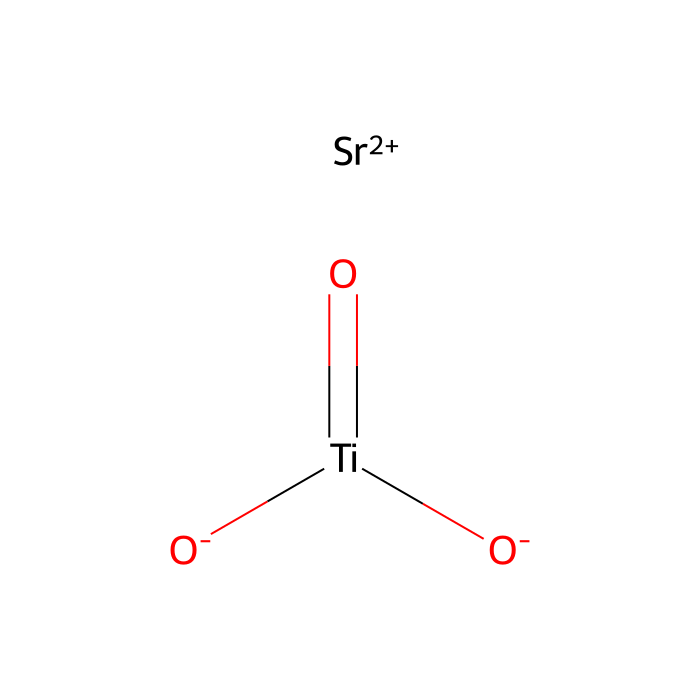
Brief description: Strontium titanate is an inorganic perovskite oxide (ABO3 type) composed of strontium(II), titanium(IV), and oxide, widely used as a dielectric ceramic and single‑crystal substrate.
Item-specific identifiers (from Product Data)
SKU: S106129
Product Name: (停产)Strontium titanate
CAS: 12060-59-2
CID (PubChem): 82899
InChIKey: 376620 (as provided)
SMILES: Not specified for this item; refer to CoA/Spec Sheet.
Molecular weight: ~183.49 g/mol (computed from Sr 87.62, Ti 47.87, O3 48.00; literature)
Structural features (descriptive, literature)
Framework: Cubic perovskite (space group Pm3̄m) at room temperature; corner‑sharing TiO6 octahedra with Sr2+ in 12‑coordination.
Oxidation states: Sr2+, Ti4+, O2−.
2D depiction (verbal): A 3D array where each Ti is octahedrally coordinated by 6 O; Sr occupies the cuboctahedral A‑site voids formed by 12 O from neighboring octahedra.
Not molecular; extended ionic/covalent solid with no discrete molecules or stereocenters.
Synthetic Utility
While not a reagent in organic synthesis, SrTiO3 has notable utility in materials synthesis and catalysis (literature/general):
Solid‑state chemistry node: Functions as a phase‑pure perovskite end‑member; participates in solid solutions (e.g., (Sr,Ba)TiO3) enabling property tuning (dielectric, ferroelectric). Useful in retrosynthetic planning of ceramic compositions via A‑ or B‑site substitutions.
Support/catalyst: Acts as a robust, high‑surface‑area (when nano‑structured) oxide support for noble metals (Pt, Au, Rh), leveraging oxygen vacancies and strong metal–support interactions.
Photocatalytic platform: The Ti 3d–O 2p electronic structure forms a conduction/valence band arrangement suitable for UV‑driven redox; doping (Nb, La, N) tailors band positions and conductivity.
Substrate utility: Single‑crystal SrTiO3 provides a lattice‑matched, atomically flat platform for epitaxial growth; essential for fabricating oxide heterostructures (e.g., LaAlO3/SrTiO3 2DEG).
Practical tips
Control oxygen stoichiometry (anneal in O2 vs vacuum/H2) to modulate conductivity and color (transparent → blue/black when reduced).
For composite ceramics, consider sintering aids and grain growth modifiers (e.g., Mn, Al) to manage dielectric losses and microstructure.
Target Specificity
Not applicable. This product is an inorganic oxide material, not a biological affinity reagent. No antigen/epitope/clone/isotype information applies to strontium titanate.
La nostra guida alla selezione delle qualità copre purezza, stato dello stabilizzatore e idoneità all'applicazione per tutte le varianti del nostro catalogo.
Utilizziamo i cookie per garantire il corretto funzionamento del sito web e, ove consentito, per migliorare la tua esperienza. Puoi gestire le tue preferenze in qualsiasi momento nelle Impostazioni. Per saperne di più, consulta la nostra Cookie Policy.
Desidera che le inviamo un messaggio quando avremo sconti disponibili?
Ricordamelo più tardi
Grazie! Controlli la sua casella di posta per confermare.
Products are supplied to verified businesses, institutions, and qualified professionals for research and development use only. Not for use in humans, animals, diagnosis, or therapy.

 K2323292