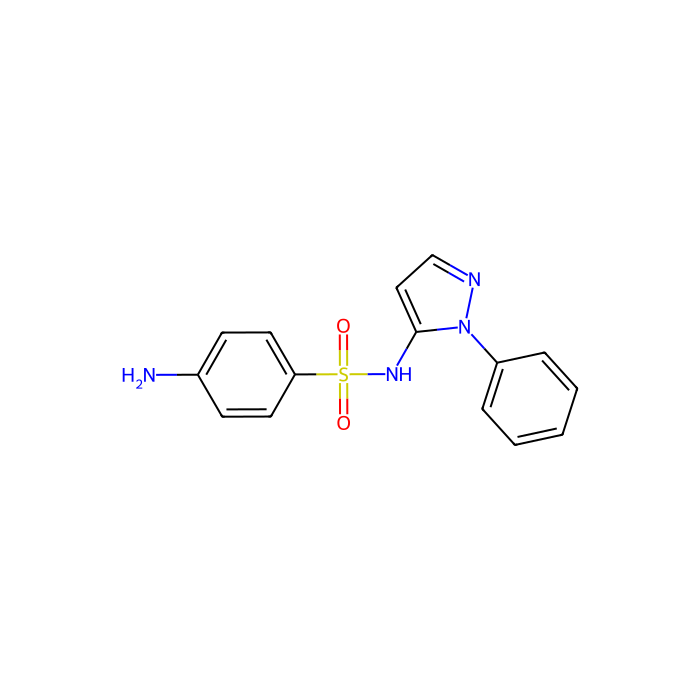
Sulfaphenazole - Moligand™, ≥98% , Bacterial dihydropteroate synthase inhibitor, CAS No.526-08-9, Bacterial dihydropteroate synthase inhibitor

CAS: 526-08-9 Cat. No.: S137259 Formula: C15H14N4O2S Peso molecolare: 314.362 PubChem CID: 5335
Disponibile su ordine
QUALITÀ & PUREZZA Moligand™ ? Moligand™ — Aladdin's line of ligands and bioactive small molecules. Use for receptor, pathway, and binding studies needing defined small-molecule tools. ≥98%
Synonyms
SULFAPHENAZOLE [MART.]|Sulfafenazol (INN-Spanish)|N'-(1-Phenylpyrazol-5-yl)sulfanilamide|Paidazolo|Sulfaphenylpyrazol|Microtan pirazolo|Orisul|SULFAPHENAZOLE [INN]|SULFAPHENAZOLE [WHO-DD]|Sulfaphenazolum [INN-Latin]|Sulfafenazol|Sulfaphenazole-d4|N(sup 1)-(1-Phenylpyrazol-5-yl)sulfanilamide|N(1)-(1-Phenylpyrazol-5-yl)sulfanilamide|Depotsulfonamide|Firmazolo|Isarol V|Lopac-S-0758|SULFAPHENAZOLE (MART.)|4-Amino-N-(1-phenyl-1H-pyrazol-5-yl)benzenesulfonamide|4-Amino-N-(1-phenyl-1H-pyrazol-5-yl)-benzenesulfonamide|Sulfaphenazol [INN-French]|Phenylsulfapyrazole|Sulfaphenazole (JAN/INN)|5-Sulfanilamido-1-phenylpyrazole|Sulfaphenylpyrazole|Sulfabid|Depocid|Sulfaphenazol|Sulfaphenazolum (INN-Latin)|Sulphenazole|3-(p-Aminobenzenesulfonamido)-2-phenylpyrazole|Sulfaphenazole [INN:BAN:JAN]|Sulfaphenylpipazol|Benzenesulfonamide, 4-amino-N-(1-phenyl-1H-pyrazol-5-yl)-|Sulfafenazol [INN-Spanish]|4-Amino-N-(2-phenyl-2H-pyrazol-3-yl)-benze-ne-13C6-sulfonamide|Sulfafenazolo|Sulfafenazolo [Italian]|4-Amino-N-(2-phenyl-2H-pyrazol-3-yl)-benzenesulfonamide|Isarol|Orisulf|Sulfaphenazol (INN-French)|Sulfaphenazolum|Sulphaphenazole|Sulfanilamide, N(sup 1)-(1-phenylpyrazol-5-yl)-|SULFAPHENAZOLE [MI]|Eftolon|Solfafenazolo [DCIT]|SULFAPHENAZOLE [JAN]|Inamil|Plisulfan|4-amino-N-(1-phenyl-1H-pyrazol-5-yl)benzene-1-sulfonamide|Solfafenazolo|1-Phenyl-5-sulfanilamidopyrazole|Sulfabid (TN)|Sulfanilamide, N1-(1-phenylpyrazol-5-yl)-|sulfaphenazole|Sulfaphenazon|4-amino-N-(2-phenylpyrazol-3-yl)benzenesulfonamide|Sulfonylpyrazol
Storage
Room temperature
Shipped In
Normal
★
Dimensione
Germania (EU)
USA*
Prezzo
Qtà
100mg
S137259-100mg
—
5 Disponibile

35,49€

53,71€
Salva 18,22 € (33.93%)
500mg
S137259-500mg
—
1 Disponibile

140,49€

210,77€
Salva 70,29 € (33.35%)
1g
S137259-1g
—
1 Disponibile

265,44€

398,21€
Salva 132,76 € (33.34%)
Enter a quantity for the sizes you want to add.

Specifiche

Sinonimi
SULFAPHENAZOLE [MART.] | Sulfafenazol (INN-Spanish) | N'-(1-Phenylpyrazol-5-yl)sulfanilamide | Paidazolo | Sulfaphenylpyrazol | Microtan pirazolo | Orisul | SULFAPHENAZOLE [INN] | SULFAPHENAZOLE [WHO-DD] | Sulfaphenazolum [INN-Latin] | Sulfafenazol | Sulfaphenazole-d4 | N(sup 1)-(1-Phenylpyrazol-5-yl)sulfanilamide | N(1)-(1-Phenylpyrazol- Mostra altro
Specifiche e purezza
Moligand™, ≥98%
Meccanismi biochimici e fisiologici
Selective, competitive CYP2C9 inhibitor (Ki = 0.3 µM). Blocks pro-inflammatory and atherogenic effects of linoleic acid (increase in oxidative stress and activation of AP-1) mediated by CYP2C9. Inhibits bradykinin-induced tPA release.
Condizioni di conservazione di stoccaggio
Room temperature
Spedito in
Normal
Grado
Moligand™
Tipo di azione
INHIBITOR
Meccanismo d'azione
Bacterial dihydropteroate synthase inhibitor
Nota
Wherever possible, you should prepare and use solutions on the same day. However, if you need to make up stock solutions in advance, we recommend that you store the solution as aliquots in tightly sealed vials at -20°C. Generally, these will be useable for up to one month. Before use, and prior to opening the vial we recommend that you allow your product to equilibrate to room temperature for at least 1 hour. Need more advice on solubility, usage and handling? Please visit our frequently asked questions (FAQ) page for more details.
Purezza
≥98%
Proprietà del prodotto
ALogP
1.5
Nomi e identificatori
Pubchem Sid
Pubchem Sid Url
https://pubchem.ncbi.nlm.nih.gov/substance/488179897
SMILES
C1=CC=C(C=C1)N2C(=CC=N2)NS(=O)(=O)C3=CC=C(C=C3)N
IUPAC Name
4-amino-N-(2-phenylpyrazol-3-yl)benzenesulfonamide
InChIKey
QWCJHSGMANYXCW-UHFFFAOYSA-N
InChI
1S/C15H14N4O2S/c16-12-6-8-14(9-7-12)22(20,21)18-15-10-11-17-19(15)13-4-2-1-3-5-13/h1-11,18H,16H2
Isomeri SMILES
C1=CC=C(C=C1)N2C(=CC=N2)NS(=O)(=O)C3=CC=C(C=C3)N
PubChem CID
5335
Peso molecolare
314.362

Dati avanzati

Taxonomic Classification

Taxonomy Tree

KingdomOrganic compounds
SuperclassOrganoheterocyclic compounds
ClasseAzoles
SubclassPyrazoles
Intermediate Tree Nodes Not available
Direct ParentPhenylpyrazoles
Alternative Parents Aminobenzenesulfonamides  Benzenesulfonyl compounds  Aniline and substituted anilines  Organosulfonamides  Heteroaromatic compounds  Aminosulfonyl compounds  Azacyclic compounds  Primary amines  Organopnictogen compounds  Organic oxides  Hydrocarbon derivatives  
Molecular FrameworkAromatic heteromonocyclic compounds
Substituents Aminobenzenesulfonamide - Phenylpyrazole - Benzenesulfonamide - Benzenesulfonyl group - Aniline or substituted anilines - Monocyclic benzene moiety - Benzenoid - Organosulfonic acid amide - Organic sulfonic acid or derivatives - Heteroaromatic compound - Aminosulfonyl compound - Sulfonyl - Organosulfonic acid or derivatives - Azacycle - Amine - Hydrocarbon derivative - Primary amine - Organic oxide - Organosulfur compound - Organonitrogen compound - Organopnictogen compound - Organic oxygen compound - Organic nitrogen compound - Aromatic heteromonocyclic compound
DescrizioneThis compound belongs to the class of organic compounds known as phenylpyrazoles. These are compounds containing a phenylpyrazole skeleton, which consists of a pyrazole bound to a phenyl group.
External Descriptors pyrazoles - substituted aniline - sulfonamide - primary amino compound - sulfonamide antibiotic
Struttura 3D
Modello di struttura chimica interattiva


Obiettivi associati (umani)
CYP2C9 Tchem Cytochrome P450 2C9 (36 Activities)
Activity TypeActivity Value -log(M)Mechanism of ActionActivity ReferencePublications (PubMed IDs)
PDE5A Tclin Phosphodiesterase 5A (5113 Activities)
Activity TypeRelationActivity valueUnitsAction TypeJournalPubMed IddoiAssay Aladdin ID
EGFR Tclin Epidermal growth factor receptor erbB1 (33727 Activities)
Activity TypeRelationActivity valueUnitsAction TypeJournalPubMed IddoiAssay Aladdin ID
CA2 Tclin Carbonic anhydrase II (17698 Activities)
Activity TypeRelationActivity valueUnitsAction TypeJournalPubMed IddoiAssay Aladdin ID
ESR1 Tclin Estrogen receptor alpha (17718 Activities)
Activity TypeRelationActivity valueUnitsAction TypeJournalPubMed IddoiAssay Aladdin ID
HMGCR Tclin HMG-CoA reductase (2475 Activities)
Activity TypeRelationActivity valueUnitsAction TypeJournalPubMed IddoiAssay Aladdin ID
NR3C1 Tclin Glucocorticoid receptor (14987 Activities)
Activity TypeRelationActivity valueUnitsAction TypeJournalPubMed IddoiAssay Aladdin ID
INSR Tclin Insulin receptor (5558 Activities)
Activity TypeRelationActivity valueUnitsAction TypeJournalPubMed IddoiAssay Aladdin ID
PGR Tclin Progesterone receptor (8562 Activities)
Activity TypeRelationActivity valueUnitsAction TypeJournalPubMed IddoiAssay Aladdin ID
ADRB2 Tclin Beta-2 adrenergic receptor (11824 Activities)
Activity TypeRelationActivity valueUnitsAction TypeJournalPubMed IddoiAssay Aladdin ID
CHRM2 Tclin Muscarinic acetylcholine receptor M2 (10671 Activities)
Activity TypeRelationActivity valueUnitsAction TypeJournalPubMed IddoiAssay Aladdin ID
ADRB1 Tclin Beta-1 adrenergic receptor (6630 Activities)
Activity TypeRelationActivity valueUnitsAction TypeJournalPubMed IddoiAssay Aladdin ID
HTR1A Tclin Serotonin 1a (5-HT1a) receptor (14969 Activities)
Activity TypeRelationActivity valueUnitsAction TypeJournalPubMed IddoiAssay Aladdin ID
ADRA2A Tclin Alpha-2a adrenergic receptor (9450 Activities)
Activity TypeRelationActivity valueUnitsAction TypeJournalPubMed IddoiAssay Aladdin ID
AR Tclin Androgen Receptor (11781 Activities)
Activity TypeRelationActivity valueUnitsAction TypeJournalPubMed IddoiAssay Aladdin ID
CHRM1 Tclin Muscarinic acetylcholine receptor M1 (12690 Activities)
Activity TypeRelationActivity valueUnitsAction TypeJournalPubMed IddoiAssay Aladdin ID
ACE Tclin Angiotensin-converting enzyme (1423 Activities)
Activity TypeRelationActivity valueUnitsAction TypeJournalPubMed IddoiAssay Aladdin ID
DRD2 Tclin Dopamine D2 receptor (23596 Activities)
Activity TypeRelationActivity valueUnitsAction TypeJournalPubMed IddoiAssay Aladdin ID
TSHR Tclin Thyroid stimulating hormone receptor (29986 Activities)
Activity TypeRelationActivity valueUnitsAction TypeJournalPubMed IddoiAssay Aladdin ID
MAOA Tclin Monoamine oxidase A (11911 Activities)
Activity TypeRelationActivity valueUnitsAction TypeJournalPubMed IddoiAssay Aladdin ID
CNR1 Tclin Cannabinoid CB1 receptor (20913 Activities)
Activity TypeRelationActivity valueUnitsAction TypeJournalPubMed IddoiAssay Aladdin ID
DRD1 Tclin Dopamine D1 receptor (9720 Activities)
Activity TypeRelationActivity valueUnitsAction TypeJournalPubMed IddoiAssay Aladdin ID
DRD4 Tchem Dopamine D4 receptor (7907 Activities)
Activity TypeRelationActivity valueUnitsAction TypeJournalPubMed IddoiAssay Aladdin ID
ACHE Tclin Acetylcholinesterase (18204 Activities)
Activity TypeRelationActivity valueUnitsAction TypeJournalPubMed IddoiAssay Aladdin ID
PTGS1 Tclin Cyclooxygenase-1 (9233 Activities)
Activity TypeRelationActivity valueUnitsAction TypeJournalPubMed IddoiAssay Aladdin ID
SLC6A2 Tclin Norepinephrine transporter (10102 Activities)
Activity TypeRelationActivity valueUnitsAction TypeJournalPubMed IddoiAssay Aladdin ID
HRH2 Tclin Histamine H2 receptor (5428 Activities)
Activity TypeRelationActivity valueUnitsAction TypeJournalPubMed IddoiAssay Aladdin ID
ADRA1D Tclin Alpha-1d adrenergic receptor (4171 Activities)
Activity TypeRelationActivity valueUnitsAction TypeJournalPubMed IddoiAssay Aladdin ID
HTR1B Tclin Serotonin 1b (5-HT1b) receptor (2801 Activities)
Activity TypeRelationActivity valueUnitsAction TypeJournalPubMed IddoiAssay Aladdin ID
HTR2A Tclin Serotonin 2a (5-HT2a) receptor (14758 Activities)
Activity TypeRelationActivity valueUnitsAction TypeJournalPubMed IddoiAssay Aladdin ID
HTR2C Tclin Serotonin 2c (5-HT2c) receptor (11471 Activities)
Activity TypeRelationActivity valueUnitsAction TypeJournalPubMed IddoiAssay Aladdin ID
ADORA1 Tclin Adenosine A1 receptor (17603 Activities)
Activity TypeRelationActivity valueUnitsAction TypeJournalPubMed IddoiAssay Aladdin ID
CALCR Tclin Calcitonin receptor (2215 Activities)
Activity TypeRelationActivity valueUnitsAction TypeJournalPubMed IddoiAssay Aladdin ID
SLC6A4 Tclin Serotonin transporter (12625 Activities)
Activity TypeRelationActivity valueUnitsAction TypeJournalPubMed IddoiAssay Aladdin ID
ADRA1A Tclin Alpha-1a adrenergic receptor (8359 Activities)
Activity TypeRelationActivity valueUnitsAction TypeJournalPubMed IddoiAssay Aladdin ID
PTGS2 Tclin Cyclooxygenase-2 (13999 Activities)
Activity TypeRelationActivity valueUnitsAction TypeJournalPubMed IddoiAssay Aladdin ID
HRH1 Tclin Histamine H1 receptor (7573 Activities)
Activity TypeRelationActivity valueUnitsAction TypeJournalPubMed IddoiAssay Aladdin ID
ADRA1B Tclin Alpha-1b adrenergic receptor (2912 Activities)
Activity TypeRelationActivity valueUnitsAction TypeJournalPubMed IddoiAssay Aladdin ID
OPRM1 Tclin Mu opioid receptor (19785 Activities)
Activity TypeRelationActivity valueUnitsAction TypeJournalPubMed IddoiAssay Aladdin ID
DRD3 Tclin Dopamine D3 receptor (14368 Activities)
Activity TypeRelationActivity valueUnitsAction TypeJournalPubMed IddoiAssay Aladdin ID
AVPR1A Tclin Vasopressin V1a receptor (5412 Activities)
Activity TypeRelationActivity valueUnitsAction TypeJournalPubMed IddoiAssay Aladdin ID
OPRD1 Tclin Delta opioid receptor (15096 Activities)
Activity TypeRelationActivity valueUnitsAction TypeJournalPubMed IddoiAssay Aladdin ID
OPRK1 Tclin Kappa opioid receptor (16155 Activities)
Activity TypeRelationActivity valueUnitsAction TypeJournalPubMed IddoiAssay Aladdin ID
SLC6A3 Tclin Dopamine transporter (10535 Activities)
Activity TypeRelationActivity valueUnitsAction TypeJournalPubMed IddoiAssay Aladdin ID
KCNH2 Tclin HERG (29587 Activities)
Activity TypeRelationActivity valueUnitsAction TypeJournalPubMed IddoiAssay Aladdin ID
HTR4 Tclin Serotonin 4 (5-HT4) receptor (2068 Activities)
Activity TypeRelationActivity valueUnitsAction TypeJournalPubMed IddoiAssay Aladdin ID
ESR2 Tclin Estrogen receptor beta (9272 Activities)
Activity TypeRelationActivity valueUnitsAction TypeJournalPubMed IddoiAssay Aladdin ID
CYSLTR1 Tclin Cysteinyl leukotriene receptor 1 (2118 Activities)
Activity TypeRelationActivity valueUnitsAction TypeJournalPubMed IddoiAssay Aladdin ID
ERBB2 Tclin Receptor protein-tyrosine kinase erbB-2 (7851 Activities)
Activity TypeRelationActivity valueUnitsAction TypeJournalPubMed IddoiAssay Aladdin ID
CHRM4 Tclin Muscarinic acetylcholine receptor M4 (6041 Activities)
Activity TypeRelationActivity valueUnitsAction TypeJournalPubMed IddoiAssay Aladdin ID
CHRM5 Tclin Muscarinic acetylcholine receptor M5 (4677 Activities)
Activity TypeRelationActivity valueUnitsAction TypeJournalPubMed IddoiAssay Aladdin ID
Obiettivi associati (non umani)
ERG11 Cytochrome P450 51 (617 Activities)
Activity TypeRelationActivity valueUnitsAction TypeJournalPubMed IddoiAssay Aladdin ID
Agtr2 Angiotensin II type 2 (AT-2) receptor (803 Activities)
Activity TypeRelationActivity valueUnitsAction TypeJournalPubMed IddoiAssay Aladdin ID
Mc4r Melanocortin receptor 4 (1205 Activities)
Activity TypeRelationActivity valueUnitsAction TypeJournalPubMed IddoiAssay Aladdin ID
Ltc4s Leukotriene C4 synthase (1 Activities)
Activity TypeRelationActivity valueUnitsAction TypeJournalPubMed IddoiAssay Aladdin ID
Sigmar1 Sigma opioid receptor (160 Activities)
Activity TypeRelationActivity valueUnitsAction TypeJournalPubMed IddoiAssay Aladdin ID
Npy1r Neuropeptide Y receptor type 1 (8 Activities)
Activity TypeRelationActivity valueUnitsAction TypeJournalPubMed IddoiAssay Aladdin ID
Cckar Cholecystokinin A receptor (90 Activities)
Activity TypeRelationActivity valueUnitsAction TypeJournalPubMed IddoiAssay Aladdin ID
Nos2 Nitric oxide synthase, inducible (3573 Activities)
Activity TypeRelationActivity valueUnitsAction TypeJournalPubMed IddoiAssay Aladdin ID
Mapk1 MAP kinase ERK2 (650 Activities)
Activity TypeRelationActivity valueUnitsAction TypeJournalPubMed IddoiAssay Aladdin ID
Hdac6 Histone deacetylase 6 (222 Activities)
Activity TypeRelationActivity valueUnitsAction TypeJournalPubMed IddoiAssay Aladdin ID
Mmp9 Matrix metalloproteinase 9 (38 Activities)
Activity TypeRelationActivity valueUnitsAction TypeJournalPubMed IddoiAssay Aladdin ID
Mycobacterium tuberculosis (203094 Activities)
Activity TypeRelationActivity valueUnitsAction TypeJournalPubMed IddoiAssay Aladdin ID
Mycobacterium tuberculosis variant bovis (1746 Activities)
Activity TypeRelationActivity valueUnitsAction TypeJournalPubMed IddoiAssay Aladdin ID
Plasmodium falciparum (966862 Activities)
Activity TypeRelationActivity valueUnitsAction TypeJournalPubMed IddoiAssay Aladdin ID
Rattus norvegicus (775804 Activities)
Activity TypeRelationActivity valueUnitsAction TypeJournalPubMed IddoiAssay Aladdin ID
Vero (26788 Activities)
Activity TypeRelationActivity valueUnitsAction TypeJournalPubMed IddoiAssay Aladdin ID
Npsr1 Neuropeptide S receptor (260 Activities)
Activity TypeRelationActivity valueUnitsAction TypeJournalPubMed IddoiAssay Aladdin ID
rep Replicase polyprotein 1ab (378 Activities)
Activity TypeRelationActivity valueUnitsAction TypeJournalPubMed IddoiAssay Aladdin ID
Txnrd1 Thioredoxin reductase 1, cytoplasmic (45279 Activities)
Activity TypeRelationActivity valueUnitsAction TypeJournalPubMed IddoiAssay Aladdin ID
Nfe2l2 Nuclear factor erythroid 2-related factor 2 (214 Activities)
Activity TypeRelationActivity valueUnitsAction TypeJournalPubMed IddoiAssay Aladdin ID
FTL Ferritin light chain (43324 Activities)
Activity TypeRelationActivity valueUnitsAction TypeJournalPubMed IddoiAssay Aladdin ID
Mycobacterium tuberculosis H37Rv (422 Activities)
Activity TypeRelationActivity valueUnitsAction TypeJournalPubMed IddoiAssay Aladdin ID
Glra2 Glycine receptor (1745 Activities)
Activity TypeRelationActivity valueUnitsAction TypeJournalPubMed IddoiAssay Aladdin ID
Meccanismi d'azione
Certificati (CoA, COO, BSE/TSE e tabella di analisi)
C of A & Other Certificates(BSE/TSE, COO):
Analytical Chart:

Find and download the COA for your product by matching the lot number on the packaging.

16 results found

Lot NumberCertificate TypeDataOggetto
C2316392C2316392Certificate of AnalysisSep 01, 2026 S137259
C2316396C2316396Certificate of AnalysisSep 01, 2026 S137259
C2316403C2316403Certificate of AnalysisSep 01, 2026 S137259
K2518212K2518212Certificate of AnalysisNov 26, 2025 S137259
K2512574K2512574Certificate of AnalysisNov 06, 2025 S137259
K2512575K2512575Certificate of AnalysisNov 06, 2025 S137259
K2512577K2512577Certificate of AnalysisNov 06, 2025 S137259
E2029086E2029086Certificate of AnalysisOct 14, 2025 S137259
C2316404C2316404Certificate of AnalysisDec 10, 2024 S137259
K2425029K2425029Certificate of AnalysisNov 28, 2024 S137259
K2217226K2217226Certificate of AnalysisSep 04, 2024 S137259
I2227027I2227027Certificate of AnalysisJul 03, 2024 S137259
A2509322A2509322Certificate of AnalysisJun 29, 2024 S137259
A2224313A2224313Certificate of AnalysisNov 02, 2023 S137259
C2316347C2316347Certificate of AnalysisMar 02, 2023 S137259
A2224316A2224316Certificate of AnalysisJan 07, 2022 S137259
Proprietà chimiche e fisiche
Peso molecolare314.400 g/mol
XLogP31.500
Hydrogen Bond Donor Count2
Hydrogen Bond Acceptor Count5
Rotatable Bond Count4
Exact Mass314.084 Da
Monoisotopic Mass314.084 Da
Topological Polar Surface Area98.400 Ų
Heavy Atom Count22
Formal Charge0
Complexity451.000
Isotope Atom Count0
Defined Atom Stereocenter Count0
Undefined Atom Stereocenter Count0
Defined Bond Stereocenter Count0
Undefined Bond Stereocenter Count0
The total count of all stereochemical bonds0
Covalently-Bonded Unit Count1
Citations of This Product
Calcolatori di soluzioni
Recensioni

Recensioni dei clienti

Application Protocols

No tested/validated protocols are provided for this item. The following is general, literature-based guidance for using small-molecule probes in enzyme assays; adapt to your system and consult primary sources.

  • Example workflow (general guidance)

    1. Prepare a 10–50 mM DMSO stock; store aliquots at −20 °C or per lab practice.
    2. Set up enzyme incubations (e.g., recombinant protein or microsomes) with appropriate buffer, co-factors, and substrate near Km.
    3. Add inhibitor across a concentration range (e.g., 0.01–100 µM) with consistent DMSO percentage.
    4. Incubate at controlled temperature (e.g., 37 °C) for a defined time; quench and quantify product/substrate by LC/LC–MS.
    5. Fit data to determine IC50/Ki where appropriate, accounting for free fraction.
  • Controls

    • Vehicle control (matching DMSO), positive control inhibitor, and heat-inactivated/blank matrix controls.
  • Notes

    • These steps are illustrative only; item-specific validated conditions are Not specified for this item; refer to CoA/Spec Sheet.
Biological Roles

Item provided strictly for research use. No clinical or diagnostic claims are made.

  • Literature context (not item-specific claims)

    • Sulfaphenazole is widely reported as a selective chemical probe for cytochrome P450 2C9 in human systems, frequently used to interrogate isoform contribution to xenobiotic metabolism in microsomes and recombinant enzymes.
    • As an aryl sulfonamide, it can engage targets via hydrogen-bond donor/acceptor interactions at the sulfonamide, coupled with hydrophobic/aromatic contacts.
  • Experimental implications

    • Probe studies typically evaluate concentration–response relationships, time-dependence, and potential competitive/noncompetitive behavior against enzyme substrates.
    • In complex biological matrices, protein binding and microsomal partitioning can influence apparent potency; free fraction determination improves interpretation.
  • Off-target considerations (literature)

    • While often used for selectivity against certain CYP isoforms, cross-screening is recommended to confirm specificity in the assay context employed.
  • Data sourcing

    • Researchers should consult primary literature and the product’s CoA for any available characterization; specific biological activity values for this item are Not specified for this item; refer to CoA/Spec Sheet.
Buffer Applications

Not typically applicable. Sulfaphenazole is a small-molecule research compound and does not function as a buffering agent.

  • Practical note
    • If used in aqueous biological assays, prepare in an appropriate buffer system (e.g., phosphate, HEPES) validated for the biological target. Maintain consistent co-solvent levels to avoid pH drift or precipitation.
    • Any specific pKa values enabling buffer action are not relevant here; item-specific pKa data are Not specified for this item; refer to CoA/Spec Sheet.
Green Alternatives

As a solid research compound, Sulfaphenazole itself has no direct “green substitute.” Greener considerations focus on the solvents and workflows used with it.

  • Solvent choices (greener context, general)

    • Prefer aqueous buffers with minimal DMSO where assay-compatible.
    • When organic stock solutions are required, consider ethanol or propylene carbonate as alternatives to DMF/NMP; validate solubility and stability.
    • For chromatographic work, use acetonitrile-water or ethanol-water mobile phases over halogenated solvents where feasible.
  • Operational changes

    • Use small-volume, high-concentration stocks to reduce solvent consumption.
    • Implement microplate formats and automation to minimize waste and exposure.
    • Employ closed containers and cold storage to extend stock life and reduce disposals.
  • Trade-offs

    • Greener solvents may reduce solubility or alter assay performance. Conduct small pilot tests to balance environmental impact with data quality.

Comparison snapshot (general guidance):

  • DMSO: excellent solubility and stability; moderate environmental concern; high assay compatibility.
  • Ethanol: greener, widely compatible; may limit maximum stock concentration.
  • DMF/NMP: strong solvents but higher regulatory/safety burdens; avoid when alternatives suffice.
Pharmaceutical Uses

No therapeutic or clinical claims. The following are research/manufacturing-context notes only.

  • Potential roles in a pharmaceutical lab (general)

    • Analytical reference standard for method development or system suitability in assays focused on metabolism and inhibition studies.
    • Tool compound for in vitro ADME characterization (enzyme phenotyping, inhibition kinetics) during discovery research.
  • Regulatory status

    • Not supplied under GMP. No pharmacopeial monograph status is claimed here.
  • Formulation context

    • When used as a laboratory control article, stock solutions are commonly prepared in DMSO or ethanol and diluted into assay-compatible media. Item-specific excipient compatibility is Not specified for this item; refer to CoA/Spec Sheet.
Physical Properties

Item-specific physico-chemical specifications have not been supplied for this catalog entry. See SDS/CoA for certified values.

  • Item-specific values

    • Melting point: Not specified for this item; refer to CoA/Spec Sheet.
    • Boiling point: Not applicable/Not specified (solid; decomp likely); refer to CoA/Spec Sheet.
    • Density: Not specified for this item; refer to CoA/Spec Sheet.
    • Refractive index: Not applicable for solids.
    • Aqueous solubility: Not specified for this item; refer to CoA/Spec Sheet.
    • LogP/logD: Not specified for this item; refer to CoA/Spec Sheet.
  • General/literature expectations for aryl sulfonamides (context, not item-spec):

    • Physical state: typically a crystalline solid with moderate to low aqueous solubility; readily soluble in polar aprotic solvents (DMSO, DMF) and in some alcohols under heating or with base.
    • Ionization: one weakly acidic sulfonamide N–H (deprotonation possible in basic media), enabling salt formation for solubility modulation.
    • Stability: generally stable under ambient conditions; prolonged exposure to strong acids/bases or high temperatures can cause hydrolysis or decomposition of the sulfonamide bond.
  • Practical notes (general)

    • Prepare concentrated DMSO stock solutions (e.g., 10–100 mM) for bioassays; dilute into buffers keeping final DMSO ≤0.1–1% v/v where compatible.
    • Filter stocks (0.2 µm PTFE) if particulates are observed.
Quality and Grades
  • Item-specific grade

    • Grade/Purity: Moligand™ (as provided). Moligand™ denotes inclusion in a ligand-like/screening small-molecule collection intended for discovery research. It emphasizes structural integrity and suitability for biochemical/biophysical assays rather than chromatographic solvent grades.
  • What this means in practice (general guidance)

    • Identity and integrity: typically supported by spectroscopic/analytical characterization (consult CoA for exact tests such as NMR, HPLC, MS).
    • Purity reporting: exact assay, residual solvents, and impurity thresholds are Not specified for this item; refer to CoA/Spec Sheet.
  • Stabilizers/inhibitors

    • None stated. If stabilizers were used, they would be declared on the CoA. Not specified for this item; refer to CoA/Spec Sheet.
  • Fit-for-purpose

    • Intended for research use in screening, target engagement studies, and chemical biology. Not intended for clinical use or GMP manufacturing.
  • Comparison to other grades (context)

    • Analytical Reagent (AR) or HPLC grades apply to solvents/reagents; for small molecules like Sulfaphenazole, assay-focused quality (identity/purity) is the dominant consideration. Low UV background is generally not a defining attribute here.
Reaction and Applications

This product is primarily offered as a research small molecule (Moligand™) rather than as a synthetic reagent. Applications are therefore centered on biochemical/chemical biology experiments, not as a stoichiometric reagent.

  • Research applications (general/literature context)

    • Frequently used in enzyme inhibition studies and selectivity panels for xenobiotic-metabolizing enzymes; widely cited as a chemical probe in microsomal and recombinant enzyme systems.
    • Employed as a reference/benchmark compound in metabolism and DDI-relevant in vitro assays (e.g., kinetic studies), with careful control of solvent, protein concentration, and incubation time.
  • Analytical uses

    • May serve as a system suitability/positive control compound in LC/LC–MS method development for bioanalytical quantification (e.g., recovery, matrix effects), with calibration in matched matrices.
  • Practical notes

    • Prepare fresh or thawed aliquots of DMSO stocks to minimize freeze–thaw cycles.
    • Control for nonspecific binding by incorporating BSA or optimizing plasticware; verify free concentration via equilibrium dialysis if necessary for mechanistic studies.
  • Synthetic chemistry

    • Not typically used as a building block; the sulfonamide functionality is generally robust and unreactive under mild conditions, though it can participate in protection–deprotection or N-derivatization under forcing conditions.
Reaction Conditions

There are no item-specific reaction condition recommendations for synthetic transformations of this compound. The following guidance addresses handling in experimental solutions.

  • Stock solution preparation (general)

    • Dissolve in anhydrous DMSO at 10–100 mM; sonication or gentle warming (≤40 °C) may assist dissolution. Filter if needed (0.2 µm PTFE).
    • For aqueous work, dilute DMSO stocks into buffers with vigorous mixing to avoid precipitation; keep final DMSO typically ≤0.1–1% v/v as permitted by the assay.
  • Stability considerations (general)

    • Avoid prolonged exposure to strong light/UV and high temperatures. Store aliquots to minimize freeze–thaw cycles.
  • Typical assay ranges (literature context)

    • Inhibition or binding experiments often explore sub-µM to tens of µM concentrations. Optimize based on target expression, substrate Km, and matrix binding.
  • Yields/times (synthetic chemistry)

    • Not applicable; this product is not supplied for use as a synthetic reagent. Any transformation conditions should be developed de novo if derivatization is pursued.
Safety and Handling

Authoritative safety information must be taken from the product SDS. The following points summarize typical considerations for aryl sulfonamide solids.

  • GHS and hazard statements (item-specific)

    • Signal word: Not specified for this item; refer to SDS.
    • H-statements: Not specified for this item; refer to SDS.
    • GHS classification/pictograms: Not specified for this item; refer to SDS.
  • General precautions (chemistry best practice)

    • PPE: lab coat, safety glasses, and suitable gloves (e.g., nitrile). Avoid dust generation; handle in a fume hood if dusting or solvent handling occurs.
    • Incompatibilities: strong oxidizers; strong acids/bases may induce degradation. Avoid extended heating above decomposition temperatures.
    • Hygiene: wash hands thoroughly after handling; avoid inhalation/ingestion and skin/eye contact.
  • First-aid overview (general)

    • Inhalation: move to fresh air; seek medical advice if symptoms persist.
    • Skin/eye contact: rinse with water for several minutes; remove contaminated clothing; obtain medical attention if irritation persists.
    • Ingestion: rinse mouth; do not induce vomiting; seek medical attention.
  • Environmental and waste

    • Prevent release to the environment. Collect solid/solutions as organic laboratory waste and dispose per institutional and local regulations.
  • Storage risk notes

    • Store sealed at room temperature away from light and moisture as a standard precaution for small-molecule solids.
Solvent Selection

Sulfaphenazole is an aromatic sulfonamide solid. Its solubility profile is typical of moderately lipophilic, weakly acidic small molecules.

  • Practical solvent choices (general/literature context)

    • High solubility: DMSO, DMF, NMP. Often used for concentrated stocks (10–100 mM).
    • Moderate solubility: methanol, ethanol, isopropanol; may require warming/sonication.
    • Low solubility: water at neutral pH; improved in basic aqueous media via deprotonation of the sulfonamide N–H, or with co-solvents/surfactants.
  • Miscibility and dilution

    • For bioassays, first dissolve in DMSO, then dilute into aqueous buffers, keeping final DMSO content low to maintain biological compatibility.
    • Pre-wet glassware with solvent to minimize adsorption losses for hydrophobic compounds at low µM concentrations.
  • Choosing among solvents

    • Select DMSO for maximal solubility and storage stability of stock solutions.
    • Use ethanol or aqueous ethanol when lower DMSO content is required; validate assay tolerance.
    • For analytical HPLC sample prep, acetonitrile/water with 0.1% acid/base modifiers may aid dissolution, subject to compound stability.
  • Solubility specifications

    • Item-specific solubility values are Not specified for this item; refer to CoA/Spec Sheet.
Storage and Reconstitution
  • Item-specific storage/shipping

    • Storage Conditions: Room temperature (as provided). Store tightly closed, in a dry place, protected from excessive heat and light.
    • Shipped In: Normal (as provided).
  • Reconstitution

    • Solvent: DMSO is recommended for initial dissolution; ethanol or other polar organics may be used if compatible. Item-specific solubility is Not specified for this item; refer to CoA/Spec Sheet.
    • Concentrated stocks: prepare 10–100 mM aliquots in DMSO; label with concentration and date.
  • Handling after reconstitution (general)

    • Store aliquots at −20 °C or per institutional practice to prolong shelf life; avoid repeated freeze–thaw cycles by using single-use aliquots.
    • Bring frozen aliquots to room temperature before opening to prevent moisture ingress; briefly vortex/sonicate if precipitate forms.
  • Stability

    • No item-specific stability data are provided; consult CoA/SDS. As a general precaution, discard solutions showing discoloration, precipitation (beyond solubility limits), or degraded assay performance.
  • Research Use Note

    • For research use only. Not for human or animal therapeutic or diagnostic use.
Structure and Identity

Brief overview: Sulfaphenazole is a small-molecule aryl sulfonamide commonly used in research as a chemical probe. Item-specific identifiers below, with literature context separated.

  • Item-specific identifiers (from Product Data)

    • SKU: S137259
    • Product name: Sulfaphenazole
    • CAS: 526-08-9
    • InChIKey: 308021 (as provided)
    • SMILES: Not specified for this item; refer to CoA/Spec Sheet.
    • Molecular formula: Not specified for this item; refer to CoA/Spec Sheet.
    • Molecular weight: Not specified for this item; refer to CoA/Spec Sheet.
  • Structural features (general/literature description)

    • Belongs to the sulfonamide class; contains a sulfonyl (SO2) group bound to an aniline-type nitrogen (–SO2–NH–) integrated into an aromatic framework.
    • Consists of multiple aromatic rings linked via a sulfonamide functionality; overall neutral molecule with one sulfonamide N–H proton capable of hydrogen bonding.
    • Typical 2D depiction: two aromatic systems connected through a –SO2–NH– linkage; para-aminobenzenesulfonamide lineage is common among “sulfa” structures.
  • Stereochemistry

    • No stereocenters expected for the canonical structure (general/literature note for this compound class).
Synthetic Utility

Sulfaphenazole is generally used as a finished probe molecule rather than as a synthetic intermediate. Nonetheless, general chemistry features of aryl sulfonamides may be informative.

  • Functional groups and reactivity (general)

    • Sulfonamide N–H is weakly acidic; deprotonation enables N-derivatization (e.g., alkylation or acylation) under appropriate conditions, though overreaction and O-alkylation must be guarded against.
    • The sulfonyl group is robust to many conditions but can hydrolyze under strong acidic/basic, high-temperature conditions.
    • Aromatic rings permit electrophilic aromatic substitution if sufficiently activated, but existing substitution patterns typically reduce reactivity.
  • Derivatization strategies (general)

    • Prodrug/salt formation via deprotonation; conjugation to reporter tags (e.g., biotin, fluorophores) through linkers attached at the sulfonamide nitrogen or peripheral positions to create affinity probes.
  • Limitations

    • As a relatively complex small molecule, site-selective modification can be challenging without affecting target engagement. Protecting group strategies and structure–activity exploration are usually preferred on synthetic precursors rather than on the final probe.
Target Specificity

Item-specific target information is not provided in the Product Data.

  • Target, epitope, species reactivity, clone/isotype: Not specified for this item; refer to CoA/Spec Sheet.

  • Note

    • While literature frequently discusses Sulfaphenazole as a chemical probe for specific enzyme isoforms, no target specificity is claimed for this catalog entry beyond general research use.

Domande frequenti

How is this product shipped?
This product ships under standard ambient conditions. No temperature-controlled packaging is required.
What is the purity of this product?
This product is supplied at ≥98% purity (chemical assay). Lot-specific values are stated on the Certificate of Analysis.
What is Moligand??
Moligand? is one of Aladdin Scientific's premium product lines, formulated for high-purity applications across multiple workflows. Compared to standard grades in the same workflow, Moligand? products typically offer tighter specifications, more rigorous QC, and stronger lot-to-lot consistency.
How should this product be stored?
Store at room temperature.
What are the CAS number, molecular formula and molecular weight?
The CAS Number is 526-08-9, the molecular formula is C15H14N4O2S, and the molecular weight is 314.362 g/mol. InChIKey QWCJHSGMANYXCW-UHFFFAOYSA-N.
What documentation is provided?
Available product documentation, including Certificates of Analysis (COA), Safety Data Sheets (SDS), and specification sheets, is shown in the product document area. Document availability and access follow the current site policy.

Desidera che le inviamo un messaggio quando avremo sconti disponibili?

Ricordamelo più tardi

Grazie! Controlli la sua casella di posta per confermare.

Ops! Le notifiche sono disabilitate.