QUALITÀ & PUREZZAMoligand™?Moligand™ — Aladdin's line of ligands and bioactive small molecules. Use for receptor, pathway, and binding studies needing defined small-molecule tools.≥98%
SW-100, a selective histone deacetylase 6 (HDAC6) inhibitor with an IC 50 of 2.3 nM, shows at least 1000-fold selectivity for HDAC6 relative to all other HDAC isozymes. SW-100 displays a significantly improved ability to cross the blood-brain-barrier
In Vitro
SW-100 (0.01-10 µM; 48 hours) shows obvious increase in the acetylated α-tubulin levels in a dose-dependent manner. MCE has not independently confirmed the accuracy of these methods. They are for reference only. Western Blot AnalysisCell Line: HEK293 cells Concentration: 0.01, 0.1, 1, 10 µM Incubation Time: 48 hours Result: Showed obvious increase in the acetylated α-tubulin levels in a dose-dependent manner.
In Vivo
SW-100 (20 mg/kg; i.p.; twice a day for two days) ameliorates several memory and learning impairments including novel object recognition, temporal ordering, and coordinate and categorical spatial processing in mouse model of Fragile X syndrome . MCE has not independently confirmed the accuracy of these methods. They are for reference only. Animal Model: 8-10 weeks old C57BL/6 mice ( Fmr1 -/- mice) Dosage: 20 mg/kg Administration: Intraperitoneal injection; twice a day for two days Result: Ameliorated several memory and learning impairments including novel object recognition, temporal ordering, and coordinate and categorical spatial processing in Fmr1 -/- mice。
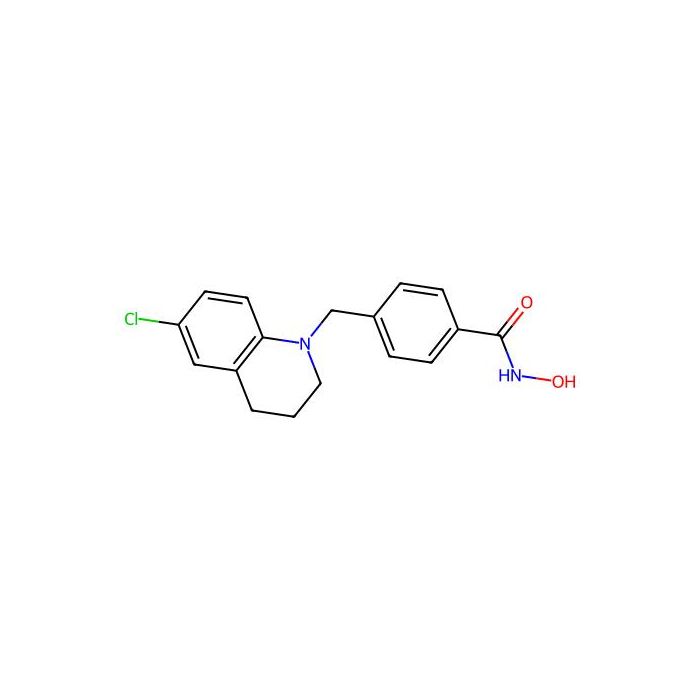
4-[[6-Chloro-3,4-dihydroquinolin-1(2H)-yl]methyl]-N-hydroxybenzamide | 4-((6-Chloro-3,4-dihydro-1(2H)-quinolinyl)methyl)-N-hydroxybenzamide | Benzamide, 4-((6-chloro-3,4-dihydro-1(2H)-quinolinyl)methyl)-N-hydroxy- | 4-((6-chloro-3,4-dihydroquinolin-1(2H)-yl)methyl)-N-hydroxybenzamide | SW100 | SW-100 | 4-[(6-chloro-3,4-dihydro-2H-quinolin Mostra altro
Specifiche e purezza
Moligand™,≥98%
Meccanismi biochimici e fisiologici
SW-100, a selective histone deacetylase 6 (HDAC6) inhibitor with an IC 50 of 2.3 nM, shows at least 1000-fold selectivity for HDAC6 relative to all other HDAC isozymes. SW-100 displays a significantly improved ability to cross the blood-brain-barrier
Condizioni di conservazione di stoccaggio
Store at -20°C
Spedito in
Ice chest + Ice pads
Questo prodotto richiede spedizione a catena fredda. I servizi di terra e altri servizi economici non sono disponibili.
This compound belongs to the class of organic compounds known as hydroquinolines. These are derivatives of quinoline in which in which at least one double bond in the quinoline moiety are reduced by adding two hydrogen atoms.
External Descriptors
Not available
1. Djoumbou Feunang Y, Eisner R, Knox C, Chepelev L, Hastings J, Owen G, Fahy E, Steinbeck C, Subramanian S, Bolton E, Greiner R, and Wishart DS. ClassyFire: Automated Chemical Classification With A Comprehensive, Computable Taxonomy. Journal of Cheminformatics, 2016, 8:61.
Determine the necessary mass, volume, or concentration for preparing a solution.
Dilution Calculator
Determine the dilution needed to prepare a stock solution.
Reconstitution Calculator
Recensioni
Recensioni dei clienti
Application Protocols
The following generic protocols support use of small-molecule library members like SW-100 in discovery assays. Adjust to your assay, and consult the SDS/CoA for item-specific constraints.
DMSO stock preparation
Equilibrate vial to room temperature in a desiccated environment to prevent moisture condensation.
Weigh quickly in a fume hood. Dissolve to 10–50 mM in anhydrous DMSO; vortex and, if needed, sonicate briefly. Filter (0.2 µm PTFE) if particulates remain.
Aliquot into low-bind tubes or amber glass vials; flush with inert gas if oxidation is a concern; cap tightly.
Plate setup (biochemical assays)
Prepare serial dilutions in DMSO (e.g., 1:3 or 1:2) to generate 8–12 point curves.
Transfer to assay plates to achieve final DMSO ≤0.1–1% v/v as tolerated. Include vehicle controls at matched DMSO.
Cell-based assays
Verify compound compatibility with serum and plastic; consider pre-dosing media with 0.01–0.05% nonionic surfactant to reduce adsorption/aggregation where appropriate.
Monitor precipitation visually and via absorbance/LC.
Stability checks
Assess freeze–thaw stability (up to 3 cycles), light sensitivity (ambient vs amber), and bench-top stability (2–6 h) by LC-MS.
Note: For research use only.
Biological Roles
No biological function or mechanism is assigned to SW-100 in the Product Data. As a Moligand™ library member, it should be treated as a research chemical of unknown biological activity.
Assigned targets/pathways: Not specified for this item; refer to CoA/Spec Sheet or published data if available for this CAS/CID.
Endogenous roles: None stated. This is a synthetic small molecule intended for in vitro research.
Biochemical behavior: Unknown. Activity, if any, must be established empirically using well-controlled biochemical or cell-based assays and corroborated with orthogonal methods.
Good practices (general)
Begin with broad target-agnostic screening only under appropriate safety and biosafety approvals.
Implement controls for aggregation (detergent counterscreens), redox activity (peroxide/ROS assays), and pan-assay interference (PAINS) if structure becomes available.
Confirm concentration-response relationships and exclude assay artifacts (fluorescence interference, inner-filter effects) before drawing conclusions.
Reminder
For research use only. No claims are made regarding therapeutic utility, diagnostic performance, or clinical relevance.
Buffer Applications
This product is a discrete small molecule, not a buffering agent. Accordingly, no buffer-capacity specifications or recommended buffer systems are applicable.
If dissolving SW-100 for biochemical assays, prepare a concentrated DMSO stock and dilute into the assay buffer, keeping final DMSO within assay-tolerated limits (commonly ≤0.1–1% v/v; validate for your system).
Buffer selection (PBS, HEPES, Tris, etc.) should be based on the biology of the assay target rather than the compound itself.
Item-specific buffer compatibility, pKa, or ionization behavior: Not specified for this item; refer to CoA/Spec Sheet once structure is available.
Green Alternatives
As SW-100 is a discrete small molecule rather than a process solvent or reagent, “green alternatives” are best considered in the context of handling and analytical workflows.
Greener handling choices (general)
Prefer DMSO or acetonitrile over chlorinated solvents for stock preparation and routine analytics. For workups, consider ethyl acetate, IPA, or 2-MeTHF where appropriate.
For LC methods, explore HILIC or aqueous-friendly reversed-phase gradients to maximize water content and minimize acetonitrile consumption; consider methanol/water blends when compatible with detection.
Minimize single-use plastics by employing glass vials and reusable racks; use low-bind plastics only where adsorption is problematic.
Illustrative comparison (general, not item-specific)
DMSO vs DMF: DMSO offers lower toxicity profile and broad solubility; DMF can be avoided unless necessary.
2-MeTHF vs THF: For any synthetic manipulation around the chemotype (if pursued), 2-MeTHF is often preferred due to lower peroxide risk and bio-based sourcing.
Programmatic considerations
Centralize compound management (barcoding, aliquoting) to reduce freeze–thaw cycles and waste.
Scale screens thoughtfully (pilot plates) to avoid unnecessary consumption of materials and solvents.
Pharmaceutical Uses
SW-100 is supplied strictly for research use only. No pharmacopeial status or excipient/active use is claimed or implied.
Intended use: Discovery/screening research within academic or industrial R&D settings.
Pharmacopeial monographs (USP/EP/JP): Not specified for this item; refer to CoA/Spec Sheet.
Formulation role: None assigned. Any preformulation or developability assessments (solubility, stability, pH compatibility) are research activities only.
If progressing research use
Conduct early developability triage only within non-clinical, pre-discovery contexts (solubility class, chemical stability, photostability) to inform assay logistics.
Do not use in human or veterinary applications. No claims of safety, efficacy, or therapeutic purpose are made.
Physical Properties
Item-specific physicochemical data were not included in the Product Data. Do not treat any values below as specifications; consult the lot-specific CoA/SDS for authoritative numbers.
Appearance: Not specified for this item; refer to CoA/Spec Sheet.
Molecular weight: Not specified for this item; refer to CoA/Spec Sheet.
Molecular formula: Not specified for this item; refer to CoA/Spec Sheet.
Melting/boiling point: Not specified for this item; refer to CoA/Spec Sheet.
Density/refractive index: Not specified for this item; refer to CoA/Spec Sheet.
Solubility (general guidance, literature/practice for diverse small molecules):
DMSO: Often the preferred solvent for library members (stock 10–50 mM, literature/practice).
Aqueous buffers: Solubility highly structure-dependent; cosolvent (≤1–2% DMSO) or cyclodextrins may help (general practice).
pKa/logP/logD: Not specified for this item; refer to CoA/Spec Sheet or calculate once structure is known.
Practical notes (general, not specifications)
Start with a small DMSO solubility screen (1–10 mg/mL) and adjust concentration, temperature (gentle warming), and sonication as needed.
Filter stocks (0.2 µm PTFE) if particulate persists; avoid adsorption by using low-bind plastics or glass vials.
Quality and Grades
Grade/Purity: Moligand™ (as listed in Product Data). This denotes inclusion in Aladdin Scientific’s small-molecule/compound library series designed for discovery and screening workflows. It does not, by itself, imply any pharmacopoeial compliance.
What Moligand™ typically implies (general program guidance):
Curated chemical entities intended for research use in screening, assay development, and chemical biology.
Lot-traceable documentation (CoA) providing identity confirmation (e.g., NMR/LC-MS/chromatographic purity) where applicable. Specific analytical metrics may vary by item.
This item’s specific purity, stabilizers, residuals: Not specified for this item; refer to CoA/Spec Sheet.
UV cutoffs, metal content, water/peroxide limits: Not specified for this item; refer to CoA/Spec Sheet.
Suitability: For research use only (as stated). Not for diagnostic, clinical, or veterinary use.
Practical guidance
Request or download the lot CoA prior to regulated or quantitation-critical work.
If using in screening campaigns, qualify the lot by LC-MS/UPLC and orthogonal ID (e.g., NMR) per your lab’s SOPs.
Where stability is uncertain, perform quick stress checks (ambient vs refrigerated vs −20°C; light vs dark) by LC to inform handling and assay timelines.
Reaction and Applications
Given its listing as a Moligand™ small-molecule library member, SW-100 is primarily suited to discovery and screening contexts rather than as a synthetic reagent. Without a disclosed structure, the following are general, non-item-specific applications.
Discovery/assay applications (general)
Chemical biology screening: Evaluate as part of panels for enzyme, receptor, or pathway modulation in biochemical or cell-based assays.
Probe development workflows: If activity is observed, progress with orthogonal counterscreens, basic DMPK profiling, and preliminary SAR around the chemotype.
Analytical reference: Use as a blinded control or spike-in to validate plate handling, transfer accuracy, and LC-MS method robustness.
If employing SW-100 in chemistry workflows
Treat as a finished small molecule rather than a building block unless functional handles are present (unknown here). If derivatization is intended, obtain the structure, then plan transformations (e.g., amide couplings, cross-couplings) accordingly.
Perform early identity/purity verification by LC-MS and 1H NMR before committing to large screens.
For hits, re-purchase or re-isolate a fresh lot and reconfirm activity to exclude artifacts (aggregation, impurities, redox cycling).
Reaction Conditions
Not typically applicable. SW-100 is offered as a discrete small molecule for screening rather than as a reagent or substrate for standard named reactions. Without structural information, recommending reaction conditions would be speculative.
If derivatization is later desired (after structure is confirmed):
Select solvents based on solubility (DMSO/DMF/MeCN or 2-MeTHF) and moisture sensitivity.
Choose catalysts/bases/temperatures appropriate to the known functional groups (e.g., Pd-catalyzed cross-couplings for aryl halides; EDC/HATU for carboxylic acid–amine couplings).
Verify stability by TLC/LC before scale-up; monitor for hydrolysis, oxidation, or photolysis.
For now, prioritize assay-oriented handling and characterization rather than chemical transformation.
Safety and Handling
Hazard information was not provided in the Product Data. Treat as a research chemical of unknown hazards and consult the SDS for the specific lot.
GHS classification, pictograms, signal word, H-statements: Not specified for this item; refer to SDS.
Primary risks (general for small molecules): Possible irritation to skin/eyes/respiratory tract; unknown systemic toxicity. Avoid inhalation of powders and contact with skin/eyes.
PPE: Lab coat, safety glasses or goggles, and appropriate chemically resistant gloves (e.g., nitrile). Use in a fume hood during weighing, dissolution, and transfers.
Incompatibilities (general): Avoid strong oxidizers and reducing agents unless compatibility is known. Do not mix with acids/bases or reactive metals unless guided by a procedure.
Hygiene: Wash hands after handling; avoid eating/drinking in lab areas. Decontaminate benches and balances after weighing.
First aid (overview; defer to SDS):
Skin: Remove contaminated clothing, wash with soap and water.
Eyes: Rinse cautiously with water for several minutes; remove contact lenses if present and easy.
Inhalation: Move to fresh air; seek medical attention if symptoms persist.
Ingestion: Rinse mouth; seek medical advice.
Spill response: Avoid dust formation, collect with inert absorbent, and dispose per institutional and local regulations.
Without a disclosed structure, solvent choices should follow best practices for diverse small molecules and be confirmed empirically.
Primary stock solvent (practice): DMSO due to broad solvating power and assay compatibility. Typical stocks: 10–50 mM; filter-sterilize (0.2 µm PTFE) if needed.
Secondary organic solvents: DMF, acetonitrile, ethanol, methanol (use anhydrous grades for stability-sensitive compounds). Avoid chlorinated solvents for routine biological assays.
Aqueous work: Introduce compound to buffer via concentrated DMSO stock; keep final DMSO ≤0.1–1% v/v for enzyme/cell assays as tolerated. Add mild surfactants (e.g., 0.01–0.05% Tween-20) or cyclodextrins if precipitation occurs (general practice).
pH effects: Unknown for this item; if ionizable, buffering near ±1 pH unit from predicted pKa improves solubility. Determine pKa once structure is available.
Comparison (general guidance)
DMSO: Highest success rate for initial dissolution; compatible with most screening assays.
Acetonitrile: Useful for LC and analytical dilutions; lower viscosity; more volatile.
Ethanol/methanol: Good for quick solubility checks; watch for assay interference in biology.
Tips
Warm (≤40 °C) and brief sonication aid dissolution; avoid prolonged heating.
Use amber vials if chromophores are suspected; minimize headspace for air- or moisture-sensitive entities.
Storage and Reconstitution
Storage conditions (from Product Data): Store at −20 °C.
Appearance: Not specified for this item; refer to CoA/Spec Sheet.
Best practices
Keep the solid (or neat oil) desiccated and protected from light until first use. Equilibrate to room temperature before opening to avoid condensation.
After initial dissolution, prepare single-use aliquots to minimize freeze–thaw. Store DMSO stocks at −20 °C to −80 °C in tightly sealed, preferably amber vials.
Avoid repeated warming/cooling; track thaw cycles. Inspect for precipitation, discoloration, or LC purity drift before critical experiments.
For aqueous use, dilute from a concentrated DMSO stock into buffer with vigorous mixing; verify that no precipitation occurs at working concentration.
Not specified for this item; refer to CoA/Spec Sheet
Stabilizers, protectants, or special atmosphere requirements.
Exact shelf life/retest interval and allowable freeze–thaw cycles.
Disposal: Follow institutional hazardous waste procedures for organic chemicals. For research use only.
Structure and Identity
Overview: SW-100 is listed as a small-molecule library member (Moligand series). Item-specific structural identifiers are largely not provided in the Product Data.
SKU: S646609
Product name: SW-100 (Moligand series)
CAS: 2126744-35-0 (catalog identifier; structure not provided here)
PubChem CID: 130345472 (catalog link identifier; structure not provided here)
InChIKey (from Product Data): 223386 (note: this is not in standard 27-character format; verify on CoA/SDS)
SMILES: Not specified for this item; refer to CoA/Spec Sheet.
Molecular formula: Not specified for this item; refer to CoA/Spec Sheet.
Molecular weight: Not specified for this item; refer to CoA/Spec Sheet.
Structural features
Item-specific functional groups, ring systems, and stereochemistry: Not specified for this item; refer to CoA/Spec Sheet.
2D description in words: Not available due to missing structure. If you have the SMILES/InChI from the CoA, we can provide a detailed functional-group breakdown and predicted properties upon request.
Notes
This product is part of a curated small-molecule/compound library. Identity confirmation and purity are typically documented on the item’s CoA. Always cross-check identifiers (CAS/CID/InChIKey) against the lot-specific documentation before critical work.
Synthetic Utility
This product is positioned as a finished small-molecule library member rather than a general synthetic reagent or building block. Without a disclosed structure, specific synthetic transformations cannot be recommended.
Functional handles/reactivity: Not specified for this item; refer to CoA/Spec Sheet. If the structure contains common handles (e.g., aryl halides, carboxylic acids, amines), standard couplings (amide formation, Suzuki, Buchwald–Hartwig) may be possible, but this is conjectural until structure is known.
Retrosynthesis/design: If SW-100 exhibits interesting activity, consider synthesizing analogs around the revealed chemotype to explore SAR, focusing on modulating lipophilicity, HBD/HBA counts, and polar surface area.
Bottom line: Treat SW-100 primarily as a screening entity. Use it synthetically only if/when the structure is confirmed and compatible with your planned transformations.
Target Specificity
No target specificity information is provided for SW-100 in the Product Data.
Target(s)/pathway: Not specified for this item; refer to CoA/Spec Sheet or your screening data.
Assay-validated selectivity: Not specified for this item; refer to internal reports if generated.
Species cross-reactivity: Not applicable to small molecules in the same sense as antibodies; evaluate activity across species-specific orthologs empirically.
Recommendation: If activity is observed, perform counterscreens against close homologs and unrelated targets to assess selectivity, and apply orthogonal assays to confirm on-target effects.
Hai bisogno di aiuto per scegliere la qualità?
La nostra guida alla selezione delle qualità copre purezza, stato dello stabilizzatore e idoneità all'applicazione per tutte le varianti del nostro catalogo.
Utilizziamo i cookie per garantire il corretto funzionamento del sito web e, ove consentito, per migliorare la tua esperienza. Puoi gestire le tue preferenze in qualsiasi momento nelle Impostazioni. Per saperne di più, consulta la nostra Cookie Policy.
Desidera che le inviamo un messaggio quando avremo sconti disponibili?
Ricordamelo più tardi
Grazie! Controlli la sua casella di posta per confermare.
Products are supplied to verified businesses, institutions, and qualified professionals for research and development use only. Not for use in humans, animals, diagnosis, or therapy.
 I2629467
