Determine the necessary mass, volume, or concentration for preparing a solution.
10mM in DMSO per flussi di lavoro cromatografici e analitici sensibili che richiedono un'interferenza minima della linea di base.
Store at -80°C Spedizione Dry ice packs + Cold packs. Consultare il COA specifico del lotto per le specifiche esatte.
SDS, COA, scheda tecnica e scheda delle specifiche disponibili per il download. COA specifico del lotto accessibile tramite ricerca per numero di lotto.
Citato in 0 pubblicazioni peer-reviewed su cromatografia, sintesi organica e reazioni di accoppiamento incrociato.
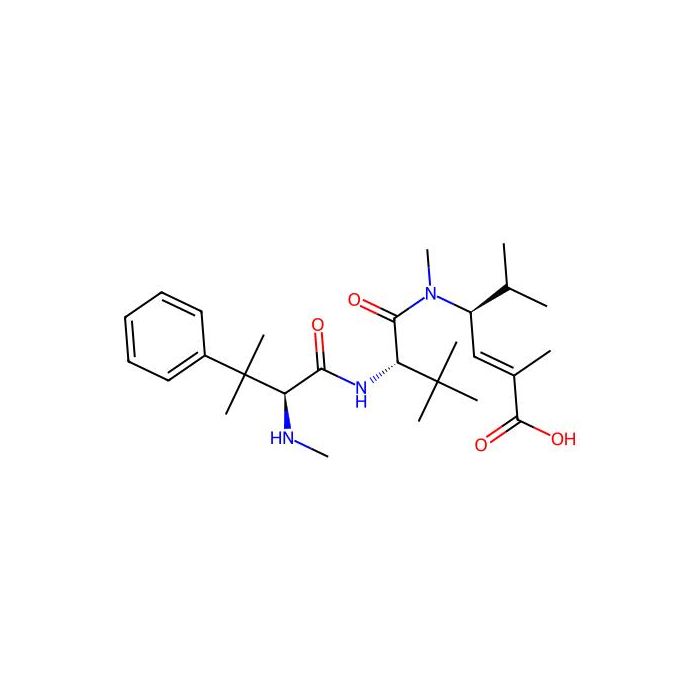
Taltobulin (HTI-286), a synthetic analogue of the tripeptide hemiasterlin, is a potent antimicrotubule agent that circumvents P-glycoprotein-mediated resistance in vitro and in vivo. Taltobulin inhibits the polymerization of purified tubulin, disrupts microtubule organization in cells, and induces mitotic arrest, as well as apoptosis
In Vitro
Taltobulin (HTI-286; 0.2-7.3 nM; 3 days) inhibits the growth of 18 tumor cell lines (leukemia, ovarian, NSCLC, breast, colon, and melanoma cell lines) with an average IC 50 of 2.5±2.1 nM and a median value of 1.7 nM. MCE has not independently confirmed the accuracy of these methods. They are for reference only. Cell Proliferation AssayCell Line: Leukemia CCRF-CEM cell line; ovarian 1A9 cell line; NSCLC A549 and NCI-H1299 cell lines; breast MX-1W and MCF-7 cell lines; colon HCT-116, DLD-1, Colo205, KM20, SW620, S1, HCT-15 and Moser cell lines; melanoma A375, Lox and SK-Mel-2 cell lines Concentration: 0.2-7.3 nM Incubation Time: 3 days Result: Inhibited the growth of tumor cell lines with IC 50 s of 0.2±0.03 nM (for leukemia CCRF-CEM cell line), 0.6±0.1 nM (for ovarian 1A9 cell line), 1.1±0.5 and 6.8±6.1 nM ( for NSCLC A549 and NCI-H1299 cell lines), 1.8±0.6, 7.3±2.3 nM (for breast MX-1W, MCF-7 cell lines), 0.7±0.2, 1.1±0.4, 1.5±0.6, 1.8±0.6, 3.6±0.8, 3.7±2.0, 4.2±2.5, and 5.3±4.1 nM ( for colon HCT-116, DLD-1, Colo205, KM20, SW620, S1, HCT-15, and Moser cell lines), 1.1±0.8, 1.4±0.6 and 1.7±0.5 nM (for melanoma A375, Lox and SK-Mel-2 cell lines).
In Vivo
Taltobulin (HTI-286; 1.6 mg/kg i.v.) inhibits the growth of human tumor xenografts (e.g., HCT-15, DLD-1, MX-1W, and KB-8-5) in athymic nu/nu female mice . ?\nTaltobulin (HTI-286; 3 mg/kg; p.o. gavage) inhibits growth by 97.3 % and 82% in athymic nu/nu female mice with Lox melanoma xenografts and KB-3-1 epidermoid xenograft model, respectively . MCE has not independently confirmed the accuracy of these methods. They are for reference only. Animal Model: Athymic nu/nu female mice with Lox melanoma model (5-6 weeks of age) Dosage: 1.6 mg/kg Administration: Administered i.v.;for 35 days Result: Growth of Lox tumors was inhibited by 96-98% on day 12 compared with vehicle-treated controls. Growth of KB-8-5 tumors was inhibited by 84% on day 14 compared with vehicle-treated controls. Growth of MX-1W tumors was inhibited by 97% compared with vehicle-treated controls. Growth of DLD-1 and HCT-15 tumors was inhibited by 80 and 66%, respectively.
IC50& Target:Traditional Cytotoxic Agents
Documento completo su pericoli, manipolazione, stoccaggio e conformità normativa.
<<<<<<< HEAD Scarica SDS → ======= Scarica SDS → >>>>>>> release248-p3Dati di qualità specifici del lotto. Inserisci il numero di lotto per recuperare il COA esatto.
Cerca COA →Riepilogo di riferimento rapido delle specifiche e applicazioni del prodotto.
Visualizza scheda tecnica →Attributi di qualità completi e criteri di accettazione per questa qualità.
Visualizza scheda delle specifiche →Find and download the COA for your product by matching the lot number on the packaging.
| Lot Number | Certificate Type | Data | Oggetto |
|---|---|---|---|
| Certificate of Analysis | Sep 07, 2026 | T655576 |
Only item-specific, tested protocols should be listed here.
General suggestion
Scope: For research use only. The following summarizes literature-level biological context for microtubule-targeting tool compounds; it is not an item-specific performance claim.
General mechanism and cellular effects (literature/general knowledge)
Use cases in chemical biology
Notes and cautions
Not a buffering reagent. However, buffer choice is critical for biological assays using Taltobulin.
General guidance for preparing working solutions (literature/practice; not item specifications)
Electrophoresis or biochemical assay buffers
Documentation
Scope note: This section typically addresses greener choices for reaction solvents or reagents. Taltobulin is a bioactive small molecule used as a research probe, not a process solvent or commodity reagent. Consequently, classical “green replacement” guidance is not directly applicable to the compound itself.
Practical sustainability considerations for handling bioactive small molecules (general)
Alternatives within the tool-compound space
No therapeutic or clinical claims are made. This product is supplied strictly for research use only.
Formulation and development research context (general; not item-specific claims)
Best practices
Item-specific physical properties (from Product Data)
Literature/general expectations for handling bioactive small molecules (not item specifications)
Practical notes
Item-specific quality information (from Product Data)
How to interpret grades (general guidance; not item-specific claims)
What to check on the CoA/Spec Sheet
Stabilizers/additives
Fit-for-purpose considerations
Applicability: As a bioactive probe, Taltobulin is not typically employed as a synthetic reagent or solvent. Its “applications” in research are primarily as a chemical tool compound.
Research applications (literature/general knowledge; not item-specific claims)
Practical considerations
Not typically applicable. Taltobulin is a research-use bioactive compound rather than a reagent for synthetic transformations.
For researchers conducting biology/biochemistry assays (general guidance; not item-specific specifications)
For chemical analysis
Always adapt to your laboratory SOPs and validate conditions for your specific assay or analytical platform.
Item-specific hazard information (from Product Data)
General safety guidance for bioactive tubulin modulators (literature/general knowledge; not item-specific)
Always consult the product-specific SDS supplied by Aladdin Scientific for authoritative hazard, handling, and emergency information.
Applicability: Taltobulin is a bioactive small molecule; solvent choice primarily concerns preparation of stock solutions for biochemical or cellular assays rather than use as a reaction solvent.
General guidance (literature/practice; not item specifications)
Polarity/miscibility context
Practical tips
Comparison (general)
Item-specific (from Product Data)
General best practices for this compound type (literature/practice; not item-specific guarantees)
Not specified for this item; refer to CoA/Spec Sheet
Brief description: Taltobulin is a research-use small molecule commonly employed as a tubulin-acting probe in chemical biology and screening collections.
Item-specific (from Product Data)
General structural notes (literature/general knowledge; not item specifications)
2D-structure description (general, literature-level)
Identity confirmation guidance (general best practice)
Applicability note: Taltobulin is a finished bioactive small molecule used as a tool compound; it is not typically employed as a reagent, catalyst, or protecting group in synthesis.
General synthetic context (literature-level; not item-specific)
When a chemist might engage synthetically
Takeaway
Only item-specific information should be listed here.
Note: While microtubules/tubulin are commonly cited in the literature for this class of compounds, no item-specific target data are provided in the Product Data for SKU T655576.