QUALITÀ & PUREZZAMoligand™?Moligand™ — Aladdin's line of ligands and bioactive small molecules. Use for receptor, pathway, and binding studies needing defined small-molecule tools.≥98%
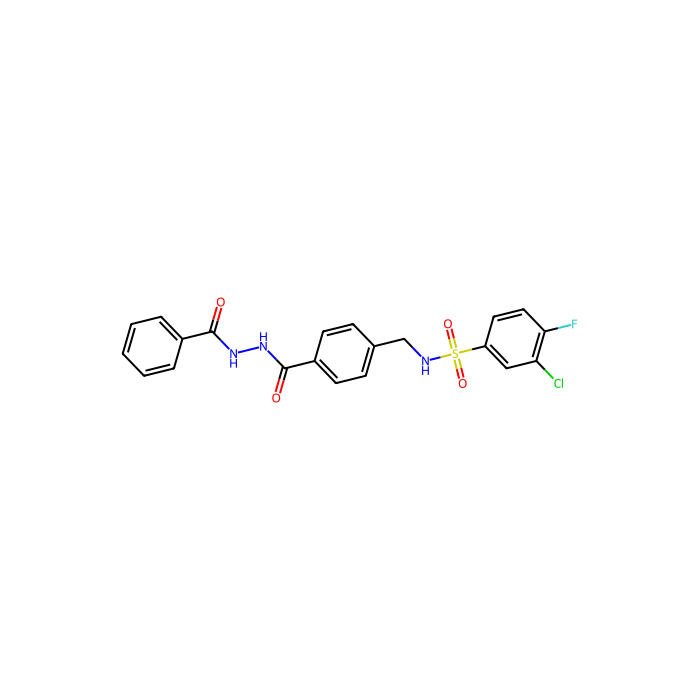
3-Chloro-4-fluoro-N-[4-[[2-(phenylcarbonyl)hydrazino]carbonyl]benzyl]benzenesulfonamide | 4-[[[(3-chloro-4-fluorophenyl)sulfonyl]amino]methyl]-benzoic acid 2-benzoylhydrazide | 3-chloro-4-fluoro-N-({4-[(phenylformohydrazido)carbonyl]phenyl}methyl)benzene-1-sulfonamide | N-[[4-(benzamidocarbamoyl)phenyl]methyl]-3-chloro-4-fluorobenzenesulf Mostra altro
Specifiche e purezza
Moligand™, ≥98%
Meccanismi biochimici e fisiologici
NMDA receptor antagonist selective for GluN1/GluN2A (formally NR1/NR2A) over GluN1/GluN2B (formally NR1/NR2B) containing receptors (pIC50values are 6.8 and <4.3, respectively, in human recombinant GluN1/GluN2A (formally NR1/NR2A) and GluN1/GluN2B (formally NR1/NR2B) FLIPR/Ca2+assays).Please refer toIUPHAR Guide to Pharmacologyfor the most recent naming conventions.TCN-201 is a sulphonamide derivative, that negatively modulates glycine binding to the GluN1 (glutamate receptor subunit) subunit of the receptor.
TCN-201 is the first NMDA receptor antagonist that is specific for NR2A-subunit containing receptors. The pIC50 for NR2A NMDA receptors is 6.8. TCN-201has no effect on NR2B-containing receptors at concentrations up to 50 mM.
Condizioni di conservazione di stoccaggio
Protected from light,Store at -20°C,Argon charged
Spedito in
Ice chest + Ice pads
Questo prodotto richiede spedizione a catena fredda. I servizi di terra e altri servizi economici non sono disponibili.
This compound belongs to the class of organic compounds known as benzenesulfonamides. These are organic compounds containing a sulfonamide group that is S-linked to a benzene ring.
External Descriptors
Not available
1. Djoumbou Feunang Y, Eisner R, Knox C, Chepelev L, Hastings J, Owen G, Fahy E, Steinbeck C, Subramanian S, Bolton E, Greiner R, and Wishart DS. ClassyFire: Automated Chemical Classification With A Comprehensive, Computable Taxonomy. Journal of Cheminformatics, 2016, 8:61.
P304+P340:IF INHALED: Remove person to fresh air and keep comfortable for breathing.
P305+P351+P338:IF IN EYES: Rinse cautiously with water for several minutes. Remove contact lenses if present and easy to do - continue rinsing.
P362+P364:Take off contaminated clothing and wash it before reuse.
P405:Store locked up.
P403+P233:Store in a well-ventilated place. Keep container tightly closed.
P501:Dispose of contents/container to an approved waste disposal plant.
P264+P265:Wash hands [and …] thoroughly after handling. Do not touch eyes.
P337+P317:If eye irritation persists: Get medical help.
P332+P317:If skin irritation occurs: Get medical help.
P319:Get medical help if you feel unwell.
WGK Germania
3
Calcolatori di soluzioni
Molarity Calculator
Determine the necessary mass, volume, or concentration for preparing a solution.
Dilution Calculator
Determine the dilution needed to prepare a stock solution.
Reconstitution Calculator
Recensioni
Recensioni dei clienti
Application Protocols
No tested application protocols, recommended dilutions, or positive controls are provided in the Product Data for this item.
General guidance for small-molecule assay use:
Stock preparation:
Prepare a concentrated stock in anhydrous DMSO under argon; protect from light. Typical working stocks are 10–50 mM. Filter if particulate is present (0.22 µm PTFE).
Assay setup:
Dilute stock into assay buffer or media, keeping final DMSO consistent across conditions (commonly ≤0.5–1% v/v). Include vehicle controls and, where possible, orthogonal readouts.
Plate handling:
Minimize edge effects by equilibrating plates, using randomized layouts, and sealing to limit evaporation. Record exact solvent percentages and timing.
Data integrity:
Confirm absence of fluorescence/absorbance interference if using optical readouts. Run serial dilutions to establish concentration–response behavior and detect solubility-limited plateaus.
Consult internal SOPs and literature specific to the intended target/system for optimized parameters.
Biological Roles
No item-specific biological/target data are provided in the Product Data. The following information is general and literature-oriented.
General role of small-molecule ligands in research:
Serve as chemical probes to interrogate protein function, validate targets, and map signaling pathways in cell-free and cellular systems.
Enable SAR studies when combined with analog series, guiding optimization of potency, selectivity, and ADME properties.
Literature note (not item-specific):
Molecules referred to as TCN-201 in the literature have been described as modulators of ionotropic receptor function in neuropharmacology research. If your work relies on such activity, confirm the structure and provenance of this specific item against authoritative references before assuming biological behavior.
Practical considerations:
Record solvent composition, exposure time, and temperature in assays, as small-molecule activity can be sensitive to these parameters.
Consider potential off-target interactions at higher concentrations; include proper controls (vehicle, inactive analogs, orthogonal assays).
This product is intended strictly for research use only and is not for human or veterinary use.
Buffer Applications
Not typically applicable. TCN 201 is a small-molecule ligand rather than a buffering agent. It does not constitute a buffer system and is not used to set or maintain pH.
Practical note for assay buffers (general guidance):
Prepare ligand stocks in DMSO or ethanol, then dilute into pre-selected biological buffers (e.g., HEPES, phosphate, Tris) appropriate to your assay’s pH range.
Maintain constant organic solvent percentage across control and treated samples to avoid confounding effects.
Refer to the Solvent Selection and Application Protocols sections for dissolution and dilution practices.
Green Alternatives
For this screening ligand, "green alternatives" primarily relate to solvent choices and handling, since the molecule itself is fixed.
Greener solvent choices for dissolution and work-up (general guidance):
Prefer ethanol or water-miscible bio-derived solvents (e.g., 2-MeTHF for organic processing, Cyrene for some polar aprotic needs) when compatible with solubility and assay constraints.
Reduce DMSO where possible by using co-solvent systems (e.g., ethanol + buffer) to keep final organic solvent content low.
Comparison of common solvents (general):
DMSO:
Pros: Excellent solvency; widely accepted in screening. Cons: Persistence in wastewater; can facilitate dermal absorption.
Ethanol:
Pros: Renewable, low toxicity. Cons: Lower solvency for many hydrophobic scaffolds; may impact membrane integrity at higher %.
Acetonitrile vs methanol (analytical):
ACN offers low viscosity and superior LC performance but is petro-derived; MeOH is less hazardous but increases backpressure and may change selectivity.
2-MeTHF (for synthesis/processing):
Greener alternative to THF with higher boiling point and lower peroxide propensity; applicability depends on the compound’s solubility and process needs.
Operational green practices:
Use minimal volumes, prepare concentrated stocks to reduce solvent usage, and aliquot to avoid repeated freeze–thaw. Implement proper waste segregation and consider in-house solvent recycling where appropriate.
Pharmaceutical Uses
Not applicable as a pharmaceutical excipient or approved ingredient per the provided Product Data. This product is sold for research use only.
Formulation-related considerations for research use (general):
For in vitro studies:
Prepare DMSO stocks and dilute into assay media; confirm absence of precipitation and monitor stability over the assay timeframe.
For exploratory in vivo research (where institutionally permitted):
Establish a formulation that balances solubility and tolerability (e.g., PEG400/saline, ethanol/cremophor/saline), but such use requires rigorous safety review and is outside the scope of this catalog entry.
There are no pharmacopeial monographs or excipient roles specified for this item. Any manufacturing or clinical applications are not covered and are not authorized under the stated research-use-only designation.
Physical Properties
Item-specific physical constants are not provided in the Product Data.
Item-specific values:
Appearance: Not specified for this item; refer to CoA/Spec Sheet.
Melting point, boiling point, density, refractive index, pKa, logP/logD, UV-Vis profile: Not specified for this item; refer to CoA/Spec Sheet.
Solubility: Not specified for this item; refer to CoA/Spec Sheet.
General/literature-based guidance for small-molecule screening ligands (not item-specific):
Solubility practices:
Many discovery ligands are sparingly soluble in water and are commonly prepared as concentrated stocks (e.g., 10–50 mM) in anhydrous DMSO for bioassays, then diluted into assay buffer with final DMSO typically kept ≤0.5% v/v to protect biological systems.
UV/LC characterization:
If performing purity checks by HPLC/UPLC, typical gradients use aqueous buffer (0.1% formic acid or ammonium acetate) to acetonitrile or methanol, with detection at 210–280 nm. Optimize wavelength once the compound’s chromophores are confirmed from an authentic spectrum.
Solid-state considerations:
Some bioactive small molecules may exhibit polymorphism or amorphous character, influencing apparent solubility and dissolution rate. Record any observation of turbidity or precipitate during buffer dilution.
Always defer to the CoA/SDS for authoritative, compound-specific physical data prior to scaling or formulating.
A discovery/screening-oriented grade intended for use as a small-molecule ligand in research assays, chemical biology, or screening libraries. Typical expectations include high identity confirmation and assay-suitable purity; however, exact purity specifications, residual solvent limits, and elemental/metal profiles are lot-dependent.
Item-specific details provided:
Purity/assay: Not specified for this item; refer to CoA/Spec Sheet.
Stabilizers/additives: Not specified for this item; refer to CoA/Spec Sheet.
UV cutoff/LC baseline characteristics: Not specified for this item; refer to CoA/Spec Sheet.
Best practices for quality verification (general):
Confirm lot-specific purity by HPLC/UPLC with PDA or MS detection when results drive critical decisions.
Verify identity by HRMS and, if needed, 1H/13C NMR. Record water content by Karl Fischer if hygroscopic behavior is suspected.
If the compound may racemize or exist as tautomers, document stereochemical integrity and time-dependent profiles under your storage and assay conditions.
Reaction and Applications
Item focus is as a research ligand in small-molecule collections rather than a synthetic reagent. No manufacturer reaction examples are provided.
Research applications (general for Moligand™ library compounds):
Use as a tool compound in biochemical, biophysical, and cell-based assays to probe target engagement, pathway modulation, or structure–activity relationships (SAR) alongside analogs.
Benchmarking in binding/functional assays as a reference modulator when supported by literature for the named scaffold.
Assay implementation tips (general):
Prepare fresh DMSO stocks under inert atmosphere if air-/light-sensitive (this item is to be protected from light and stored under argon at −20°C per Product Data).
Filter sterilize through 0.22 µm PTFE when sterility is required; avoid cellulose esters if solvent contains DMSO.
Perform solubility and stability checks at working concentrations in your assay buffer (observe for precipitation or signal drift over time).
Literature context (non-item-specific):
Compounds bearing the TCN-201 designation have been reported as selective small-molecule receptor modulators in neuroscience research settings. If using this item as such, verify structural identity and compare to authoritative literature prior to adopting concentrations or protocols.
This item is not typically used in named organic reactions (e.g., cross-couplings) as a reagent; see the Synthetic Utility section only if you plan to derivatize the scaffold.
Reaction Conditions
No item-specific reaction conditions are provided, and the product is not primarily intended as a synthetic reagent. The following is general guidance only, applicable if you plan to derivatize or analyze the compound.
Stock solution preparation (general):
Dissolve in anhydrous DMSO under inert atmosphere to prepare 10–50 mM stocks; sonication and gentle warming (≤40°C) may aid dissolution. Protect from light per Product Data.
Purification/analysis:
Reverse-phase HPLC with water (0.1% formic acid or ammonium acetate) and acetonitrile/methanol gradient is common. Monitor multiple wavelengths if chromophores unknown.
Stability checks:
Evaluate stability over 24–72 h at room temperature and 4°C in assay-relevant buffers; compare to frozen aliquots to identify degradation or adsorption losses.
If conducting synthetic modifications (scaffold-dependent):
Choose conditions compatible with any sensitive heterocycles or halogens once the structure is confirmed. Many bioactive heteroaromatics are moisture/air-sensitive under strong basic or oxidative conditions; mild cross-coupling catalysts and neutral to slightly basic media are often preferred.
Always use the verified structure and consult primary literature for the specific TCN-201 scaffold before selecting reaction conditions.
Safety and Handling
Safety information specific to this item is limited in the Product Data.
Item-specific hazard data:
Signal word: Not specified for this item; refer to SDS.
H-statements: Not specified for this item; refer to SDS.
GHS classification: Not specified for this item; refer to SDS.
Pictograms: Not specified for this item; refer to SDS.
General laboratory handling guidance (not a substitute for the SDS):
Personal protective equipment:
Wear lab coat, safety glasses, and suitable chemically resistant gloves (e.g., nitrile). Use in a chemical fume hood to avoid inhalation of dust or vapors.
Handling:
Avoid inhalation and skin contact; prevent generation of dust/aerosols. For bioassay stocks, handle anhydrous DMSO solutions carefully to prevent dermal absorption of dissolved compounds.
Storage incompatibilities and cautions:
Follow item-specific storage: store at −20°C, protected from light, under argon. Keep container tightly closed to limit moisture/oxygen ingress and photodegradation.
Keep away from strong oxidizers and sources of ignition as a general precaution for organic small molecules.
First-aid overview (general):
Skin: Wash with soap and water. Eyes: Rinse cautiously with water for several minutes; remove contact lenses if present. Ingestion/inhalation: Seek medical attention; provide SDS.
Spill and disposal:
Absorb small spills with inert material and dispose according to institutional and local regulations. Collect organic waste separately and label clearly.
Always consult the SDS for definitive hazard classification and response measures.
Solvent Selection
This product is a small-molecule library ligand; no item-specific solubility data are provided. The following guidance is general for hydrophobic/heteroaromatic ligands and should be adapted once the structure/CoA is reviewed.
Primary stock solvent (general best practice):
Anhydrous DMSO for concentrated stocks (e.g., 10–50 mM) owing to broad solvating power and compatibility with biochemical assays at low final %.
Secondary solvents for preparative work:
DMF or NMP for difficult solutes (synthetic settings), ethanol or acetonitrile for HPLC-friendly intermediate stocks.
Aqueous compatibility:
Expect limited water solubility; prepare working solutions by serial dilution of DMSO stocks into buffered saline or assay media, maintaining final DMSO ≤0.5–1% v/v as assay-tolerated.
Polarity/solvent class (general):
Likely dissolves in polar aprotic solvents (DMSO, DMF, ACN) and many organic solvents (EtOAc, MeOH) depending on functional groups.
Comparison (general guidance):
DMSO vs ethanol:
DMSO typically offers higher solubility and stability for diverse scaffolds; ethanol can be preferable for cell-based work with tighter DMSO limits but may have lower solubility.
ACN vs MeOH for analytical prep:
ACN gives lower viscosity and often better peak shape in LC; MeOH can modulate selectivity and is more protic.
Document actual solubility and stability after confirming the compound’s structure and lot characteristics.
Reconstitution guidance (general best practice for small-molecule ligands):
Upon receipt:
Allow to equilibrate to room temperature in sealed packaging to avoid condensation. Open under dry inert atmosphere if possible.
Stock solution:
Dissolve in anhydrous DMSO to a convenient concentration (e.g., 10–50 mM). Vortex/sonicate gently if needed. If particulate remains, warm mildly (≤40°C) or consider an alternate solvent compatible with downstream use.
Aliquoting:
Dispense single-use aliquots into amber vials or plates to minimize freeze–thaw and light exposure. Backfill vials with argon or nitrogen before sealing.
Storage of solutions:
Store aliquots at −20°C or below, protected from light. Avoid repeated freeze–thaw cycles; discard aliquots showing precipitation, color change, or assay signal drift.
Aqueous working solutions:
Prepare immediately before use; confirm clarity after dilution. If stability is unknown, use within the experimental day.
Note: Appearance, exact solubility, and stability limits are not specified for this item; refer to the CoA/Spec Sheet and SDS for lot-specific guidance.
Structure and Identity
Concise identity summary for a small-molecule screening ligand.
Item-specific (from Product Data):
Product name: TCN 201
CAS: 852918-02-6
CID: 4787937
InChIKey: 95360 (as provided; note this is not in the standard 27-character format)
SMILES: Not specified for this item; refer to CoA/Spec Sheet.
Molecular formula: Not specified for this item; refer to CoA/Spec Sheet.
Molecular weight: Not specified for this item; refer to CoA/Spec Sheet.
Structural features:
2D structure description: Not available in the provided data. Without a definitive SMILES/InChI, ring systems, substituents, and stereochemical elements cannot be enumerated for this specific lot. Please consult the CoA or supplier SDS for a structure diagram.
Cross-referencing guidance:
Use the CAS or PubChem CID to locate a full structural record and verify against your project’s requirements. Ensure any downloaded structure matches your intended isomer and salt form.
Notes on identity control in screening collections (general guidance):
For discovery compounds, confirm identity by orthogonal methods (e.g., HRMS, 1H/13C NMR) upon receipt if your workflow requires analytical verification.
If multiple tautomers or polymorphs are possible for the scaffold, document the form used in assays to support reproducibility.
Synthetic Utility
Primary use is as a finished small-molecule ligand for screening; it is not positioned as a building block or reagent in routine synthetic transformations.
When derivatization is desired (general guidance):
Confirm the exact scaffold from the CoA/structure record, then plan modifications at positions least likely to disrupt core binding interactions if retaining biological activity is a goal (bioisosteric replacement, vector exploration, or handle installation for PROTAC/bioconjugation concepts).
Typical tactics include amide coupling (if a carboxyl/amine is present), heteroaryl cross-coupling (Suzuki–Miyaura, Buchwald–Hartwig) if aryl halides/boronates exist, or late-stage C–H functionalization depending on the scaffold.
Analytical support:
For any semi-synthesis, employ LC–MS for rapid profiling, and NMR for structure confirmation. Assess purity to ≥95% for SAR comparability unless otherwise justified.
Because the precise functional groups of this item are not specified here, do not assume compatibility with specific reaction conditions without consulting the detailed structure and literature precedents for the TCN-201 scaffold.
Target Specificity
No target, epitope, clone, or isotype information is provided in the Product Data for this small-molecule product. Target specificity details are not available for this item.
If you intend to use TCN 201 as a reference ligand for a particular protein target, verify identity and target annotations from peer-reviewed literature and match them to this product’s exact structure and lot.
Domande frequenti
What is the purity of this product?
This product is supplied at ≥98% purity (chemical assay). Lot-specific values are stated on the Certificate of Analysis.
What is Moligand??
Moligand? is one of Aladdin Scientific's premium product lines, formulated for high-purity applications across multiple workflows. Compared to standard grades in the same workflow, Moligand? products typically offer tighter specifications, more rigorous QC, and stronger lot-to-lot consistency.
How should this product be stored?
Store at ?20 °C, protected from light, under argon. It is supplied under an argon blanket; reseal under inert gas after each use.
How is this product shipped?
This product ships in an insulated container with ice pads. Unpack on arrival and transfer it to the storage condition stated above.
What are the CAS number, molecular formula and molecular weight?
The CAS Number is 852918-02-6, the molecular formula is C21H26N4O2, and the molecular weight is 366.46 g/mol. InChIKey FYIBXBFDXNPBSF-UHFFFAOYSA-N.
What documentation is provided?
Available product documentation, including Certificates of Analysis (COA), Safety Data Sheets (SDS), and specification sheets, is shown in the product document area. Document availability and access follow the current site policy.
Hai bisogno di aiuto per scegliere la qualità?
La nostra guida alla selezione delle qualità copre purezza, stato dello stabilizzatore e idoneità all'applicazione per tutte le varianti del nostro catalogo.
Utilizziamo i cookie per garantire il corretto funzionamento del sito web e, ove consentito, per migliorare la tua esperienza. Puoi gestire le tue preferenze in qualsiasi momento nelle Impostazioni. Per saperne di più, consulta la nostra Cookie Policy.
Desidera che le inviamo un messaggio quando avremo sconti disponibili?
Ricordamelo più tardi
Grazie! Controlli la sua casella di posta per confermare.
Products are supplied to verified businesses, institutions, and qualified professionals for research and development use only. Not for use in humans, animals, diagnosis, or therapy.

 C2328985