≥98% per flussi di lavoro cromatografici e analitici sensibili che richiedono un'interferenza minima della linea di base.
🌡
Stoccaggio e spedizione
Store at -20°C Spedizione Ice chest + Ice pads. Consultare il COA specifico del lotto per le specifiche esatte.
📋
Documenti di qualità
SDS, COA, scheda tecnica e scheda delle specifiche disponibili per il download. COA specifico del lotto accessibile tramite ricerca per numero di lotto.
📚
Prova documentale
Citato in 0 pubblicazioni peer-reviewed su cromatografia, sintesi organica e reazioni di accoppiamento incrociato.
Panoramica
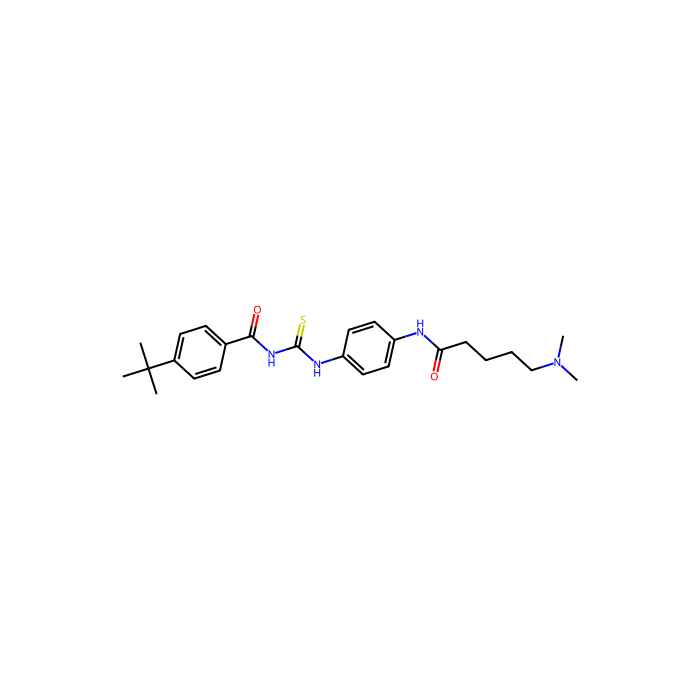
Tenovin-6 is the water soluble analog of Tenovin-1 and acts as a potent SIRT1 and SIRT2 inhibitor as well as p53 activator. SIRT1 and SIRT2 are protein-deacetylases that belong to the NAD|+|-dependent class III histone deacetylases. Although the function of sirtuins in humans is not entirely known, in yeast, they have been shown to regulate epigenetic gene expression. Studies show that tenovin-6 increases p53 levels more than tenovin-1 and is also more toxic to yeast. Tenovin-6 has also been shown to inhibit SIRT3.
This compound belongs to the class of organic compounds known as n-acyl-phenylthioureas. These are thiourea derivatives where one nitrogen atom of the urea group is linked to a phenyl group and the other is acylated.
1. Djoumbou Feunang Y, Eisner R, Knox C, Chepelev L, Hastings J, Owen G, Fahy E, Steinbeck C, Subramanian S, Bolton E, Greiner R, and Wishart DS. ClassyFire: Automated Chemical Classification With A Comprehensive, Computable Taxonomy. Journal of Cheminformatics, 2016, 8:61.
Soluble in ethanol (~1 mg/ml), and DMSO (~20 mg/ml).
Indice di rifrazione
n20D1.62 (Predicted)
Peso molecolare
454.600 g/mol
XLogP3
5.100
Hydrogen Bond Donor Count
3
Hydrogen Bond Acceptor Count
4
Rotatable Bond Count
9
Exact Mass
454.24 Da
Monoisotopic Mass
454.24 Da
Topological Polar Surface Area
106.000 Ų
Heavy Atom Count
32
Formal Charge
0
Complexity
616.000
Isotope Atom Count
0
Defined Atom Stereocenter Count
0
Undefined Atom Stereocenter Count
0
Defined Bond Stereocenter Count
0
Undefined Bond Stereocenter Count
0
The total count of all stereochemical bonds
0
Covalently-Bonded Unit Count
1
Calcolatori di soluzioni
Molarity Calculator
Determine the necessary mass, volume, or concentration for preparing a solution.
Dilution Calculator
Determine the dilution needed to prepare a stock solution.
Reconstitution Calculator
Recensioni
Recensioni dei clienti
Application Protocols
Item-specific (from Product Data)
Tested applications, recommended concentrations, and detailed protocols: Not specified for this item.
General guidance (literature/institutional best practices)
Biochemical assays: Prepare fresh DMSO stock; perform concentration–response curves with appropriate controls; maintain constant DMSO across wells; include detergent if aggregation artifacts are suspected.
Cell-based assays: Filter-sterilize stock if needed; pretest solvent tolerance of the cell line; start with low micromolar to sub-micromolar ranges as guided by literature for related probes, and optimize empirically.
Data quality: Include technical replicates, plate layout to minimize edge effects, and inter-day repeat experiments. Confirm compound integrity at study end by LC.
Documentation
Record lot number, stock prep details (solvent, concentration, date), storage conditions, and freeze–thaw cycles in ELN for reproducibility.
Biological Roles
Item-specific (from Product Data)
None provided; this product is for research use only.
Literature/general context (non-clinical; for research planning)
Tenovin-class compounds are widely used as small-molecule tools to modulate NAD+-dependent deacetylase (sirtuin) activity in biochemical and cell-based studies. Researchers employ such probes to interrogate protein acetylation dynamics and downstream cellular signaling cascades.
Typical research readouts include changes in acetylation of known deacetylase substrates, shifts in transcriptional programs detectable by qPCR/RNA-seq, and phenotypic responses in cell models. These findings are assay- and context-dependent and must be independently validated.
Off-target considerations: As with many tool compounds, profile for potential off-target interactions using counterscreens and orthogonal chemotypes when drawing mechanistic conclusions (general best practice).
Important note
No medical or clinical uses are claimed or supported. All work should be conducted under appropriate institutional approvals and solely for laboratory research.
Buffer Applications
Not typically applicable
Tenovin-6 is not a buffering reagent. It is generally prepared as a DMSO stock and diluted into pre-made biological buffers or media for assays.
Practical notes (general)
When diluting into buffers, add the DMSO stock slowly with vigorous mixing to mitigate precipitation.
Validate compound stability in your chosen buffer (pH, ionic strength, protein content), as small-molecule probes can exhibit pH- and protein-binding–dependent solubility and stability.
Green Alternatives
Context
As a bioactive small molecule used primarily in assays rather than bulk synthesis, the main green-chemistry levers are solvent choice, waste minimization, and process scale.
Greener handling strategies (general)
Use the minimum effective DMSO content in assays and consider aqueous-compatible enabling excipients (e.g., cyclodextrins) to reduce aprotic solvent use.
Favor ethanol/water for cleaning and preliminary solubility screening where compatible.
Implement microscale assay formats (96-/384-well) to minimize chemical consumption and waste.
Consolidate analytical runs and use short LC methods with greener eluents (higher water content, ethanol as an alternative to acetonitrile when feasible).
Greener alternative: DMSO minimization via cosolvents or carriers; MeOH/H2O or EtOH/H2O mobile phases; miniaturized assays.
Item-specific limitations
No item-specific green data provided; verify compound stability and assay performance when substituting greener solvents or carriers.
Pharmaceutical Uses
Not applicable for this catalog item
This product is sold strictly for research use only. No excipient role, pharmacopeial status, or manufacturing application is specified for this item.
General note
Researchers sometimes use tool compounds during preclinical target validation and mechanism studies; however, such use is distinct from any clinical or manufacturing application and requires separate qualification and regulatory review.
Physical Properties
Item-specific (from Product Data)
Appearance: Not specified for this item; refer to CoA/Spec Sheet.
Grade/Purity: Not specified for this item; refer to CoA/Spec Sheet.
Molecular weight: Not specified for this item; refer to CoA/Spec Sheet.
Literature/general (typical for Tenovin-class small molecules; verify for this specific lot)
Physical state: typically an organic solid at ambient conditions (literature, general for related analogs).
Solubility: commonly soluble in organic polar aprotic solvents such as DMSO or DMF; limited aqueous solubility is typical for hydrophobic probe molecules (literature/general guidance).
Partitioning: many Tenovin analogs are moderately lipophilic, aiding cell permeability (literature/general).
Spectral characterization: UV-vis and LC-UV at 210–280 nm are frequently used for purity assessment of small-molecule probes; exact absorbance maxima depend on the chromophores present (literature/general).
Melting point, boiling point, density, logP, pKa, refractive index: Not specified for this item; consult the CoA/Spec Sheet or primary literature specific to Tenovin-6 if needed for method development.
Practical notes
Prepare concentrated master stocks in dry DMSO when compatible with your assay; filter sterilize (0.22 µm) if sterility is required for cell-based work (literature/general practice). Validate solubility and stability at intended concentrations before scale-up.
Quality and Grades
Item-specific (from Product Data)
Grade/Purity: Not specified for this item; refer to CoA/Spec Sheet.
How to interpret quality for a research probe (general guidance)
Purity metrics: For small-molecule bioactive compounds, HPLC purity (area %) and orthogonal characterization (1H/13C NMR, HRMS) are commonly provided on the CoA. For sensitive assays, confirm single-peak LC and identity by MS.
Residual solvents and water: If your application is sensitive (e.g., lyophilized powder to be reconstituted in DMSO for cellular assays), review residual solvent profile and Karl Fischer water content on the CoA when available. If not listed, consider drying under high vacuum at room temperature before use if compatible.
Batch-to-batch consistency: Record lot numbers in all experiments; verify retention time and purity by your in-house LC method to ensure consistency across studies.
Stabilizers: Not specified for this item; refer to CoA/Spec Sheet. If no stabilizer is present, minimize light/air/moisture exposure during storage and handling.
Fit for purpose
For biochemical/biophysical and cell-based assays, consider establishing an internal qualification: potency curve reproducibility, DMSO stock stability, and absence of assay-interfering impurities (e.g., aggregators or redox-active species) using control assays.
Reaction and Applications
Item-specific (from Product Data)
Manufacturer Applications: Not specified for this item.
Research Use Note: For research use only.
Applicability for this compound type (general, non-therapeutic)
Tenovin-6 is commonly used as a chemical biology tool compound in research settings to modulate NAD+-dependent deacetylase activity in vitro and in cells. Typical applications include: enzyme inhibition assays, cell-based pathway modulation studies, and target-validation experiments (literature/general; verify suitability for your assay).
Assay development tips (general)
Prepare fresh DMSO stocks, protect from light, and minimize freeze-thaw cycles.
Include DMSO-only and inactive-analog controls to detect assay interference.
Check for time-dependent effects; some probes exhibit slow equilibration with intracellular targets.
Confirm on-target biochemical activity with orthogonal readouts (e.g., substrate acetylation levels by immunoblot) to avoid false positives.
Analytical QC within assays
Monitor compound concentration by LC-UV/MS in stock and working solutions to ensure dose accuracy.
Evaluate precipitation or adsorption in plasticware; consider glass vials or low-bind plastics.
Note
This product is not positioned as a synthetic reagent; if your need is synthetic transformation, consider alternative reagents fit for the specific chemistry.
Reaction Conditions
Not applicable to this product’s typical use
Tenovin-6 is not supplied as a reagent for chemical transformation, and no synthetic reaction conditions are specified for this catalog item.
General analytical/handling conditions (literature/general)
Stock preparation: dissolve in anhydrous DMSO to a verified concentration; store aliquots at low temperature to minimize degradation.
Assay use: dilute into assay buffer or media immediately before use; maintain consistent solvent percentages across conditions to control for solvent effects.
Stability checks: periodically analyze stocks by LC-MS or LC-UV to confirm integrity during the course of a study.
Safety and Handling
Item-specific (from Product Data)
Storage: Store at -20°C.
Shipping: Ice chest + ice pads.
GHS/Signal word/H-statements/Pictograms: Not specified for this item; refer to the SDS.
General laboratory safety (literature/general guidance)
Handle in a chemical fume hood, avoiding inhalation of dust or aerosols. Use appropriate PPE: lab coat, safety glasses, and nitrile gloves. Avoid skin and eye contact.
Incompatibilities: Avoid strong oxidizers and strong acids/bases unless compatibility is verified. Do not heat to decomposition; many bioactive organics can degrade and/or emit irritating fumes upon overheating (general).
First aid (overview; defer to SDS): In case of skin contact, wash with soap and water. For eye contact, rinse cautiously with water for several minutes. If inhaled, move to fresh air. If ingested, rinse mouth and seek medical advice. Provide SDS to medical personnel.
Environmental precautions: Prevent release to the environment. Collect spills with inert absorbent and dispose of in accordance with institutional and local regulations.
Documentation
Always consult the Aladdin SDS and your institution’s risk assessment for authoritative hazard classification and exposure controls prior to use.
Solvent Selection
Item-specific (from Product Data)
No solvent recommendations are specified for this item; refer to CoA/Spec Sheet.
Literature/general guidance for small-molecule probe dissolution
Likely compatible solvents: Anhydrous DMSO is the most common vehicle for hydrophobic research probes; DMF and NMP are alternatives when higher solubility is required (literature/general).
Aqueous use: For biological assays, prepare a concentrated DMSO stock (e.g., 10–20 mM) and dilute into buffered media immediately before use, keeping final DMSO typically ≤0.1–0.5% v/v to limit solvent effects (institutional best practice; validate for your system).
Cosolvent strategies: If precipitation occurs upon dilution, add slowly with vigorous mixing, use premade DMSO:buffer cosolvent blends, or include carrier proteins/surfactants compatible with the assay (e.g., 0.01–0.1% Tween-20 for some biochemical assays). Always verify compound stability in the chosen matrix.
Analytical solvents: For LC characterization, use acetonitrile/water or methanol/water with formic acid or ammonium salts as needed for ionization; confirm compound stability under mobile-phase conditions.
When to choose alternatives
If your workflow is green-chemistry driven or DMSO-sensitive, evaluate PEG-400, cyclodextrin inclusion, or liposomal carriers (literature/general). Balance solubility, assay compatibility, and potential interference with readouts.
Storage and Reconstitution
Item-specific (from Product Data)
Storage conditions: Store at -20°C.
Shipping: Ice chest + ice pads.
General guidance (literature/institutional best practices; verify with your CoA/SDS)
Light and moisture protection: Store in tightly sealed, light-resistant containers under inert headspace if feasible. Allow vials to equilibrate to room temperature before opening to minimize condensation.
Reconstitution: Commonly reconstituted in anhydrous DMSO to prepare concentrated stocks for assay use; mix until fully dissolved. If sterility is required, pass through a 0.22 µm PTFE syringe filter. Label with compound name, lot, solvent, concentration, and date.
Aliquoting: Prepare single-use aliquots to avoid repeated freeze–thaw cycles. Track the number of freeze–thaw events if aliquoting is not possible.
Working solution stability: Assess stability in your assay matrix (buffer or media) over the intended incubation time. Discard solutions that show visible precipitation or are aged beyond validated stability windows.
Specifications not provided
Exact solubility limits, aqueous compatibility, and long-term solution stability are not specified for this item; refer to the CoA/Spec Sheet and perform small-scale validation for your application.
Structure and Identity
Item-specific (from Product Data)
Product name: Tenovin-6 (SKU: T338048)
CAS: 1011557-82-6
InChIKey: Not specified for this item; refer to CoA/Spec Sheet. (Product Data lists "35334", which is not a standard InChIKey)
SMILES: Not specified for this item; refer to CoA/Spec Sheet.
Molecular formula: Not specified for this item; refer to CoA/Spec Sheet.
Molecular weight: Not specified for this item; refer to CoA/Spec Sheet.
Category: Small molecules and compound libraries (全部 / 可售 / 小分子和化合物库)
Literature/general description (for context; not lot-specific)
Tenovin-6 is a small-molecule research probe widely used in chemical biology studies of NAD+-dependent deacetylases (sirtuins). It is commonly referenced as a cell-permeable compound employed to modulate deacetylation pathways in vitro and in cells (research use only).
Structural features (literature, qualitative): Tenovin-class molecules generally comprise aromatic/heteroaromatic systems and amide/urea-like linkages that impart planarity and H-bonding capacity; many analogs are designed to enhance cell permeability and solubility. Exact ring systems and stereochemistry for Tenovin-6 should be confirmed from the CoA/Spec Sheet for this SKU.
Identity best-practice
For unambiguous identification, consult the batch-specific CoA for NMR/HRMS/HPLC data and confirm the registry identifiers (CAS, InChI/InChIKey, SMILES) before method development or biological testing.
Synthetic Utility
Limited applicability
Tenovin-6 is a finished small-molecule research probe and is not typically used as a synthetic building block or reagent.
If used in method development or analog synthesis (general note)
Any derivatization would require knowledge of its exact functional groups and protecting-group strategy; consult primary structural data (CoA/Spec Sheet or literature) before planning transformations.
For SAR studies, researchers typically start from known Tenovin scaffolds and introduce modifications via late-stage functionalization or by de novo synthesis following published routes. Those routes, conditions, and intermediates are outside the scope of this product listing.
Target Specificity
Item-specific (from Product Data)
Target(s), affinity/potency, species reactivity, and selectivity panel: Not specified for this item; refer to CoA/Spec Sheet and primary literature.
General note
When using any tool compound to infer target biology, employ orthogonal validation (e.g., genetic knockdown/knockout, alternative chemotypes) and include negative controls to confirm specificity in your system.
Utilizziamo i cookie per garantire il corretto funzionamento del sito web e, ove consentito, per migliorare la tua esperienza. Puoi gestire le tue preferenze in qualsiasi momento nelle Impostazioni. Per saperne di più, consulta la nostra Cookie Policy.
Desidera che le inviamo un messaggio quando avremo sconti disponibili?
Ricordamelo più tardi
Grazie! Controlli la sua casella di posta per confermare.
Products are supplied to verified businesses, institutions, and qualified professionals for research and development use only. Not for use in humans, animals, diagnosis, or therapy.

 H2206119