This compound belongs to the class of organic compounds known as alkoxysilanes. These are organosilicon compounds with the general formula RO[Si](OR')(R'')(R''') (R,R' = organyl; R'',R''' = any atom).
External Descriptors
Not available
1. Djoumbou Feunang Y, Eisner R, Knox C, Chepelev L, Hastings J, Owen G, Fahy E, Steinbeck C, Subramanian S, Bolton E, Greiner R, and Wishart DS. ClassyFire: Automated Chemical Classification With A Comprehensive, Computable Taxonomy. Journal of Cheminformatics, 2016, 8:61.
P305+P351+P338:IF IN EYES: Rinse cautiously with water for several minutes. Remove contact lenses if present and easy to do - continue rinsing.
P362+P364:Take off contaminated clothing and wash it before reuse.
P405:Store locked up.
P501:Dispose of contents/container to an approved waste disposal plant.
P203:Obtain, read and follow all safety instructions before use.
P264+P265:Wash hands [and …] thoroughly after handling. Do not touch eyes.
P318:if exposed or concerned, get medical advice.
P337+P317:If eye irritation persists: Get medical help.
P332+P317:If skin irritation occurs: Get medical help.
Calcolatori di soluzioni
Molarity Calculator
Determine the necessary mass, volume, or concentration for preparing a solution.
Dilution Calculator
Determine the dilution needed to prepare a stock solution.
Reconstitution Calculator
Recensioni
Recensioni dei clienti
Application Protocols
No antibody/assay protocols apply to this chemical reagent. For practical use, see the Reaction Conditions and Reaction & Applications tabs for general sol‑gel formulation steps and handling tips.
Biological Roles
This product is a synthetic organosilicate precursor and does not have intrinsic biological roles.
General context (literature)
Tetraalkoxysilanes are used to generate inorganic silica matrices via sol‑gel processes. These matrices can physically entrap biomolecules for research applications (e.g., biosensors, immobilized enzymes), but the reagent itself is not a metabolite or signaling molecule.
Hydrolysis releases 2‑methoxyethanol, which is biologically active and toxic; avoid exposure and prevent contamination of biological systems.
No clinical or therapeutic implications are intended or implied; for research use only.
Buffer Applications
Not typically applicable. Tetra(methoxyethoxy)silane is a moisture‑sensitive silica precursor, not a buffering agent. It will hydrolyze in aqueous buffers, altering pH and composition. For practical use with this reagent, see Reaction & Applications and Reaction Conditions for sol‑gel formulation guidance.
Green Alternatives
Environmental, health, and safety considerations (general)
Hydrolysis of tetra(methoxyethoxy)silane releases 2‑methoxyethanol, a glycol ether with recognized reproductive toxicity and environmental concerns. From a green chemistry perspective, minimizing generation of this alcohol or substituting with less hazardous leaving groups is desirable.
Alternative silica precursors (literature comparison)
TEOS (tetraethyl orthosilicate): Hydrolyzes to ethanol (significantly less hazardous than 2‑methoxyethanol). Faster kinetics than 2‑methoxyethoxy; widely used, good availability.
Waterglass (sodium silicate): Aqueous, low‑VOC, benign leaving species; suitable for some coatings/adhesives but offers less control over fine structure and may introduce sodium.
Partially hydrolyzed siloxane sols: Can reduce VOC and avoid glycol ethers; tailored for specific coatings.
Trade-offs
Tetra(methoxyethoxy)silane offers improved compatibility with polar organics and slower hydrolysis (process control), at the cost of generating a more hazardous alcohol. TEOS is greener on EHS but may require tighter process control to avoid rapid gelation. Waterglass is greenest but less tunable and less suitable for high‑clarity, organic‑compatible formulations.
Process intensification options
Use closed systems and efficient condensers to capture and treat alcohol byproducts.
Replace hazardous cosolvents with greener options (e.g., EtOH, MeOH, 2‑MeTHF) when compatible with the sol‑gel chemistry.
Optimize at ambient temperature/pressure to reduce energy input.
Pharmaceutical Uses
This product is not used as a drug or therapeutic. It has no pharmacopeial monograph known to the manufacturer for excipient use.
General formulation context (literature)
Tetraalkoxysilanes may be employed in research settings to create sol‑gel derived coatings or matrices for device prototypes, diagnostics components, or immobilization supports. Any such use must ensure complete reaction and removal/capture of residual alkoxysilane and alcohol byproducts due to toxicity concerns.
No medical or clinical claims are made. For research and development use only.
Physical Properties
Item-specific values (from Product Data)
Appearance: Not specified for this item; refer to CoA/Spec Sheet.
Molecular Formula: Not specified for this item; refer to CoA/Spec Sheet.
Molecular Weight: Not specified for this item; refer to CoA/Spec Sheet.
Literature/general properties (for context; not item-specific specifications)
State: Typically a colorless to pale liquid (literature, tetraalkoxysilanes of this type).
Approx. molecular weight (literature): ~328.43 g/mol for C12H28O8Si.
Volatility: Significantly less volatile than TEOS; low vapor pressure expected (literature trend for higher‑boiling tetraalkoxysilanes bearing glycol ether groups).
Solubility: Miscible with many polar aprotic solvents (e.g., acetonitrile, THF, acetone) and alcohols; limited intrinsic miscibility with water but hydrolyzes in aqueous media (literature).
Hydrolysis: Acid- or base-catalyzed hydrolysis in the presence of water to silanols, liberating 2‑methoxyethanol (literature behavior of tetra(alkoxy)silanes).
Density, refractive index, boiling point, melting point, logP, pKa: Not specified for this item; refer to CoA/Spec Sheet. Use literature data sources or measure as needed for method development.
Note: Always verify critical physical constants experimentally or via the CoA for your specific lot before process design.
Quality and Grades
Item-specific details
Grade/Purity: Not specified for this item; refer to CoA/Spec Sheet.
Stabilizers/Inhibitors: Not specified for this item; refer to CoA/Spec Sheet.
Interpreting grades for tetraalkoxysilanes (general guidance)
High‑purity reagent or electronic grades typically control hydrolyzable chloride, total volatile bases/acids, alcohol content, and metal ion contaminants that can poison catalysts or affect film properties.
Water content is critical for predictable sol‑gel kinetics. Karl Fischer moisture limits are commonly specified for these reagents; verify on the CoA for this lot.
For chromatography or optical applications (ORMOSIL coatings), low UV‑absorbing impurities and low particulate matter can be essential.
Practical recommendations
Verify acidity/basicity (titrable impurities) and moisture before kinetics‑sensitive syntheses.
If your process is moisture‑sensitive, consider on‑receipt KF testing and, if permissible, brief drying over activated molecular sieves (note: such procedures are user‑side process steps; the supplied item’s official specifications are only those on the CoA).
Refer to the Aladdin CoA/Spec Sheet for the definitive specifications applicable to SKU T192053.
Reaction and Applications
Sol‑gel silica precursor (literature)
Serves as a tetrafunctional Si(OR)4 source for hydrolysis/condensation to Si–O–Si networks. The 2‑methoxyethoxy substituents slow hydrolysis relative to methoxy/ethoxy analogs, providing improved control over nucleation and growth of silica particles, films, and monoliths.
Useful for ORMOSIL and hybrid organic–inorganic materials where enhanced compatibility with polar organic monomers/polymers is advantageous.
Coatings and encapsulation
Enables formation of transparent, low‑shrinkage coatings on glass, metals, and polymers. The slower hydrolysis can reduce cracking and phase separation in thick films.
Entrapment of dyes, enzymes, or nanoparticles in silica matrices with reduced denaturation risk due to moderated hydrolysis exotherm (general sol‑gel practice; ensure compatibility with your biomolecules and avoid clinical/diagnostic claims).
Surface modification and crosslinking
Acts as a crosslinker for hydroxylated surfaces (glass, silica, metal oxides) via silanol condensation. Can be used to pre‑hydrolyze to oligomeric siloxanes that wet and bond surfaces.
Practical tips (general)
Dry handling; exclude moisture until hydrolysis step. Use acid (e.g., HCl, p‑TsOH) or base (e.g., NH3, amines) catalysis to tune rates and network structure.
Control water-to-silane molar ratio (R). Lower R (≤2) favors partially condensed oligomers; higher R (≥4) drives extensive network formation.
Temperature 0–60°C commonly used; cooling can moderate exotherm on water addition. Aging/drying protocols (e.g., solvent exchange) influence porosity and shrinkage.
All conditions should be optimized for your formulation; consult primary sol‑gel literature for system‑specific parameters.
Reaction Conditions
General sol‑gel conditions for tetraalkoxysilanes (literature guidance; optimize for your system):
Hydrolysis and condensation
Catalyst: Acid (e.g., 0.001–0.1 M HCl or p‑TsOH) yields more linear/weakly branched networks; base (e.g., NH3(aq), amines) promotes rapid condensation and particulate formation.
Water-to-silane molar ratio (R): 1–2 for partial hydrolysis/oligomers; 4–8 for extensive network formation; >8 for faster gelation and particle synthesis.
Solvent: Alcohols (EtOH, i‑PrOH) commonly used to homogenize mixtures; polar aprotics (MeCN, THF) can be co‑solvents to manage viscosity and evaporation.
Temperature: 0–25°C during initial hydrolysis to control exotherm; subsequent aging/condensation at 25–60°C to tune network growth.
Time: Minutes to hours for hydrolysis; hours to days for gelation/aging depending on R, catalyst, and temperature.
Practical steps
Pre‑dry glassware and solvents. Charge solvent, cool if necessary, add catalyst and water, then add silane dropwise with vigorous stirring to avoid local over‑hydrolysis.
Post‑gel processing: Solvent exchange (e.g., to EtOH or supercritical CO2) and controlled drying can minimize capillary stress and cracking.
Byproduct management: Provide adequate venting/condensation to capture 2‑methoxyethanol.
Analytical monitoring
Track conversion via FT‑IR (Si–OR loss, Si–OH/Si–O–Si growth), 29Si NMR for network speciation (T/Q signals not applicable to tetrafunctional homopolymer except Qn), viscosity, and particle size (DLS) for sols.
Safety and Handling
Item-specific hazard information from Product Data
Signal Word: Not specified for this item; refer to SDS.
H-Statements: Not specified for this item; refer to SDS.
GHS Classification/Pictograms: Not specified for this item; refer to SDS.
General safety considerations for tetraalkoxysilanes with glycol‑ether leaving groups (literature guidance)
Reactivity: Moisture-sensitive. Hydrolyzes in contact with water or humid air to silanols and silica, releasing 2‑methoxyethanol (a toxic glycol ether; reproductive toxin per literature). Control moisture exposure and capture/vent gases and vapors.
Flammability: Combustible liquid; use away from ignition sources. Vapors of the hydrolysis alcohol are flammable.
Incompatibilities: Avoid strong acids/bases unless intentionally catalyzing sol‑gel; reacts with water, alcohols (transesterification), strong oxidizers. Corrosive to some metals upon prolonged contact via acidic/byproduct formation during hydrolysis.
PPE: Chemical‑resistant gloves (e.g., nitrile), safety goggles/face shield, lab coat; handle in fume hood. Consider butyl or laminate gloves if extended exposure to glycol ethers is possible.
First aid (overview; defer to SDS): Eye/skin contact—immediately flush with water for ≥15 min; remove contaminated clothing. Inhalation—move to fresh air; seek medical attention if symptoms persist. Ingestion—rinse mouth; do not induce vomiting; get medical advice.
Storage/handling: Keep tightly closed under dry inert gas. Use dry glassware. Segregate from aqueous reagents and oxidizers. Spill control with inert absorbent; prevent contact with water during cleanup.
Always consult the product SDS for authoritative hazard, exposure limits, and emergency procedures.
Solvent Selection
This product is itself a reactive organosilicate reagent rather than a routine solvent. Selection of a working medium focuses on supporting controlled sol‑gel hydrolysis/condensation and on compatibility.
Polarity/miscibility profile (literature trends)
Miscible with many polar aprotic solvents (acetonitrile, acetone, THF) and lower alcohols (MeOH, EtOH). Limited direct miscibility with water; will hydrolyze in aqueous media.
The 2‑methoxyethoxy arms raise polarity relative to TEOS/TMOS, improving compatibility with glycol ethers and polar organics.
Media typically used with tetraalkoxysilanes (general guidance)
Alcoholic media (MeOH/EtOH/i‑PrOH) for classical sol‑gel; facilitate homogeneous mixing with added water/catalyst.
Polar aprotic co‑solvents (MeCN, THF, DMF, DMSO) when formulating hybrid sols or when water content must be minimized prior to initiating hydrolysis.
Glycol ethers (e.g., 2‑methoxyethanol, 2‑ethoxyethanol) can provide matched solubility but consider EHS implications.
When to choose this reagent vs alternatives
Choose tetra(methoxyethoxy)silane when slower, more controllable hydrolysis and better compatibility with polar organics are desired relative to TMOS/TEOS, enabling uniform films or bulk gels with reduced premature precipitation.
Consider TEOS when a benign leaving alcohol (ethanol) is preferred and faster hydrolysis is acceptable; consider TMOS for very fast hydrolysis and high volatility (with increased toxicity concerns).
Note: If the reagent is used as a component in a solvent system, account for its moisture sensitivity and potential transesterification in protic media.
Storage and Reconstitution
Item-specific storage and shipping
Storage Conditions: Store at 2–8°C (from Product Data).
Shipped In: Wet ice (from Product Data).
General handling and storage guidance (literature)
Moisture sensitive. Store tightly sealed under dry inert gas (argon or nitrogen). Use desiccant and minimize headspace where feasible.
Do not freeze unless validated; repeated freeze–thaw is not applicable but low temperatures can increase viscosity and slow equilibration.
If a precipitate or phase separation is observed after cold storage, allow to warm to ambient under dry inert atmosphere and mix thoroughly before use.
Dispense using dry syringes or cannula techniques to limit moisture ingress.
Reconstitution
Not applicable; supplied as a neat liquid reagent. If formulation is required, prepare immediately before use by diluting in anhydrous, compatible solvent (e.g., EtOH, i‑PrOH, MeCN) under dry conditions.
Always refer to the product CoA and SDS for lot‑specific guidance and safety information.
Structure and Identity
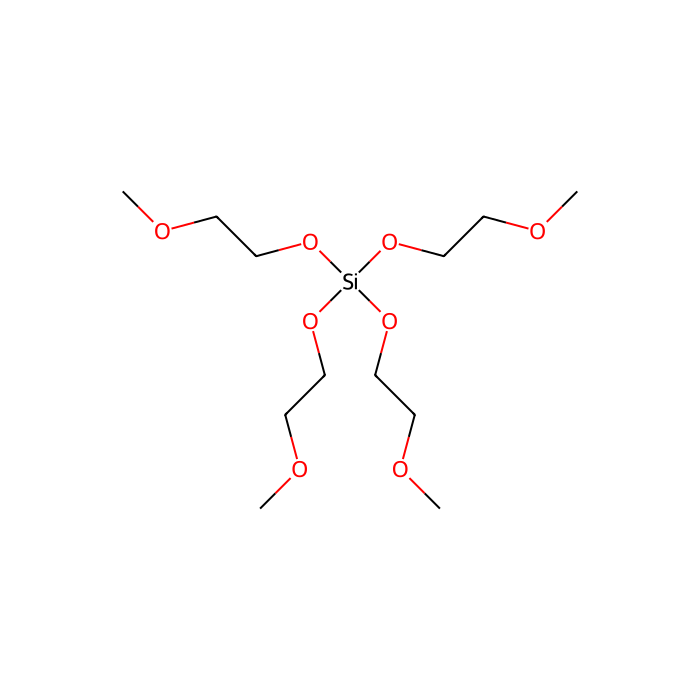
Tetra(methoxyethoxy)silane is a tetraalkoxysilane where silicon is bound to four 2‑methoxyethoxy (–O–CH2–CH2–O–CH3) groups; it is a sol‑gel silica precursor with internal ether functionality on each alkoxy arm.
Item-specific (from Product Data)
Product Name: tetra(Methoxyethoxy)silane
CAS: 2157-45-1
InChIKey: 168653
SKU: T192053
Category: 化学和生化试剂 (research use only)
Literature/computed identifiers (general reference; not item-specific specs)
Preferred name (literature): Tetrakis(2‑methoxyethoxy)silane; Si[OCH2CH2OCH3]4
Central tetrahedral Si(IV) fully substituted by four alkoxy substituents.
Each substituent is a 2‑methoxyethoxy chain, introducing an internal ether oxygen and a terminal methoxy group, increasing polarity versus simple C1–C3 alkoxysilanes.
2D description: A silicon center with four Si–O single bonds radiating to –CH2–CH2–O–CH3 chains; no rings, no stereocenters, neutral, non-aromatic.
Synthetic Utility
Functional group reactivity (general)
Si–OR groups are hydrolyzable to Si–OH, which then condense to Si–O–Si networks. The 2‑methoxyethoxy substituents are less labile than methoxy/ethoxy, offering slower, more controllable conversion.
Transesterification can occur with other alcohols under acidic/basic catalysis, enabling exchange of the OR group for process tailoring.
Applications in synthesis and materials
Precursor to silica gel, monoliths, and thin films via controlled sol‑gel; useful for embedding catalysts, dyes, or nanoparticles.
Fabrication of ORMOSIL hybrids by co‑condensation with organo‑trialkoxysilanes (e.g., R′–Si(OR)3) to introduce organic functionality (epoxy, methacrylate, amine) into the network.
Surface priming: Generation of silanol‑rich layers for subsequent functional silane coupling to substrates (glass, metal oxides, ceramics).
Retrosynthetic value
Serves as a tetrafunctional crosslinking node for designing network architectures; choice of OR group tunes hydrolysis/condensation kinetics, impacting porosity, shrinkage, and optical clarity.
Target Specificity
Not applicable. This product is a small‑molecule organosilicate reagent, not a biological targeting reagent (e.g., antibody, ligand, or inhibitor). No antigen/epitope, species reactivity, clone, or isotype information applies.
Utilizziamo i cookie per garantire il corretto funzionamento del sito web e, ove consentito, per migliorare la tua esperienza. Puoi gestire le tue preferenze in qualsiasi momento nelle Impostazioni. Per saperne di più, consulta la nostra Cookie Policy.
Desidera che le inviamo un messaggio quando avremo sconti disponibili?
Ricordamelo più tardi
Grazie! Controlli la sua casella di posta per confermare.
Products are supplied to verified businesses, institutions, and qualified professionals for research and development use only. Not for use in humans, animals, diagnosis, or therapy.

 H1919037