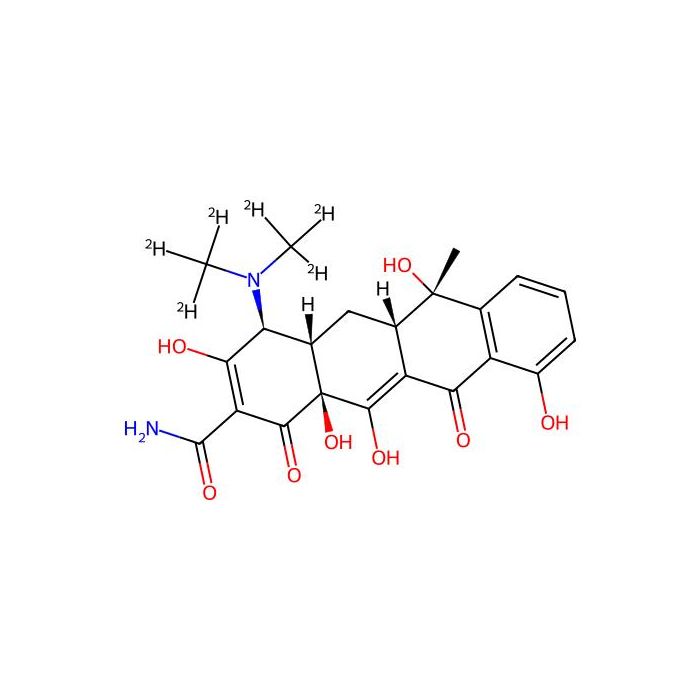
Tetracycline-d 6 is the deuterium labeled Tetracycline . Tetracycline is a broad-spectrum antibiotic , exhibiting activity against a wide range of gram-positive and gram-negative bacteria.
In Vitro
Stable heavy isotopes of hydrogen, carbon, and other elements have been incorporated into drug molecules, largely as tracers for quantitation during the drug development process. Deuteration has gained attention because of its potential to affect the pharmacokinetic and metabolic profiles of drugs. MCE has not independently confirmed the accuracy of these methods. They are for reference only.
Specifiche
Meccanismi biochimici e fisiologici
Tetracycline-d 6 is the deuterium labeled Tetracycline . Tetracycline is a broad-spectrum antibiotic , exhibiting activity against a wide range of gram-positive and gram-negative bacteria.
Condizioni di conservazione di stoccaggio
Store at -20°C
Spedito in
Ice chest + Ice pads
Questo prodotto richiede spedizione a catena fredda. I servizi di terra e altri servizi economici non sono disponibili.
Determine the necessary mass, volume, or concentration for preparing a solution.
Dilution Calculator
Determine the dilution needed to prepare a stock solution.
Reconstitution Calculator
Recensioni
Recensioni dei clienti
Application Protocols
Example protocols are provided as general guidance for research use. Adjust to your instrumentation and SOPs.
Preparation of stock and working solutions (LC–MS)
Equilibrate vial to room temperature in the dark. 2) Prepare a 1–10 mg/mL stock in anhydrous methanol or DMSO. 3) Vortex until fully dissolved; if needed, sonicate briefly avoiding heat. 4) Aliquot into amber microvials; store at −20°C.
For working solutions (0.1–10 µg/mL), dilute stock into water:methanol (50:50) with 0.1% formic acid. Keep final DMSO ≤1%.
Internal standard spiking for matrix samples
Add IS at a fixed concentration to all calibrators, QCs, and unknowns prior to extraction. Typical IS level is chosen to bracket expected analyte concentrations; verify linearity and matrix effects.
For protein precipitation, mix sample with 3–4 volumes acetonitrile containing IS and 0.1% formic acid; vortex, centrifuge, and inject supernatant after dilution with aqueous mobile phase.
System suitability checks
Monitor retention time, peak symmetry, and the expected +6 Da mass transition. Track qualifier/quantifier ion ratios to confirm identity.
Light and metal precautions
Use amber ware and acidified solutions; avoid contact with glass containing leachable alkali where possible or precondition with acidified solvent to reduce adsorption.
These are general literature-style practices and not product-specific specifications.
Biological Roles
Content in this section summarizes literature knowledge of the unlabeled parent (tetracycline) to provide biochemical context; it does not imply any medical or clinical use.
Molecular target and mechanism (literature)
Tetracycline binds to the 30S subunit of bacterial ribosomes, obstructing aminoacyl‑tRNA binding to the A-site and inhibiting protein synthesis. Binding involves coordination to rRNA with participation of divalent cations.
Physicochemical determinants
The amphoteric, chelating scaffold and the C4-dimethylamino group govern ionization, membrane permeability, and ribosomal affinity. Protonation state influences target engagement and transport.
Biotransformation and degradation (literature)
Known transformations include C4 epimerization (to 4‑epitetracycline), dehydration, oxidation, and metal-complex formation. Environmental photolysis and hydrolysis yield a spectrum of products.
Deuteration considerations
Substitution of six hydrogens by deuterium (commonly on N,N-dimethylamino methyl groups) minimally affects binding but confers a precise +6 Da mass shift, enabling use as an internal standard for tracking the parent compound in biochemical systems.
Research uses leveraging biology (non-clinical)
In vitro studies of ribosome interactions, transport, and efflux can employ Tetracycline-d6 to decouple analytical signal from endogenous or contaminant tetracyclines. Deuterated standards also facilitate isotope-dilution quantitation in enzyme assays or microbiological media without altering the biological mechanism under study.
Buffer Applications
Tetracycline-d6 is not a buffer or buffering agent. It does not establish a defined pH range and is not used to prepare biochemical buffers.
Practical notes for solution preparation (analytical use):
For aqueous handling, employ mildly acidic buffers (e.g., water with 0.1% formic or acetic acid) to enhance solubility and stability; avoid basic buffers that accelerate degradation.
Keep multivalent cations low to prevent chelation; if unavoidable, include a chelation control experiment to assess recovery.
Filter and degas mobile phases; use low-metal contact fluid paths to minimize analyte–surface interactions.
Green Alternatives
While Tetracycline-d6 itself is a specialized analytical standard, greener choices can be made around solvents and workflows used with it.
Greener solvent choices (literature/general)
Replace acetonitrile with methanol where chromatographically feasible; MeOH has lower life-cycle environmental impact and can be produced renewably.
Favor aqueous mobile phases with volatile, low-toxicity modifiers (e.g., 0.1% formic acid) over non-volatile buffers. Avoid ion-pair reagents that complicate waste handling.
For stock solutions, minimize DMSO volumes and avoid halogenated solvents. Ethanol can substitute for methanol in some sample preparations with minor retention adjustments.
Sample preparation efficiency
Use micro-scale extraction and 96-well plate formats to reduce solvent consumption. Solid-phase extraction with water-wettable sorbents can cut organic volumes compared with LLE, while improving cleanup for tetracycline-class analytes.
Waste and energy
Combine compatible LC–MS wastes for bulk disposal; segregate only when necessary. Keep autosampler and column ovens at the lowest temperatures permitting performance to reduce energy usage.
Tradeoffs
Methanol vs acetonitrile: MeOH often improves sensitivity for tetracyclines but may generate higher backpressure at comparable compositions; use smaller-particle, shorter columns or moderate flow rates.
Aqueous-rich methods curb solvent use but can increase metal-chelation interactions; mitigate by passivating metal surfaces or using inert-flow paths.
These adjustments improve the environmental footprint without compromising the analytical value of the deuterated standard.
Pharmaceutical Uses
This product is supplied strictly for research use only. No medical or clinical use is intended or implied.
Within pharmaceutical R&D and manufacturing analytics (non-clinical):
Internal standard for QC analytics: Used as a stable-isotope internal standard in HPLC/LC–MS methods for assay and impurity profiling of tetracycline in raw materials, intermediates, and finished goods.
Stability-indicating methods: Supports forced-degradation studies (light, heat, pH stress) by providing a reliable reference for recovery and response factor normalization.
In vitro ADME and formulation studies: Facilitates quantitative tracking of tetracycline in dissolution media, permeation models, and excipient compatibility screens without altering chromatographic behavior.
Method transfer/validation: Enables system suitability checks (retention time, ion ratio) and calibrator preparation for accuracy/precision assessments in regulated bioanalytical methods.
Documentation considerations:
Ensure the CoA details isotopic enrichment, chemical purity, and labeling locus to meet audit expectations.
Verify absence of interfering isotopologues (e.g., d0–d5) at levels that could bias low-level quantitation.
Physical Properties
Item-specific specifications have not been provided for this catalog entry; consult the CoA/SDS for definitive properties.
Item-specific values
Appearance: Not specified for this item; refer to CoA/Spec Sheet.
Molecular weight: Not specified for this item; refer to CoA/Spec Sheet.
Melting point, boiling point, density, refractive index, water/peroxide/metal content: Not specified for this item; refer to CoA/Spec Sheet.
General/literature guidance for tetracycline analogues (non-binding to this item)
Physical state: typically yellow to orange solids, strongly light-sensitive; propensity to discolor under light/alkaline conditions.
Solubility profile: sparingly soluble in most neutral organic solvents; increased solubility in polar aprotic media (DMSO, DMF) and in water when mildly acidified (e.g., formic/acetic acid) due to protonation of the tertiary amine. Solubility decreases in basic media due to chelation/aggregation.
pKa (tetracycline, literature): multiple pKa values reflecting phenolic/enolic and tertiary amine functionalities; overall amphoteric behavior with isoelectric-type behavior near neutral pH. Exact values vary by analogue and medium; consult primary data for precise numbers.
LogP/logD (literature): moderate polarity; logD is highly pH-dependent due to ionization and chelation.
Because deuteration minimally perturbs bulk physicochemical properties, Tetracycline-d6 is expected to exhibit closely similar solubility and stability behavior to the unlabeled parent under comparable conditions (literature).
Quality and Grades
Item-specific grade/purity: Not specified for this item; refer to CoA/Spec Sheet.
Isotope labeling quality (general guidance)
Isotopic enrichment: For LC–MS/MS internal standards, high D-incorporation at defined positions (e.g., ≥98 atom % D at labeled sites) is typically required to ensure a robust +6 Da mass shift with minimal hydrogen–deuterium exchange. Consult the CoA for this item’s enrichment and labeling pattern.
Chemical purity vs. isotopic purity: Chemical purity (e.g., HPLC area %) governs chromatographic cleanliness; isotopic purity determines mass separation from the analyte. Both are critical in quantitative bioanalysis.
Residual unlabeled analogue: Minimization of tetracycline (d0) content is essential to avoid bias in quantitation at low analyte levels.
Stabilizers/additives
Not specified for this item; refer to CoA/Spec Sheet. Some suppliers include trace acid or desiccant and package under inert gas to enhance shelf life; verify packaging notes.
Identity confirmation
Typical QC includes high-resolution MS confirming +6 Da shift relative to tetracycline, and NMR showing deuteration at designated positions. CoA should provide chromatographic purity and isotopic distribution spectra.
Fit-for-purpose guidance
For regulated bioanalytical work, ensure documentation covers isotopic enrichment, residual solvents, water content, and stability indicating methods. For discovery assays, ensure matrix compatibility and absence of interfering UV-active impurities.
Reaction and Applications
This deuterated standard is primarily used in analytical and tracer applications rather than as a synthetic reagent.
Analytical applications (primary use)
Stable isotope dilution mass spectrometry (SID-MS): Serves as an internal standard for quantitative LC–MS/MS of tetracycline in complex matrices (environmental samples, food safety, in vitro ADME). The +6 Da shift enables coelution with minimal isotopic overlap (literature).
Method development: Used to assess matrix effects, ion suppression, and extraction recoveries; supports calibration curve construction and QC samples.
Tracer/labeling studies (literature)
Metabolic fate and transformation products: Tracking degradation pathways (e.g., epimerization, dehydration) in controlled lab systems. The fixed mass offset assists in distinguishing analyte-derived vs background signals.
Reactivity/stability considerations (general)
Photo/thermal degradation: Avoid light; work at low temperature. Tetracycline class compounds form 4-epimers and dehydrated species; monitor by LC–MS.
Metal chelation: Complexation with Ca2+/Mg2+/Fe3+ can shift retention and reduce ionization; use acidified, low-metal systems and chelator-free labware.
Practical tips
Prepare fresh working dilutions daily in 0.1% formic acid in water/MeOH. Filter mobile phases through low-metal filters. For low-level quantitation, verify lack of carryover and adsorptive losses by conditioning autosampler vials (siliconized or low-bind polymers).
These practices leverage the deuterium label to enhance quantitation accuracy and reproducibility in research workflows.
Reaction Conditions
As an analytical standard rather than a reagent, Tetracycline-d6 is not commonly used in preparative reactions. However, controlled conditions are relevant for stability studies and sample handling.
Stability testing conditions (literature/general)
Light stress: Expose to UV/visible light to evaluate photodegradation; protect routine samples with amber vials and minimal light exposure.
pH stress: Acidic conditions (pH 2–4) may cause dehydration; neutral to mildly acidic conditions often favored for short-term stability; basic conditions accelerate epimerization and decomposition.
Thermal stress: Elevated temperatures hasten degradation; keep solutions chilled (4–8°C) during extended autosampler runs.
LC–MS method environment (typical, literature)
Mobile phases: Water + 0.1% formic acid (A), methanol or acetonitrile + 0.1% formic acid (B). Gradients resolving tetracycline often favor higher MeOH proportions; column temps 25–40°C.
Injection solvent: Match or be weaker than initial mobile phase; keep DMSO content ≤1–2% to avoid peak distortion.
Metal interaction control
Use passivated stainless-steel or inert hardware (PEEK-lined) and low-metal salts. Precondition columns with chelator-free, acidified mobile phases to reduce secondary interactions.
Expected outcomes
Under optimized acidified LC–MS conditions, tetracycline-class analytes typically show stable response over several hours; nonetheless, verify with bracketed QCs and monitor epimer peaks. These guidelines are general literature practices and not specifications for this item.
Safety and Handling
Safety information specific to this item is not provided in the Product Data; refer to the product SDS for authoritative guidance. The notes below summarize general handling considerations for tetracycline-class materials in research and analytical laboratories.
GHS/CLP status
Signal word, hazard statements, pictograms: Not specified for this item; refer to CoA/SDS.
General hazards (literature/class-based)
Photosensitivity: tetracyclines are light-sensitive; protect from light to avoid degradation/epimerization and potential formation of reactive species.
Chelation: strong complexes with divalent/trivalent metals (Ca2+, Mg2+, Fe3+, Al3+), which can affect solubility, stability, and assay recovery.
Dust handling: avoid aerosolization; use containment for weighing.
PPE and engineering controls
Wear lab coat, safety glasses, and appropriate chemical-resistant gloves (e.g., nitrile). Handle powders in a fume hood or ventilated balance enclosure.
Storage incompatibilities and precautions
Avoid strong bases and strong oxidizers. Maintain in the dark, under inert headspace if possible. Use acidified aqueous solutions or polar aprotic solvents for short-term handling; avoid prolonged exposure to elevated temperature.
First aid overview (general)
Inhalation/ingestion/skin/eye exposure: move to fresh air, rinse skin/eyes with water for at least 15 minutes; seek medical attention per institutional SOPs. Provide SDS to responders.
Waste
Collect solutions and solids as organic hazardous waste. Avoid drains; chelated metal complexes may persist.
Solvent Selection
Tetracycline-d6 is amphoteric and chelating; solvent choice strongly affects stability and recovery.
Polarity and miscibility (general, literature)
Polar aprotic solvents (DMSO, DMF): high solubilizing power for stock solutions; miscible with water and organic mobile phases. DMSO is generally preferred for concentrated stocks.
Alcohols (MeOH, EtOH): moderate solubility; suitable for LC–MS standards and dilutions. Methanol is often the primary organic in mobile phases for tetracyclines.
Water: solubility increases in mildly acidic conditions (e.g., 0.1% formic or acetic acid). Neutral to basic water promotes chelation and degradation; avoid.
Acetonitrile: lower solubility than MeOH for tetracyclines; often used as a co-solvent for protein precipitation with aqueous acid.
Practical selection scenarios
LC–MS internal standard stocks: prepare 1–10 mg/mL in dry DMSO or MeOH; store at −20°C, protected from light. For working solutions, dilute into water with 0.1% formic acid or into mobile phase A/B.
Bioanalytical sample prep: spike IS in MeOH or MeOH/water (with 0.1% FA). For protein precipitation, ACN with 0.1% FA can be used, but ensure adequate solubility by including ≥10–20% MeOH.
Avoid strong bases and avoid buffers containing high concentrations of multivalent cations (e.g., phosphate buffers with Mg2+/Ca2+ present) to prevent chelation and adsorption losses.
Comparison note (literature)
MeOH often yields better peak shape and sensitivity for tetracyclines than ACN; DMSO provides superior solubility for concentrates but should be kept low (<1–2%) in injections to maintain chromatographic performance.
Storage and Reconstitution
Storage conditions (Product Data)
Store at −20°C. Protect from light. Shipped in an ice chest with ice pads to maintain cold chain during transit.
Packaging and handling
Allow the sealed container to reach room temperature before opening to minimize moisture condensation. Work quickly in low light.
Reconstitution
Dissolve in anhydrous methanol or DMSO for concentrated stocks. For aqueous use, dilute into water containing 0.1% formic or acetic acid to improve stability and solubility. Avoid basic media and minimize exposure to multivalent cations to prevent chelation.
Aliquoting and freeze–thaw
Prepare single-use aliquots in amber vials or low-bind microtubes to avoid repeated freeze–thaw cycles. Thaw on ice or at room temperature protected from light; do not heat.
Short-term stability (general guidance)
Working solutions are best kept at 2–8°C in the autosampler and used within the same day. Verify stability with bracketed QCs if runs are prolonged.
Long-term stability
For extended storage, keep dry, under inert gas if possible, at −20°C. Refer to the CoA/SDS for any item-specific shelf-life and stability data.
Disposal
Dispose of unused solutions and residues as organic hazardous waste according to institutional and local regulations.
Research Use Note: For research use only (Product Data).
Structure and Identity
Tetracycline-d6 is a stable-isotope–labeled analogue of the polycyclic polyketide antibiotic tetracycline, incorporating six deuterium atoms for mass spectrometric differentiation.
Item-specific identifiers
CAS: 2373374-42-4 (Product Data)
SMILES: Not specified for this item; refer to CoA/Spec Sheet.
InChIKey: Not specified for this item; refer to CoA/Spec Sheet.
Molecular formula: Not specified for this item; refer to CoA/Spec Sheet.
Molecular weight: Not specified for this item; refer to CoA/Spec Sheet.
Structural features (general, literature)
Tetracycline core: fused four-ring naphthacene scaffold with multiple oxygenated functions (phenolic OH, enolized diketone, amide/CONH, and tertiary alcohol), and a C4-dimethylamino substituent on the A-ring.
Isotopic labeling: d6 denotes six deuteriums. Common commercial implementations place all six deuteria on the N,N-dimethylamino group (i.e., N,(CD3)2) to provide a +6 Da mass shift while preserving chromatographic behavior; confirm exact labeling pattern on the CoA for this item.
2D description (general)
Linear tetracyclic system (rings D–A) bearing a C2 amide side chain, multiple hydroxyls on rings C/D, a conjugated enolized 1,3-dicarbonyl across C11–C12, and a C4 dialkylamino substituent. Numerous intramolecular hydrogen-bonding possibilities stabilize the conformation.
Synthetic Utility
Tetracycline-d6 is not typically used as a synthetic building block due to its structural complexity and sensitivity. Its principal value in synthesis-oriented laboratories lies in isotopic tracking rather than transformation.
Uses in mechanistic/analytical synthesis workflows (literature/general)
Isotopic tracer in degradation or transformation studies of tetracycline under defined conditions (photolysis, acid/base treatment, metal complexation). The d6 label enables deconvolution of product maps by mass spectrometry.
Benchmarking derivatization: For methods that derivatize tetracycline (e.g., for fluorescence or GC amenability), Tetracycline-d6 can serve as an internal calibrant to correct for yield and workup losses.
Reactivity constraints
Multiple sensitive moieties (enolized diketone, phenols, tertiary alcohol, tertiary amine) limit harsh conditions. Base promotes epimerization and degradation; strong acids can dehydrate or cleave.
Chelation to metals can alter reactivity; avoid metal-catalyzed steps unless complexes and outcomes are explicitly desired.
Retrosynthetic perspective
The compound’s dense functionality and polycyclic core make it unsuitable as a modular synthon; instead, deploy it to validate synthetic or degradative hypotheses concerning the unlabeled parent by isotopic mass balance and recovery.
Target Specificity
Not applicable. This product is a small-molecule analytical standard, not an antibody, enzyme, or affinity reagent. It does not have an application-specific biological target specification within the context of this catalog listing.
Domande frequenti
How should this product be stored?
Store at ?20 °C. Freezer storage is required to maintain the specified shelf life.
How is this product shipped?
This product ships in an insulated container with ice pads. Unpack on arrival and transfer it to the storage condition stated above.
What are the CAS number, molecular formula and molecular weight?
The CAS Number is 2373374-42-4, the molecular formula is C22H18D6N2O8, and the molecular weight is 450.47 g/mol.
What documentation is provided?
Available product documentation, including Certificates of Analysis (COA), Safety Data Sheets (SDS), and specification sheets, is shown in the product document area. Document availability and access follow the current site policy.
Utilizziamo i cookie per garantire il corretto funzionamento del sito web e, ove consentito, per migliorare la tua esperienza. Puoi gestire le tue preferenze in qualsiasi momento nelle Impostazioni. Per saperne di più, consulta la nostra Cookie Policy.
Desidera che le inviamo un messaggio quando avremo sconti disponibili?
Ricordamelo più tardi
Grazie! Controlli la sua casella di posta per confermare.
Products are supplied to verified businesses, institutions, and qualified professionals for research and development use only. Not for use in humans, animals, diagnosis, or therapy.