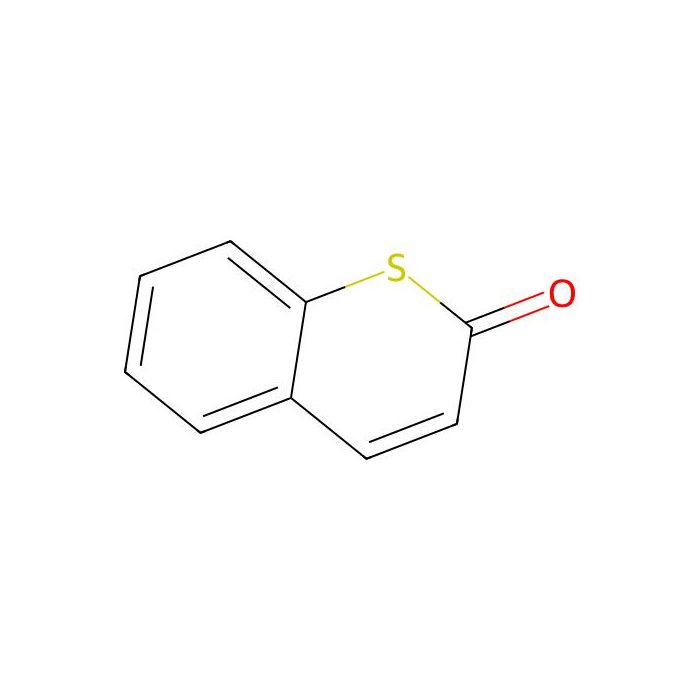
This compound belongs to the class of organic compounds known as thiochromenes. These are organosulfur compounds that are analogues to chromene, with the difference that a sulfur atom replaces the oxygen atom.
External Descriptors
Not available
1. Djoumbou Feunang Y, Eisner R, Knox C, Chepelev L, Hastings J, Owen G, Fahy E, Steinbeck C, Subramanian S, Bolton E, Greiner R, and Wishart DS. ClassyFire: Automated Chemical Classification With A Comprehensive, Computable Taxonomy. Journal of Cheminformatics, 2016, 8:61.
Certificati (CoA, COO, BSE/TSE e tabella di analisi)
C of A & Other Certificates(BSE/TSE, COO):
Analytical Chart:
Proprietà chimiche e fisiche
Peso molecolare
162.210 g/mol
XLogP3
2.400
Hydrogen Bond Donor Count
0
Hydrogen Bond Acceptor Count
2
Rotatable Bond Count
0
Exact Mass
162.014 Da
Monoisotopic Mass
162.014 Da
Topological Polar Surface Area
42.400 Ų
Heavy Atom Count
11
Formal Charge
0
Complexity
198.000
Isotope Atom Count
0
Defined Atom Stereocenter Count
0
Undefined Atom Stereocenter Count
0
Defined Bond Stereocenter Count
0
Undefined Bond Stereocenter Count
0
The total count of all stereochemical bonds
0
Covalently-Bonded Unit Count
1
Calcolatori di soluzioni
Molarity Calculator
Determine the necessary mass, volume, or concentration for preparing a solution.
Dilution Calculator
Determine the dilution needed to prepare a stock solution.
Reconstitution Calculator
Recensioni
Recensioni dei clienti
Application Protocols
No application protocols are specified for this item.
Item-specific tested applications (WB, IHC, IF, FC, ELISA, etc.): Not applicable to this small-molecule building block.
General laboratory use: For synthetic procedures and assay preparation, dissolve in an appropriate organic solvent (e.g., DMSO for stock solutions), filter if necessary, and dilute into the reaction or assay medium. Typical stock concentrations for screening assays are 10–100 mM in DMSO; adjust based on solubility and assay tolerance to organic co-solvent.
Analytical method snippet: For RP-HPLC, start with 60:40 MeCN:H2O (0.1% formic acid) on C18, 1 mL/min, UV 254–300 nm; tune gradient and detection as needed. This is general guidance only.
Biological Roles
Item-specific biological data: Not specified for this item; refer to CoA/Spec Sheet.
General context (no medical/clinical claims):
Thiochromen-2-one is a synthetic heteroaromatic scaffold and does not have a known endogenous biological role. It is the sulfur analog of coumarin and can be used to probe how sulfur substitution affects photophysical properties, redox behavior, and interactions with biomacromolecules in fundamental studies.
In chemical biology, benzothiopyranone frameworks appear as cores in probe or ligand libraries. Their conjugated enone can undergo Michael-type interactions with nucleophilic amino acid side chains in model systems; such reactivity is typically tuned by substitution and is evaluated under carefully controlled conditions.
Photophysics: Coumarins are well known for fluorescence; sulfur incorporation generally red-shifts absorption and may modulate quantum yields. Researchers may investigate these effects for sensor development or as comparative standards, but performance is highly substituent- and environment-dependent.
Metabolic/transformation considerations (in vitro): Thio-lactones could, in principle, be susceptible to nucleophilic ring opening in strongly basic or thiol-rich environments; however, specific biotransformation data for the parent Thiochromen-2-one is limited in the open literature.
This section provides general background for research planning only. For any biological testing or assay development, generate empirical data under your conditions and consult the SDS for safe handling.
Buffer Applications
This compound is a neutral, water-poorly-soluble heteroaromatic building block and is not typically employed as a buffering agent or buffer component.
Not typically applicable: No recognized buffering system, pKa pair, or ionic equilibria suitable for maintaining pH in aqueous solutions.
Practical note: If using thiochromen-2-one in aqueous assays, dissolve first in a water-miscible co-solvent (e.g., DMSO or acetonitrile), then dilute into the desired buffer (e.g., phosphate, HEPES). Keep final organic co-solvent content low (typically ≤1–2% v/v) to minimize perturbation of biological systems.
Green Alternatives
This product is a solid heteroaromatic building block rather than a commodity solvent or reagent with direct “green” substitutes. Greener choices pertain to the processes in which it is used.
Greener solvent choices for typical transformations (general guidance)
Replace chlorinated solvents (DCM/CHCl3) with ethyl acetate, 2-MeTHF, CPME, or toluene where feasible.
For polar aprotic media, consider propylene carbonate, Me-THF, or safer esters instead of DMF/NMP/DMSO when compatible with kinetics and workup.
Oxidations/reductions on this scaffold
Prefer Oxone or hydrogen peroxide (with phase-transfer or catalytic systems) over chromium(VI) oxidants when oxidizing S to sulfoxide/sulfone.
Use transfer hydrogenation or catalytic hydrogenation under mild conditions instead of stoichiometric metal hydrides for conjugate reductions.
Energy and workup efficiency
Employ flow or microwave-assisted methods to shorten reaction times and reduce solvent volumes.
Favor crystallization over chromatographic purification to cut silica/solvent waste.
Comparison snapshot (process level)
Traditional: DCM or DMF; stoichiometric reagents; silica-heavy purification.
Greener: 2-MeTHF/EtOAc or MeCN/H2O systems; catalytic reagents; crystallization or minimal chromatography.
Note: Any process change should be validated to assure yield, selectivity, and impurity profile remain acceptable for your research goals.
Pharmaceutical Uses
Item-specific pharmacopeial status: Not specified for this item; refer to CoA/Spec Sheet.
General formulation/manufacturing context (no therapeutic claims):
Role: Thiochromen-2-one can serve as a synthetic intermediate or impurity reference standard in API research programs exploring benzothiopyranone motifs.
Pre-formulation considerations: As a hydrophobic aromatic lactone, it may require solubilization via organic co-solvents (e.g., EtOH, PEGs, NMP), cyclodextrin inclusion, or lipid-based vehicles for nonaqueous processing in research settings.
Analytical methods: Reverse-phase HPLC/UPLC with UV detection (near-UV absorbance due to conjugation) is typically suitable. MS detection is facilitated by the presence of sulfur (characteristic isotope pattern) and a stable molecular ion under APCI/ESI (method development required).
Impurity control: Potential oxidized congeners (sulfoxide/sulfone) and ring-opened acids/esters may form under stress. Stability-indicating methods should resolve these species during method development.
Any use is for research and development only. This material is not approved as an excipient or active ingredient; suitability for GMP or regulated environments must be established independently with full specifications and quality documentation.
Physical Properties
Item-specific specifications (this lot):
Grade/Purity: Not specified for this item; refer to CoA/Spec Sheet.
Appearance: Not specified for this item; refer to CoA/Spec Sheet.
Literature/general properties (for context; not item specifications):
Molecular formula: C9H6OS (literature)
Molecular weight: ~162.20 g/mol (literature)
Phase: Typically a solid aromatic lactone at ambient conditions (literature/analogy to coumarin congeners)
Solubility: Expected to be sparingly soluble in water; soluble in common organic solvents (e.g., dichloromethane, chloroform, THF, acetone, ethyl acetate, toluene, acetonitrile) due to aromatic and weakly polar character (literature/general)
Acid/base profile: Neutral lactone; no formal pKa for a strongly ionizable center under neutral conditions. Ring-opening hydrolysis under strong base produces carboxylate/thiolate (literature).
Partitioning: Anticipated moderate lipophilicity (logP > 1) owing to fused aromatic system (qualitative, literature-based).
Spectroscopic notes: Conjugated enone typically shows strong UV absorption in near-UV (coumarin-like), and IR bands for C=O (lactone ~1730–1750 cm−1) and C=C; sulfur substitution can shift bands slightly to lower frequency vs oxo-analog (literature trends).
If precise numerical constants (mp, bp, density, refractive index, UV cutoffs) are required for your method development or QC, please consult the CoA/Spec Sheet for this specific SKU.
Quality and Grades
Item-specific details
Grade/Purity: Not specified for this item; refer to CoA/Spec Sheet.
Stabilizers/Inhibitors: Not specified for this item; refer to CoA/Spec Sheet.
UV cutoff/GC/HPLC suitability: Not specified for this item; refer to CoA/Spec Sheet.
How to interpret common grades (general guidance)
Analytical/AR grade: Tight limits on inorganic/organic impurities for analytical work.
Synthesis grade: Suitable for routine organic synthesis where trace UV-absorbers/trace metals are less critical.
HPLC grade solvents/standards: Defined by very low UV absorbance and particulates; not typically applicable to this solid heterocycle unless offered as a reference standard.
Considerations specific to thiochromen-2-one (general)
Aromatic thio-lactones can contain trace oxidized congeners (sulfoxide/sulfone). If your application is oxidation-sensitive or requires a single oxidation state, check CoA for related substances by HPLC/GC.
If photophysical or fluorescence studies are intended, request UV-Vis/fluorescence background data, as conjugated lactones may exhibit intrinsic absorbance and weak fluorescence.
Documentation
For method development, regulatory filings, or impurity profiling, request the batch CoA/SDS and, if available, a detailed specifications sheet (limits for related substances, residual solvents, water by KF, assay).
Lot-specific values supersede general guidance.
Reaction and Applications
Thiochromen-2-one serves as a useful heteroaromatic building block and an activated Michael acceptor within a conjugated thio-lactone framework.
Electrophilic conjugate acceptor
Michael additions of carbon- and hetero-nucleophiles to the 3-position (β-carbon), forming 3-substituted benzothiopyran-2-ones. Bases such as K2CO3/DBU in DMF/MeCN, or organocatalysis, are commonly used (literature).
1,4-Additions with soft nucleophiles (thiols, malonates, enolates) proceed under mild conditions; hard nucleophiles can lead to ring opening.
Ring opening and functional interconversions
Base- or acid-catalyzed lactone opening provides o-mercapto–cinnamic acid derivatives (saponification), enabling subsequent amide/ester couplings or decarboxylative steps (literature).
Oxidation at sulfur to sulfoxide/sulfone (m-CPBA, Oxone) modulates electronics and reactivity of the enone.
Cycloadditions and annulations
Acts as a dienophile in Diels–Alder reactions with electron-rich dienes, giving polycyclic adducts; Lewis acids can accelerate (literature analogies to coumarins).
Photochemical [2+2] or [4+4] cycloadditions are described for coumarins; sulfur substitution alters photophysics but analogous transformations may be adapted with wavelength control (literature).
Electrophilic substitutions/halogenation
Halogenation at the 3-position furnishes 3-halo intermediates useful for cross-coupling (e.g., Suzuki, Stille) on the benzothiopyranone core (literature precedents for coumarin/thiochromenones).
Applications
Scaffold for benzothiopyran/benzothiopyranone libraries in materials chemistry and small-molecule discovery.
Precursor to sulfur-containing fluorescent or photoreactive probes where the enone’s conjugation is leveraged (general research use only).
Reaction Conditions
General literature-guided conditions for typical transformations on thiochromen-2-one (for planning; optimize for your system):
Notes: Maintain anhydrous conditions to avoid competitive ring opening. Monitor by TLC/HPLC; products often crystallize on workup.
Ring opening (saponification)
Reagents: NaOH or K2CO3 in MeOH/H2O or EtOH/H2O.
Temperature: 25–60°C.
Outcome: o-Mercapto–cinnamate/cinnamic acid analogs; acidify to precipitate acids.
Oxidation of sulfur
Reagents: m-CPBA (1.0–1.2 equiv for sulfoxide; 2.0–2.5 equiv for sulfone) in DCM at 0–25°C.
Notes: Control equivalents/temperature to select oxidation state; monitor by TLC/NMR (distinctive shifts near S).
Diels–Alder (as dienophile)
Diene: Cyclopentadiene or electron-rich dienes.
Catalyst: Optional Lewis acid (BF3·Et2O, AlCl3) in DCM or toluene.
Temperature: 0–25°C (or reflux in toluene for less reactive partners).
Halogenation at C-3
Reagents: NBS/NCS in inert solvent (DCM/MeCN) with catalytic acid or radical initiator, 0–25°C.
Follow-up: Cross-coupling under Pd catalysis (e.g., Pd(PPh3)4, base: K2CO3, solvent: dioxane/H2O, 80–100°C) to append aryl/alkenyl groups.
These are representative conditions from general heteroarene/enone chemistry; verify on small scale and adjust to substrate substitution and desired selectivity.
Safety and Handling
Item-specific hazard data (GHS/CLP):
Signal Word: Not specified for this item; refer to SDS.
H-Statements: Not specified for this item; refer to SDS.
GHS Classification/Pictograms: Not specified for this item; refer to SDS.
General safety guidance (literature/good laboratory practice; not a substitute for SDS):
Likely hazards: Aromatic lactones and related thio-heterocycles are commonly classified as irritants; avoid inhalation of dust and contact with skin/eyes. Combustible organic solid; keep away from ignition sources.
PPE: Wear lab coat, suitable gloves (e.g., nitrile), safety glasses or face shield. Use a certified chemical fume hood to minimize inhalation exposure.
Handling: Avoid generating dust; minimize exposure to air/heat when weighing or transferring. For synthetic work, handle under ambient dry conditions; rigorous exclusion of moisture is only necessary for reactions sensitive to trace water.
Incompatibilities: Strong bases (can cause lactone ring opening), strong nucleophiles (Michael addition at C-3), strong oxidants (may oxidize sulfur to sulfoxide/sulfone), and strong reducing agents (may reduce the enone). Segregate from oxidizers.
First aid (overview): If on skin/eyes, rinse with water for several minutes; remove contaminated clothing. If inhaled, move to fresh air. If ingested, rinse mouth; seek medical advice. Always follow the SDS for detailed instructions.
Fire response: Use CO2, dry chemical, or foam. Combustion may produce CO/CO2 and sulfur oxides.
Waste: Collect in halogen-free organic waste unless contaminated otherwise; comply with local regulations.
Solvent Selection
Applicability: Thiochromen-2-one is a neutral, moderately lipophilic, conjugated aromatic lactone. It dissolves in a range of organic solvents; water solubility is expected to be low.
Poorly soluble: Water and highly nonpolar alkanes at room temperature (qualitative expectation).
Choosing a solvent by application
Reaction medium: Polar aprotic solvents (DMF, DMSO, MeCN) enhance rates for nucleophilic additions (Michael) to the enone. Chlorinated solvents (DCM/CHCl3) are suitable for electrophilic aromatic substitutions or Lewis-acid catalyzed transformations when moderate polarity is sufficient.
Crystallization/purification: Ethyl acetate/hexanes or toluene/hexanes systems often give good crystallization windows for aromatic lactones. For HPLC, acetonitrile/water or methanol/water with 0.1% formic acid (for better peak shape) are common; expect retention on C18 due to hydrophobicity.
Spectroscopy: DMSO-d6, CDCl3, or acetone-d6 typically provide well-resolved NMR spectra; beware of base-catalyzed ring opening in highly basic deuterated media.
Comparison to analogs
Versus coumarin (chromen-2-one): Similar solubility profile; thio analog can be marginally more lipophilic and less hydrogen-bond accepting, which may reduce polarity and slightly change elution order on silica.
For moisture-/air-sensitive transformations on this scaffold, dry, oxygen-free solvents are recommended; otherwise, standard anhydrous grades suffice.
Storage and Reconstitution
Item-specific instructions (from Product Data):
Storage Conditions: Room temperature
Shipped in: Not specified for this item; refer to CoA/Spec Sheet.
General handling and storage guidance (solid heteroaromatic lactone):
Container: Store in a tightly closed, light-resistant container to minimize photochemical changes and moisture ingress.
Atmosphere: Ambient air is typically acceptable. For long-term storage or if very low impurity levels are required, consider storing under inert gas to limit slow sulfur oxidation.
Stability considerations: Avoid prolonged exposure to strong light, elevated heat, and oxidants. Trace formation of sulfoxide/sulfone under harsh conditions is possible.
Reconstitution/preparation of stock solutions (for research use):
Solvents: DMSO, acetonitrile, acetone, or ethanol are convenient for concentrated stock solutions. Ensure solvent compatibility with downstream applications.
Typical concentrations: 10–100 mM in DMSO for screening or assay work; verify solubility empirically. Warm gently (≤40°C) and vortex/sonicate to aid dissolution; avoid strong base during dissolution to prevent ring opening.
Filtration: If particulate is present, pass through a 0.2 µm PTFE syringe filter.
Freeze–thaw: If storing solutions, aliquot to avoid repeated freeze–thaw cycles. Store solutions at 2–8°C (short term) or −20°C (long term) protected from light; check for precipitation before use.
Always follow the SDS and CoA for lot-specific guidance.
Structure and Identity
Brief description: Thiochromen-2-one is the sulfur analog of coumarin (1-benzothiopyran-2-one), a fused benzothiopyran bearing a lactone (2-one) at the heterocycle.
Item-specific (from Product Data)
CAS: 1075-14-5
PubChem CID: 10953838
InChIKey: 216578 (as provided)
Storage guidance: Room temperature
Literature/computed identifiers (for reference; not item specifications)
InChIKey (literature): Not specified here to avoid mismatch; consult major databases or CoA.
Structural features (general description)
Fused bicyclic system: a benzene ring fused to a thiopyran-2-one ring (six-membered ring with a thioether sulfur and a lactone carbonyl at C-2).
Functional groups: conjugated enone within a thio-lactone; aromatic benzene ring; thioether sulfur in the heterocycle.
Planarity/conjugation: Highly conjugated system across the benzene and the α,β-unsaturated carbonyl in the thiopyranone, enabling pronounced electrophilicity at the 3-position and typical coumarin-like reactivity.
Stereochemistry: None (achiral, no stereocenters). 2D depiction would show a benzene fused to a six-membered ring containing S and a C=O at position-2, with a C=C between positions 3–4.
Synthetic Utility
Key reactivity stems from the conjugated thio-lactone and fused aromatic system.
Electrophilic enone chemistry
Michael acceptor: Enables C–C and C–X bond formation at C-3 with enolates, malonates, thiols, amines, and stabilized carbanions. Provides access to 3-substituted benzothiopyran-2-ones.
Halogenation/nitration at C-3 (via enone activation) yields versatile handles for cross-coupling (Suzuki–Miyaura, Stille, Negishi) to elaborate the scaffold (literature precedents).
Lactone manipulations
Ring opening under base (NaOMe/MeOH, K2CO3/MeOH, aqueous NaOH) to o-mercapto–cinnamate/cinnamic acid analogs; reclosure achievable by acid-catalyzed lactonization, enabling protection–deprotection tactics.
Reduction pathways: 1,2- or 1,4-reduction with chemoselectivity tuned by hydride source (e.g., NaBH4 vs catalytic hydrogenation), affording dihydro or chromanone-type derivatives after sulfur considerations.
Heteroatom chemistry at sulfur
Controlled oxidation to sulfoxide/sulfone modulates electronics, enhancing dienophilicity or altering basicity and solubility.
Alkylation at sulfur (after ring opening to thiolate) to diversify side chains, then relactonization to introduce S-alkyl functionality around the core.
Annulations and cycloadditions
Diels–Alder reactions with electron-rich dienes; Lewis acids (e.g., AlCl3, BF3·Et2O) may accelerate. Post-cycloaddition aromatization can furnish polycyclic sulfur-containing frameworks.
Retrosynthetic value
Serves as a convergent node linking o-mercaptobenzoic acid derivatives and activated acrylic fragments; also accessible from salicylaldehyde thio-variants via Perkin/Knövenagel-type condensations followed by cyclization (literature strategies).
Target Specificity
Not applicable. This product is a small-molecule heterocycle and not a biological targeting reagent (e.g., antibody, peptide, or ligand with defined biological target) in this catalog entry.
Item-specific biological target, clone, isotype, species reactivity: Not specified for this item; refer to CoA/Spec Sheet if any such information is ever provided for specialized uses.
Utilizziamo i cookie per garantire il corretto funzionamento del sito web e, ove consentito, per migliorare la tua esperienza. Puoi gestire le tue preferenze in qualsiasi momento nelle Impostazioni. Per saperne di più, consulta la nostra Cookie Policy.
Desidera che le inviamo un messaggio quando avremo sconti disponibili?
Ricordamelo più tardi
Grazie! Controlli la sua casella di posta per confermare.
Products are supplied to verified businesses, institutions, and qualified professionals for research and development use only. Not for use in humans, animals, diagnosis, or therapy.