10mM in DMSO for sensitive chromatographic and analytical workflows requiring minimal baseline interference.
🌡
Storage & shipping
Store at -80°C Ships Dry ice packs + Cold packs Check lot-specific COA for exact specifications.
📋
Quality documents
SDS, COA, datasheet, and spec sheet available for download. Lot-specific COA accessible via lot number lookup.
📚
Literature proof
Cited in 156 peer-reviewed publications across chromatography, organic synthesis, and cross-coupling reactions.
Panoramica
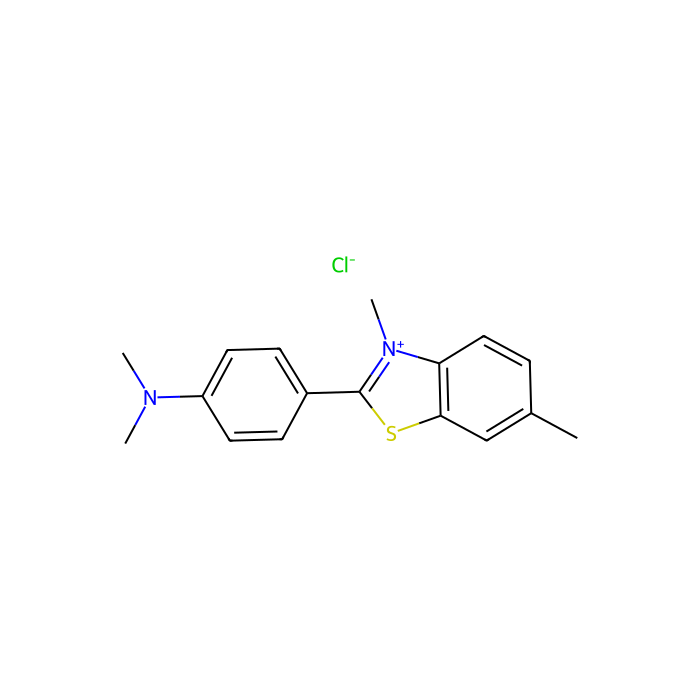
Thioflavin T is a benzothiazole dye that increases in fluorescence upon binding to amyloid.Thioflavin T has been used in histology and for protein characterization. Usually used to identify the presence of amyloid fibrils in samples.
Fluorescent cell-permeable amyloid binding benzothiazole salt. Dye used to visualise stacked β sheets in vitro and in vivo . Binding induces a shift in excitation maximum (385 nm to 450 nm) and emission maximum (445 nm to 482 nm). Highly soluble in water.
Condizioni di conservazione di stoccaggio
Store at -80°C
Spedito in
Dry ice packs + Cold packs
Questo prodotto richiede spedizione a catena fredda. I servizi di terra e altri servizi economici non sono disponibili.
This compound belongs to the class of organic compounds known as benzothiazoles. These are organic compounds containing a benzene fused to a thiazole ring (a five-membered ring with four carbon atoms, one nitrogen atom and one sulfur atom).
External Descriptors
organic chloride salt
1. Djoumbou Feunang Y, Eisner R, Knox C, Chepelev L, Hastings J, Owen G, Fahy E, Steinbeck C, Subramanian S, Bolton E, Greiner R, and Wishart DS. ClassyFire: Automated Chemical Classification With A Comprehensive, Computable Taxonomy. Journal of Cheminformatics, 2016, 8:61.
Determine the necessary mass, volume, or concentration for preparing a solution.
Dilution Calculator
Determine the dilution needed to prepare a stock solution.
Reconstitution Calculator
Recensioni
Recensioni dei clienti
Application Protocols
Tested applications, recommended dilutions, and detailed protocols are not specified for this item in the provided Product Data. Refer to the CoA/Spec Sheet and SDS for any lot-specific instructions.
General-use protocols from the literature are available for plate-based aggregation assays and fluorescence microscopy staining; however, per policy, only product-provided protocols can be listed here.
Biological Roles
Thioflavin T is a synthetic fluorescent dye and does not have a natural biological role. In biochemical research, it is employed as a noncovalent reporter of supramolecular protein structure (literature, general).
Binding behavior (literature, general):
Exhibits selective fluorescence enhancement upon association with cross-β sheet motifs present in amyloid-like fibrils formed by various peptides and proteins.
Binding is primarily driven by shape complementarity and restriction of intramolecular rotation within the dye, which suppresses nonradiative decay and increases quantum yield.
Multiple binding sites with micromolar-to-submicromolar apparent affinities are often reported, depending on fibril morphology and buffer conditions.
Photophysical response (literature, general):
Free ThT shows weak fluorescence due to twisted intramolecular charge transfer states and rotational relaxation; immobilization in fibril channels increases fluorescence lifetimes and emission intensity.
Experimental considerations:
ThT can perturb aggregation kinetics at higher concentrations; maintain dye concentration low relative to monomer to minimize interference.
Ionic strength, pH, and cosolvents can modulate both binding affinity and spectral output—validate conditions for each system.
Note: All uses are for research and laboratory purposes only; no clinical or diagnostic claims are made.
Buffer Applications
As a fluorescent probe rather than a buffering reagent, Thioflavin T is not used to establish pH. However, its performance is buffer-dependent (literature, general):
Common assay buffers: PBS (pH 7.2–7.4), Tris-HCl (pH 7.4–8.0), HEPES (pH 7.2–7.6). Maintain ionic strength similar to physiological conditions when studying protein aggregation.
Working concentrations: Typical final ThT concentrations are 5–20 µM in assays; higher levels may increase background or perturb aggregation.
Stock preparation: Concentrated stocks (e.g., 1–5 mM) are commonly prepared in water or DMSO, then diluted into buffer immediately before use to minimize photodegradation (literature, general). Note: reconstitution details are not specified for this item; consult CoA/Spec Sheet.
Filtration: 0.22 µm filtration of buffers and dye solutions reduces particulate scattering and background fluorescence.
pH effects: Fluorescence response and binding can vary with pH; neutral to slightly basic conditions are generally favored. Strongly acidic conditions reduce fluorescence enhancement (literature, general).
Additives: Detergents, denaturants, and crowding agents can alter dye response; validate in the intended buffer matrix.
For buffer recipes, select components with low intrinsic fluorescence and minimal absorbance at ~440–450 nm excitation and ~480–490 nm emission.
Green Alternatives
For amyloid-binding fluorescence assays, the principal environmental impacts derive from solvent choice, dye mass, and waste handling rather than the dye itself.
Greener handling strategies (general):
Prefer aqueous buffers over organic-rich media; keep DMSO or alcohol cosolvent fractions minimal.
Use microvolume formats and miniaturized plates (384-/1536-well) to reduce dye and solvent consumption.
Implement light-protective but reusable containers to reduce single-use plastics.
Alternative probes and tradeoffs (literature, general):
Thioflavin S: mixture of sulfonated dyes; strong staining for histology but broader spectral bands and batch variability.
Congo Red: classic amyloid stain; requires polar aprotic or alkaline conditions and may raise waste disposal concerns.
Luminescent conjugated oligothiophenes (LCOs): high sensitivity and spectral polymorphism; often more expensive and may require organic cosolvents.
Environmentally benign protein aggregation reporters (e.g., dye-binding peptides): potentially aqueous-only but with differing sensitivity/selectivity.
Comparison (literature, general):
ThT vs ThS: ThT offers defined composition and consistent photophysics; ThS can give brighter histology but with compositional variability.
ThT vs Congo Red: ThT enables simple aqueous fluorescence assays with blue excitation; Congo Red typically requires polarized light microscopy or absorbance methods and generates more dye-laden waste.
Bottom line: For most in vitro assays, aqueous ThT with minimized organic cosolvent provides a practical and relatively green choice.
Pharmaceutical Uses
Thioflavin T is a research dye and is not used as a pharmaceutical active or a standard excipient. No pharmacopeial monograph is indicated for this item. All uses are for research and laboratory applications only.
Potential roles in non-clinical development workflows (literature, general):
In-process analytical tool in formulation or bioprocess research to monitor protein aggregation under stress conditions via plate-based assays.
Fluorescent marker for screening of aggregation inhibitors or stabilizers in preformulation studies.
Notes specific to this item:
Grade/purity: Not specified for this item; refer to CoA/Spec Sheet.
Regulatory status: Not intended for human or veterinary use; for research use only (Product Data).
Physical Properties
Appearance: Not specified for this item; refer to CoA/Spec Sheet.
Molecular weight: Not specified for this item; refer to CoA/Spec Sheet.
Molecular formula: Not specified for this item; refer to CoA/Spec Sheet.
Melting point: ~247–251 °C (decomp) (literature, typical for the chloride salt).
Boiling point: Not applicable for ionic organic dyes; decomposition occurs prior to boiling at ambient pressure (literature, general).
Density: Not specified for this item; refer to CoA/Spec Sheet.
Solubility (literature, general):
Water: readily soluble; routinely prepared as 1–5 mM stocks for assays.
Polar organics: soluble in methanol, ethanol, and DMSO; limited solubility in nonpolar solvents due to cationic nature.
pKa/logP: The dye is a quaternary ammonium-type cation (permanently charged); octanol/water partitioning (logP) is not typically reported as for neutral molecules (literature, general).
Refractive index/UV cutoff: Not specified for this item; refer to CoA/Spec Sheet.
Spectral properties (literature, general; solvent- and environment-dependent):
Fluorescence: weak when free; strong enhancement upon binding to β-sheet–rich aggregates, with emission typically ~480–490 nm when excited ~440–450 nm.
Photostability (literature, general): moderate; susceptible to photobleaching with prolonged intense illumination; store and handle protected from light.
Quality and Grades
Grade/purity: Not specified for this item; refer to CoA/Spec Sheet.
Typical quality considerations for research-grade Thioflavin T (literature, general):
Dye content and counterion identity (commonly chloride) influence molar absorptivity and background fluorescence; high dye purity minimizes assay variability.
Trace metal and inorganic salt content can affect baseline fluorescence and binding kinetics in sensitive plate-reader assays.
Spectral QC often includes verification of absorbance maximum and fluorescence enhancement upon binding to an amyloid surrogate (e.g., cellulose or preformed fibrils) as a functional test.
Stabilizers: Not specified for this item; refer to CoA/Spec Sheet. In general, ThT is stable as a dry solid without stabilizers when protected from light and moisture.
What to check on receipt (best practice):
Confirm lot-specific certificate for dye content or assay performance (if provided), water content, and residual solvent levels.
Verify storage condition on label matches -80°C requirement in Product Data.
For quantitative work, determine lot-specific extinction coefficient in your assay buffer to normalize fluorescence responses.
Reaction and Applications
Primary application domain: fluorescence-based detection and quantification of β-sheet–rich protein aggregates (amyloid-like fibrils) in vitro (literature, general). The dye exhibits a pronounced fluorescence enhancement and a red-shifted emission upon binding to ordered fibrillar structures, enabling sensitive kinetic assays and endpoint measurements.
Typical research applications (literature, general):
Real-time aggregation kinetics in microplates (ThT fluorescence monitored over time to extract lag time, growth rate, half-time).
Endpoint fibril quantification and screening of modulators of aggregation.
Staining of fixed samples (tissue sections, fibril pellets) followed by fluorescence microscopy with blue excitation.
Spectroscopic studies of dye–fibril binding thermodynamics and photophysics.
Practical assay considerations:
Use freshly prepared working solutions (e.g., 5–20 µM) in assay buffer; confirm linearity of fluorescence within the chosen concentration range.
Control for inner-filter effects by keeping absorbance at excitation <0.1 AU and by appropriate pathlength/volume in microplates.
Include buffer-only and monomer-only controls to establish baseline fluorescence.
Temperature control and orbital shaking can significantly affect aggregation kinetics; maintain consistent conditions.
Normalize signals using well-characterized fibril standards where available.
Report excitation/emission settings, slit widths, and gain to aid reproducibility between instruments.
Reaction Conditions
This product functions as a fluorescent probe rather than a reagent or catalyst. Nevertheless, assay “reaction” conditions for ThT–protein aggregation studies are well-established in the literature (general guidance):
Working concentration: 5–20 µM ThT in aqueous buffer; verify that fluorescence intensity remains within instrument linear range.
Buffer: PBS, Tris, or HEPES at pH 7–8. Avoid components with significant absorbance near 440–450 nm.
Temperature: Maintain constant temperature suited to the protein system (e.g., 25–42 °C for many in vitro aggregation models); elevated temperatures can accelerate kinetics.
Mixing/shaking: Orbital shaking (e.g., 200–600 rpm in sealed microplates) can promote fibril formation; keep conditions consistent across wells.
Plate format and optics: Black, clear-bottom plates minimize cross-talk; read from top or bottom per instrument specs with excitation around 440–450 nm and emission around 480–490 nm. Use appropriate bandwidths/slits to avoid bleed-through.
Controls: Include dye-only, buffer-only, and protein-only controls. When comparing conditions, normalize for pathlength and plate geometry.
Kinetic sampling: Acquire readings at intervals (e.g., 2–10 min) to capture lag, growth, and plateau phases. Minimize photobleaching by limiting exposure.
Note: The above are literature-derived assay conditions and are not item-specific specifications. Optimize for the particular protein and instrument.
Safety and Handling
GHS classification, signal word, pictograms, and H-statements: Not specified for this item; consult the product SDS for authoritative hazard information.
General hazards (literature, general): cationic dyes can cause irritation to skin, eyes, and respiratory tract; avoid inhalation of dust and contact with skin/eyes.
Water: readily soluble; primary vehicle for biological assays.
Alcohols (MeOH, EtOH): good solubility; useful for stock solutions and certain histological protocols.
DMSO: excellent solvent for concentrated stocks; dilute into aqueous buffers to final working concentrations to avoid DMSO-related effects.
Poorly soluble in nonpolar solvents (e.g., hexanes, toluene) due to ionic character.
Buffer compatibility (literature, general):
Commonly used in PBS, Tris, HEPES at neutral to slightly basic pH; high ionic strength is generally tolerated.
Detergents (e.g., SDS, Triton X-100) and denaturants (urea, guanidinium) can alter spectral properties and binding—validate in your matrix.
When to choose each solvent:
Water/PBS: live or fixed sample staining, plate-reader kinetics, minimal background.
DMSO stocks: for long-term frozen aliquots; improves weighing/handling of small quantities.
Alcohols: rapid permeation in fixed tissue protocols; ensure compatibility with mounting media.
Practical tips:
Filter stock/working solutions (0.22 µm) to reduce particulate scattering.
Minimize organic cosolvent fraction (<1–2% v/v) in final aqueous assays to limit matrix effects.
Storage and Reconstitution
Storage (Product Data): Store at -80°C.
Shipping (Product Data): Shipped on dry ice packs + cold packs to maintain low temperature.
Appearance: Not specified for this item; refer to CoA/Spec Sheet.
Reconstitution: Not specified for this item; refer to CoA/Spec Sheet.
Stability considerations (general): Protect from light and moisture; minimize freeze–thaw cycles by aliquoting upon first use. Note that this is general information and not an item-specific specification.
Research Use Note: For research use only.
Structure and Identity
Product identity: Thioflavin T (ThT), a cationic benzothiazolium dye widely used as an amyloid-binding fluorescent probe in biochemical research.
CAS: 2390-54-7 (Product Data)
PubChem CID: 16953 (Product Data)
InChIKey: Not specified for this item; refer to CoA/Spec Sheet. (Product Data lists a placeholder)
SMILES: Not specified for this item; refer to CoA/Spec Sheet.
Molecular formula: Not specified for this item; refer to CoA/Spec Sheet.
Molecular weight: Not specified for this item; refer to CoA/Spec Sheet.
Structural features (general chemistry description):
Thioflavin T is typically supplied as the chloride salt of a quaternary benzothiazolium cation bearing a dimethylamino-substituted benzylidene group.
Key functional motifs: benzothiazolium ring (heteroaromatic thiazole fused to benzene, positively charged at the 2-position), conjugated C=C linkage to an anilinium ring substituted with a dimethylamino group (electron-donating), and a counterion (commonly Cl−).
2D structure in words: two aromatic systems (benzothiazole and dimethylaminobenzene) connected through a polarized vinyl linkage; the benzothiazole nitrogen bears a formal positive charge (quaternized), balanced by a chloride anion. The extended π-conjugation underlies its distinct absorption/emission behavior.
Ionization state: permanently cationic (quaternary), enhancing water solubility; counterion identity can influence solubility and spectral properties slightly (literature, general).
Thioflavin T is a finished dye and is not commonly used as a building block or reagent in organic synthesis. Therefore, its synthetic utility in transformations (e.g., cross-couplings, oxidations, C–C bond formation) is limited.
Relevant chemistry context (literature, general):
The cationic benzothiazolium framework is representative of push–pull dyes often formed via condensation (e.g., Knoevenagel-type) between benzothiazolium salts and electron-rich aromatic aldehydes; such reactions are of interest for the synthesis of related fluorescent probes.
The dye’s strong photophysical response to restricted intramolecular rotation has inspired the development of “rotor” dyes and molecular probes, but ThT itself is not typically a reagent.
If a synthetic transformation requires a benzothiazolium component, consider starting from benzothiazole or benzothiazolium precursors rather than from Thioflavin T.
Target Specificity
Not an antibody or biologic. No target specificity data (antigen, epitope, species reactivity, clone, isotype) are applicable.
Item-specific target details: Not specified for this item; refer to CoA/Spec Sheet if any binding performance metrics are provided.
Utilizziamo i cookie per garantire il corretto funzionamento del sito web e, ove consentito, per migliorare la tua esperienza. Puoi gestire le tue preferenze in qualsiasi momento nelle Impostazioni. Per saperne di più, consulta la nostra Cookie Policy.
Desidera che le inviamo un messaggio quando avremo sconti disponibili?
Ricordamelo più tardi
Grazie! Controlli la sua casella di posta per confermare.
Products are supplied to verified businesses, institutions, and qualified professionals for research and development use only. Not for use in humans, animals, diagnosis, or therapy.

 H2614775