≥98% for sensitive chromatographic and analytical workflows requiring minimal baseline interference.
🌡
Storage & shipping
Room temperature,Argon charged,Desiccated Ships FedEx DG Service Check lot-specific COA for exact specifications.
📋
Quality documents
SDS, COA, datasheet, and spec sheet available for download. Lot-specific COA accessible via lot number lookup.
📚
Literature proof
Cited in 162 peer-reviewed publications across chromatography, organic synthesis, and cross-coupling reactions.
Panoramica
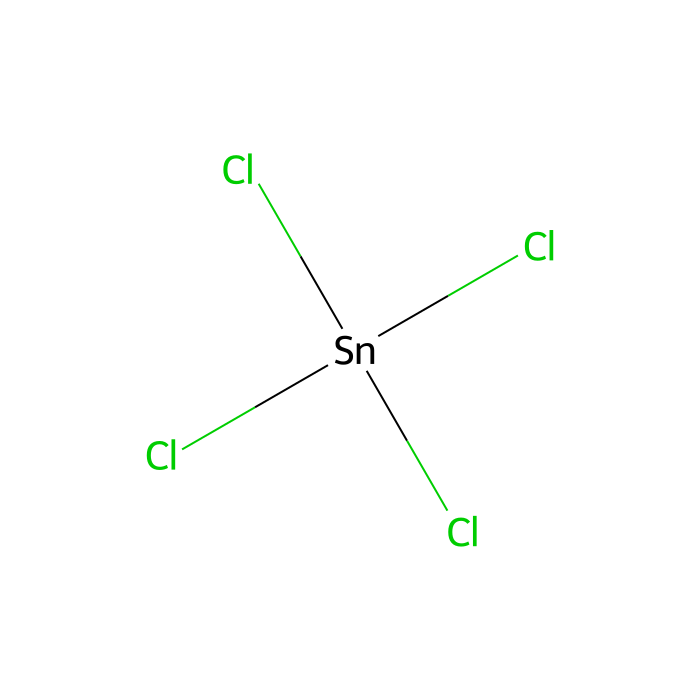
Stannic chloride (SnCl 4 ) is a strong Lewis acid widely used as a promoter or catalyst in organic synthesis. It is soluble in most organic solvents.
Application
Stannic chloride can be used to catalyze: Cyclization of trans β-monocyclohomofarnesic acid to form norambreinolide. Formation of C-glycosides of aromatic compounds such as thiophene, naphthalene and phloroglucinol trimethyl ether. Formal [4+2] cycloaddition of 3-ethoxycyclobutanones and allyltrialkylsilanes to form 3-ethoxy-5-[(trialkylsilyl)methyl]cyclohexan-1-ones. Diastereoselective reaction of δ-alkoxyallylstannanes with aldehydes to form 1,5-diol derivatives. Other applications of SnCl 4 : The SnCl 4 -2,6-dialkoxyphenols complexes can catalyze cyclization of poylenes, such as 4-(homogeranyl)toluene to form trans -fused tricyclic compound. SnCl 4 can act as a promoter during the reaction of ortho -aminobenzonitriles with β-ketoesters and β-enaminonitriles to form 4-aminoquinolines and 4-aminopyridines, respectively. SnCl 4 -silver perchlorate forms an effective catalytic system for the stereoselective of glycosylation 1- O -acetyl glucose.
Post-transition metal chloride - Inorganic chloride salt - Inorganic tin salt - Inorganic salt
Descrizione
This compound belongs to the class of inorganic compounds known as post-transition metal chlorides. These are inorganic compounds in which the largest halogen atom is Chlorine, and the heaviest metal atom is a post-transition metal.
External Descriptors
Not available
1. Djoumbou Feunang Y, Eisner R, Knox C, Chepelev L, Hastings J, Owen G, Fahy E, Steinbeck C, Subramanian S, Bolton E, Greiner R, and Wishart DS. ClassyFire: Automated Chemical Classification With A Comprehensive, Computable Taxonomy. Journal of Cheminformatics, 2016, 8:61.
We use cookies to ensure the website functions properly and, where permitted, to improve your experience. You can manage your preferences at any time in Settings. Learn more in our Cookie Policy.
Shall we send you a message when we have discounts available?
Remind me later
Thank you! Please check your email inbox to confirm.
Products are supplied to verified businesses, institutions, and qualified professionals for research and development use only. Not for use in humans, animals, diagnosis, or therapy.

 H2603051