Determine the necessary mass, volume, or concentration for preparing a solution.
| Activity Type | Relation | Activity value | Units | Action Type | Journal | PubMed Id | doi | Assay Aladdin ID |
|---|

≥98% per flussi di lavoro cromatografici e analitici sensibili che richiedono un'interferenza minima della linea di base.
Store at -20°C Spedizione Ice chest + Ice pads. Consultare il COA specifico del lotto per le specifiche esatte.
SDS, COA, scheda tecnica e scheda delle specifiche disponibili per il download. COA specifico del lotto accessibile tramite ricerca per numero di lotto.
Citato in 0 pubblicazioni peer-reviewed su cromatografia, sintesi organica e reazioni di accoppiamento incrociato.
Information
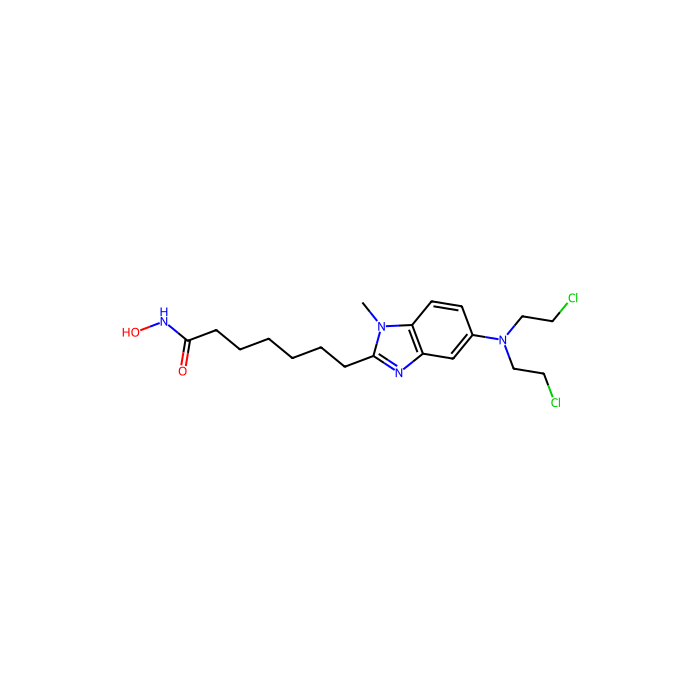
Tinostamustine(EDO-S101) is a first-in-classalkylating deacetylaseinhibitor with IC50 values of 9 nM, 9 nM, 25 nM and 107 nM for HDAC1, HDAC2, HDAC3 and HDAC8 (Class 1 HDACs) respectively and 6 nM, 72 nM for HDAC6 and HDAC10 (Class II HDACs).
Targets
HDAC6 (Cell-free assay); HDAC1 (Cell-free assay); HDAC2 (Cell-free assay); HDAC3 (Cell-free assay); HDAC10 (Cell-free assay) 31723,6 nM; 9 nM; 9 nM; 25 nM; 72 nM
In vitro
The IC50s of EDO-S101 range between 5-13 μM in 8 myeloma cell lines. EDO-S101 has significant synergistic cytotoxicity with the proteasome inhibitors bortezomib and carfilzomib across all cell types tested. EDO-S101 induces strong protein and histone acetylation and is a strong inducer of pIRE-1, the key activator protein of the UPR in MM cells.
Cell Research(from reference)
Cell lines:HL-60 cells
Concentrations:4 μM
Incubation Time:0, 6, 12, 18, 24h
Documento completo su pericoli, manipolazione, stoccaggio e conformità normativa.
<<<<<<< HEAD Scarica SDS → ======= Scarica SDS → >>>>>>> release248-p3Dati di qualità specifici del lotto. Inserisci il numero di lotto per recuperare il COA esatto.
Cerca COA →Riepilogo di riferimento rapido delle specifiche e applicazioni del prodotto.
Visualizza scheda tecnica →Attributi di qualità completi e criteri di accettazione per questa qualità.
Visualizza scheda delle specifiche →Taxonomy Tree
| Kingdom | Organic compounds |
|---|---|
| Superclass | Organoheterocyclic compounds |
| Classe | Benzimidazoles |
| Subclass | Not available |
| Intermediate Tree Nodes | Not available |
| Direct Parent | Benzimidazoles |
| Alternative Parents | Nitrogen mustard compounds Dialkylarylamines N-substituted imidazoles Benzenoids Heteroaromatic compounds Hydroxamic acids Amino acids and derivatives Azacyclic compounds Organopnictogen compounds Organochlorides Organic oxides Hydrocarbon derivatives Carbonyl compounds Alkyl chlorides |
| Molecular Framework | Aromatic heteropolycyclic compounds |
| Substituents | Benzimidazole - Dialkylarylamine - Tertiary aliphatic/aromatic amine - Nitrogen mustard - Benzenoid - N-substituted imidazole - Heteroaromatic compound - Imidazole - Azole - Tertiary amine - Hydroxamic acid - Amino acid or derivatives - Azacycle - Carboxylic acid derivative - Organic nitrogen compound - Organic oxygen compound - Organopnictogen compound - Organic oxide - Hydrocarbon derivative - Organooxygen compound - Organonitrogen compound - Organochloride - Organohalogen compound - Carbonyl group - Amine - Alkyl halide - Alkyl chloride - Aromatic heteropolycyclic compound |
| Descrizione | This compound belongs to the class of organic compounds known as benzimidazoles. These are organic compounds containing a benzene ring fused to an imidazole ring (five member ring containing a nitrogen atom, 4 carbon atoms, and two double bonds). |
| External Descriptors | Not available |
| Activity Type | Relation | Activity value | Units | Action Type | Journal | PubMed Id | doi | Assay Aladdin ID |
|---|
| Activity Type | Relation | Activity value | Units | Action Type | Journal | PubMed Id | doi | Assay Aladdin ID |
|---|
| Activity Type | Relation | Activity value | Units | Action Type | Journal | PubMed Id | doi | Assay Aladdin ID |
|---|
| Activity Type | Relation | Activity value | Units | Action Type | Journal | PubMed Id | doi | Assay Aladdin ID |
|---|
Find and download the COA for your product by matching the lot number on the packaging.
| Lot Number | Certificate Type | Data | Oggetto |
|---|---|---|---|
 A2412678 | Certificate of Analysis | Oct 13, 2025 | T414166 |
| A2412679 | Certificate of Analysis | Oct 13, 2025 | T414166 |
| A2412680 | Certificate of Analysis | Oct 13, 2025 | T414166 |
| A2412681 | Certificate of Analysis | Oct 13, 2025 | T414166 |
| A2412683 | Certificate of Analysis | Oct 13, 2025 | T414166 |
| A2412684 | Certificate of Analysis | Oct 13, 2025 | T414166 |
| A2412685 | Certificate of Analysis | Oct 13, 2025 | T414166 |
| A2412686 | Certificate of Analysis | Oct 13, 2025 | T414166 |
| A2412687 | Certificate of Analysis | Oct 13, 2025 | T414166 |
| A2412677 | Certificate of Analysis | Oct 13, 2025 | T414166 |
| F2316298 | Certificate of Analysis | Mar 04, 2025 | T414166 |
| F2316328 | Certificate of Analysis | Mar 04, 2025 | T414166 |
| F2316326 | Certificate of Analysis | Mar 04, 2025 | T414166 |
| F2316325 | Certificate of Analysis | Mar 04, 2025 | T414166 |
| F2316324 | Certificate of Analysis | Mar 04, 2025 | T414166 |
| F2316317 | Certificate of Analysis | Mar 04, 2025 | T414166 |
| F2316316 | Certificate of Analysis | Mar 04, 2025 | T414166 |
| F2316315 | Certificate of Analysis | Mar 04, 2025 | T414166 |
| F2316314 | Certificate of Analysis | Mar 04, 2025 | T414166 |
| I2525085 | Certificate of Analysis | Nov 14, 2023 | T414166 |
| F2316329 | Certificate of Analysis | May 15, 2023 | T414166 |
| Solubilità | Solubility (25°C) In vitro DMSO: 14 mg/mL (33.7 mM); Ethanol: 2 mg/mL (4.81 mM); Water: Insoluble; |
|---|---|
| DMSO (mg/mL) Solubilità massima | 14 |
| DMSO (mM) Solubilità massima | 33.7057010785824 |
| Acqua (mg/mL) Solubilità massima | <1 |
| Peso molecolare | 415.400 g/mol |
| XLogP3 | 3.600 |
| Hydrogen Bond Donor Count | 2 |
| Hydrogen Bond Acceptor Count | 4 |
| Rotatable Bond Count | 12 |
| Exact Mass | 414.159 Da |
| Monoisotopic Mass | 414.159 Da |
| Topological Polar Surface Area | 70.400 Ų |
| Heavy Atom Count | 27 |
| Formal Charge | 0 |
| Complexity | 438.000 |
| Isotope Atom Count | 0 |
| Defined Atom Stereocenter Count | 0 |
| Undefined Atom Stereocenter Count | 0 |
| Defined Bond Stereocenter Count | 0 |
| Undefined Bond Stereocenter Count | 0 |
| The total count of all stereochemical bonds | 0 |
| Covalently-Bonded Unit Count | 1 |
Item-specific validated applications, recommended dilutions, and controls: Not specified for this item; refer to CoA/Spec Sheet or internal SOPs.
General workflow suggestions (literature/general)
These are non-validated, literature-style outlines. Optimize conditions for your platform and consult institutional guidelines.
Nature of the compound (literature/general)
Roles in cellular studies (literature/general)
Selectivity considerations (literature/general)
All statements above describe research/biochemical utility only. No clinical or medical claims are made. Consult primary literature for quantitative potency and isoform data.
This compound is a small-molecule research tool and does not function as a buffering agent.
No defined pKa-based buffer systems are applicable to this item.
This product is a targeted research compound rather than a process solvent or commodity reagent. “Green alternatives” are therefore more about handling media and vehicles than replacing the compound itself.
Greener solvent choices for stock/assay preparation (literature/general)
Operational green chemistry practices
Comparison (general)
No therapeutic, diagnostic, or clinical claims are made for this product. It is supplied strictly for research use only.
Formulation context in research (literature/general)
Pharmacopeial status
Item-specific specs (from Product Data)
Literature/general expectations (for planning only; confirm experimentally)
Note: Use these literature/general notes only for preliminary planning. For specifications required in regulated or quantitative work, consult the item’s CoA/Spec Sheet and SDS.
Item-specific grade/purity (from Product Data)
Interpreting common grades (general guidance)
Practical recommendations
Applicability as a reagent
Research applications (literature/general)
Practical notes
For synthetic transformations or building-block applications, this molecule is not typically selected; see the Synthetic Utility section for context.
This product is a bioactive probe rather than a synthetic reagent; standard “reaction conditions” are not typically applicable.
All quantitative conditions (concentrations, exposure times) must be derived from primary literature or pilot experiments; they are not specified for this item.
Item-specific hazard data (from Product Data)
General safety guidance (literature/general for alkylating/HDAC-inhibiting research chemicals)
Always defer to the current SDS and institutional cytotoxic handling procedures for authoritative guidance.
Item-specific solubility data: Not specified for this item; refer to CoA/Spec Sheet.
Literature/general guidance for tinostamustine and similar amphiphilic bioactives
Practical tips
All solvent choices should be validated in pilot experiments for the specific biological system.
Item-specific instructions (from Product Data)
Reconstitution (general guidance)
Handling and stability (general)
Always consult the product’s CoA and SDS for definitive storage stability, re-test intervals, and any specific cautions for this lot.
A bifunctional small molecule combining a DNA-alkylating nitrogen mustard and a hydroxamic-acid HDAC inhibitor pharmacophore (commonly referenced in the literature as EDO-S101).
Item-specific identifiers (from Product Data)
Structural features (literature/general)
2D structure description (literature/general)
Tinostamustine itself is not typically used as a synthetic intermediate; it is a finalized, functionally complex probe molecule. Nonetheless, understanding its functionality informs derivatization and analogue synthesis (literature/general):
Reactive motifs and implications
Retrosynthetic considerations
Derivatization strategies
For routine synthesis tasks, choose simpler building blocks; employ tinostamustine primarily as a research probe.
Item-specific target data: Not specified for this item; refer to CoA/Spec Sheet and primary literature.
Literature/general context
Users should consult peer-reviewed studies for quantitative target profiles relevant to their system.