Determine the necessary mass, volume, or concentration for preparing a solution.
Taxonomy Tree
| Kingdom | Inorganic compounds |
|---|---|
| Superclass | Mixed metal/non-metal compounds |
| Classe | Transition metal organides |
| Subclass | Transition metal sulfides |
| Intermediate Tree Nodes | Not available |
| Direct Parent | Transition metal sulfides |
| Alternative Parents | Inorganic sulfides Inorganic salts |
| Molecular Framework | Not available |
| Substituents | Transition metal sulfide - Inorganic sulfide - Inorganic salt |
| Descrizione | This compound belongs to the class of inorganic compounds known as transition metal sulfides. These are inorganic compounds containing a sulfur atom of an oxidation state of -2, in which the heaviest atom bonded to the oxygen is a transition metal. |
| External Descriptors | Not available |
Find and download the COA for your product by matching the lot number on the packaging.
| Lot Number | Certificate Type | Data | Oggetto |
|---|---|---|---|
| Certificate of Analysis | Oct 24, 2026 | T302605 | |
| Certificate of Analysis | Oct 24, 2026 | T302605 | |
| Certificate of Analysis | Oct 24, 2026 | T302605 | |
| Certificate of Analysis | Sep 20, 2025 | T302605 | |
| Certificate of Analysis | Sep 20, 2025 | T302605 | |
| Certificate of Analysis | Sep 20, 2025 | T302605 | |
| Certificate of Analysis | Apr 09, 2025 | T302605 | |
| Certificate of Analysis | Dec 26, 2024 | T302605 | |
| Certificate of Analysis | Dec 26, 2024 | T302605 | |
| Certificate of Analysis | Dec 26, 2024 | T302605 | |
| Certificate of Analysis | Aug 05, 2023 | T302605 | |
| Certificate of Analysis | Aug 05, 2023 | T302605 | |
| Certificate of Analysis | Aug 05, 2023 | T302605 | |
| Certificate of Analysis | Mar 10, 2022 | T302605 | |
| Certificate of Analysis | Mar 10, 2022 | T302605 |
| Solubilità | insoluble in water and moderately acid soluble. |
|---|---|
| Sensibilità | Moisture sensitive |
| Peso molecolare | 112 |
| XLogP3 | |
| Hydrogen Bond Donor Count | 0 |
| Hydrogen Bond Acceptor Count | 2 |
| Rotatable Bond Count | 0 |
| Exact Mass | 111.892 Da |
| Monoisotopic Mass | 111.892 Da |
| Topological Polar Surface Area | 64.200 Ų |
| Heavy Atom Count | 3 |
| Formal Charge | 0 |
| Complexity | 18.300 |
| Isotope Atom Count | 0 |
| Defined Atom Stereocenter Count | 0 |
| Undefined Atom Stereocenter Count | 0 |
| Defined Bond Stereocenter Count | 0 |
| Undefined Bond Stereocenter Count | 0 |
| The total count of all stereochemical bonds | 0 |
| Covalently-Bonded Unit Count | 1 |
H252:Self-heating in large quantities; may catch fire
H315:Causes skin irritation
H319:Causes serious eye irritation
H335:May cause respiratory irritation
P235:Keep cool.
P261:Avoid breathing dust/fume/gas/mist/vapors/spray.
P264:Wash hands [and …] thoroughly after handling.
P271:Use only outdoors or in a well-ventilated area.
P280:Wear protective gloves/protective clothing/eye protection/face protection.
P321:Specific treatment (see ... on this label).
P302+P352:IF ON SKIN: wash with plenty of water.
P304+P340:IF INHALED: Remove person to fresh air and keep comfortable for breathing.
P305+P351+P338:IF IN EYES: Rinse cautiously with water for several minutes. Remove contact lenses if present and easy to do - continue rinsing.
P362+P364:Take off contaminated clothing and wash it before reuse.
P405:Store locked up.
P407:Maintain air gap between stacks or pallets.
P410:Protect from sunlight.
P413:Store bulk masses greater than ... kg/...lbs at temperatures not exceeding ... °C/...°F.
P420:Store separately.
P403+P233:Store in a well-ventilated place. Keep container tightly closed.
P501:Dispose of contents/container to an approved waste disposal plant.
P264+P265:Wash hands [and …] thoroughly after handling. Do not touch eyes.
P337+P317:If eye irritation persists: Get medical help.
P332+P317:If skin irritation occurs: Get medical help.
P319:Get medical help if you feel unwell.
No biological assay protocols (e.g., WB, IHC, IF, FC) are applicable to this inorganic material.
General materials processing examples (literature; not item-specific)
These examples are illustrative only. Optimize parameters (solids loading, binder ratio, milling time) for your equipment and performance targets.
All uses are for research only. For biocompatibility or toxicology assessments, consult primary literature and conduct application-specific testing.
Titanium(IV) sulfide is not a buffering reagent and does not form conventional aqueous buffer systems. It is insoluble in water and is not used to control pH.
For TiS2 as a functional material, “green alternatives” focus on greener processing and application routes rather than replacing the compound outright.
Comparison snapshot (literature)
Tradeoffs: Moving to water-based binders may require surface treatments to maintain dispersion stability and electrode integrity. Validate electrochemical performance after process changes.
This product is not an excipient and has no recognized role in pharmaceutical formulations. It is supplied strictly for research and materials science applications.
Item-specific values are not provided in the product data. Do not treat the following as specifications for this catalog item.
Where precise values (e.g., density, band gap, thermal expansion) are required for design or modeling, consult primary literature for TiS2 or the item’s CoA/Spec Sheet.
Request the CoA/Spec Sheet for this specific lot to obtain definitive purity, phase analysis, and morphology data.
Titanium(IV) sulfide (TiS2) is valued in materials science and solid-state chemistry due to its layered structure and intercalation chemistry.
All applications described are for research use only and should be validated for the specific morphology and purity of the supplied material.
General literature conditions relevant to TiS2. These are not item-specific specifications.
Notes
Always consult the product’s SDS for authoritative, item-specific safety information.
This product is a solid inorganic layered material; solvent selection pertains to dispersing, processing, or intercalation rather than dissolution.
Note: These are general literature practices for TMD dispersions and not item-specific recommendations. Validate solvent compatibility with your process and EHS requirements.
Research use only. Consult the SDS for detailed handling and emergency information.
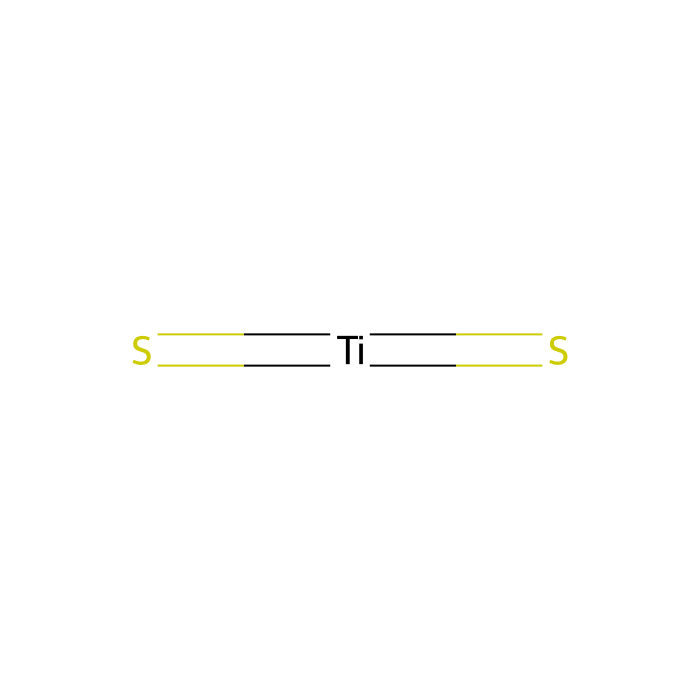
Titanium(IV) sulfide is a layered transition-metal dichalcogenide (TMD), commonly formulated as TiS2, featuring edge-sharing TiS6 octahedra arranged in a CdI2-type structure.
Note: All structure descriptions beyond identifiers are general literature information for TiS2 and not item-specific specifications.
Practical considerations
Not applicable. Titanium(IV) sulfide is an inorganic material, not a biological targeting reagent (e.g., antibody, ligand, probe). No target, epitope, or species specificity pertains to this product.