Determine the necessary mass, volume, or concentration for preparing a solution.
≥99.8% metals basis, nanopowder, 25 nm particle size, hydrophilic for sensitive chromatographic and analytical workflows requiring minimal baseline interference.
Room temperature,Desiccated,Cool Ships Normal Check lot-specific COA for exact specifications.
SDS, COA, datasheet, and spec sheet available for download. Lot-specific COA accessible via lot number lookup.
Cited in 2596 peer-reviewed publications across chromatography, organic synthesis, and cross-coupling reactions.
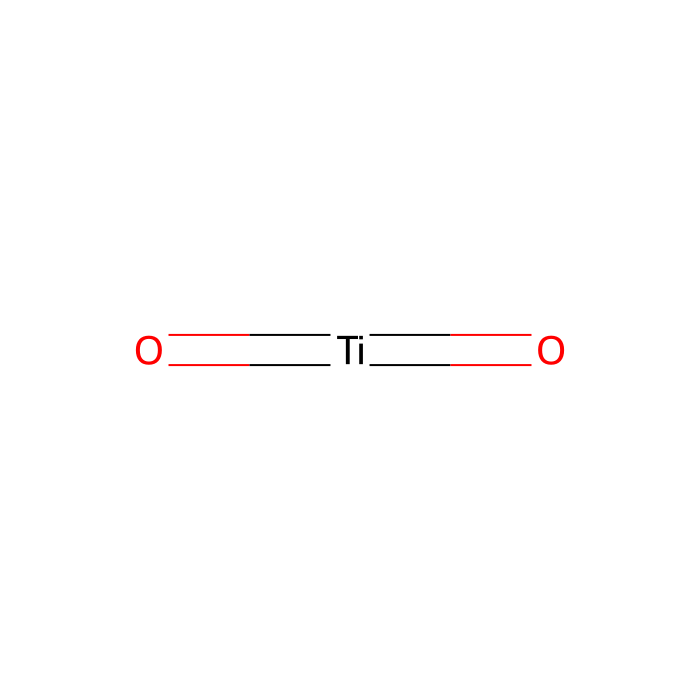
Rutile titanium(IV) oxide, also called titanium dioxide, is a fine powder with a particle size less than 100 nm. This titanium adopts the rutile crystal structure and is a white, opaque, crystalline solid with a high refractive index. It is widely used as a pigment in paints, plastics, paper, and cosmetics. Rutile titanium dioxide nanopowder has a high surface area, making it more reactive and effective in a range of applications. It is resistant to heat and chemical attack, making it suitable for use in high-temperature and corrosive environments.
Comprehensive hazard, handling, storage, and regulatory compliance document.
Download SDS →Lot-specific quality data. Enter your lot number to retrieve the exact COA.
Look up COA →Full quality attributes and acceptance criteria for this grade.
View spec sheet →Taxonomy Tree
| Kingdom | Inorganic compounds |
|---|---|
| Superclass | Mixed metal/non-metal compounds |
| Classe | Transition metal organides |
| Subclass | Transition metal oxides |
| Intermediate Tree Nodes | Not available |
| Direct Parent | Transition metal oxides |
| Alternative Parents | Inorganic salts Inorganic oxides |
| Molecular Framework | Not available |
| Substituents | Transition metal oxide - Inorganic oxide - Inorganic salt |
| Descrizione | This compound belongs to the class of inorganic compounds known as transition metal oxides. These are inorganic compounds containing an oxygen atom of an oxidation state of -2, in which the heaviest atom bonded to the oxygen is a transition metal. |
| External Descriptors | titanium molecular entity |
Find and download the COA for your product by matching the lot number on the packaging.
| Lot Number | Certificate Type | Data | Oggetto |
|---|---|---|---|
| Certificate of Analysis | Mar 17, 2026 | T104942 | |
| Certificate of Analysis | Mar 17, 2026 | T104942 | |
| Certificate of Analysis | Mar 17, 2026 | T104942 | |
| Certificate of Analysis | Mar 17, 2026 | T104942 | |
| Certificate of Analysis | Jun 23, 2025 | T104942 | |
| Certificate of Analysis | Jun 23, 2025 | T104942 | |
| Certificate of Analysis | Jun 23, 2025 | T104942 | |
| Certificate of Analysis | Jun 23, 2025 | T104942 | |
| Certificate of Analysis | Jun 23, 2025 | T104942 | |
| Certificate of Analysis | Jun 23, 2025 | T104942 | |
| Certificate of Analysis | Jun 23, 2025 | T104942 | |
| Certificate of Analysis | Jun 23, 2025 | T104942 | |
| Certificate of Analysis | Jun 23, 2025 | T104942 | |
| Certificate of Analysis | Jan 04, 2025 | T104942 | |
| Certificate of Analysis | Jan 04, 2025 | T104942 | |
| Certificate of Analysis | Jan 04, 2025 | T104942 | |
| Certificate of Analysis | Jan 04, 2025 | T104942 | |
| Certificate of Analysis | Jan 04, 2025 | T104942 | |
| Certificate of Analysis | Jan 04, 2025 | T104942 | |
| Certificate of Analysis | Jan 04, 2025 | T104942 | |
| Certificate of Analysis | Jan 04, 2025 | T104942 | |
| Certificate of Analysis | May 07, 2024 | T104942 | |
| Certificate of Analysis | Apr 23, 2024 | T104942 | |
| Certificate of Analysis | Apr 23, 2024 | T104942 | |
| Certificate of Analysis | Apr 23, 2024 | T104942 | |
| Certificate of Analysis | Apr 23, 2024 | T104942 | |
| Certificate of Analysis | Apr 23, 2024 | T104942 | |
| Certificate of Analysis | Jan 04, 2023 | T104942 | |
| Certificate of Analysis | Jan 04, 2023 | T104942 | |
| Certificate of Analysis | Jan 04, 2023 | T104942 | |
| Certificate of Analysis | Mar 04, 2022 | T104942 | |
| Certificate of Analysis | Mar 04, 2022 | T104942 | |
| Certificate of Analysis | Mar 04, 2022 | T104942 | |
| Certificate of Analysis | Mar 04, 2022 | T104942 | |
| Certificate of Analysis | Mar 04, 2022 | T104942 |
| Punto di ebollizione (°C) | 2900 °C/1013 hPa |
|---|---|
| Punto di fusione (°C) | 1855 °C |
| Peso molecolare | 79.866 g/mol |
| XLogP3 | |
| Hydrogen Bond Donor Count | 0 |
| Hydrogen Bond Acceptor Count | 2 |
| Rotatable Bond Count | 0 |
| Exact Mass | 79.9378 Da |
| Monoisotopic Mass | 79.9378 Da |
| Topological Polar Surface Area | 34.100 Ų |
| Heavy Atom Count | 3 |
| Formal Charge | 0 |
| Complexity | 18.300 |
| Isotope Atom Count | 0 |
| Defined Atom Stereocenter Count | 0 |
| Undefined Atom Stereocenter Count | 0 |
| Defined Bond Stereocenter Count | 0 |
| Undefined Bond Stereocenter Count | 0 |
| The total count of all stereochemical bonds | 0 |
| Covalently-Bonded Unit Count | 1 |