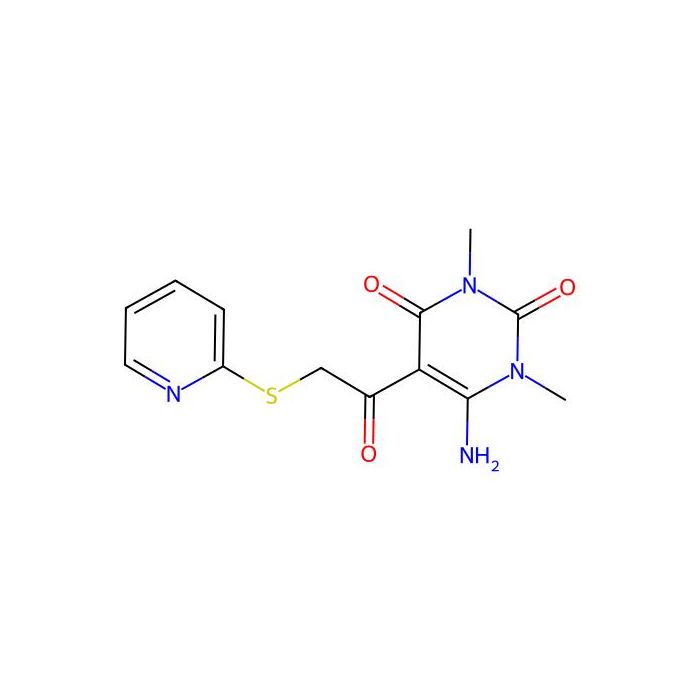
TM6089 is a unique Prolyl Hydroxylase (PHD) inhibitor which stimulates HIF activity without iron chelation and induces angiogenesis and exerts organ protection against ischemia. Local administration of TM6089 enhances angiogenesis, and oral administration stimulates HIF activity in transgenic rats expressing a hypoxia-responsive reporter vector.
Specifiche
Specifiche e purezza
10mM in DMSO
Meccanismi biochimici e fisiologici
TM6089 is a unique Prolyl Hydroxylase (PHD) inhibitor which stimulates HIF activity without iron chelation and induces angiogenesis and exerts organ protection against ischemia. Local administration of TM6089 enhances angiogenesis, and oral administration
Condizioni di conservazione di stoccaggio
Store at -80°C
Spedito in
Dry ice packs + Cold packs
Questo prodotto richiede spedizione a catena fredda. I servizi di terra e altri servizi economici non sono disponibili.
Nomi e identificatori
Isomeri SMILES
CN1C(=C(C(=O)N(C1=O)C)C(=O)CSC2=CC=CC=N2)N
PubChem CID
2352701
Peso molecolare
306.34
Dati avanzati
Certificati (CoA, COO, BSE/TSE e tabella di analisi)
C of A & Other Certificates(BSE/TSE, COO):
Analytical Chart:
Calcolatori di soluzioni
Molarity Calculator
Determine the necessary mass, volume, or concentration for preparing a solution.
Dilution Calculator
Determine the dilution needed to prepare a stock solution.
Reconstitution Calculator
Recensioni
Recensioni dei clienti
Application Protocols
No tested application protocols are provided for this item in the product data.
General guidance for screening compounds:
Compound handling: Allow to equilibrate to room temperature before opening cold shipments to avoid condensation. If solid, quickly weigh under low humidity; if solution, mix gently after thawing.
Plate preparation: Prepare intermediate DMSO dilutions and plate using calibrated liquid handlers. Include vehicle controls matched for final solvent content.
Data integrity: Track lot number, storage history, and freeze–thaw counts for each aliquot. Confirm identity/purity prior to critical studies.
Biological Roles
Item-specific note: No target, mode of action, or biological role is provided for TM6089 in the product data.
General guidance for small-molecule library members:
Treat as functionally uncharacterized unless otherwise disclosed. Avoid assuming target specificity or pathway involvement.
In discovery workflows, apply counter-screens for common assay interferences (e.g., redox cycling, aggregation, fluorescence quenching/inner filter effects).
If activity is observed, perform orthogonal assays, concentration–response confirmation, and basic physicochemical profiling (solubility, lipophilicity, chemical stability) to contextualize results.
Compliance reminder: For research use only; not intended for diagnostic, therapeutic, or other clinical applications.
Buffer Applications
Not typically applicable: TM6089 is a small organic compound and not a buffering reagent. Buffer selection will depend on the intended biological assay or analytical method.
Practical note:
When delivering TM6089 into aqueous buffers, evaluate compatibility in representative assay buffers (e.g., PBS, HEPES, Tris) with minimal DMSO or ethanol as cosolvent, ensuring the final organic content is within assay tolerance and that no precipitation occurs.
Green Alternatives
Applicability note: As a screening compound rather than a process solvent or common reagent, “green alternative” considerations mainly pertain to solvent handling during stock preparation and analytics.
Greener handling suggestions (general):
Prefer lower-toxicity, lower-VOC solvents where compatible with solubility and assay requirements (e.g., ethanol over methanol when feasible; water with minimal DMSO).
Minimize solvent volumes and employ microplate-based solubility screening to reduce waste.
Use LC–MS mobile phases with volatile buffers (ammonium formate/acetate) and optimize gradients to shorten runs and reduce solvent consumption.
Consolidate shipments and store long-term at −80°C to limit waste from stability losses.
Trade-offs:
DMSO remains the practical standard for library stocks due to broad solvency; greener options may not match its performance. Any substitution must be validated for solubility, compound stability, and assay compatibility.
Pharmaceutical Uses
No pharmacopeial status, excipient role, or formulation use is specified for this item. TM6089 is supplied strictly for research use only.
Context (general, non-clinical):
In early discovery, compounds of unknown profile may be utilized in in vitro assays or exploratory screening campaigns. Any preformulation or developability assessment (e.g., kinetic solubility, stability in biorelevant media) is beyond the scope of the current product data and should be executed under appropriate non-clinical research frameworks.
Physical Properties
Item-specific specification status:
Appearance: Not specified for this item; refer to CoA/Spec Sheet.
Melting/Freezing point: Not specified for this item; refer to CoA/Spec Sheet.
Boiling point: Not specified for this item; refer to CoA/Spec Sheet.
Density: Not specified for this item; refer to CoA/Spec Sheet.
Refractive index: Not applicable/Not specified for this item; refer to CoA/Spec Sheet.
pKa/logP/solubility: Not specified for this item; refer to CoA/Spec Sheet.
Practical guidance (general):
For small-molecule library members with unknown solvent profile, begin with DMSO solubility screening (e.g., 1–10 mg/mL) at ambient temperature, followed by co-solvent or aqueous compatibility tests if needed.
When physical constants are unavailable, determine a quick melting range (if solid) using micro-melting apparatus and assess thermal behavior by DSC/TGA as part of incoming QC.
Solubility profiling may be performed using miniaturized shake-flask in DMSO, MeOH, ACN, PBS (with 0.5–2% DMSO), and buffer at intended assay pH.
Note: Any numerical values not present above are not specified for this item and should be confirmed from the CoA/Spec Sheet or by in-house measurement.
Quality and Grades
Item-specific quality information:
Grade/Purity: Not specified for this item; refer to CoA/Spec Sheet.
Interpretation and guidance:
For screening library members, suppliers typically provide identity confirmation (e.g., LC–MS, 1H NMR) and a purity threshold (commonly ≥90% by HPLC/LC–MS) when applicable. Because this listing does not specify a grade, users should consult the CoA/Spec Sheet for exact purity methodology (HPLC vs. qNMR) and acceptance criteria.
If a stabilizer or counter-ion is present, it will be indicated on the CoA; absence of such information here means it is not specified for this item.
For bioassay reliability, verify purity and residual solvent profile upon receipt, especially if the compound will be used at low micromolar concentrations where impurities may influence outcomes.
Recommendations:
Request or download the lot-specific CoA to confirm assay method, purity, and identity.
If needed, perform in-house verification (orthogonal HPLC method, HRMS) and document storage history to maintain traceability for screening data.
Reaction and Applications
Not a typical synthetic reagent: TM6089 is cataloged within a small-molecule/compound library category and is primarily intended for research screening and discovery workflows rather than as a building block or reagent.
Research applications (general):
Assay development and primary screening: Preparation of DMSO stocks for target-based or phenotypic assays with appropriate controls and plate-mapping.
Orthogonal confirmation: Use multiple readouts (biochemical vs. cell-based) to deconvolute assay interference.
Analytical characterization: LC–MS and HPLC purity check prior to hit triage.
If used in chemistry contexts:
Without structure-specific information, no particular reaction families or named reactions can be recommended. Do not assume reactivity or functional-group compatibility. If structural data become available, reassess for derivatization or SAR expansion.
Reaction Conditions
Not applicable: TM6089 is not provided with functional-group data or intended use as a chemical reagent. Therefore, no reliable reaction conditions can be recommended.
Operational conditions for handling as a test article (general):
Stock preparation: Commonly 10–50 mM in dry DMSO, filter if necessary (0.2 µm PTFE) and store as aliquots at −80°C to minimize freeze–thaw. Verify concentration by UV (if chromophore) or quantitative NMR where appropriate.
Assay dilution: Titrate into assay buffer to a final DMSO content compatible with the system (often ≤0.5–1% v/v), confirming absence of precipitation.
All specific numeric conditions should be validated experimentally for TM6089.
Safety and Handling
Authoritative data source: Always consult the SDS for TM6089 before use.
GHS status (item-specific):
Signal word: Not specified for this item; refer to SDS.
Hazard statements (H-codes): Not specified for this item; refer to SDS.
GHS classification and pictograms: Not specified for this item; refer to SDS.
General laboratory precautions for small-molecule research compounds:
PPE: Laboratory coat, safety glasses, and appropriate chemical-resistant gloves (e.g., nitrile). Avoid skin contact and inhalation of dusts or aerosols.
Engineering controls: Handle in a certified chemical fume hood. Use ventilated enclosures for weighing powders.
Storage incompatibilities: Until structure-specific information is available, segregate from strong oxidizers and acids/bases as a precaution. Avoid light and moisture exposure unless otherwise indicated on the CoA/SDS.
First aid (overview): In case of contact, rinse affected area with water for ≥15 minutes and remove contaminated clothing. If inhaled, move to fresh air. Seek medical advice and provide the SDS.
Spill/cleanup: Avoid dust generation; absorb solutions with inert material. Dispose according to institutional and local regulations.
Special risks (general):
Unknown sensitization or toxicity profile—minimize exposure and avoid aerosolization. For cryogenic shipments, beware of cold-burn hazards when unpacking dry-ice shipments.
Solvent Selection
Applicability note: No structural or solubility data are provided for TM6089; solvent recommendations must therefore be general and verified experimentally.
General approach for small-molecule library members:
Primary solvent: DMSO is typically the first-choice solvent for preparing screening stocks (e.g., 10–50 mM), given its broad solvency and assay compatibility at ≤0.5–1% v/v in wells.
Secondary solvents for pre-dissolution or co-solvent systems: DMF, methanol, ethanol, or acetonitrile can be evaluated if DMSO solvency is limited.
Aqueous systems: If aqueous delivery is required, evaluate buffered media (e.g., PBS, HEPES) with small percentages of DMSO or ethanol as cosolvent and mild warming/sonication as needed.
Insoluble or unstable cases: Consider volatile vehicles (acetonitrile, methanol) for analytical work or formulate as micellar solutions with nonionic surfactants (e.g., 0.01–0.1% Tween 80) after confirming assay compatibility.
Selection criteria:
Match solvent to intended use (biological assay, analytical method, or synthetic step) and to any stability constraints revealed on the CoA/SDS (light, hydrolysis, oxidation). Validate by LC–MS to confirm no solvent-induced degradation.
Storage and Reconstitution
Item-specific conditions:
Storage: Store at −80°C (per product data).
Shipping: Shipped on dry ice packs + cold packs.
General best practices for small-molecule library members:
Upon receipt: Inspect for integrity and temperature compliance. Allow container to warm in a desiccator to prevent condensation before opening.
Aliquoting: If supplied as solid, aliquot promptly into moisture-tight vials. If supplied as solution (e.g., in DMSO), subdivide into single-use aliquots to minimize freeze–thaw cycles.
Reconstitution: Solvent is not specified for this item; refer to CoA/Spec Sheet. In absence of guidance, evaluate DMSO first, then alternative solvents (DMF, MeOH, EtOH, ACN) as needed. Use mild warming (≤40°C) and/or sonication to aid dissolution; avoid prolonged heating.
Stability: Protect from moisture, air, and light until stability is known. Record preparation date, solvent, and concentration on each aliquot.
Freeze–thaw: Minimize cycles; thaw on ice or at ambient temperature, mix gently, and refreeze promptly. Discard aliquots showing precipitation, discoloration, or anomalous LC–MS profiles.
Note: Any additional storage constraints (e.g., light sensitivity, desiccation requirement) are not specified for this item and should be confirmed on the CoA/SDS.
Structure and Identity
Brief: TM6089 (SKU T655850) is listed as a small-molecule library member; no structural identifiers beyond CAS/CID are provided in the item record.
CAS: 863421-32-3
PubChem CID: 2352701
InChIKey: Not specified for this item; refer to CoA/Spec Sheet.
SMILES: Not specified for this item; refer to CoA/Spec Sheet.
Molecular formula: Not specified for this item; refer to CoA/Spec Sheet.
Molecular weight: Not specified for this item; refer to CoA/Spec Sheet.
Structural features (general note):
No functional groups, ring systems, or stereochemical descriptors are available in the current product data. If structure is needed for cheminformatics or analytical confirmation, request the CoA/Spec Sheet or consult the referenced CAS/CID entry from authoritative databases.
2D description (general):
Without a provided SMILES or structure graphic, a 2D description cannot be given. Typical due diligence for library members includes verifying identity by LC–MS and 1H NMR against supplier reference spectra when available.
Synthetic Utility
Not applicable as a defined reagent: TM6089 lacks disclosed structure and functional groups in the item listing, so no synthetic transformations or named-reaction roles can be responsibly described.
General advice if derivatization is contemplated post-structure disclosure:
Map functional groups and liabilities (e.g., hydrolysis-, oxidation-prone motifs) and design protecting/derivatization strategies accordingly.
For SAR expansion, prioritize modular transformations that retain core scaffolds while varying vectors tied to potency/ADME hypotheses. Validate purity and identity after each step by orthogonal methods.
Target Specificity
No target, enzyme/receptor class, or binding profile is provided for TM6089. There are no item-specific data on species selectivity, off-targets, or mechanism in the current listing.
Domande frequenti
What documentation is provided?
Available product documentation, including Certificates of Analysis (COA), Safety Data Sheets (SDS), and specification sheets, is shown in the product document area. Document availability and access follow the current site policy.
Utilizziamo i cookie per garantire il corretto funzionamento del sito web e, ove consentito, per migliorare la tua esperienza. Puoi gestire le tue preferenze in qualsiasi momento nelle Impostazioni. Per saperne di più, consulta la nostra Cookie Policy.
Desidera che le inviamo un messaggio quando avremo sconti disponibili?
Ricordamelo più tardi
Grazie! Controlli la sua casella di posta per confermare.
Products are supplied to verified businesses, institutions, and qualified professionals for research and development use only. Not for use in humans, animals, diagnosis, or therapy.