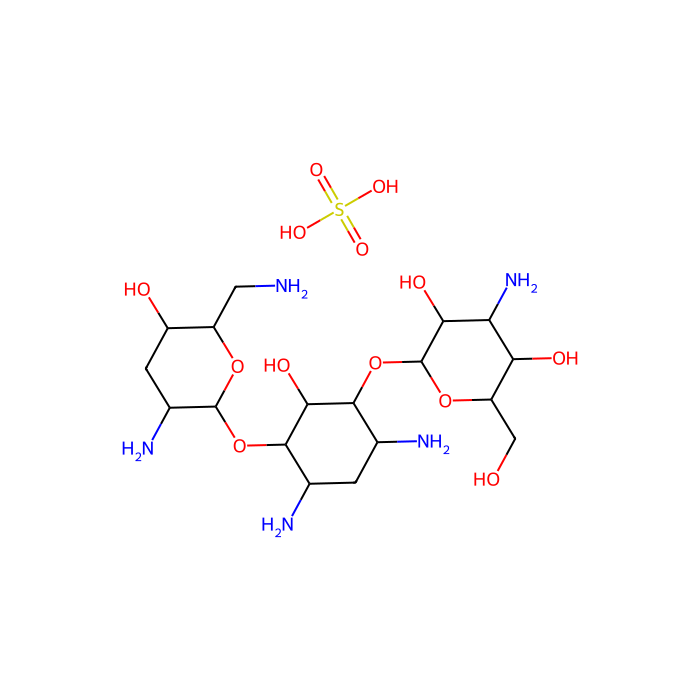
Determine the necessary mass, volume, or concentration for preparing a solution.
10mM in Water for sensitive chromatographic and analytical workflows requiring minimal baseline interference.
Store at -80°C Ships Dry ice packs + Cold packs Check lot-specific COA for exact specifications.
SDS, COA, datasheet, and spec sheet available for download. Lot-specific COA accessible via lot number lookup.
Cited in 3 peer-reviewed publications across chromatography, organic synthesis, and cross-coupling reactions.
product description:
Tobramycin Sulfate is a broad-spectrum antibiotic. It is effective against gram-negative bacteria. It especially potent against the Pseudomonas species.
Comprehensive hazard, handling, storage, and regulatory compliance document.
Download SDS →Lot-specific quality data. Enter your lot number to retrieve the exact COA.
Look up COA →Full quality attributes and acceptance criteria for this grade.
View spec sheet →Taxonomy Tree
| Kingdom | Organic compounds |
|---|---|
| Superclass | Organic oxygen compounds |
| Classe | Organooxygen compounds |
| Subclass | Carbohydrates and carbohydrate conjugates |
| Intermediate Tree Nodes | Aminosaccharides - Aminoglycosides - Aminocyclitol glycosides - 2-deoxystreptamine aminoglycosides |
| Direct Parent | 4,6-disubstituted 2-deoxystreptamines |
| Alternative Parents | O-glycosyl compounds Aminocyclitols and derivatives Cyclohexylamines Cyclohexanols Oxanes Organic sulfuric acids Monosaccharides 1,2-aminoalcohols Oxacyclic compounds Acetals Primary alcohols Organopnictogen compounds Organic oxides Monoalkylamines Hydrocarbon derivatives |
| Molecular Framework | Aliphatic heteromonocyclic compounds |
| Substituents | 4,6-disubstituted 2-deoxystreptamine - Glycosyl compound - O-glycosyl compound - Aminocyclitol or derivatives - Cyclohexanol - Cyclohexylamine - Sulfuric acid - Oxane - Cyclitol or derivatives - Monosaccharide - Organic sulfuric acid or derivatives - Cyclic alcohol - Secondary alcohol - 1,2-aminoalcohol - Oxacycle - Organoheterocyclic compound - Acetal - Primary amine - Organopnictogen compound - Primary aliphatic amine - Organic oxide - Alcohol - Organonitrogen compound - Organic nitrogen compound - Amine - Hydrocarbon derivative - Primary alcohol - Aliphatic heteromonocyclic compound |
| Descrizione | This compound belongs to the class of organic compounds known as 4,6-disubstituted 2-deoxystreptamines. These are 2-deoxystreptamine aminoglycosides that a glycosidically linked to a pyranose of furanose unit at the C4- and C6-positions. |
| External Descriptors | Not available |
Find and download the COA for your product by matching the lot number on the packaging.
| Lot Number | Certificate Type | Data | Oggetto |
|---|---|---|---|
| Certificate of Analysis | Aug 28, 2026 | T580543 |
| Peso molecolare | 565.600 g/mol |
|---|---|
| XLogP3 | |
| Hydrogen Bond Donor Count | 12 |
| Hydrogen Bond Acceptor Count | 18 |
| Rotatable Bond Count | 6 |
| Exact Mass | 565.227 Da |
| Monoisotopic Mass | 565.227 Da |
| Topological Polar Surface Area | 351.000 Ų |
| Heavy Atom Count | 37 |
| Formal Charge | 0 |
| Complexity | 690.000 |
| Isotope Atom Count | 0 |
| Defined Atom Stereocenter Count | 0 |
| Undefined Atom Stereocenter Count | 14 |
| Defined Bond Stereocenter Count | 0 |
| Undefined Bond Stereocenter Count | 0 |
| The total count of all stereochemical bonds | 0 |
| Covalently-Bonded Unit Count | 2 |
The following non-validated, literature-based procedures are provided as general guidance for research use. Optimize for your system.
Preparation of sterile stock solutions:
Use in microbial research assays (literature/general):
Biophysical binding studies:
LC/LC-MS quantification (literature):
Note: Concentrations and conditions above are typical literature ranges and not specifications for this item.
Literature/general overview of biological function (no clinical claims):
Note: The above roles describe biochemical mechanisms and laboratory research contexts and are not therapeutic claims. This product is supplied strictly for research use only.
This compound is not a buffering reagent and is not used to control pH. Consequently, classic buffer recipes and pKa-targeted buffer systems do not apply.
Practical notes for aqueous use (literature/general):
For detailed buffer composition and compatibility with your system, consult your assay protocol; this item does not serve as a buffer component.
This product is a bioactive aminoglycoside salt rather than a process solvent or reagent, so “green alternative solvent” frameworks do not directly apply. Environmental considerations focus on responsible use and disposal:
Considerations (general):
Comparison within class (literature/general):
No direct greener substitute is recommended for this specific active; optimize protocols to use minimal effective concentrations and volumes.
Contextual, non-clinical information (literature/general):
Important: This product is provided for research use only and is not intended for human or veterinary use, clinical applications, or diagnostic procedures.
Item-specific physicochemical specifications are not provided for this catalog entry. The following are general literature descriptors for tobramycin and its sulfate salt; they are not product specifications.
Notes for practical handling (general):
All numerical values and exact specifications for this item: Not specified for this item; refer to CoA/Spec Sheet.
Guidance on interpreting typical grades for this compound class (general):
Recommendation:
This compound is primarily used as a bioactive small molecule in research settings rather than as a synthetic reagent. Accordingly, “reaction applications” in an organic chemistry sense are limited. Relevant research applications (literature/general) include:
If you intend to derivatize or immobilize the molecule (e.g., for probe development), the multiple primary amines can undergo acylation, alkylation, or carbamate formation under mild aqueous-compatible conditions; however, such transformations are outside typical use and must be optimized to preserve the polyol/glycosidic integrity.
For classical named organic reactions or catalytic applications, this compound is not commonly utilized.
Classical reaction condition guidance is not directly applicable since this compound is not typically used as a reagent. For chemical modifications or conjugations (literature/general):
These are general literature guidelines for conjugation chemistry on aminoglycosides and are not specifications or validated procedures for this catalog item.
Authoritative safety information should be taken from the product SDS. The following are general laboratory precautions for aminoglycoside sulfate salts.
Tobramycin sulfate is a highly polar, polycationic small molecule salt. Solvent choice is therefore driven by ionic strength and hydrogen-bonding capability rather than by classical organic polarity scales.
Polarity/miscibility (literature/general):
Practical selection guidance:
Comparison (general):
Storage conditions (from Product Data):
Stability notes (general/literature, not product-specific):
Reconstitution (general guidance):
Packaging/containers:
For any specification not listed here (appearance, assay basis, salt stoichiometry, hydration), consult the CoA/Spec Sheet. Research use only.
Tobramycin sulfate is the sulfate salt of the aminoglycoside antibiotic tobramycin, supplied for research use only.
Item-specific identifiers (from Product Data):
Structural features (literature/general):
Molecular formula and molecular weight:
As a densely functionalized polyol/polyamine, tobramycin sulfate is generally not employed as a building block in routine organic synthesis. However, in specialized research contexts (literature/general):
Because the molecule contains multiple basic centers and glycosidic bonds, harsh basic or acidic conditions can cause degradation (deamination, glycosidic cleavage). Any synthetic manipulation should be performed under carefully controlled, mild conditions, and analytical verification (LC-MS, NMR in D2O) is recommended after each step.
This section typically applies to biological macromolecules such as antibodies or ligand-targeted probes with defined specificity. For a small-molecule aminoglycoside like tobramycin sulfate, target specificity data (clone, isotype, antigen, species reactivity) are not applicable.
General literature note: Tobramycin interacts with the bacterial ribosomal 30S A-site RNA; however, no antibody-style specificity parameters are defined for this product.